
How to Sleep in Extreme Heat Without AC
If you are trying to sleep in extreme heat without AC, the fastest useful strategies are body-first, not room-first: move air across bare or lightly damp skin, take a cool—not cold—shower before bed, reduce heat coming into the room during the day, and sleep lower in the home if you can. These methods help your body shed heat through evaporation and blood-flow changes; they do not make an overheated room safe by themselves. The European Insomnia Network’s practical heat-sleep recommendations put this kind of targeted cooling ahead of comfort tricks because sleep onset depends on the body’s ability to lower core temperature by roughly 1–2°F.[1]
That boundary matters. If you are pregnant, 65 or older, taking medications that affect sweating, hydration, heart rate, alertness, or heat response, or already feeling dizzy, confused, faint, nauseated, unusually weak, or unusually hot with worsening symptoms, do not keep testing hacks in bed. Get to a cooler place, call for help, or seek emergency care depending on symptoms. The CDC warns that heat exposure in any trimester is associated with preterm birth, stillbirth, and low birthweight, and it flags older adults as especially vulnerable because thermoregulation is blunted and many medications can impair heat response.[2][3]
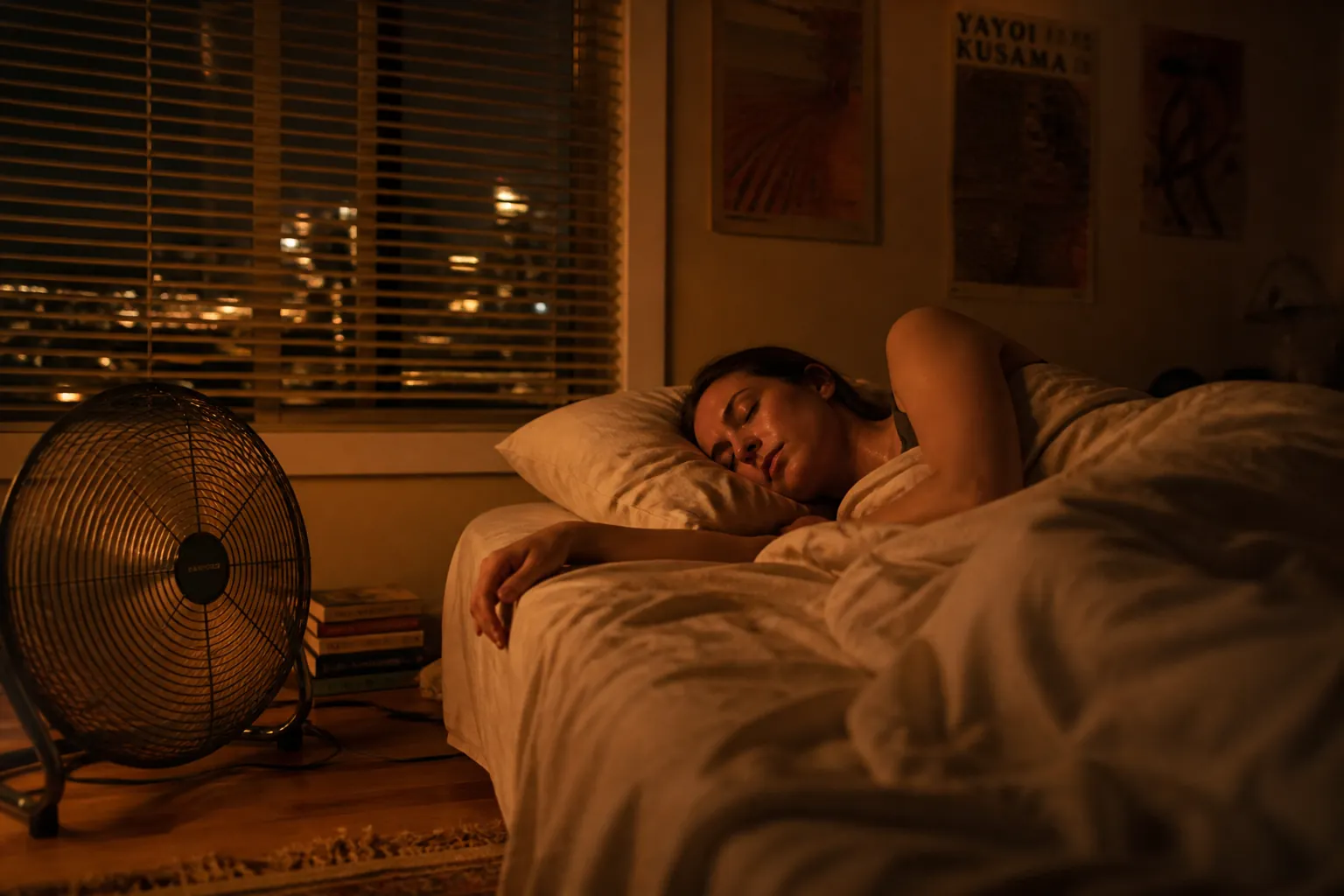
Why a hot bedroom keeps you awake
A hot room does not just feel unpleasant. It interferes with a basic sleep signal: the body needs to move heat from the core toward the skin and release it. When the air around you is already hot, still, or humid, that transfer slows. You can be exhausted and still lie awake because the body has not been able to start the thermal drop that normally helps sleep arrive.
Large sleep datasets show the effect is measurable. In a 2025 Nature Communications study using more than 23 million wearable sleep records from China, each 10°C rise in ambient temperature was associated with a 20.1% increase in the odds of insufficient sleep and a 2.82% decline in deep sleep.[4] That is strong evidence that hotter nights degrade sleep in a dose-dependent way, but it should not be stretched too far: the study population, Huawei wearable devices, housing conditions, and air-conditioning context are not the same as every U.S. bedroom.
A separate 2024 systematic review on ambient heat and sleep found that bedroom temperatures above roughly 25°C, or 77°F, are associated with poorer sleep.[5] That threshold is not a magic cliff. A healthy adult in dry moving air may manage one night above it better than an older adult in a humid top-floor apartment. But it is a useful warning line: once the room stays around or above that range, comfort advice becomes less important than whether your body can still lose heat.
The evidence-ranked order for cooling your body without AC
If you only have energy for a few changes tonight, use the ones that directly increase heat loss from skin. Room rearrangement, bedding swaps, and ice bowls may feel sensible, but they are slower and weaker unless they change airflow, evaporation, or heat load.
| Priority | What to do | Why it helps | When it can fail |
|---|---|---|---|
| 1 | Run a fan across bare or lightly damp skin | Increases convective and evaporative heat loss | Unsafe to rely on when indoor air is very hot; CDC warns fans can increase body temperature above about 90°F |
| 2 | Take a cool, not icy, shower before bed | Cools the skin and can trigger rebound blood flow that helps release core heat | Too-cold water can cause vasoconstriction and make rebound less useful |
| 3 | Use damp towels or wet cloths only in drier air | Evaporation pulls heat from skin or incoming air | High humidity slows evaporation and can add moisture without cooling |
| 4 | Sleep lower, block sun by day, reduce bedding heat | Cuts radiant and stored heat and makes body cooling easier | May not be enough during sustained heat, blackout conditions, or top-floor heat buildup |
1. Put moving air on skin, not just into the room
A fan helps most when it blows across exposed skin: arms, legs, neck, face if comfortable. Bare skin in moving air releases heat faster than covered skin in still air. If the air is dry enough, lightly damp skin increases the effect because evaporation carries heat away. This is the most practical rapid method in the European Insomnia Network guidance and aligns with emergency heat protocols that use water plus airflow to accelerate cooling.[1]
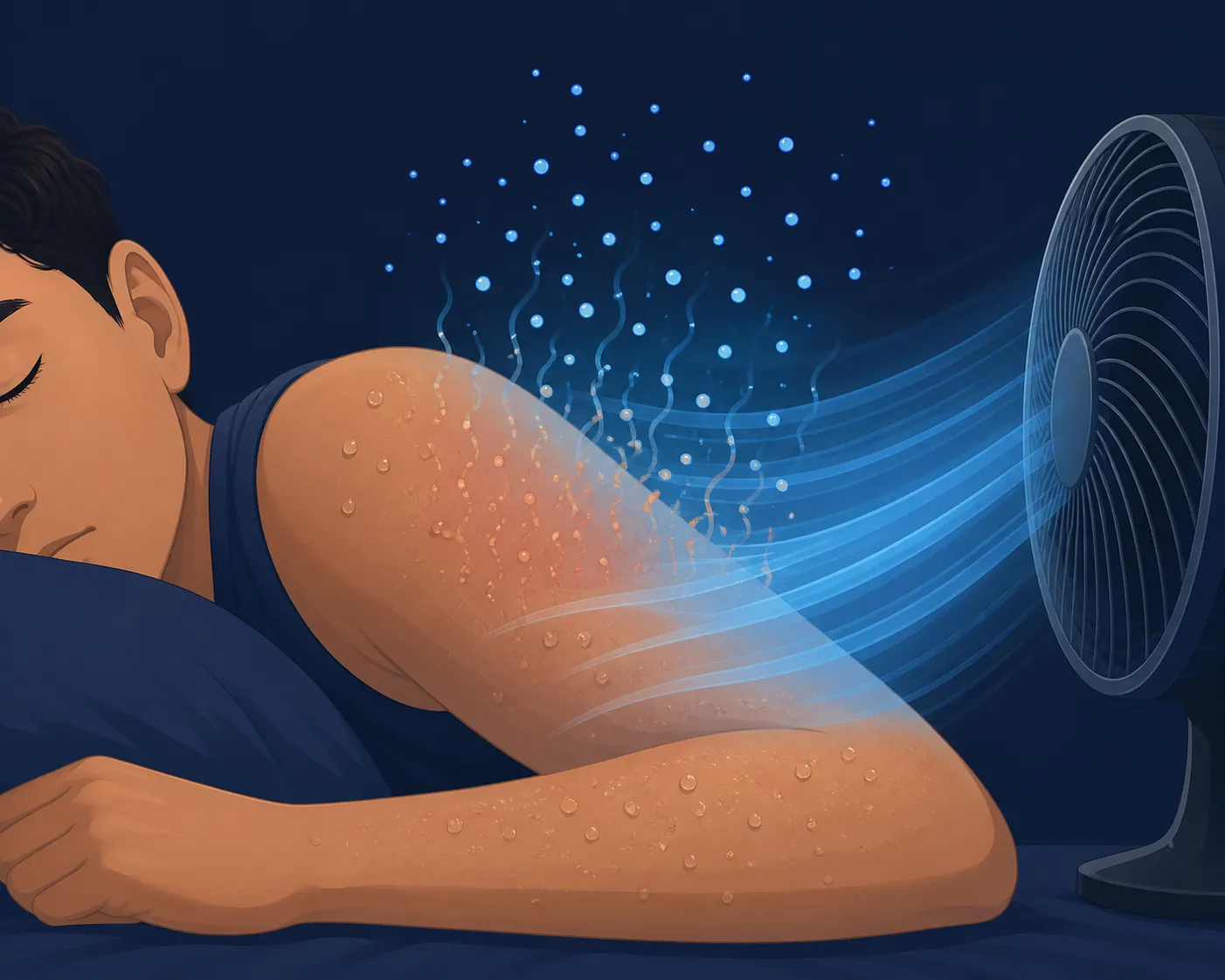
The simplest setup is a fan angled across the bed rather than straight at a wall or ceiling. Wear as little as is safe and comfortable. Use a thin cotton or linen sheet only if you need a cover. If you can tolerate it, wipe forearms, calves, or the back of the neck with a damp cloth, then let the fan pass over that skin. Do not soak the mattress or bedding; wet fabric that cannot dry becomes clammy, humid, and harder to cool through.
There is a hard limit. The CDC warns that fans may increase body temperature and should not be used as the main cooling source when indoor temperatures are above about 90°F.[3] That warning is often missed because fan advice is repeated as if airflow is always protective. It is not. When the air blowing over you is too hot, the fan can add heat faster than your body can shed it, especially if sweating is limited, humidity is high, or you are older, pregnant, dehydrated, ill, or taking medications that change heat response.
For a same-night sequence of body-first fixes—what to wet, where to place the fan, and how to set up the bed—use the no-AC tonight guide. The point here is the ranking: airflow is useful because it changes heat exchange at the skin, not because it magically cools an unsafe room.
2. Take a cool shower before bed, then let the rebound work
A cool shower can help more than a freezing one. The goal is to lower skin temperature without triggering a strong cold-defense response. Very cold water can constrict skin blood vessels, which temporarily pulls blood away from the surface. A cool shower is more likely to leave you with a useful rebound: skin vessels open again, warm blood moves toward the surface, and the body can dump heat into the surrounding air.[1]
Take it close enough to bedtime that the effect is still present, but not so late that you climb into bed dripping and turn the sheets humid. Dry lightly, leave skin slightly cool, and then sit or lie near moving air. If the bathroom itself is hot and steamy, ventilate it or step out quickly; adding steam to an already humid home makes evaporation harder.
This is also why an ice-cold blast right before bed is not automatically better. The sensation can be dramatic while the physiology is less helpful. You want the body to release heat, not protect it.
3. Use damp towels only when the air can actually evaporate them
A damp towel over a chair, near a window, or briefly on the body can help in dry heat because evaporation removes heat. In humid heat, the same towel may just make the room heavier and the bedding wetter. An HVAC expert interviewed by The Spruce gives a practical cutoff: damp-towel window cooling works best below about 60% relative humidity; above that, the towel adds moisture without much cooling and may contribute to mold problems.[6]
That 60% line is expert HVAC guidance, not a clinical sleep trial. Treat it as a practical room-condition rule. If you do not have a humidity reading, use what you can observe: if towels stay wet for hours, sweat sits on your skin, and the room feels sticky even with a fan, evaporation is already struggling. In that setting, prioritize getting to a cooler space over adding more damp fabric.
4. Lower the heat load before bedtime
The slower fixes still matter because they decide how much heat your body has to fight at night. Sleep on the lowest safe floor. Heat rises, and upper rooms often store radiant heat from the roof and walls. If the ground floor, basement, or a shaded interior room is cooler and safe, move the sleep setup there.
Block heat before it enters. Close blinds or curtains on sun-facing windows during the day. Open windows only when outdoor air is cooler than indoor air and security, air quality, and noise allow it. In a power outage, the same logic applies: reduce daytime heat gain first, then use body cooling once the room begins to cool. For outage-specific sleep and cooling decisions, see the power-grid emergency sleep tips.
Use breathable bedding because it removes one obstacle from the skin. Cotton and linen usually perform better than heavy synthetic bedding in heat because they trap less warmth and moisture. A cooling pillow or special sheet is secondary; it can help only if it does not block airflow or hold sweat against the body.
What only works in certain conditions
Opening windows is useful only when the outside is cooler, drier, or moving enough to improve heat loss. During a heat wave, outdoor air may stay hot long after sunset. If the room is cooler than outside, opening windows can make the bedroom worse. If outside air is cooler after midnight, cross-ventilation can help: open windows on opposite sides if safe, place a fan to move air through the room, and keep the bed out of direct hot airflow from walls or windows that radiated heat all day.
Ice near a fan can create a brief pocket of cooler air if you have ice, a stable container, and low enough humidity. It is not a dependable overnight safety strategy. The cooling fades as the ice melts, and in a humid room the extra moisture can work against evaporation from skin. If you use it, aim the fan so moving air still crosses your body; do not treat the ice bowl as the main intervention.
Sleeping on the floor may help if the floor level is actually cooler and clean enough to be safe. It is not worth a fall risk for an older adult, a late-pregnancy balance risk, or a pest, mold, or flooding exposure. A low mattress, couch, or temporary bed in a cooler room is often safer than improvising on a hard floor.
What to avoid on a dangerously hot night
- Do not rely on a fan as your main cooling source above about 90°F indoors. The CDC’s warning is especially important for older adults, but the principle applies broadly when heat and humidity overwhelm sweat evaporation.[3]
- Do not drink alcohol to “knock yourself out.” Alcohol fragments sleep, can worsen dehydration risk, and can make heat judgment worse. Heat already pushes sleep in the wrong direction; adding alcohol gives the body another problem to manage.[1]
- Do not keep adding damp towels in sticky air. If fabric is not drying, evaporation is not doing enough useful work.
- Do not take sedating medications, sleep aids, or extra doses outside your prescribed plan to force sleep through heat. If you use medications that affect alertness, sweating, blood pressure, heart rate, or hydration, ask a clinician or pharmacist how to handle heat events.
- Do not ignore a person who stops sweating, becomes confused, vomits, faints, has hot skin, or cannot cool down after moving to shade or airflow. That is no longer a sleep problem.
ADHD adults who take stimulant medications deserve a special note because generic heat advice often skips them. The heat-sleep guidance literature flags medication and neurodevelopmental conditions as an area needing more research, and the stimulant-specific risk picture is still more clinical-consensus than settled trial evidence.[1] The practical caution is still reasonable: if your medication affects appetite, thirst, sweating, heart rate, sleep timing, or your ability to notice body signals, do not wait until you feel severely ill to move to a cooler place.
Pregnancy, perimenopause, older age, and medications change the margin
The same bedroom can carry different risk depending on who is trying to sleep in it. Pregnancy raises the stakes because heat exposure in any trimester is associated with adverse birth outcomes in CDC clinical guidance.[2] If you are pregnant and the room stays hot despite airflow, a cool shower, and lighter bedding, the safer plan is to relocate to cooling earlier rather than spend the night proving endurance. For pregnancy-specific sleep and heat-safe options, use the pregnancy insomnia remedies guide or the pregnancy sleep problems guide.
Older adults may not feel heat danger as quickly, and common medications can interfere with sweating or cardiovascular adjustment.[3] A fan across damp skin can help while the air is within a safe range, but an older person alone in a hot apartment should not be left with a fan and a bottle of water as the whole plan. Check-ins, transport to a cooling center, and medication-aware planning matter.
Perimenopause can add night sweats and vasomotor symptoms to an already hot room. The method hierarchy stays the same—skin cooling, airflow, heat blocking—but timing and bedding choices may need to account for sweat surges and awakenings. For that more specific protocol, see the perimenopause no-AC heat-wave guide. For the broader physiology of why heat waves hit life stages differently, use the heat-wave sleep science explainer.
When to stop managing the night at home
Stop trying to sleep it off if cooling steps are not changing how your body feels. A room can be “managed” only while the body can still shed heat. If you are lying in front of a fan, damp skin is not drying, your pulse feels unusually high, you feel weak or lightheaded, or you keep getting hotter after a cool shower, the setup is failing.
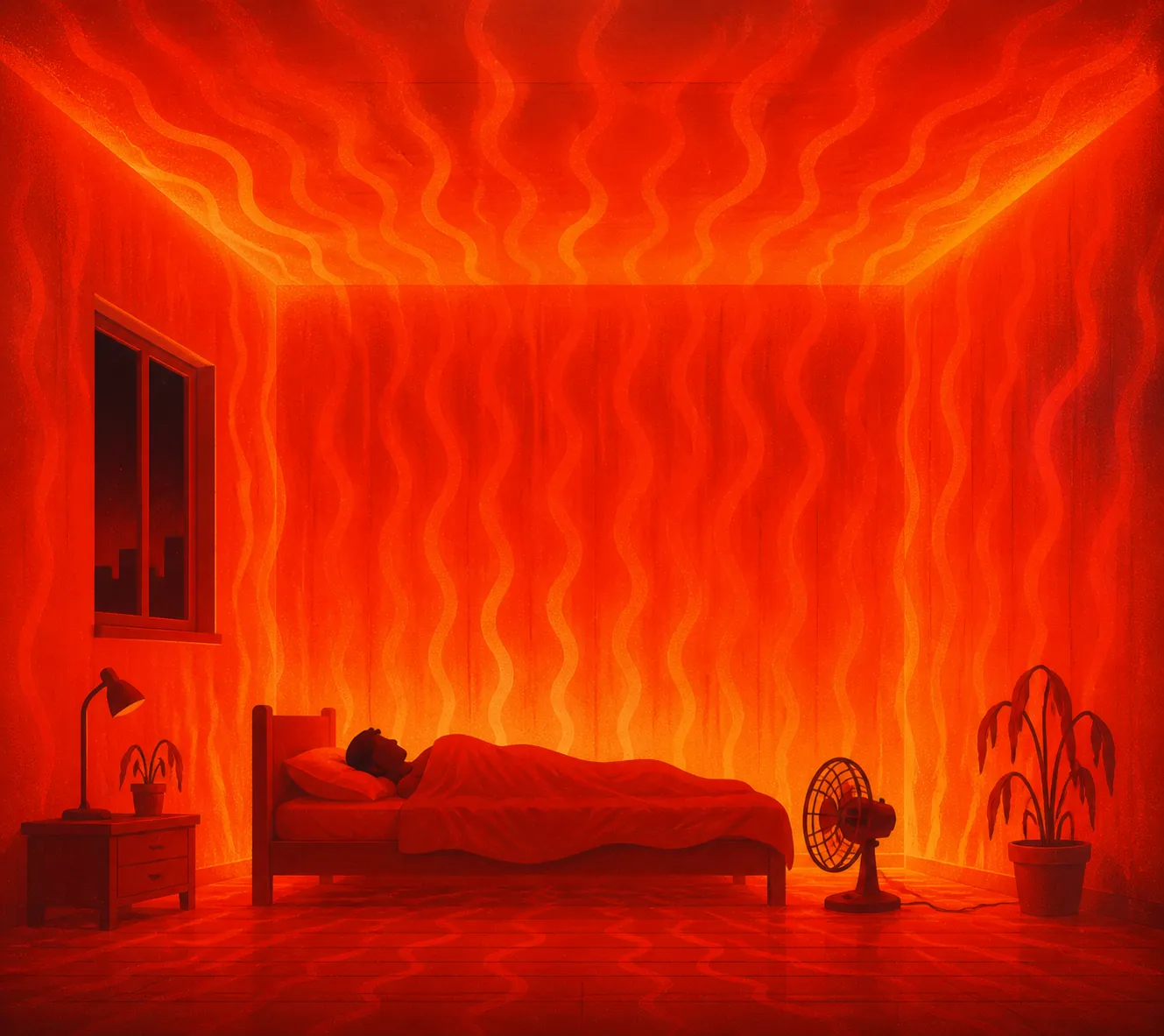
Public-health guidance for people without air conditioning repeatedly comes back to the same escalation point: use cooling centers, libraries, public buildings, shaded community spaces, or another cooled location when home cooling is not enough, especially for people at higher risk.[7][8] This can feel like an overreaction when the goal was only to get through the night. It is not. Sleep loss is one problem; heat illness is another.
Call emergency services if someone has signs of heat stroke or severe heat illness: confusion, loss of consciousness, seizure, repeated vomiting, very hot skin, collapse, or symptoms that worsen despite moving to a cooler place. Do not wait for sleep to arrive. Do not wait for morning.
No-AC cooling works while airflow, evaporation, blood-flow rebound, and heat blocking are enough to let the body release heat. Once the room, humidity, health status, or symptoms overwhelm that system, the correct sleep strategy is to get to cooling, not to optimize another trick.
References
- Dealing with sleep problems during heatwaves: practical recommendations from the European Insomnia Network, Journal of Sleep Research, 2023
- Clinical Overview of Heat and Pregnant Women, Centers for Disease Control and Prevention
- Heat and Older Adults (Aged 65+), Centers for Disease Control and Prevention
- Ambient temperature and sleep health: evidence from 23 million wearable sleep records in China, Nature Communications, 2025
- The effect of ambient temperature on sleep: A systematic review, Sleep Medicine Reviews, 2024
- Does Hanging a Damp Towel in a Window Actually Cool Down a Room? We Asked an Expert, The Spruce
- Extreme summer heat without air conditioning, NPR, July 15, 2026
- How to stay cool and safe in a heat wave even without air conditioning, PBS NewsHour