
How Hot Is Too Hot to Sleep Safely?
An uncomfortable hot bedroom and an unsafe hot bedroom are different problems. The practical answer is this: if the room is merely too warm for good sleep, cool your body and the room. If the room stays hot enough that your body cannot recover, symptoms appear, a fan is your only cooling in very hot indoor air, or the sleeper is older or medically vulnerable, stop treating the night as a sleep problem. Move to a cooler place or get help.
Last reviewed: July 31, 2026. Evidence tier: public-health guidance plus observational sleep research and systematic-review evidence. This is informational only and is not a substitute for emergency care, local heat alerts, or medical advice for your medications or health conditions.

For ordinary sleep, one source-reported range puts an ideal bedroom at roughly 60–72°F, with sleep disruption becoming more likely above about 75°F.[1] Those numbers are not personal safety guarantees. A healthy adult may tolerate a bad night in the upper 70s better than an older adult tolerates a bedroom that never cools down after several hot days.
The more important heat-wave number is the overnight low. UK and European weather discussions often call a night that does not fall below 20°C — 68°F — a “tropical night,” because the body gets less overnight recovery from daytime heat.[2] In US terms, think of it less as jargon and more as a warning: when the night stays around 68–70°F or higher outside, many homes do not get a real cool-down window indoors.
That matters most for adults 65 and older, people with chronic conditions, people taking multiple medications, and anyone who may not wake up or respond clearly when heat illness begins. In a 2017 analysis using self-reported BRFSS sleep data, Obradovich and colleagues found that adults 65 and older lost nearly twice as much sleep as younger adults on warm nights, and low-income older adults experienced much larger summer sleep losses.[3] A 2024 systematic review also found that people do not appear to adapt quickly to hot nights, which is why “I’ll get used to it” is not a safety plan during a heat streak.[4]
People in perimenopause, caregivers of older adults, and households with layered vulnerabilities may need the stricter version of this protocol from the start. For more on who loses sleep during heat streaks, see who loses the most sleep in heat and hot-weather sleep disruption in perimenopause.
Classify the night before you try to sleep through it
Use an indoor thermometer if you have one. The outdoor forecast can understate the problem in an apartment, upstairs bedroom, mobile home, or top-floor room that stored heat all day.
| Tier | What it looks like | What to do |
|---|---|---|
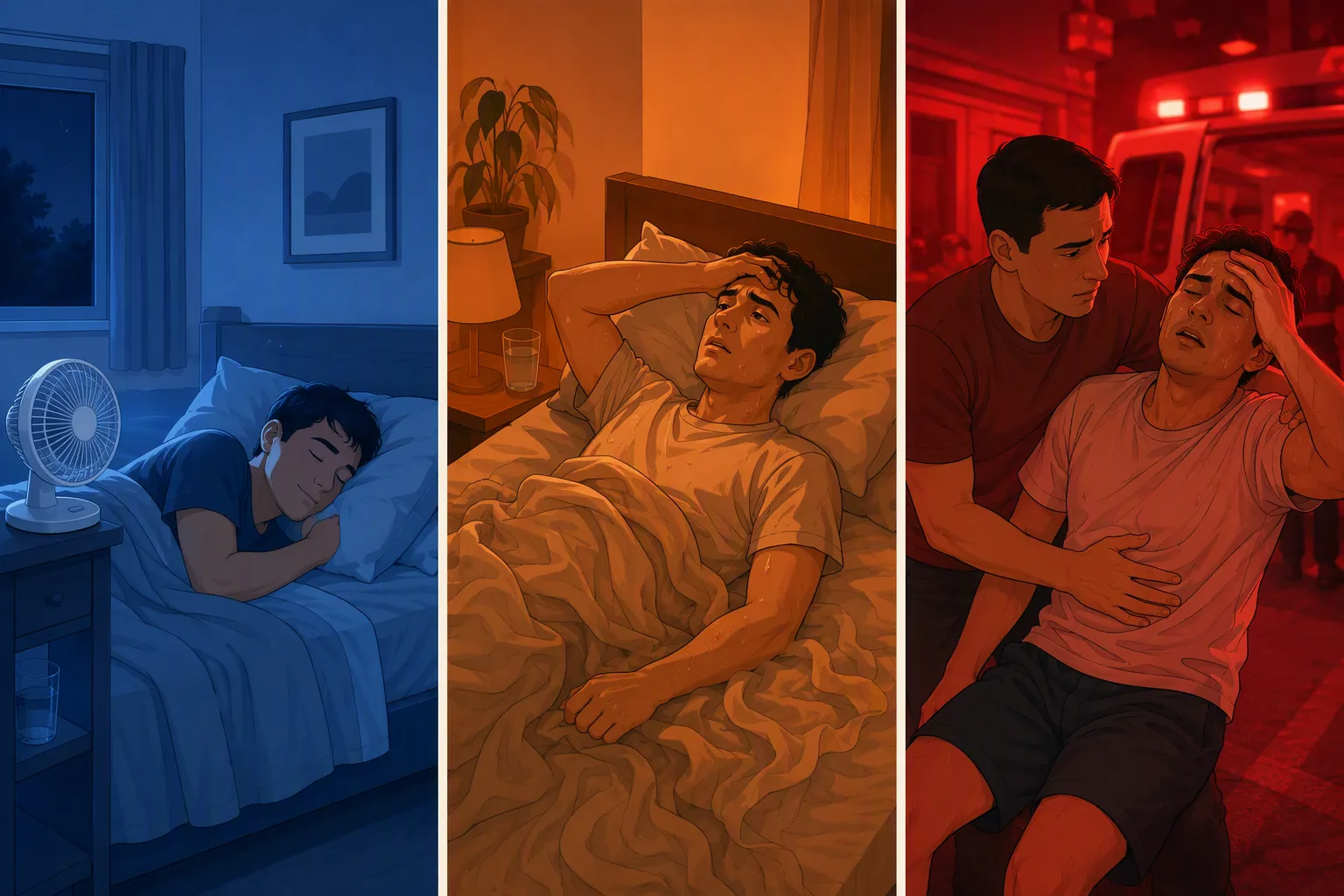
| Manageable hot night | The room is warmer than your preferred sleep range or above about 75°F, but the sleeper is alert, drinking normally, sweating normally, and the room is cooling with outdoor air or another reliable method. | Use basic cooling steps. Recheck the room and the sleeper before bed and again if they wake up hot. |
| Unsafe night | The room stays hot for hours, the outdoor low is around 68–70°F or higher, the sleeper is 65+ or medically vulnerable, symptoms appear, or a fan is the main cooling method while indoor air is near or above 90°F. | Stop trying to sleep. Move to the coolest room, a cooler building, a friend’s home, a hotel, or a cooling center. Caregivers should check directly, not by text only. |
| Emergency | There is confusion, fainting, collapse, seizure, inability to stay awake, or a measured core temperature at or above 104°F with mental-status change. | Call 911. Start cooling while waiting. Do not give fluids to someone with suspected heatstroke who has altered mental status or cannot drink safely. |
If a vulnerable sleeper is involved, move one tier stricter. A “manageable” room for a healthy adult can be an unsafe room for someone who is older, dehydrated, living with heart or kidney disease, taking medications that affect heat tolerance, or unable to recognize early symptoms. CDC guidance flags older adults as higher risk during heat and advises caregivers to plan ahead for hot days, check on them, and use local cooling resources such as 2-1-1 when needed.[5]
Why night is the dangerous part of a heat wave
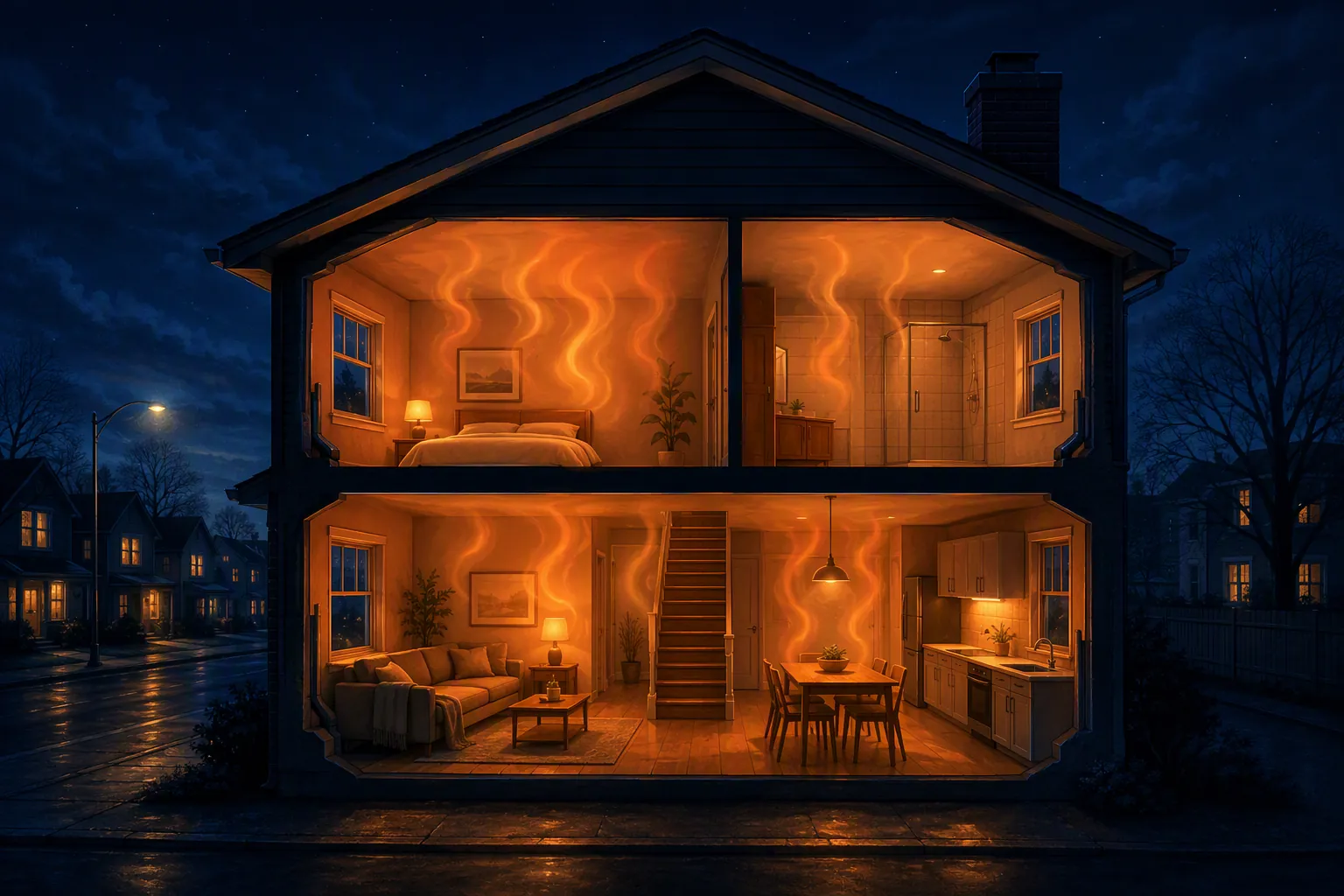
A bedroom can stay dangerous after sunset because walls, roofs, pavement, and upper-floor rooms release stored heat slowly. The outdoor temperature may fall; the bed, walls, and indoor air may not. That is why the overnight low matters. If the forecast never gives your home a cooler recovery window, the second or third night can be worse than the first even when the afternoon high looks similar.
Sleep also removes the early-warning system. A person who is awake can notice dizziness, nausea, headache, weakness, heavy sweating, cramps, or a racing pulse and decide to move. A person who finally falls asleep in a hot room may not wake up at the point when cooling would still be simple. That is the reason to make the decision before bed, not at 3 a.m. after symptoms have already started.
For comfort-focused cooling ideas, use the heat-wave sleep safety quick FAQ. This article is narrower: it is for deciding when the night has crossed from miserable to unsafe.
Tier 1: hot but still manageable
A manageable hot night still deserves attention. Above about 75°F, sleep may fragment, and sweating can make you wake more often.[1] But if the sleeper is a healthy adult, the room is gradually cooling, there are no heat-illness symptoms, and you have a way to cool the body, the next step is practical cooling rather than emergency escalation.
- Move to the lowest, coolest room available, especially if the bedroom is upstairs.
- Use lightweight bedding and sleepwear; remove heat-trapping mattress toppers if they are making the bed feel warmer.
- Drink water before bed if you can do so safely, but avoid forcing large amounts of fluid late at night.
- Use cool cloths, a lukewarm or cool shower, and shaded or cross-ventilated windows if outdoor air is cooler than indoor air.
- Set a check-in point: if the room is not cooling, symptoms begin, or an older or medically vulnerable person is involved, move to Tier 2.
Keep the comfort tricks in proportion. Frozen pillowcases, ice packs near a fan, or chilled socks may make a few minutes feel better, but they do not make a dangerously hot room safe. For a fuller room setup, use the sleep environment temperature guide; for claims that sound too confident, see heat-wave sleep myths and alternatives.
Tier 2: the unsafe night, where waiting is the mistake
This is the tier most people underreact to. The room is not yet an obvious emergency, but the conditions are stacked against recovery: the house has held heat for hours, the outdoor low will not fall enough to flush the room, the sleeper is older or medically vulnerable, or the only cooling method is a fan moving hot indoor air.
CDC and National Weather Service guidance warn that fans are not enough when indoor temperatures are very hot; the practical CDC/NWS cutoff used here is 90°F indoors, above which fan use can raise body temperature rather than safely cool it.[6][7] Other public guidance has used higher caution points, including roughly 95°F and 104°F, and recent controlled chamber studies in adults over 65 suggest fans may help in humid heat but worsen strain in very dry heat. Those are not real-world apartments with unknown hydration, medication effects, and limited supervision. Treat the uncertainty conservatively: a fan can be a comfort tool, not the reason to keep a vulnerable person in a hot room.
At Tier 2, the action is relocation or active cooling with supervision. Do not spend another hour trying to “settle down” in the same room. Move to an air-conditioned lobby, library, community center, cooling center, house of worship, friend’s home, hotel, or emergency-designated site. If transportation is the barrier, call local non-emergency services, 2-1-1 where available, or a nearby person who can drive. If the heat is extreme enough that you are weighing whether the home is safe at all, use the no-AC power-outage stay-or-leave guide.
Symptoms also move the night into Tier 2 even if the thermometer looks less dramatic. Heavy sweating, weakness, dizziness, nausea, headache, cramps, or unusual fatigue are reasons to cool down now and have another person monitor the sleeper. If symptoms improve quickly after cooling and hydration, continue monitoring; if they worsen, do not keep troubleshooting in the bedroom.
For caregivers: check the person, not just the thermostat
A text that says “I’m fine” is not enough for an older adult in a hot apartment. Drowsiness, embarrassment, confusion, hearing problems, and a desire not to bother anyone can all hide risk. If you are the adult child, neighbor, or caregiver, ask concrete questions: What does the indoor thermometer say? Are you sweating? Dizzy? Nauseated? Can you stand and walk normally? Have you urinated recently? Is the bedroom still hot after sunset? Do you have a cooler place you can get to tonight?
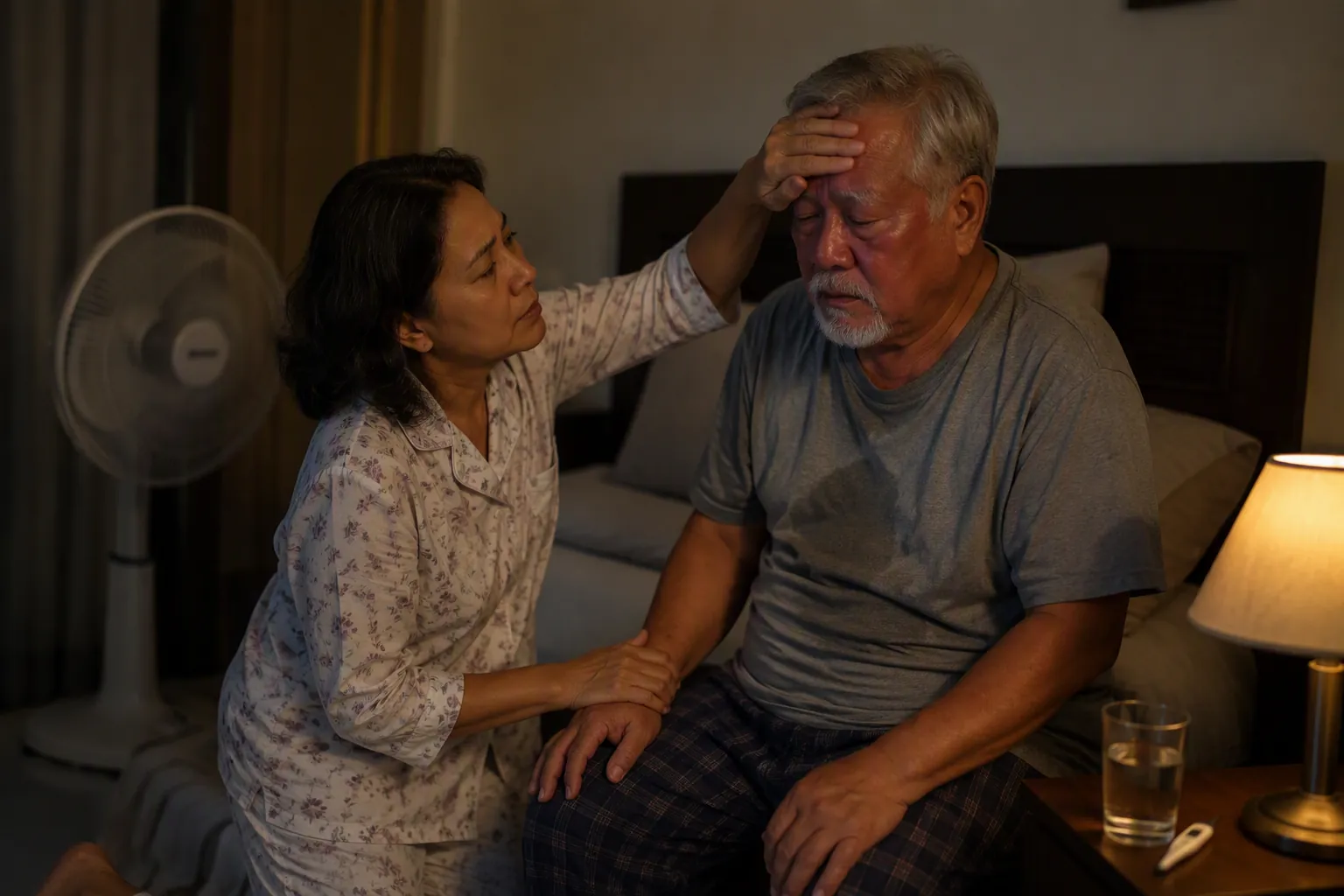
If the person has chronic conditions or takes medications, do not tell them to stop medication abruptly because of heat. The safer move is planning: use HeatRisk or local alerts before orange or red heat days, confirm transportation, identify the nearest cooling site, and make sure the person can get there before bedtime if the apartment will not cool. CDC guidance for older adults specifically emphasizes advance planning, regular checks, and using local cooling resources.[5]
For life-stage and caregiver routing during prolonged heat patterns, see sleep tips for Super El Niño heat waves and vulnerable households. If the forecast is near 110°F or the home has no realistic cool room, go directly to the extreme-heat escalation guide rather than trying to adapt ordinary sleep advice.
Tier 3: when 911 replaces home cooling
Heatstroke is an emergency. Mayo Clinic defines heatstroke as a core body temperature of 104°F or higher, usually with central nervous system changes such as confusion, agitation, slurred speech, irritability, delirium, seizures, or coma.[8] In a bedroom, you usually will not have a reliable core-temperature measurement. Do not wait for one if mental status changes.
- Call 911 if the person is confused, fainting, collapsing, having a seizure, unable to stay awake, or not acting like themselves in a hot environment.
- Move them to the coolest available place while waiting, if you can do so safely.
- Remove excess clothing and start active cooling with cool cloths, misting, fanning with cooler air, or ice packs at the neck, armpits, and groin if available.
- Do not give fluids to someone with suspected heatstroke who is confused, unconscious, vomiting, or unable to drink safely; the Red Cross specifically warns against giving fluids in that scenario.[9]
- Keep cooling until emergency help arrives unless responders tell you otherwise.
The hard line is mental status. A sweating, miserable, fully alert person may still be in a preventable stage. A confused or collapsing person in a hot room is no longer deciding between cooling hacks. They need emergency help.
A quick decision rule before bed
Before you lie down, answer four questions. Is the room actually cooling? Will the outdoor low give the home a recovery window? Is the sleeper older, medically vulnerable, taking multiple medications, dehydrated, pregnant, alone, or unable to leave without help? Are there any symptoms already?
If the answers are reassuring, use basic cooling and check again if you wake. If the room is still hot, the night will not cool, the person is vulnerable, or symptoms have started, leave the bedroom for a cooler place. If mental status changes, fainting, seizure, collapse, or inability to drink safely appears, call 911. At that point the task is not to sleep better; it is to get cooled, get out, or get emergency care.
References
- Too Hot to Sleep? Here’s Why and What You Can Do — Sleep.com
- Understand tropical nights and their impact — Met Office — 2025
- Nighttime temperature and human sleep loss in a changing climate — PMC — 2017
- The impact of heat on sleep health: A systematic review — PubMed — 2024
- Heat and Older Adults (Aged 65+) — CDC
- About Heat and Your Health — CDC
- During a Heat Wave — National Weather Service
- Heatstroke - Symptoms and causes — Mayo Clinic
- Extreme Heat Safety — American Red Cross
Read the full guide: How to Sleep Safely When Heat Index Hits 115°F