
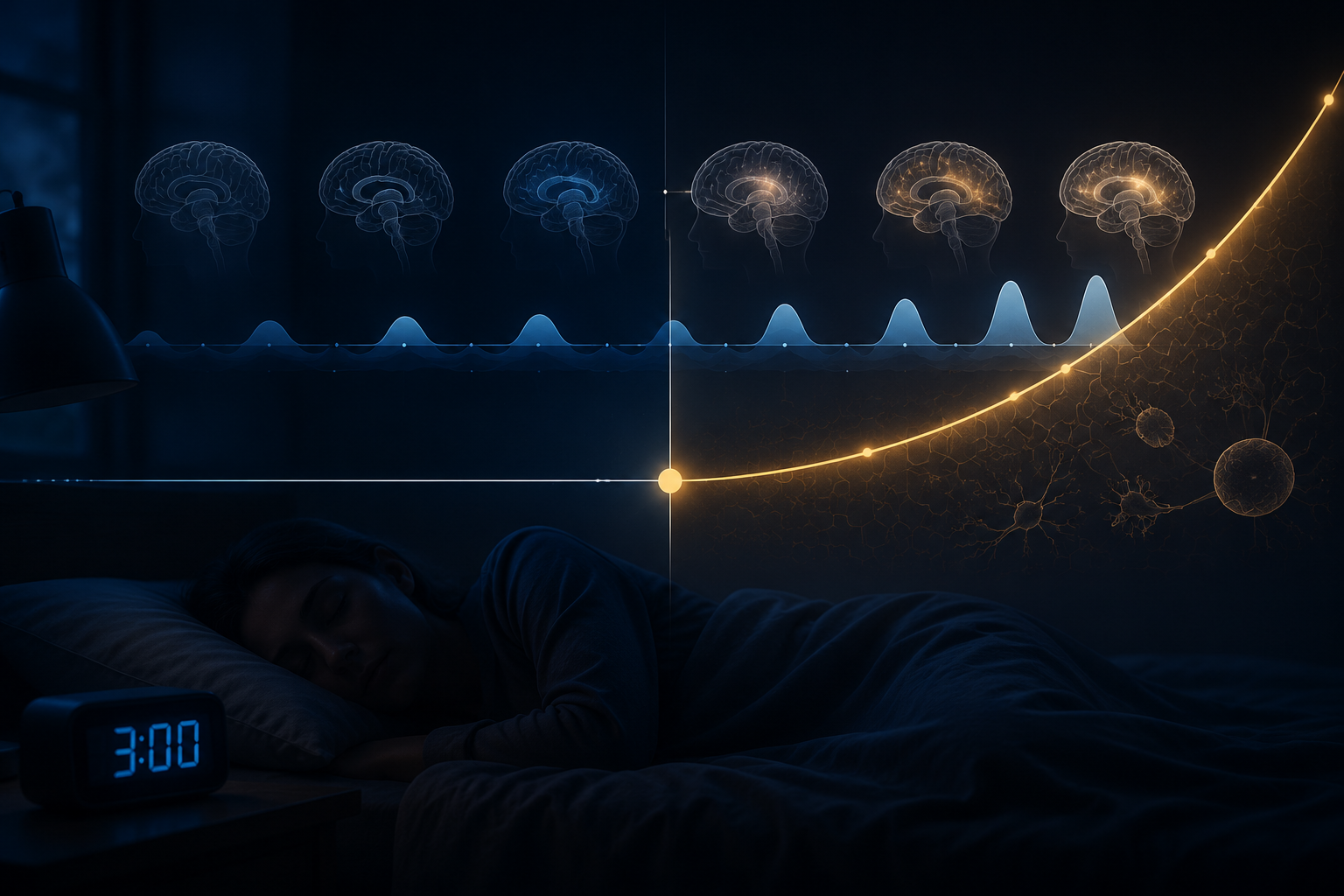
Waking up at 3am every night usually feels too precise to be random. The short answer is that 3am often lands in a vulnerable part of the night: sleep has become lighter and more REM-heavy, while cortisol is beginning its normal early-morning rise. That combination can make a brief arousal easier to notice, especially if your stress system is already on alert.
That does not mean 3am has a special supernatural meaning, and it also does not mean nothing is happening. It means ordinary sleep biology is becoming noticeable. For many people, the same process creates only a tiny awakening they never remember. For others, it becomes a full, frustrating wake-up: eyes open, mind online, heart a little too present, clock glowing back at them.
Why 3am Is a Fragile Part of the Night
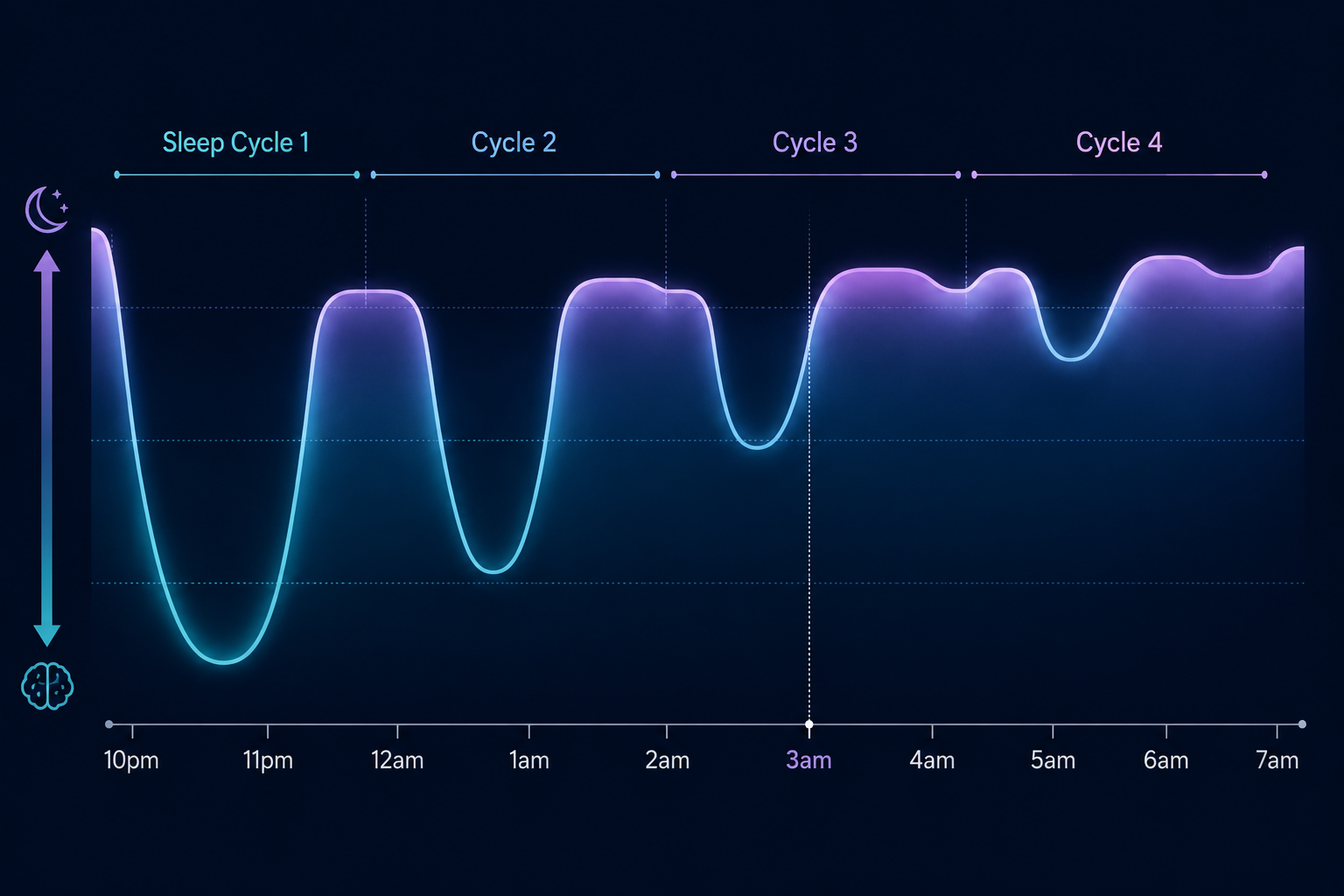
Sleep is not one long, even state. Adults move through repeating sleep cycles that last about 90 minutes, with deeper non-REM sleep more concentrated earlier in the night and more REM sleep appearing later.[1][2] If you fall asleep around 10:30 or 11pm, 3am often arrives after two or three cycles. By then, your sleep is typically less deep than it was near midnight.
REM sleep is not “bad” sleep. It is normal, necessary sleep. But it is also a lighter, more internally active stage than deep non-REM sleep. Your brain is doing more. Dreams are more likely. Body temperature, breathing, and autonomic activity can fluctuate. A sound, a bladder signal, a worry, reflux, a bed partner moving, or a small rise in physiological arousal has a better chance of breaking through.
At the same time, your circadian system is preparing the body for morning. Cortisol, a hormone involved in alertness and energy regulation, begins rising in the early morning hours as part of the normal daily rhythm. The cortisol awakening response is usually measured as a rise after waking, with primary literature describing increases in the range of about 38% to 75% after awakening.[3] The important point is not that cortisol “spikes” at 3am. It is that the body’s alerting system is gradually moving upward before the day begins.
Put those two processes together and 3am starts to make sense. Sleep is lighter. REM is more common. The body’s morning chemistry is beginning to lift. A person who slept through a similar signal at midnight may wake fully from it at 3am.
A Brief Awakening Is Not the Same as an Insomnia Pattern
Everyone wakes during the night. Most awakenings are short enough that they disappear from memory. You shift position, register the room, maybe surface for a few seconds, then fall back under. That kind of arousal is part of normal sleep architecture, not proof that your sleep is broken.
Middle-of-the-night waking is also common. Sleep Foundation, citing National Health and Nutrition Examination Survey data, reports that 35.5% of U.S. adults wake in the middle of the night on three or more nights per week.[4] That number is useful because it removes some of the isolation from the experience. It does not, by itself, tell you whether your own pattern needs attention.
The boundary is less about the clock and more about what happens after you wake. A few minutes awake, no distress, and no next-day impairment is different from lying awake for 30 minutes or more on repeated nights, watching the hour become something you dread. If that second description fits, the pattern has moved closer to sleep maintenance insomnia than to harmless sleep-stage awareness.
Why Some People Wake Fully Instead of Rolling Over
The useful question is not only “Why did I wake?” It is “Why did this small arousal become a full awakening?” That threshold is different from person to person and from month to month.
Stress is one reason, but the word is too blunt unless it is connected to timing. In the second half of the night, the body is already closer to waking. If your nervous system is carrying unresolved threat, deadlines, grief, caregiving pressure, conflict, or rumination, the normal early-morning rise in alerting signals may be enough to push you over the line. Research has found that people with insomnia can show an earlier and steeper cortisol rise compared with good sleepers, which supports the idea that hyperarousal changes how the normal morning ramp is experienced.[5]
This is why some people describe the wake-up as immediate mental activity rather than gradual awareness. They are not calmly noticing that they are awake. They open their eyes already thinking. The grocery list, the medical bill, the unfinished conversation, the work problem, the fear of not falling back asleep: all of it arrives too quickly because the brain has treated wakefulness as relevant.
Sleep reactivity matters here. Sleep reactivity describes how strongly stress disrupts a person’s sleep. People with higher sleep reactivity are more likely to have sleep disturbed by stress, rumination, and arousal; Sleep Foundation notes that it tends to be higher in women and in people with certain genetic tendencies.[6] Two people can have the same difficult week and the same 3am REM-rich window. One sleeps through it. The other wakes and stays awake.
For readers who recognize the “awake and wired” version of the pattern, the deeper issue may be the conflict between nighttime anxiety and the body’s alerting chemistry. That mechanism is covered more directly in why anxiety gets worse at night.
How the Clock Time Can Become Learned
A 3am wake-up can begin for an ordinary reason: a stressful month, alcohol too close to bed, a hot room, perimenopause symptoms, a newborn, an illness, a medication change, late meals, or a run of early work alarms. The original trigger may fade. The wake-up can remain because the brain has learned the pattern.
Conditioned insomnia is not imaginary sleep trouble. It is learning. If you repeatedly wake at 3am and then spend that hour monitoring the clock, calculating lost sleep, trying hard to force sleep, or bracing for the next day, the bed and the hour become linked with effort. Eventually, 3am is no longer just a vulnerable biological window. It is a cue.
This helps explain the cruel precision people report: “I wake at 3:07 almost every night.” The body may have started the pattern, but attention and fear can keep rehearsing it. The more meaning the brain assigns to that moment, the more wakefulness has to work with.
Other Causes Can Overlap With the 3am Window
The sleep-cycle and cortisol explanation is often enough to explain the timing, but it is not the only possible cause of waking at 3am. Some awakenings are driven by other body signals that become easier to notice during lighter late-night sleep.
- Blood sugar changes can wake some people, especially when late meals, alcohol, diabetes, or glucose-regulating medications are involved.
- Perimenopause and menopause can fragment sleep through hot flashes, temperature shifts, and hormonal changes.
- Sleep apnea can cause repeated arousals through breathing interruptions, sometimes without the person realizing breathing is involved.
- Alcohol can make the first part of the night feel heavy while worsening sleep fragmentation later.
- Pain, reflux, nocturia, medications, and caregiving interruptions can all become more noticeable in lighter late-night sleep.
Those possibilities matter most when the awakening comes with a specific physical clue: sweating, gasping, chest discomfort, frequent urination, reflux, pain, shakiness, or a medication change. In those cases, 3am may still be the window when you notice the problem, but not the whole explanation for why it is happening.
Why Generic Sleep Hygiene Often Feels Unsatisfying
Advice like “avoid screens,” “keep a regular bedtime,” and “make the room dark” is not useless. It is just often too broad for someone asking a timing question. If you are waking at the same hour despite doing the obvious things, the issue may not be a lack of discipline. It may be that your arousal threshold is too low during the lightest, most REM-rich part of the night.
That is the point where the better question becomes more specific: what is making the 3am arousal memorable? Stress physiology, conditioned wakefulness, alcohol timing, sleep apnea, hot flashes, pain, or circadian irregularity would not call for the same response. For readers who have already cleaned up the basics and still wake predictably, the limits of sleep hygiene are worth taking seriously.
If you want the biology underneath this timing, the companion explanations on sleep architecture and circadian rhythm mechanisms go further into why the night changes shape as morning approaches.
When 3am Waking Deserves More Attention
A 3am awakening is usually not alarming on its own. It deserves closer attention when it becomes frequent, prolonged, distressing, or costly the next day. The clock time is less important than the pattern around it.
- You wake in the middle of the night on three or more nights per week.
- You are awake for about 30 minutes or longer after waking.
- You begin dreading the wake-up before you fall asleep.
- You feel unrefreshed, sleepy, irritable, or less functional during the day.
- The awakening comes with gasping, chest symptoms, severe sweating, pain, or other new physical symptoms.
In the milder version, 3am waking is normal biology becoming briefly visible. In the more persistent version, the same biology is meeting a nervous system, body signal, or learned sleep pattern that keeps you awake. That difference is the part worth paying attention to.
References
- Stages of Sleep, Sleep Foundation, https://www.sleepfoundation.org/stages-of-sleep
- Sleep Basics, Cleveland Clinic, https://my.clevelandclinic.org/health/body/12148-sleep-basics
- The cortisol awakening response: Applications and implications for sleep medicine, PubMed, 2017, https://pubmed.ncbi.nlm.nih.gov/28870447/
- How Often Do People Wake Up at Night?, Sleep Foundation, https://www.sleepfoundation.org/sleep-faqs/how-often-do-people-wake-up-at-night
- The Cortisol Awakening Response and Sleep in Adults, PubMed Central, https://pmc.ncbi.nlm.nih.gov/articles/PMC4688585/
- Stress and Sleep, Sleep Foundation, https://www.sleepfoundation.org/mental-health/stress-and-sleep
Comments
Join the discussion with an anonymous comment.