
The worst part of losing sleep over cheating rumors and anxiety is often the absence of anything solid. There may be no confession, no clear evidence, not even a fight that explains why the body is suddenly awake at 3 a.m. There is only a changed tone, a comment from someone else, a message that did not arrive, and the strange humiliation of having a nervous system react before the facts are settled.
That reaction is not imaginary. In reporting on research by Weigel and Shrout, Psychology Today noted that even the mere suspicion of a partner's infidelity was associated with measurable insomnia and anxiety, not only confirmed cheating. The study involved about 200 college students in dating relationships averaging about two years, with a predominantly female and heterosexual sample, so it should not be stretched to explain every marriage, queer partnership, or long-term relationship. Still, the finding matters because it gives a name to something many people feel ashamed to admit: uncertainty alone can disturb sleep before anyone knows what happened. [1]
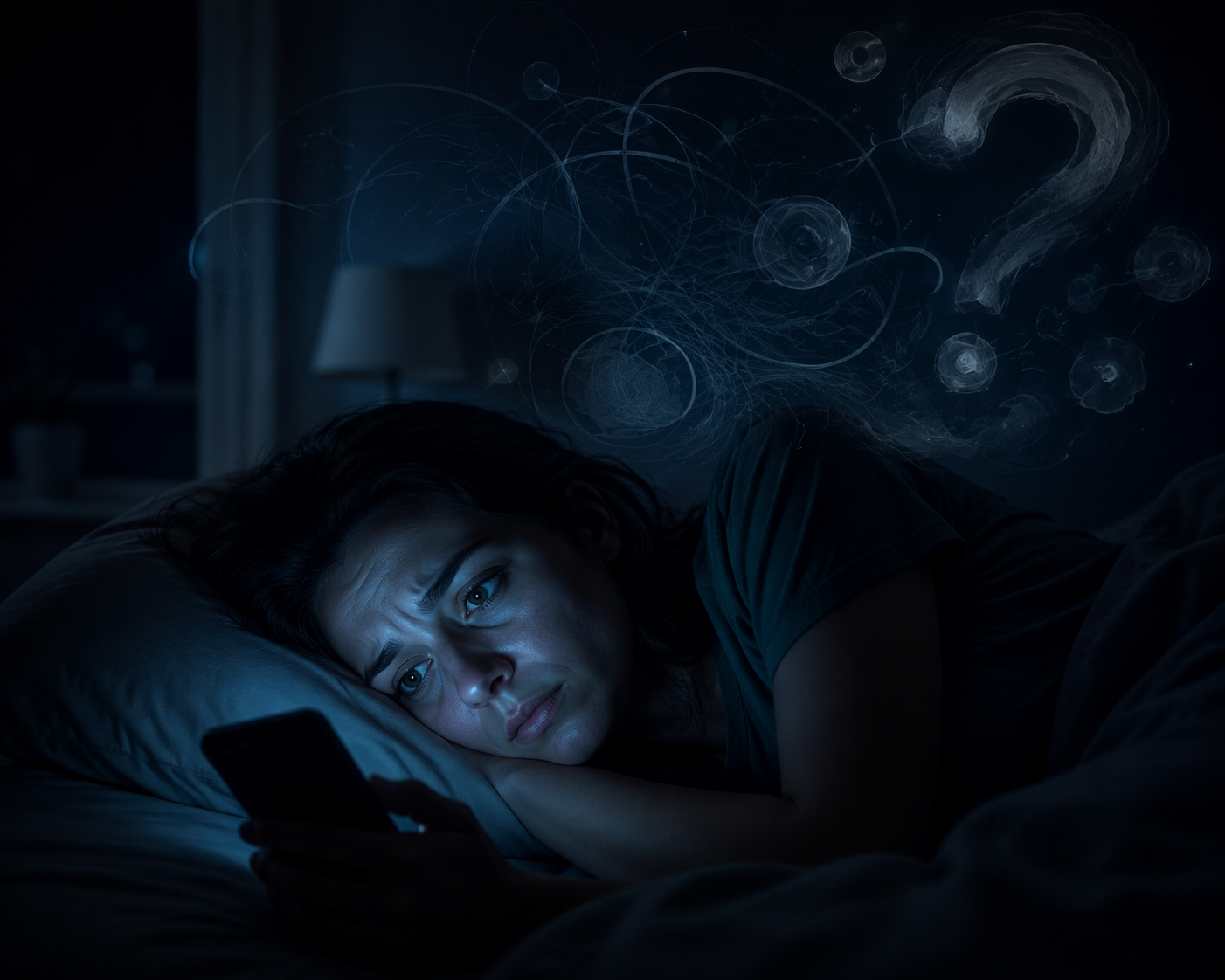
The sleep problem does not prove betrayal. It proves stress. That distinction is not a technicality; it is the thing that keeps a vulnerable person from treating every racing heartbeat as evidence. A rumor can be false and still make the bed feel unsafe. A suspicion can be unconfirmed and still recruit the same threat systems that make sleep harder.
Why Suspicion Keeps the Body Awake
Sleep asks the brain to give up surveillance. Suspicion asks the brain to intensify it. That is the basic conflict.
Once the possibility of betrayal enters the room, the mind starts treating ordinary gaps as unfinished evidence. A delayed reply becomes a scene to reconstruct. A partner's tiredness becomes something to decode. A friend's warning becomes a file that will not close. At night, when there are fewer distractions and fewer ways to verify anything, the brain does not simply "think too much." It tries to reduce uncertainty by rehearsing, checking, comparing, and predicting.
That mental loop has a physiological cost. Sladek and colleagues studied healthy young adults and found that daily rumination about stress interacted with stress levels to predict about 23.6% higher waking cortisol the next day, as well as about 1.52 minutes longer sleep onset latency. This was not an infidelity study; it measured general life stress in a sample with a mean age of 20.91. Used carefully, it helps explain a mechanism rather than prove that every relationship suspicion produces the same cortisol pattern. [2]
Cortisol is not the villain by itself. It helps the body mobilize. The problem is timing and repetition. The system that is useful when there is something to solve becomes punishing when the threat is ambiguous, social, and unavailable for resolution at midnight.
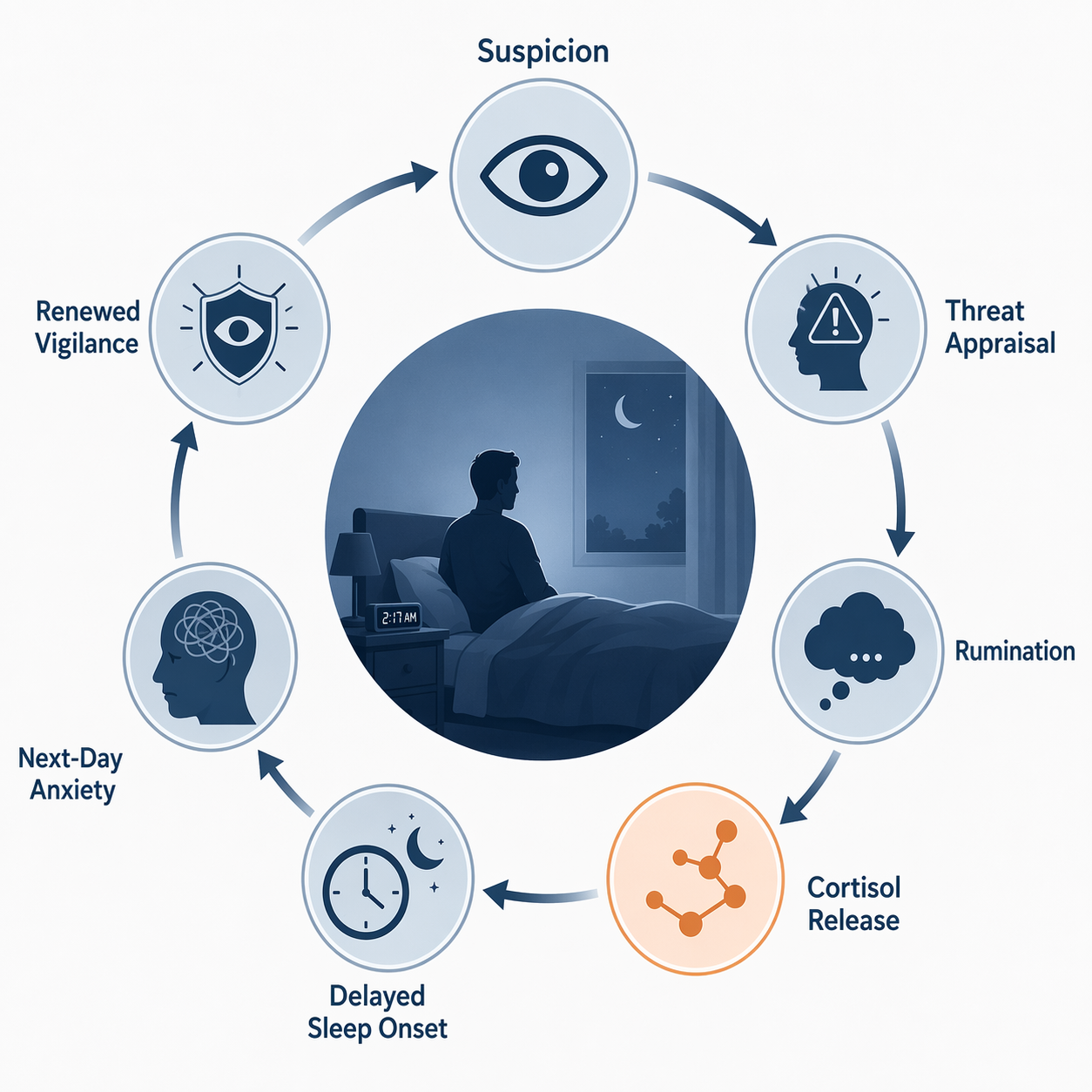
The Cortisol-Rumination Cycle
The loop usually does not begin with a dramatic thought. It begins with a signal the brain marks as socially dangerous: a rumor, a vague inconsistency, a private change in closeness, a message left unread. The first step is threat appraisal. The body asks, "Am I safe here?" before the rational mind has enough evidence to answer.
From there, rumination tries to act like investigation. It promises that one more replay will clarify the truth. In practice, it often expands the threat field. One memory brings up another. The mind searches for patterns, then starts treating the search itself as urgent. This is why a person can feel exhausted and activated at the same time.
| Part of the night loop | What it can feel like | Where sleep gets hit |
|---|---|---|
| Intrusive thought | A rumor or image arrives suddenly | The wind-down is interrupted |
| Threat appraisal | The body feels alert before there is proof | Heart rate, muscle tension, and vigilance rise |
| Checking or rehearsal | You review messages, memories, tone, timelines | The bed becomes associated with investigation |
| Delayed sleep | You are tired but cannot drop | Sleep onset gets pushed later |
| Next-day anxiety | Poor sleep makes the situation feel less manageable | The next night begins with less resilience |
| Renewed vigilance | You return to bed expecting another bad night | The loop becomes conditioned |
Sleep science gives the next part of the loop more weight. Anxiety at night can reduce time spent in REM and deep sleep stages, and sleep loss can then intensify anxiety the following day. That means the first bad night is not just a consequence; it can become fuel for the next one. [3]
This is where the experience starts to feel unfair. The person who most needs emotional steadiness wakes up with less of it. The next day's conversation, silence, or ambiguous text lands on a brain that slept badly. The body is more reactive, so the same uncertainty feels more threatening. By bedtime, the bedroom is no longer neutral. It has become the place where the mind gathers evidence.
Suspicion Is Not Evidence, but It Is a Real Stressor
One of the more delicate tasks here is separating two truths that often get tangled together. A disrupted sleep pattern does not confirm that a partner cheated. It also does not mean the sleeper is being dramatic. The symptom belongs to the stress response, not to the legal case for or against the relationship.
In the Weigel and Shrout reporting, women were more likely than men to report insomnia in response to suspected infidelity, while men more often reported risky coping behaviors. That is useful context, but it should not become a rule for how any one person is supposed to react. People learn different ways to manage shame, uncertainty, anger, and fear. Sleep is one place those differences become visible. [1]
Confirmed infidelity can be associated with severe distress as well. Verywell Mind, citing 2021 research, reports that 30% to 60% of people who experience infidelity develop anxiety, depression, or PTSD-like symptoms, including insomnia. That figure concerns people who experience infidelity, not merely everyone who hears a rumor. It is still relevant because it shows that sleep disturbance belongs inside the real injury of relational threat, rather than outside it as a minor inconvenience. [4]
Find the Shape of the Insomnia First
Before trying to fix the night, identify where the night is breaking. Cheating-related anxiety does not disturb everyone in the same pattern.
- Sleep-onset insomnia: you cannot fall asleep because the mind starts reviewing details as soon as the room gets quiet.
- Sleep-maintenance insomnia: you fall asleep, then wake in the middle of the night with a jolt of dread or an urge to check.
- Early-morning awakening: you wake too early and cannot return to sleep because the day already feels emotionally loaded.
Those patterns need different pressure points. A person who lies awake for two hours at bedtime may need a stronger pre-bed containment plan. A person who wakes at 4 a.m. may need a plan for not turning the awakening into an interrogation session. For a fuller way to sort those patterns, see why you can't sleep depends on your insomnia pattern.
Use CBT-I Against the Loop, Not Against Your Feelings
Cognitive behavioral therapy for insomnia, or CBT-I, is considered a first-line evidence-based treatment for insomnia, including insomnia that co-occurs with anxiety. Sleep Foundation and Cleveland Clinic both describe CBT-I as a structured treatment that targets the behaviors and thought patterns maintaining sleeplessness. [5][6]
That does not mean CBT-I answers the relationship question. It means it can keep the bed from becoming the place where the relationship question damages the nervous system every night. If you want the broader treatment frame, start with CBT-I explained. In this situation, the most useful CBT-I tools are the ones aimed at bed-vigilance, catastrophic certainty, and uncontrolled rumination.
Stimulus Control: Stop Letting the Bed Become an Investigation Site
Stimulus control is blunt because conditioning is blunt. If the bed repeatedly becomes the place where you check messages, replay conversations, search social media, or rehearse confrontation, the brain learns that bed means vigilance. After a while, lying down itself becomes the cue for alertness.
The practical move is to protect the bed from that association. If you are awake and pulled into checking or mental replay, leave the bed for a low-light, low-stimulation place. Do something quiet and non-investigative until sleepiness returns. This is not punishment for being anxious. It is a way of refusing to train the body that sheets, darkness, and suspicion belong together.
Cognitive Restructuring: Challenge Certainty, Not Pain
Cognitive restructuring is often misunderstood as positive thinking. That would be useless here. The goal is not to tell yourself everything is fine. The goal is to label the difference between what is known, what is feared, and what is being inferred at 3 a.m.
| Night thought | More accurate label | Sleep-protective replacement |
|---|---|---|
| They are definitely cheating. | Catastrophic certainty | I have a fear and some signals. I do not have a settled fact tonight. |
| If I sleep, I am letting myself be fooled. | False responsibility | Sleeping does not decide the relationship. It gives me a clearer brain tomorrow. |
| I need to check one more thing. | Urgency loop | Checking now is likely to wake my body further. I can write the question down. |
| My anxiety means something must be true. | Emotional reasoning | My anxiety proves threat activation, not the specific event. |
The wording matters. If the replacement thought is too cheerful, the brain rejects it. If it is too harsh, shame enters the loop. The most useful line is usually sober and narrow: "I do not have to solve this in bed."
Scheduled Worry: Give Rumination an Appointment
Rumination gets stronger when the brain believes it will lose access to the problem. Scheduled worry works by proving the opposite. You choose a consistent daytime window, ideally not close to bedtime, and use it for the thoughts that keep trying to invade the night.
- Write the actual question, not the whole emotional storm.
- Separate known facts from interpretations.
- List any action that can only happen during waking hours.
- End by writing where the note will be available tomorrow.
At night, when the thought returns, the response is not "I should not care." It is "This has a place, and the place is not my bed." Verywell Mind includes scheduled worry time among strategies for sleep struggles connected to betrayal-related distress. [4]
A Wind-Down That Matches the Threat
Generic sleep hygiene advice can feel insulting when the real problem is relational alarm. A cool room and a regular bedtime may help, but they do not address the specific way suspicion hijacks attention. The wind-down has to remove opportunities for investigation and give the body repeated cues that no decision will be made tonight.
A realistic 60-minute version might include putting the phone outside the bed area, writing unresolved questions on paper, doing a short relaxation practice, and reading or listening to something that does not touch the relationship. For the general structure, use sleep hygiene fundamentals and an evidence-based bedtime routine as the base, then adapt it around the checking and rumination triggers that are actually keeping you awake.
Downshift the Body When the Mind Will Not Settle
Sometimes the thought work is not available yet. The body is already activated: chest tight, jaw clenched, stomach alert, hands reaching for the phone. In that state, arguing with the thought can become another form of engagement. Start lower in the system.
The PBT Institute describes 4-7-8 breathing as a technique that activates the parasympathetic nervous system. The pattern is simple: inhale for 4 counts, hold for 7, exhale for 8. The long exhale is the point. It gives the body a repeated downshift signal when the mind is still trying to prosecute the case. [7]
Progressive muscle relaxation can serve the same purpose in a different channel. Tense and release one muscle group at a time, moving slowly from feet to face or face to feet. The task gives attention somewhere to go besides the rumor, and it lets the body notice the difference between guarding and letting go. The PBT Institute and Verywell Mind both include progressive muscle relaxation and limits on alcohol and caffeine among practical supports for betrayal-related sleep difficulty. [4][7]
Alcohol deserves special mention because it can look like relief while worsening the night. It may make sleep arrive faster for some people, but it does not answer the threat and can leave the second half of the night more fragmented. Caffeine is less emotionally complicated but just as relevant: a body already running on vigilance does not need another stimulant carrying into bedtime.
What to Do When the Urge to Check Hits
Checking feels productive because it offers a task. The problem is that nighttime checking usually expands the number of things to interpret. A timestamp, a profile change, a missing detail, a tone from earlier in the day: each one can create another branch of the same tree.
A sleep-protective checking plan needs to be decided before the urge hits. For example, a person might decide that after the wind-down begins, they will not look at messages, social media, location information, or old conversations. If a question feels urgent, it goes onto paper for the scheduled worry window. If the urge persists, they leave the bed and use a regulation exercise rather than negotiating with the phone from under the covers.
This does not require pretending the relationship is fine. It requires recognizing that 3 a.m. surveillance is rarely the setting in which a person becomes more discerning. Sleep is not surrender. It is preparation for better judgment.
When Sleep Tools Are Not Enough
There is a limit to what insomnia tools can do when the relational threat keeps being reactivated. If new information appears every night, if conversations remain chronically destabilizing, or if the relationship includes coercion, intimidation, or monitoring, the sleep problem is not only a sleep problem. The body may be responding to an environment that still feels unsafe.
For ordinary uncertainty, CBT-I tools can reduce the conditioning between suspicion and wakefulness. For ongoing relational harm, professional support may need to include therapy, medical care, or safety planning. The key is not to demand that the body calm down while the situation keeps escalating unchecked.
Suspected infidelity can produce real sleep disruption before facts are settled. The sleep loss does not prove cheating, and it does not prove weakness. It shows that uncertainty has entered the threat system. Sleep tools cannot resolve the relationship question, but they can interrupt the nightly pattern in which suspicion becomes rumination, rumination becomes arousal, and arousal becomes a cortisol-conditioned insomnia loop.
References
- Suspected Infidelity May Impair Mental and Physical Well-Being, Psychology Today.
- Daily stress, rumination, and cortisol in young adults, Cognition and Emotion, 2019.
- Anxiety and Sleep, Sleep Foundation.
- How to Cope With Infidelity, Verywell Mind.
- Cognitive Behavioral Therapy for Insomnia, Sleep Foundation.
- Cognitive Behavioral Therapy for Insomnia (CBT-I), Cleveland Clinic.
- 4-7-8 Breathing, PBT Institute.
Comments
Join the discussion with an anonymous comment.