
You can be separated, relieved, devastated, practical, angry, or all of those before lunch, and still have the same problem at 2:40 a.m.: you are awake again. Then a blood pressure reading comes back higher than usual, and the question stops being purely emotional. Is this just divorce stress, or is your sleep becoming a health issue?
One clarification first: this is about actual marital separation or divorce, especially after one partner has physically moved out. It is not about the “sleep divorce” trend, where couples who are still together voluntarily sleep in separate beds or rooms to improve rest. That can be a useful arrangement for some couples; it is a different problem from lying awake after a breakup, legal conflict, changed housing, and repeated contact with an ex-partner.
The most useful evidence does not say that every bad night after separation is dangerous. It gives a time marker. In a prospective study of adults who had recently separated, sleep complaints predicted later increases in resting systolic blood pressure. Each standard deviation increase in Pittsburgh Sleep Quality Index complaints was associated with roughly a 6 mmHg rise in systolic blood pressure at the next measurement visit, and participants with high sleep complaints beyond about 10 weeks after physical separation showed systolic blood pressure in the hypertensive range, above 140 mmHg.[1]
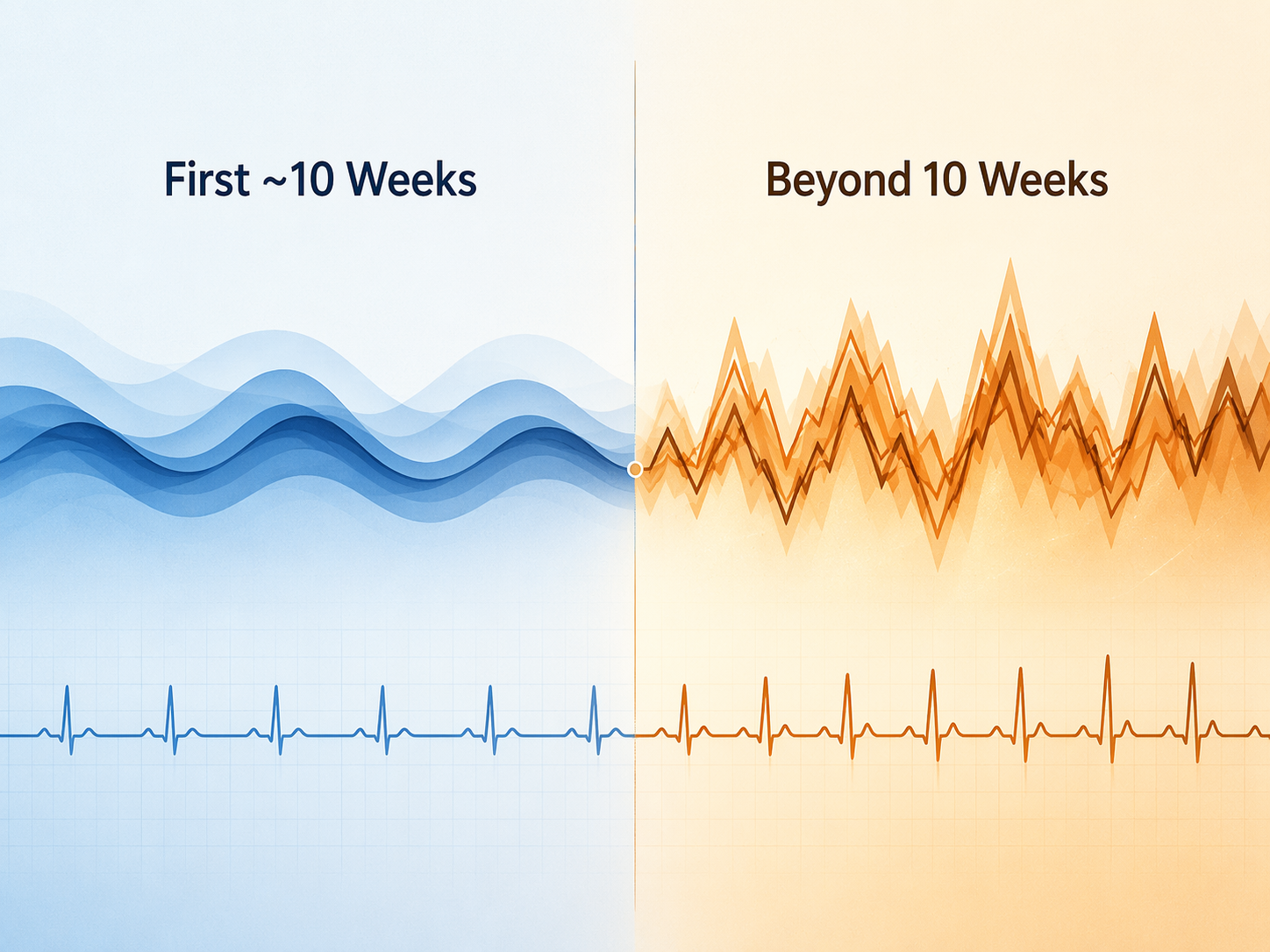
The 10-week mark is a warning light, not a cliff
The Krietsch study matters because it followed people forward rather than simply asking whether divorced people sleep poorly. Participants were assessed after recent marital separation, then followed over time. Sleep complaints were measured with the Pittsburgh Sleep Quality Index, a questionnaire that captures problems such as sleep duration, sleep quality, sleep disturbance, and daytime impairment. Blood pressure was measured at study visits rather than guessed from symptoms.[1]
That order is the point. Poor sleep complaints predicted later blood pressure increases; the study did not find the reverse pattern as the main explanation. For someone sitting in a clinic months after moving out, that distinction is not academic. It means insomnia is not only a sad accessory to divorce stress. In this sample, persistent sleep problems carried information about what happened next in the cardiovascular system.[1]
The time boundary should be handled carefully. The “about 10 weeks” threshold comes from the study’s timing: participants were around two months post-separation at baseline, and the risk pattern appeared when sleep complaints stayed high beyond that early period. It is not a universal biological deadline. Someone at week nine is not safe by definition, and someone at week eleven is not doomed. But the marker is clinically useful because it interrupts the vague instruction to “give it time.”
Early separation insomnia often makes sense. You may be sleeping in a new room, listening for children, replaying conversations with lawyers, checking messages, or waking before a difficult exchange with your ex-partner. The body can treat the new arrangement as unstable. For the first several weeks, that is often an acute stress response. When the same level of sleep complaint is still present two to five months after physical separation, it deserves a different level of attention.
| Timing after physical separation | How to interpret poor sleep | Reasonable next move |
|---|---|---|
| First several weeks | Often an acute stress response to housing, contact, legal, financial, or parenting disruption | Stabilize routines, reduce avoidable arousal, monitor sleep and blood pressure if already elevated |
| Around 10 weeks | A useful checkpoint, especially if sleep complaints remain frequent or daytime function is worsening | Stop treating insomnia as automatically temporary; consider structured behavioral treatment |
| Beyond about 10 weeks with high sleep complaints | In the Krietsch study, this pattern predicted later systolic blood pressure increases | Discuss sleep and blood pressure together with a clinician rather than waiting indefinitely |
Why divorce can keep sleep unstable after the first shock
Divorce does not disturb sleep only because people feel bad. A partner often functions as part of the sleep system: a shared bedtime, a morning rhythm, a familiar body in the room, a second adult who helps absorb threats, plans, and small decisions. When that person is gone, even for good reasons, the body loses both a time cue and a stress buffer.
That loss can be especially sharp at night because the day’s practical competence finally runs out. During business hours, there are forms to complete, children to move, accounts to separate, and appointments to keep. At night, the nervous system may still behave as if someone needs to stay on duty. Sleep becomes lighter, more fragmented, and easier to interrupt.
Recent actigraphy evidence helps explain why sleep may not recover cleanly once the initial move is over. In a study of 122 recently separated adults, mean sleep efficiency was 82%, below the 85% threshold often used clinically to mark inefficient sleep. The same study found that contact with an ex-partner predicted lower sleep efficiency in a unidirectional pattern, meaning the contact appeared to drive poorer sleep rather than poor sleep simply making contact more likely.[2]
That finding is easy to recognize in ordinary life. A text about custody at 9:30 p.m., a hostile email before bed, or a necessary conversation about money can restart alertness just when the body should be downshifting. The issue is not whether contact is morally good or bad; many separated adults have to communicate. The sleep question is whether the timing, channel, and emotional intensity of that contact keep the nervous system from standing down.

Older laboratory work also supports the idea that divorce-related sleep disturbance is biologically real. Cartwright and Wood reported reduced delta sleep, the deep slow-wave stage of sleep, during active divorce.[3] Because that study is older, it should not be treated as a complete modern account of divorce insomnia. It is still useful for one limited point: this is not merely a story people tell about being stressed. The sleeping body can change during marital disruption.
What rising blood pressure changes
A higher reading during separation does not prove that divorce insomnia caused hypertension in one individual person. Blood pressure moves for many reasons: pain, alcohol, medication changes, weight changes, caffeine, existing cardiovascular risk, measurement conditions, and family history. The Krietsch sample was also modest in size, with 138 participants, 75% White participants, and 38 men, so the estimate should not be treated as if it describes every separated adult equally.[1]
Still, the blood pressure finding changes the burden of proof. If sleep complaints are high beyond roughly 10 weeks and systolic numbers are climbing, it is no longer especially helpful to say, “Of course you are stressed.” That may be true and still inadequate. The practical question becomes: what is keeping the insomnia in place, and what can be changed now?
The average participant in the Krietsch study continued to report clinically meaningful sleep problems, with PSQI scores above 5, nearly a year after separation.[1] That is the part worth sitting with. Waiting can be reasonable in the first acute phase. Waiting for many months while sleep remains poor and blood pressure rises is not the same thing as healing.
What to do when divorce insomnia persists
The first move is to name the problem accurately. “I am under stress” is true but too broad. More useful language is: “Since physical separation, I have had persistent sleep complaints for about 10 weeks or more, and my blood pressure has increased.” That gives a clinician something to work with. It also keeps the conversation from drifting into reassurance before the health signal has been considered.
For persistent insomnia, the strongest behavioral pathway is cognitive behavioral therapy for insomnia, or CBT-I. It is not generic advice to relax. It works by changing the patterns that train the bed to become a place for wakefulness, threat monitoring, and frustrated effort. If you need a fuller explanation of how it works, start with What Actually Cures Insomnia? CBT-I Explained.
In divorce-related insomnia, CBT-I may need to be paired with very practical boundary work. Not grand emotional closure. Smaller things: moving ex-partner communication out of the last hour before bed when possible, using written channels for topics that become volatile, setting a morning review window for non-urgent messages, and keeping the bed out of legal, financial, or custody planning. The goal is not to pretend the divorce is less serious. It is to stop rehearsing it in the same place where sleep is supposed to happen.
- Track sleep complaints for two weeks: bedtime, wake time, long awakenings, early waking, naps, alcohol, and late ex-partner contact.
- Track blood pressure if it has already been elevated, using the method your clinician recommends rather than reacting to isolated readings.
- Protect a consistent wake time before trying to perfect bedtime; morning timing is often easier to control during a chaotic separation.
- Move emotionally charged administrative work out of bed and, when possible, out of the pre-sleep window.
- Ask directly about CBT-I or a referral if sleep remains poor around the 10-week mark.
Basic sleep hygiene still matters, but it should not be used as a polite way to minimize persistent insomnia. A darker room, less alcohol, morning light, and a steadier routine can reduce pressure on the system. They are foundations, not proof that the problem is simple. For the basics, use Sleep Hygiene Fundamentals and an Evidence-Based Bedtime Routine as a starting point.
Divorce is one version of a larger pattern: a life event creates hyperarousal, and then the sleep system keeps reacting after the original shock has passed. The treatment logic overlaps with other event-triggered insomnia patterns, such as the anxiety cycle described in Can’t sleep after an earthquake? How CBT-I breaks the anxiety cycle. The trigger differs; the learned wakefulness can look familiar.
When to bring it to a clinician
Bring sleep up sooner if you have chest pain, severe shortness of breath, fainting, very high blood pressure readings, suicidal thoughts, escalating alcohol or sedative use, or symptoms of mania. Those are not “wait until week 10” situations. They need direct medical or mental health attention.
For the more common gray zone, use the 10-week mark as a checkpoint. If you are physically separated and still having frequent sleep complaints around that point, especially with higher blood pressure, daytime impairment, or repeated nighttime contact conflict, treat sleep as part of your health care. You do not have to prove that the divorce is unusually terrible. Persistence is enough reason to act.
The calm version is also the firm one: do not panic over early separation insomnia, but do not keep apologizing for being exhausted while your body keeps giving you data. Months of high sleep complaints, especially with rising blood pressure, are worth addressing as a measurable health signal rather than waiting for divorce stress to resolve on its own.
References
- Sleep Complaints Predict Increases in Resting Blood Pressure Following Marital Separation, Health Psychology, 2014.
- Actigraphy study of sleep efficiency and ex-partner contact following marital separation, Coppola et al., 2023.
- Adjustment disorders of sleep: the sleep effects of a major stressful event and its resolution, PubMed, 1991.
Comments
Join the discussion with an anonymous comment.