
Why You Keep Hearing Conflicting Advice About Sleeping on Your Back
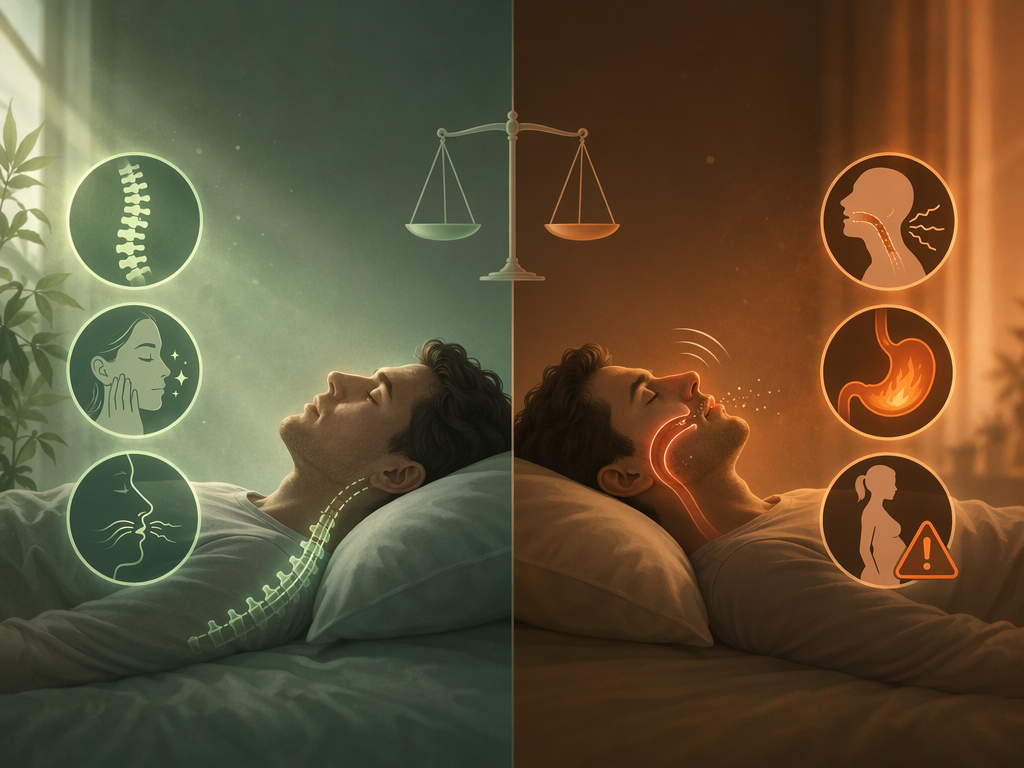
If you have tried to figure out the "best" sleep position, you have almost certainly run into a contradiction. Spine specialists and physical therapists often recommend back sleeping because it keeps the head, neck, and spine in neutral alignment. Sleep medicine physicians, on the other hand, warn that the supine position can worsen snoring and obstructive sleep apnea by allowing the tongue and soft palate to collapse backward into the airway.
Both camps are correct — for different people. The problem is that most advice is delivered as a universal rule rather than a conditional recommendation. A position that reduces morning back pain for one person can increase apnea severity for another. The goal of this guide is to give you a framework for deciding where you fall on that spectrum, based on your own health profile, not on a one-size-fits-all rule.
Who Benefits from Sleeping on Their Back?
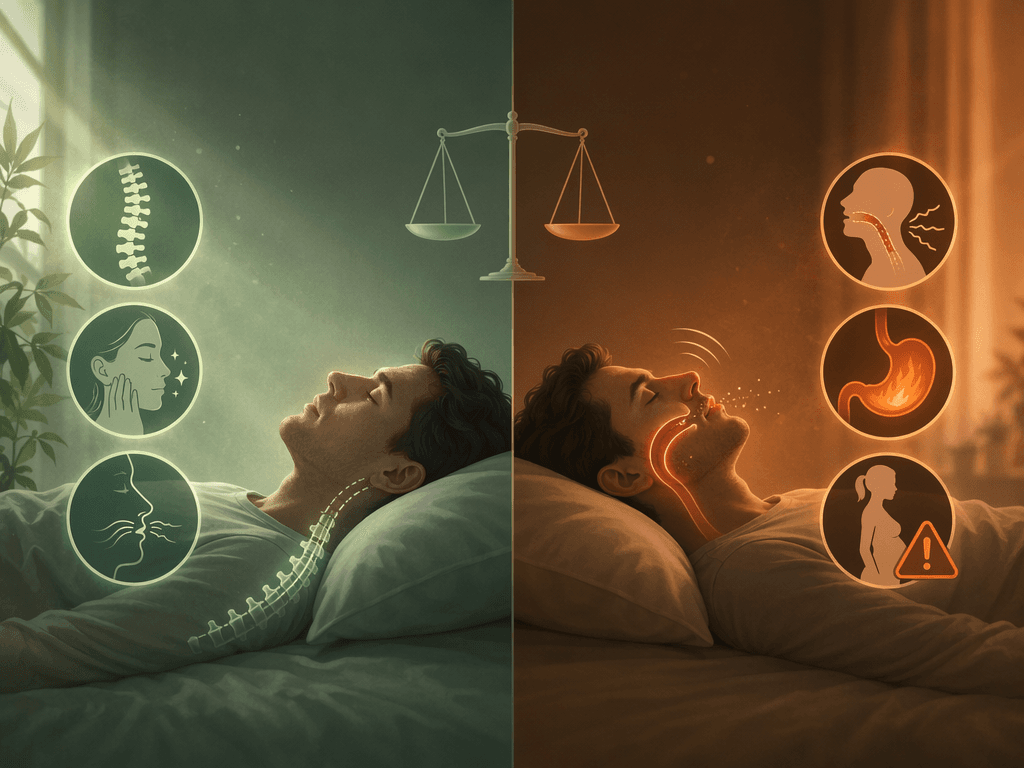
For certain health concerns, back sleeping is supported by clinical evidence as a beneficial or even therapeutic position. The key is that the benefits are conditional on proper setup — a wrong pillow or unsupportive mattress can negate the advantages.
Spinal Alignment and Back or Neck Pain Relief
When you sleep on your back with appropriate support, your spine maintains its natural S-shaped curve. The Sleep Foundation notes that a medium-loft pillow filling the space between the neck and the mattress prevents the head from tilting too far forward or backward, keeping the cervical spine neutral. Harvard Health adds that back sleeping keeps the spine straighter and can reduce neck, back, and hip pain compared to side or stomach positions.
The National Spine Health Foundation reports that, according to the American Chiropractic Association, sleeping on your back places approximately 50 pounds of pressure on the spine. However, placing a pillow under the knees reduces this pressure by relaxing the hip flexors and maintaining the natural curve of the lower back. The Mayo Clinic specifically recommends this pillow-under-knees technique for back sleepers with lower back pain.
Reduced Facial Wrinkles and Skin Breakouts
Side and stomach sleeping press the face against the pillow for hours each night, creating friction and compression that can contribute to sleep wrinkles — lines that eventually become etched into the skin. Back sleeping eliminates this pressure entirely. Consumer Reports cites dermatologist advice that back sleeping can prevent sleep wrinkles by removing pillow friction, and that doing skincare at least one hour before bed allows products to absorb before position shifts.
A 2021 study in Sleep Medicine (cited by Consumer Reports) found that sleep restriction — getting only three hours of sleep — negatively impacted skin hydration, elasticity, and complexion brightness in a sample of 24 women. While this study focused on sleep duration rather than position, it underscores the link between sleep quality and skin health. Northwestern Medicine neurologist Dr. Phyllis C. Zee cautions that the direct link between sleep position and wrinkles lacks definitive data, but notes that sleep itself is restorative for skin.
Fewer Tension Headaches
Tension headaches often originate from muscle strain in the neck and shoulders. When you sleep on your stomach, your neck is rotated to one side for hours, placing sustained strain on the cervical facet joints and muscles. Back sleeping with a properly supportive pillow keeps the head and neck in a neutral position, reducing this source of morning headache. Healthline notes that the neutral head, neck, and spine position achieved in back sleeping can alleviate pressure that contributes to tension headaches.
Sinus Congestion Relief with Head Elevation
Back sleeping becomes a therapeutic position for sinus congestion when the head is elevated. Gravity helps drain mucus from the nasal passages, reducing the feeling of stuffiness that can interfere with breathing during sleep. Healthline cites a 2016 review supporting head elevation for GERD relief, and the same principle applies to sinus drainage. A wedge pillow or an adjustable bed base can provide the necessary elevation without compromising spinal alignment.
Who Should Avoid Sleeping on Their Back?
For several common health conditions, back sleeping is not just suboptimal — it can be actively harmful. Understanding these contraindications is essential before deciding to adopt the supine position.
Obstructive Sleep Apnea and Chronic Snoring
The supine position is consistently associated with more severe obstructive sleep apnea (OSA). When you lie on your back, gravity pulls the tongue and soft palate backward, narrowing the pharyngeal airway. Harvard Health describes this as the soft tissue in the back of the throat falling back "like a cork." Sleep medicine physician Dr. Gerard Meskill, quoted by the Sleep Foundation, explains that back sleeping exacerbates the retropositioning of the jaw and relaxation of the tongue, leading to more airway collapse.
The prevalence of sleep apnea is substantial. A 2021 American Heart Association scientific statement, cited in a 2025 AHA News article, reports that sleep apnea affects approximately 34% of middle-aged men and 17% of middle-aged women. Dr. Susan Redline of Brigham and Women's Hospital notes that "most people with sleep apnea have much, much worse sleep apnea when they sleep on their back versus on their sides." Side sleeping can reduce apnea episodes by up to 50%, a widely cited clinical finding in sleep medicine.
GERD and Heartburn
Lying flat on your back allows stomach acid to flow more easily into the esophagus, worsening gastroesophageal reflux disease (GERD) symptoms. The Sleep Foundation cites the National Library of Medicine in noting that heartburn is more likely when lying flat, and recommends upper body elevation to mitigate this. Johns Hopkins Medicine adds that sleeping on the right side can worsen reflux symptoms, while the left side helps. If you have GERD and prefer back sleeping, elevating the head of the bed with a wedge pillow or adjustable base is essential.
Late Pregnancy (After 20 Weeks)
By approximately 20 weeks of pregnancy, the uterus is large enough that lying flat on the back can compress the inferior vena cava and aorta, potentially reducing blood flow to the heart and fetus. Cleveland Clinic Ob/Gyn Dr. Salena Zanotti explains that the concern is real, though short periods on the back (an hour or two) likely do no harm. The American College of Obstetricians and Gynecologists (ACOG) advises against back sleeping in the second and third trimesters. Harvard Health and the Mayo Clinic both recommend side sleeping — preferably the left side — during pregnancy for optimal blood flow. Propping up with pillows at a 20- to 30-degree angle can relieve pressure on the vena cava if back sleeping is unavoidable for short periods.
Heart Failure
People with heart failure often experience orthopnea — shortness of breath when lying flat. The American Heart Association reports that individuals with heart failure often feel worse when sleeping on the left side and may prefer the right side or an elevated position. While back sleeping with significant head elevation may be tolerable, flat back sleeping can exacerbate breathing difficulties in this population.
How to Sleep on Your Back Correctly: The Setup That Makes It Work
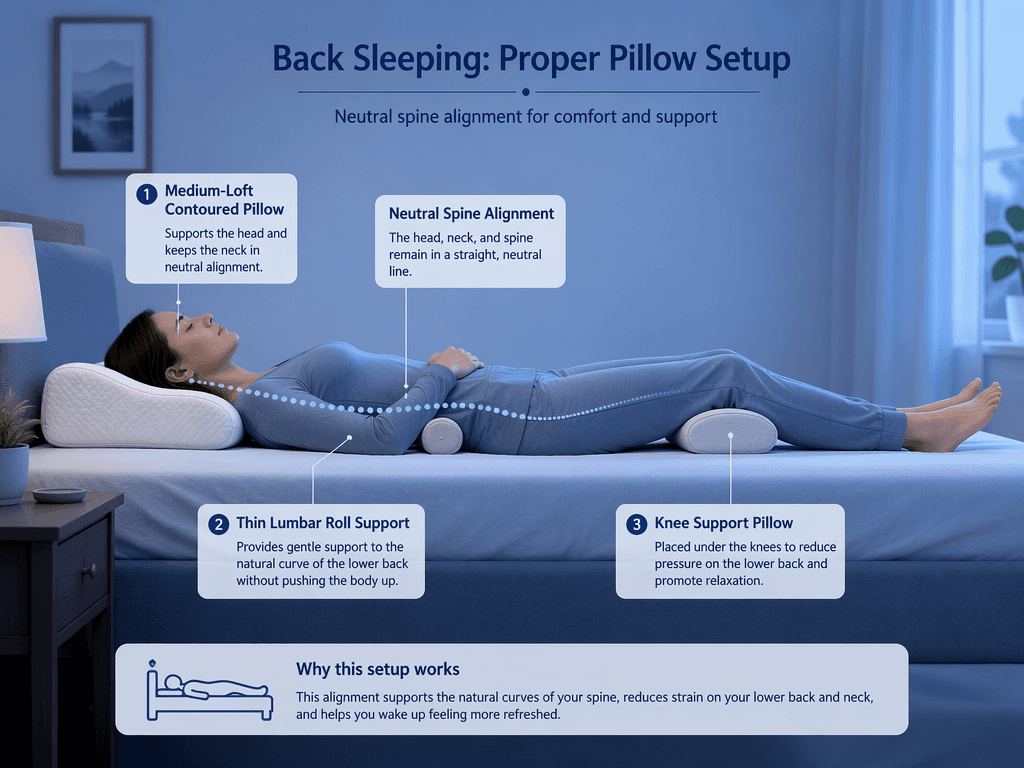
Back sleeping only delivers its benefits when the setup is correct. An improper setup — wrong pillow height, no knee support, or a sagging mattress — can create new problems or fail to resolve existing ones. Here is the evidence-based configuration.
- Pillow under the knees. This is the single most important adjustment for back sleepers. The Mayo Clinic recommends placing a pillow under your knees to help relax the back muscles and maintain the natural curve of your lower back. The National Spine Health Foundation confirms that this reduces stress on the lower back and counteracts the pressure that back sleeping places on the spine.
- Medium-loft neck pillow. Your pillow should fill the space between your head and the mattress without tilting your chin toward your chest or forcing your head backward. The Sleep Foundation specifies a medium-loft pillow for back sleepers to maintain neutral neck alignment. Johns Hopkins Medicine recommends a supportive pillow that cradles the neck.
- Optional lumbar support. If you feel a gap between your lower back and the mattress, a small rolled towel or thin lumbar pillow can provide additional support. The Mayo Clinic suggests this as an option for additional support.
- Medium-firm to firm mattress. The National Spine Health Foundation recommends a firm or medium-firm mattress to distribute pressure evenly. A mattress that is too soft allows the hips to sink, compromising spinal alignment. A mattress that is too firm creates pressure points at the shoulders and heels.
- Head elevation for GERD or sinus relief. If you have GERD or sinus congestion, elevating the head of the bed with a wedge pillow or adjustable base can provide relief while maintaining back sleeping. Northwestern Medicine recommends elevating the head with more pillows, a wedge pillow, or a smart bed to keep airways open. For more on adjustable bed options, see our Tempur-Pedic adjustable base review.
How to Train Yourself to Sleep on Your Back
If you have spent years sleeping on your side or stomach, switching to back sleeping will feel unnatural at first. Most people change positions three to five times per 90-minute sleep cycle, according to Harvard Health, so retraining your default position takes consistent practice. These strategies, drawn from the Sleep Foundation and other sources, can help.
- Use pillow barriers. Place pillows on both sides of your body to create a physical barrier that discourages rolling onto your side or stomach. The Sleep Foundation recommends surrounding yourself with pillows to prevent rolling. Consumer Reports adds that this method is a standard training technique.
- Start the night on your back. Even if you roll over during the night, beginning in the supine position increases the total time spent on your back. Over weeks, this gradual exposure can shift your default position.
- Practice during the day. Lie on your back for 5–10 minutes during the day while reading or relaxing. This helps your body become accustomed to the position without the pressure of needing to fall asleep.
- Optimize your sleep environment. A supportive mattress and the correct pillow setup (knee pillow, medium-loft neck pillow) make back sleeping more comfortable and sustainable. If your mattress is more than seven to ten years old, it may no longer provide adequate support. For a full guide on environmental factors, see our article on the sleep environment as a tool.
- Consider a positional therapy device. For people with sleep apnea who need to avoid back sleeping, the AHA mentions electronic devices that vibrate when the user rolls onto their back, and shirts with a pocket for a tennis ball. These are more commonly used to avoid back sleeping than to adopt it, but the principle of sensory feedback applies in either direction.
When to Choose Side Sleeping Instead
Despite the benefits of back sleeping for certain conditions, side sleeping is the clearly superior choice for several common health profiles. If any of the following apply to you, side sleeping — with proper pillow support — is likely the better option.
- Diagnosed sleep apnea or chronic snoring. The evidence is consistent and strong: side sleeping reduces airway collapse and can cut apnea severity significantly. The Mayo Clinic states that sleeping on the back is the worst position for those with sleep apnea. Harvard Health notes that side sleeping helps keep the airway open and cuts down on snoring. For more on sleep apnea diagnosis and treatment, see our Sleep Apnea FAQ.
- GERD or frequent heartburn. Sleeping on the left side is the preferred position for acid reflux. Johns Hopkins Medicine explains that the right side can worsen reflux, while the left side helps. The AHA also notes that sleeping on the left side may be better for GERD.
- Pregnancy (after 20 weeks). ACOG and multiple clinical sources recommend side sleeping — preferably the left side — during the second and third trimesters. The Mayo Clinic notes that left-side sleeping keeps pressure off internal organs and promotes healthy blood flow. For comprehensive guidance on sleep during pregnancy, see our article on insomnia during pregnancy.
- Heart failure. Individuals with heart failure may experience worsened shortness of breath when lying flat or on the left side. The AHA reports that many people with heart failure prefer sleeping on the right side or in an elevated position.
If you choose side sleeping, proper support is still essential. The Mayo Clinic recommends drawing your legs up slightly toward your chest and placing a pillow between your knees to align your spine, pelvis, and hips. The National Spine Health Foundation adds that a pillow between the knees keeps the hips balanced and can reduce pressure on the spine by nearly half.
The Bottom Line: A Decision Table for Your Sleep Position
The following table summarizes the evidence-based recommendations for each common health condition. Use it as a starting point, but always consult your healthcare provider for personalized advice, especially if you have a diagnosed condition.
| If you have this condition... | Recommended position | Key setup requirements | When to consult a doctor |
|---|---|---|---|
| Chronic back or neck pain | Back sleeping | Pillow under knees, medium-loft neck pillow, medium-firm mattress | If pain persists after 2–4 weeks of proper setup |
| Tension headaches | Back sleeping | Neutral neck alignment with supportive pillow | If headaches worsen or are accompanied by neurological symptoms |
| Sinus congestion | Back sleeping with head elevation | Wedge pillow or adjustable base for 20–30° head elevation | If congestion is chronic or accompanied by facial pain |
| Skin concerns (wrinkles, breakouts) | Back sleeping | Satin or silk pillowcase to reduce friction if side sleeping is unavoidable | No medical consultation needed for this purpose alone |
| Obstructive sleep apnea or chronic snoring | Side sleeping (any side) | Pillow between knees, head-supporting pillow maintaining neck alignment | See a sleep specialist for diagnosis and treatment |
| GERD or frequent heartburn | Left side sleeping | Head elevation with wedge pillow if back sleeping is preferred | If symptoms persist despite positional changes and medication |
| Pregnancy (after 20 weeks) | Left side sleeping | Pillow between knees, full-body pregnancy pillow for support | Discuss sleep position with your OB/GYN at each prenatal visit |
| Heart failure | Side sleeping (right side often preferred) | Head elevation, pillow support for comfort | Follow your cardiologist's specific positioning recommendations |
Comments
Join the discussion with an anonymous comment.