
Mechanism explainer
Does eating less protein affect sleep?
Eating less protein can affect sleep, but only meaningfully at the extremes: intake below roughly 16% of daily energy is associated with worse sleep quality, while moderate protein around 15-20% of energy looks like the sweet spot. You'll find the mechanism, the evidence tiers, and specific grams-per-day numbers to check against your own intake.
Last reviewed: August 2, 2026. Evidence reviewed by Nora Vale, sleep-science editor.
Does eating less protein affect sleep? It can, but the best answer is not “protein makes you sleep better.” In Tanaka et al. 2013, a cross-sectional study of 4,835 middle-aged Japanese workers, protein intake below roughly 16% of daily energy was associated with poorer sleep quality, while protein intake at or above roughly 19% was associated with more difficulty maintaining sleep — a U-shaped pattern rather than a simple more-is-better line.[1]

That matters because many people who ask this question have not started a strange experiment. They have cut calories, switched to more plant-based meals, made smaller dinners, reduced grocery costs, or drifted into lighter eating. The useful question is narrower: did the protein cut move you toward the low end of intake, or does it only feel low compared with how you used to eat?
The first clue is a U-shape, not a rule to eat more protein
In Tanaka et al., protein intake was divided by percent of total energy. The low-protein group, below roughly 16% of energy, had higher odds of poor sleep quality, with an odds ratio of 1.24 and a 95% confidence interval of 1.04 to 1.48. The same low group was marginally associated with difficulty falling asleep, also with an odds ratio of 1.24, but with a 95% confidence interval of 0.99 to 1.56. At the other end, protein at or above roughly 19% of energy was associated with difficulty maintaining sleep, with an odds ratio of 1.40 and a 95% confidence interval of 1.12 to 1.76.[1]
This is observational evidence. It can show that low protein intake and worse sleep appear together in that sample; it cannot prove that cutting protein caused the sleep problem. People who sleep badly may eat differently the next day. People who are dieting may change caffeine, alcohol, meal timing, hunger, stress, and body weight at the same time. A modest association in a workplace sample should not be turned into a universal dinner rule.
Still, the shape of the finding is useful. If your protein intake has dropped from “high” to “moderate,” this study does not say that your sleep should suffer. If it has dropped toward the low edge of usual intake, especially while calories are also low, the question becomes more plausible.
The stronger evidence comes from calorie restriction
The most practical experimental anchor is Zhou et al. 2016, because it tested higher- and lower-protein diets during energy restriction rather than simply asking people what they ate. In one randomized trial, adults with overweight or obesity were assigned diets during an approximately 750 kcal/day calorie restriction. Sleep quality, measured by the Pittsburgh Sleep Quality Index, was worse at 10% protein than at 20% protein: the reported PSQI global score was 6.0 in the 10% group versus 5.0 in the 20% group.[2]
That one-point PSQI difference is not a dramatic transformation. It is also not nothing. During weight loss, sleep can improve as body weight changes, but very-low-protein intake seemed to blunt some of that improvement in this trial.[2]
The same paper also reported a 16-week randomized trial comparing 1.5 g/kg/day with 0.8 g/kg/day. Sleep improved only in the 1.5 g/kg/day group, while the 0.8 g/kg/day group did not show the same improvement and increased sleep-medication use. Importantly, when protein was pushed higher, 30% of energy did not outperform 20% of energy.[2]
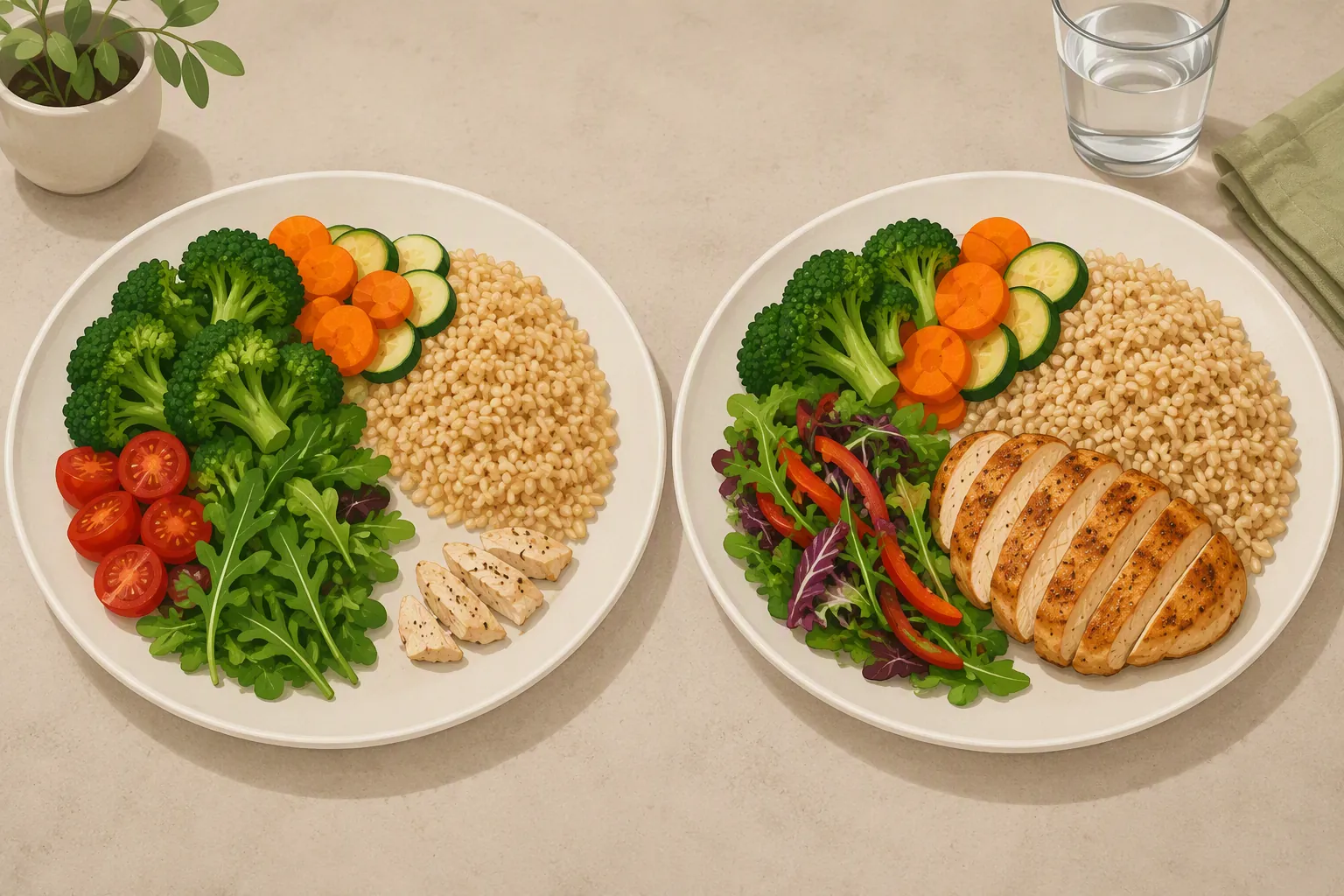
This is the part that keeps the advice from drifting into either fear or hype. The trial does not support eliminating protein at dinner, and it also does not support chasing the highest possible protein percentage for sleep. In the dieting context studied, moderate protein performed better than very low protein, and more protein stopped adding sleep benefit once intake was around 20% of energy.[2]
Why protein could matter without acting like a sleep pill
Protein supplies amino acids, including tryptophan. Tryptophan is a precursor for serotonin and melatonin, two molecules involved in sleep-wake regulation. That basic pathway is real, but it is often oversimplified. Tryptophan has to compete with other large neutral amino acids for transport into the brain, so eating more total protein does not automatically mean more tryptophan reaches the brain.[3]
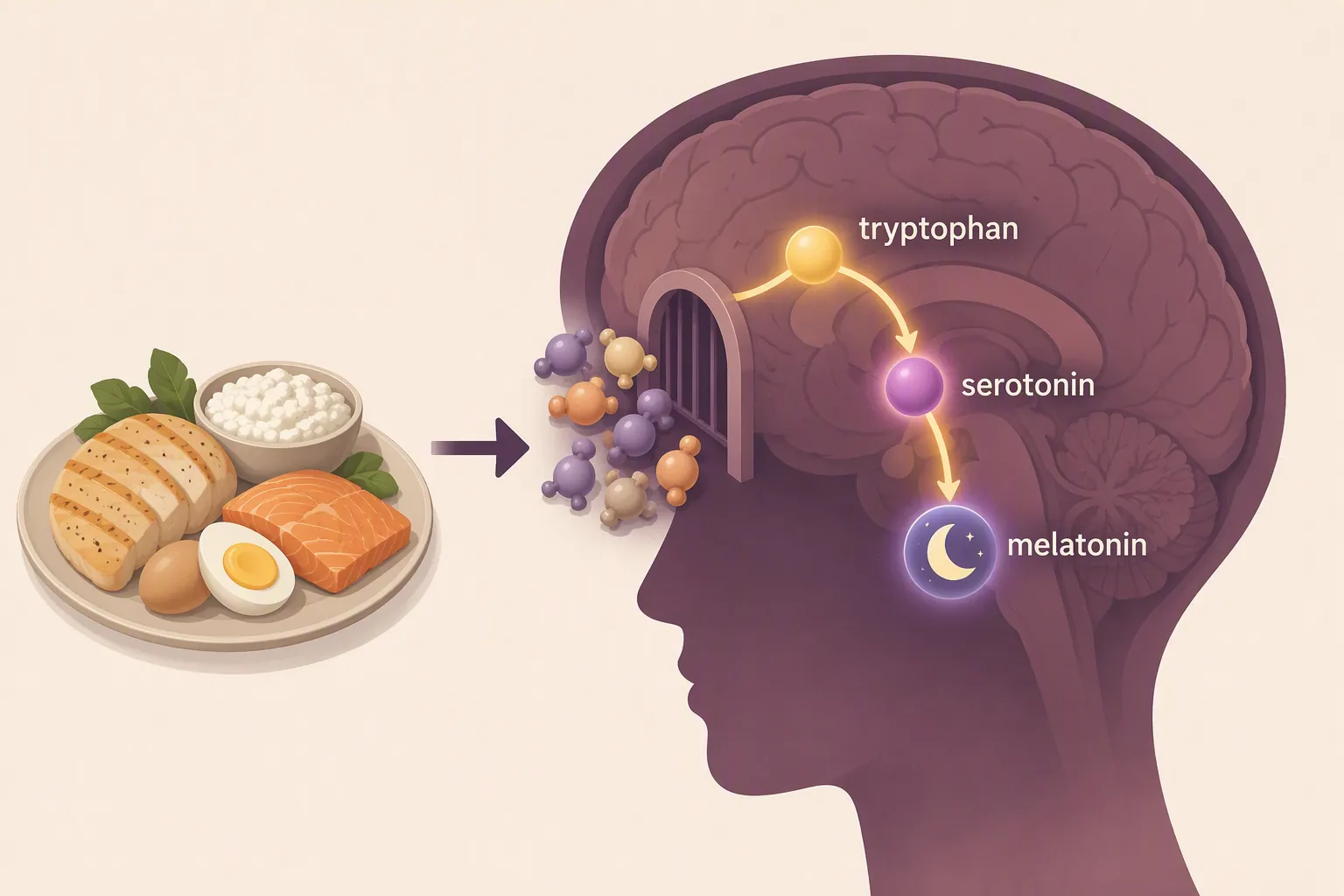
Carbohydrate complicates the story further. By changing the balance between tryptophan and competing amino acids, carbohydrate can raise the tryptophan-to-large-neutral-amino-acid ratio. That is one reason a meal’s whole composition may matter more than whether it contains one “sleep nutrient.”[3]
A narrative review by Wilson, St-Onge, and Tasali summarized evidence that higher-protein diets have been linked with more REM sleep, higher sleep efficiency, and less wake after sleep onset, but it also noted no clear benefit beyond roughly 20% of energy. The mechanism fits the dose problem: too little protein may remove useful substrate or change meal composition in a way that matters, but extra protein does not keep converting into better sleep.[3]
How to check whether your own protein cut is large enough to matter
Start with percent of calories if you track food. Protein has about 4 calories per gram, so the rough calculation is: daily calories × protein percentage ÷ 4 = grams of protein. The table below uses hypothetical calorie targets, not a prescription.
| Hypothetical daily intake | 15% of energy from protein | 20% of energy from protein |
|---|---|---|
| 1,600 kcal/day | 60 g/day | 80 g/day |
| 2,000 kcal/day | 75 g/day | 100 g/day |
| 2,400 kcal/day | 90 g/day | 120 g/day |
The low-protein signal in Tanaka et al. was below roughly 16% of energy, while the RCT contrast in Zhou et al. favored 20% over 10% during calorie restriction.[1][2] If your intake is around the middle of that range, protein may not be the first sleep variable to blame. If your diet is closer to 10% of energy from protein, or if a calorie cut has pushed you near the low end, the evidence becomes more relevant.
The grams-per-kilogram check is often easier during weight loss. Zhou et al. found sleep improvement over 16 weeks in the 1.5 g/kg/day group, not the 0.8 g/kg/day group.[2] A practical dieting range of roughly 1.0 to 1.5 g/kg/day is therefore a reasonable place to compare your current intake, especially if you are eating fewer calories than usual.
- If you reduced calories and protein at the same time, check protein in grams, not just portion size.
- If you switched to plant-based eating, check whether beans, soy foods, lentils, seitan, nuts, seeds, or higher-protein grains actually replaced the animal protein you removed.
- If dinner became much smaller, look at the whole day. A low-protein dinner may be fine if breakfast and lunch carried enough.
- If you are already around 15% to 20% of energy from protein, pushing higher is not supported as a sleep strategy.
For comparison, a hypothetical 70 kg adult eating 1.0 to 1.5 g/kg/day would land around 70 to 105 g/day. That does not need to come from a supplement, and it does not need to be concentrated at night. The point is to avoid an unintentional slide into very low intake while the rest of the diet is also restricted.
The broader evidence is mixed enough to stay cautious
A large NHANES analysis by Zhang et al. adds population-level support, but it remains observational. In 35,252 adults, 24.6% reported sleep problems, and the highest protein-intake quartile had the lowest odds of sleep problems after adjustment. The association was stronger in women.[4]
That finding should not be read as proof that low protein causes insomnia. NHANES-style data can also show that short sleepers eat less protein, which leaves direction unresolved: worse sleep may change appetite, meal timing, food choice, or dietary reporting rather than the other way around.[4]
The sex pattern is also not tidy. Tanaka et al. reported findings that were stronger in men and attenuated in women, while Zhang et al. found a stronger association in women.[1][4] That conflict is a reason to avoid a clean sex-specific claim. At this stage, evidence tier matters more than a neat narrative.
Prospective cohort evidence also complicates the story. Wirth et al. 2024 analyzed 3 prospective cohorts and found that total protein intake was not associated with sleep quality overall. Protein source appeared more relevant: vegetable protein was positively associated with sleep quality in one cohort, while processed red meat and poultry were associated with worse sleep quality.[5]
So the honest hierarchy is this: the clearest low-protein concern comes from observational data and from randomized weight-loss trials, not from proof that every adult sleeps better after increasing protein. The most concrete experimental contrast is modest — about a one-point PSQI difference between 10% and 20% protein in an energy-restricted trial — and review-level summaries describe many diet-sleep effects in minute-scale changes rather than hour-scale changes.[2][3]
This is also why lists of sleep foods tend to outrun the evidence. A broader 26-study analysis covered in Wilson, St-Onge, and Tasali found insufficient evidence that specific foods reliably change sleep outcomes, and a separate null randomized trial in young military personnel sits in the caution column rather than the prescription column.[3]
If your sleep problem is clearly tied to another pressure — heat, an outage, life-stage symptoms, caregiving, or irregular schedules — protein may be a side issue. For related sleep-science context, see the site’s explainer on heatwave insomnia, the guide to sleep quality during a power outage, and the life-stage discussion of why millennial tiredness is not one problem.
A restrained practical answer
Eating less protein can affect sleep if the cut moves you toward very low intake, especially while you are also restricting calories. The best-supported target is not maximal protein. It is moderate protein: roughly 15% to 20% of daily energy, or about 1.0 to 1.5 g/kg/day during dieting, judged against your full day of eating rather than one meal.[1][2]
If your current intake is far below that range, bring it back toward moderate before blaming yourself for poor sleep hygiene. If you are already in that range, adding more protein is unlikely to be a stand-alone sleep fix. Meal timing, hunger, caffeine, alcohol, stress, light exposure, medical symptoms, and the reason you changed your diet may matter as much or more.
Seek clinical care if the protein cut is part of extreme restriction, if you have unexplained weight loss, or if sleep problems last more than a month. Protein is a diet variable worth checking; it is not a treatment for persistent insomnia.
References
- Associations of Protein, Fat, and Carbohydrate Intakes With Insomnia Symptoms Among Middle-aged Japanese Workers — PMC, 2013.
- Higher-protein diets improve indexes of sleep in energy-restricted overweight and obese adults: results from 2 randomized controlled trials — PMC, 2016.
- Diet Composition and Objectively Assessed Sleep Quality: A Narrative Review — PMC, 2022.
- Impact of protein consumption on sleep problems: Insights from NHANES data — Journal of Clinical and Basic Psychosomatics, 2024.
- Protein intake and its association with sleep quality: results from 3 prospective cohort studies — European Journal of Clinical Nutrition, 2024.
Supports these guides
Spot an error or have clinical feedback?
Because this article covers clinical, medication, or safety information, we use a moderated correction channel instead of open public comments. Let us know if something about “Does eating less protein affect sleep?” needs a closer look.
Send feedback on this article