Mechanism explainer
How a power outage disrupts sleep quality (and what helps)
A power outage disrupts sleep through four compounding channels — heat, light, sound, and stress — so most healthy adults rebound within days of power returning. This explainer weighs the evidence for each channel, marks who is genuinely at risk once an outage stretches past roughly eight hours, and lays out realistic recovery steps for the night of the outage and the nights after.
One reason a power outage affecting sleep quality can feel so disproportionate is that it rarely removes just one support. The room warms or stops cooling. The fan quits. Streetlights disappear, but phone screens and flashlights flare up. The familiar hum of appliances drops out, then a neighbor’s generator or a beeping backup device takes over. You may still be lying in the same bed, at the same hour, but the sleep environment has been rebuilt around you without permission.
That is why one outage can produce a worse night than ordinary stress or one warm bedroom. Heat, light, sound, and stress stack. Each channel can fragment sleep on its own; together, they push the body away from the usual cues that say “downshift now.” For most healthy adults, that damage is temporary and sleep tends to settle again over the next few nights after power returns. The more important question is whether the person in the bed has enough reserve for the conditions: heat tolerance, pregnancy, perimenopause, older age, and electric-dependent medical devices change the calculation.
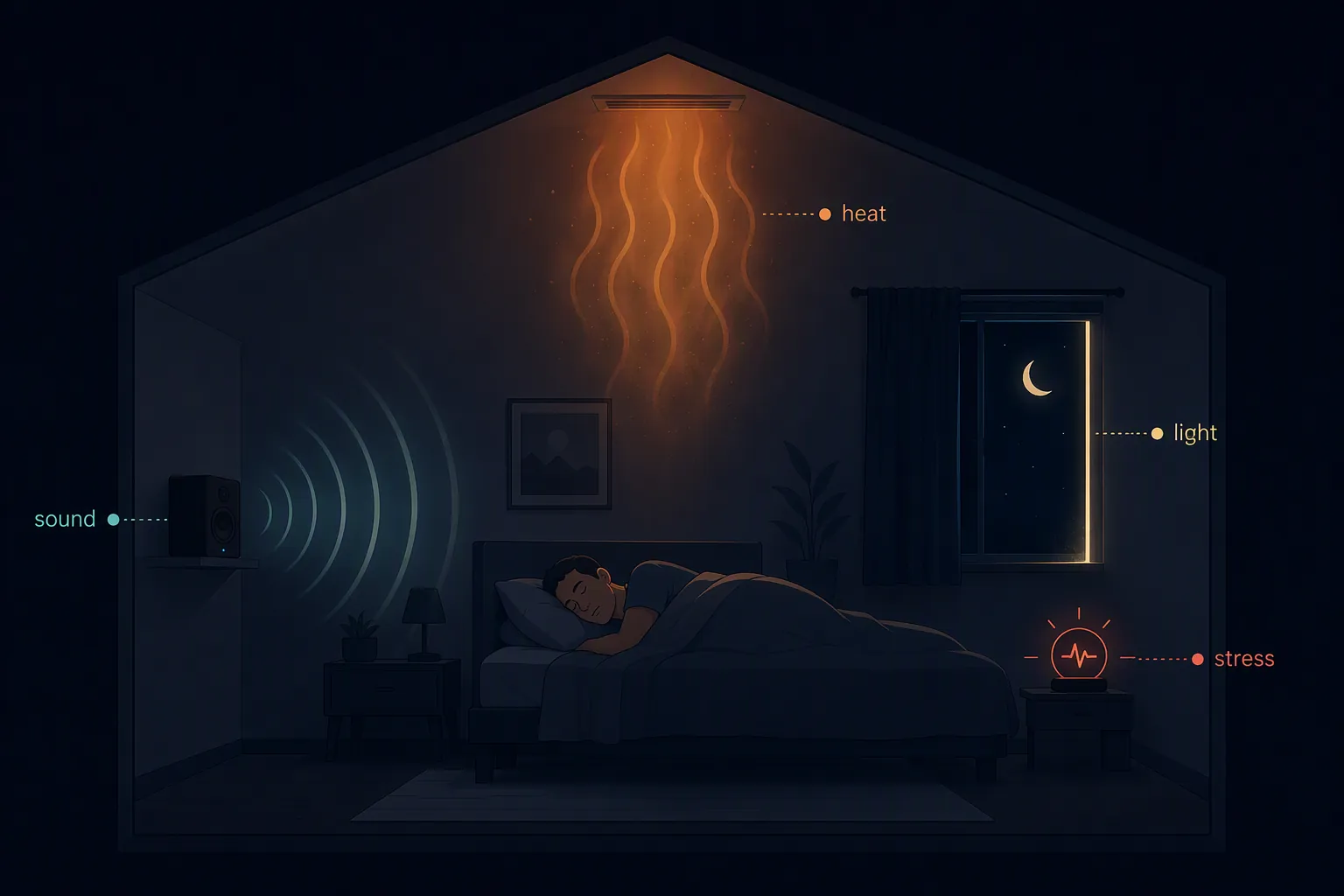
The four channels that usually break sleep during an outage
The useful way to think about an outage night is not “I failed to sleep because I checked my phone” or “I should have been tougher about the heat.” The bedroom system changed. Some of the evidence is strong and direct, especially for temperature. Some is more practical and consensus-based, especially for emergency behavior. The point is to match the confidence of the advice to the evidence behind it.
| Channel | What changes when power fails | Evidence tier and what it supports |
|---|---|---|
| Heat | Air conditioning, powered fans, and sometimes ventilation stop; indoor heat can accumulate overnight. | Mechanistic and observational support. In older adults, measured bedroom temperature was tied to lower sleep efficiency and shorter sleep duration as rooms warmed [1]. Large-scale wearable and weather-linked data also associate warmer nights with shorter sleep [2]. |
| Light | The room may become darker overall, but emergency lights, flashlights, and phone screens often become more intense and irregular. | Mechanistic and practical support. Darkness supports melatonin timing, while evening light exposure can interfere with sleep signaling [3]. |
| Sound | White-noise machines, fans, and HVAC hum stop; new sounds such as alarms, generators, sirens, or unfamiliar silence become more noticeable. | Practical and indirect support. Outage-health reviews identify disruptions to normal home conditions and stressors, but sound-specific outage sleep data are thinner than temperature data [4]. |
| Stress | The night becomes less predictable: battery levels, food safety, medical devices, weather alerts, and restoration estimates all compete for attention. | Observational, clinical, and consensus support. Power-outage health literature identifies mental-health and vulnerable-population concerns [4], while clinical commentary after a large blackout described anxiety, awakenings, nightmares, and recovery behaviors, though that source is not peer-reviewed research [5]. |
Heat is the channel with the least margin for error
Temperature deserves more space than the other channels because it is not only uncomfortable. It changes the body’s ability to maintain sleep, and for some sleepers it changes medical risk. In a study of 50 community-dwelling older adults across 10,903 person-nights, sleep was most efficient when nighttime ambient bedroom temperature was in the 20–25°C range. As bedroom temperature rose from 25°C to 30°C, sleep efficiency was associated with a 5–10% decrease; when temperature rose from 22°C to 30°C, total sleep time was about 60 minutes shorter [1].
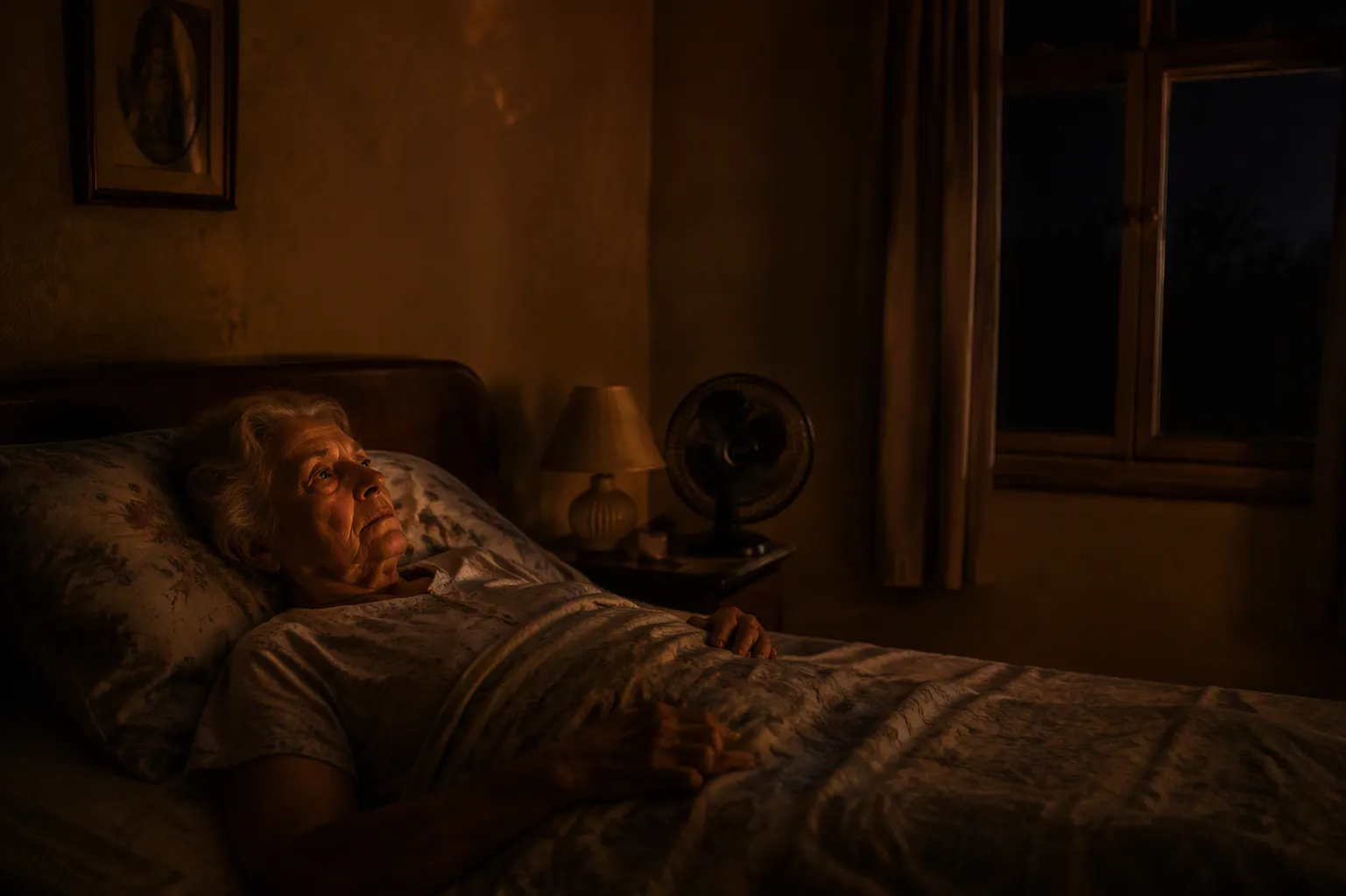
That finding is concrete, but it should not be flattened into a universal rule that everyone must sleep between 20°C and 25°C. The study was in older adults, and the authors reported meaningful variation between people [1]. Still, it gives shape to a problem many people recognize during an outage: once the room crosses from mildly warm to heat-retaining, sleep can become lighter, shorter, and more interrupted even before the night feels like an emergency.
Broader evidence points in the same direction, though with smaller average effects because it is spread across many climates and people. A study linking roughly 12 million nights of sleep from 14,232 U.S. adults with outdoor temperature found that a 10°C higher nighttime temperature was associated with about 2.6 minutes less sleep on average, with larger effects reported among females, people with chronic disease, lower-socioeconomic-status groups, and people on the West Coast [2]. That kind of average can sound modest until the room is your room, the air is still, and the sleeper is already vulnerable.
During an outage, the practical goal is to reduce heat load without pretending a bedroom can be optimized the way it is when the grid is working. Move to the coolest safe part of the home if one exists. Use light bedding. Avoid adding metabolic heat with heavy meals, alcohol, or unnecessary exertion late at night. If a battery fan is available, use it only in conditions where moving air helps rather than worsening heat strain; for the site’s detailed fan decision rule, see the fan-during-heat-wave outage guide. For cooling tactics that do not depend on air conditioning, use the more specific sleeping without AC during a heat wave and extreme heat without AC protocols rather than improvising at 2 a.m.
Light gets stranger, not simply darker
A blackout sounds like it should help darkness. Sometimes it does. The problem is that outage light is often badly timed and emotionally loaded: a phone held close to the face, a flashlight swept across the room, a bright lantern used for one small task, then a return to bed with the brain more awake than before.
Light matters because darkness supports melatonin production and the circadian signal for sleep; light exposure at night can delay or weaken that signal [3]. In an outage, the better move is not total darkness at all costs. It is controlled, low-intensity light for necessary tasks, then back to darkness. Keep one dim light source in a known place. Do not turn the phone into the room’s main lamp if you can avoid it. If you need to check an outage map, weather alert, or medical-device status, do it deliberately, not repeatedly from bed.
Sound changes twice: the familiar hum leaves, then the unfamiliar noise arrives
A fan is not only a cooling tool for many sleepers. It is also masking. When the fan and HVAC stop, small noises become more distinct: branches, neighbors, pets, traffic, a refrigerator trying and failing to restart, the house settling in a way you do not usually hear. Then the replacement noises begin — backup batteries chirping, generators outside, emergency vehicles, family members moving around with flashlights.
The outage-specific sleep evidence for sound is less direct than the temperature evidence, so the advice should stay modest. If silence is the problem, a battery-powered white-noise source, earplugs, or a downloaded sound track can help. If outside noise is the problem, masking may help some people but make others more anxious if they need to hear alerts. On storm nights, the setup is different: preserve the alerts that matter and reduce the rest. The site’s severe-storm sleep alert guide covers that balance more directly.
Stress is not just worry; it is the work of monitoring
The stress of an outage is unusually sticky because it keeps assigning tasks. Check the battery. Check the utility estimate. Check the freezer. Check whether the older parent is too warm. Check whether the CPAP battery will last. That kind of monitoring is not a personality flaw. It is a response to a suddenly unreliable environment.
Power-outage health reviews identify older adults and people who rely on electricity-dependent durable medical equipment as groups with particular vulnerability, and they describe mental-health consequences as part of the outage-health picture [4]. After the April 28 blackout in Spain and Portugal, clinicians at the IIS Sleep Research Institute described anxiety, stress, insomnia, awakenings, and nightmares after the event, along with recovery advice such as restoring routines, limiting news exposure, breathing exercises, and keeping the room dark and calm [5]. That IIS piece is useful clinical color, not a peer-reviewed measurement of what all outage sleepers experience.
The practical sleep move is to convert monitoring into intervals. Decide what actually needs checking, who checks it, and when. A person who checks the outage map every six minutes is not gaining six-minute safety; they are turning the bed into a command center. If the situation is medically relevant, the plan should move out of the bed and into action. If it is not medically relevant, the plan should be boring enough that the nervous system can stop negotiating with it.
When a bad night becomes a risk problem
National outage averages are useful only as background, not as a promise about your night. U.S. electricity customers averaged about five and one-half hours of power interruptions in 2022, about seven hours in 2021, and nearly two hours per year when major events are excluded, according to the U.S. Energy Information Administration [6]. Weather also matters: Climate Central reported that about 83% of major U.S. outages from 2000 through 2021 were weather-related [7]. Those numbers explain why sleep and outage planning belong in the same conversation. They do not tell you whether the room you are in tonight is safe.
The pivot point for many households is around eight hours. Joan Casey, quoted in ABC News, noted that outages lasting eight hours or more exceed most backup batteries and are when impacts for high-risk groups become more likely [8]. That is not a magic biological boundary. It is a practical threshold: food, medication refrigeration, device batteries, indoor heat, and caregiver attention all start to face different limits once the outage has lasted long enough to outlive the easy backup assumptions.
For a healthy adult in a tolerable room, one outage night is usually a sleep-quality problem. For someone with lower reserve, the same night can become a safety problem. The difference is not willpower. It is heat tolerance, physiology, equipment dependence, and whether there is a plan that still works after the first few hours.
CPAP, oxygen, and other electric-dependent devices
A CPAP user does not merely lose a convenience when power goes out. The machine stops unless it has a working power source. ResMed notes that CPAP devices shut off during a power outage; full-face masks have an anti-asphyxia valve, while nasal-mask users can breathe through the mouth, and their guidance also notes that a CPAP should be plugged into either a wall outlet or a battery, not both at the same time [9]. That is device-specific information from a manufacturer, so it should be treated as practical product guidance rather than independent clinical research.
Oxygen users, people using ventilatory support, and households with refrigerated medications need a preparation plan before the outage, not a bedside decision after the battery warning starts. The American Lung Association recommends planning for power outages as a medical device user, including use of utility medical-needs registries and attention to medication refrigeration requirements [10]. Full safety procedures belong in a dedicated checklist; for generator and carbon-monoxide precautions, use the power-outage-after-a-storm safety FAQ rather than relying on memory in the middle of the night.
Older adults, pregnancy, and perimenopause
Older adults deserve explicit attention because the bedroom-temperature data are not abstract for them. In the older-adult study, warmer nighttime indoor conditions were associated with meaningful drops in sleep efficiency and duration, and the authors emphasized individual differences [1]. In practice, that means the question is not only “Did they sleep badly?” It is also “Are they overheating, dehydrating, confused, unable to move to a cooler area, or waiting too long to ask for help?”
Pregnant people and perimenopausal women may also have less room to shrug off heat-fragmented sleep. The large temperature-and-sleep study found larger heat-associated sleep effects in females, among other groups [2]. That does not prove every pregnant or perimenopausal sleeper will respond the same way, and it does not replace medical advice. It does justify taking their reports seriously when a warm outage room feels unbearable sooner than it does for someone else in the household. For perimenopause-specific heat sensitivity, see the site’s guides to Miami heat and perimenopause sleep and cooler-weather sleep in perimenopause.
What helps on the night the power is out
The night-of plan should be small enough to follow when everyone is tired. Start with the channel that is actually driving the problem. If the room is hot, cooling and relocation matter more than another breathing exercise. If the room is tolerable but the phone has become an anxiety feed, the sleep problem is now light and stress. If the silence is keeping you alert, sound masking may be more useful than another trip to the window.
- Reduce heat load first: move to the coolest safe room, lighten bedding, avoid adding heat with unnecessary activity, and use battery-powered cooling only when it is appropriate for the conditions.
- Keep light purposeful: use a dim, known light source for necessary tasks, then return to darkness. Avoid making the phone the default lamp.
- Replace lost sound cues only if they help: earplugs, a battery sound source, or a downloaded track can work, but do not mask emergency alerts you truly need.
- Turn monitoring into a schedule: decide what needs checking, when, and by whom. Keep restoration estimates and news out of bed unless they change a safety decision.
- Escalate instead of troubleshooting sleep if the sleeper depends on powered medical equipment, the room is becoming dangerously hot, or an older adult, pregnant person, or otherwise low-reserve sleeper is deteriorating.
For a shorter, tonight-only version of outage sleep tactics, use the power-grid emergency sleep guide. This article is meant to explain why those tactics matter; the FAQ is meant to get you through the next few hours.
The next three nights after power returns
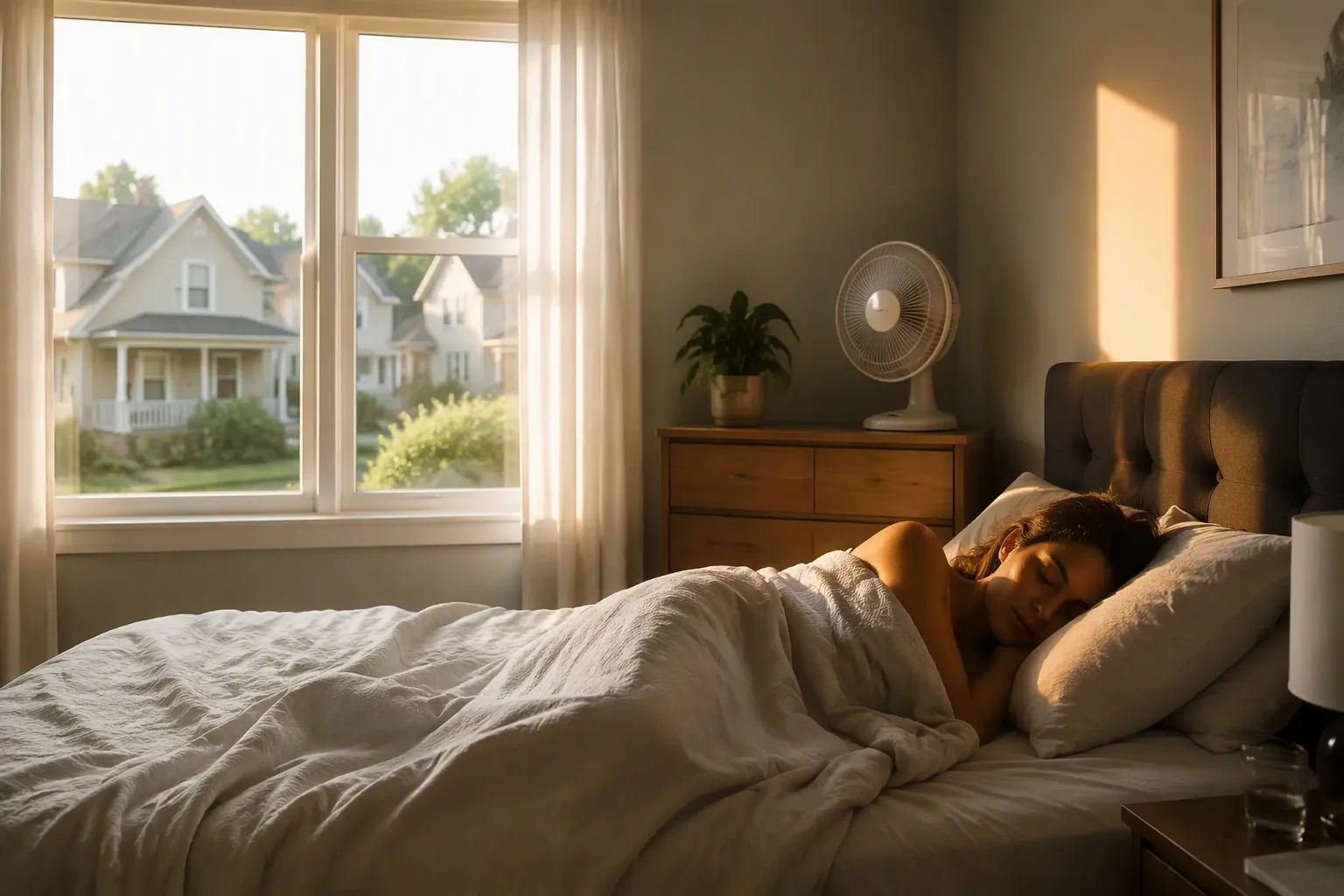
The first night after an outage can be oddly tense. The room is cool again, the devices work, and yet the body may still be listening for the next interruption. Clinical commentary after the Iberian blackout described most sleep symptoms as resolving in days, with recovery supported by routines, limited news exposure, relaxation practices, and a dark, calm sleep environment [5]. That is a reasonable frame for most healthy adults: expect rebound over days, not instant obedience from the nervous system.
Do not try to repay the entire sleep debt in one dramatic night. Go back to your usual wake time as closely as you can. Use morning light, normal meals, and ordinary wind-down cues. If you nap, keep it conservative enough that it does not steal pressure from the next night. Avoid turning the outage into a nightly postmortem in bed; if you need to make a household plan, do it earlier in the day with chargers, batteries, medication needs, and contact numbers in front of you.
If the outage was one bad night in a tolerable room, recovery is mostly about restoring cues and not overcorrecting. If it was long, hot, medically device-relevant, or hard on someone with low reserve, the next useful step is preparation before the next outage: power plans for devices, a cooling plan that does not depend on improvisation, and a clear threshold for leaving the bedroom problem behind and seeking safer conditions.
References
- Nighttime Ambient Temperature and Sleep in Community-Dwelling Older Adults — Science of The Total Environment, 2023
- Study links rising temperatures to reduced sleep in U.S. adults — Keck School of Medicine of USC
- Light and Sleep: Effects on Sleep Quality — Sleep Foundation
- Power outages and community health: a narrative review — Current Environmental Health Reports, 2020
- How the April 28 blackout affected sleep: anxiety, stress, and tips for recovery — IIS Sleep Research Institute, Madrid
- U.S. electricity customers averaged five and one-half hours of power interruptions in 2022 — U.S. Energy Information Administration
- Surging Power Outages and Climate Change — Climate Central
- How power outages can affect physical and mental health — ABC News
- Should I get a CPAP battery? — ResMed
- Preparing for a Power Outage as a Medical Device User — American Lung Association
Supports these guides
Spot an error or have clinical feedback?
Because this article covers clinical, medication, or safety information, we use a moderated correction channel instead of open public comments. Let us know if something about “How a power outage disrupts sleep quality (and what helps)” needs a closer look.
Send feedback on this article