Mechanism explainer
How to recover sleep after severe storms
Severe storms disrupt sleep through hyperarousal, overnight alerts, and anticipation — a predictable stress response, not a personal failure. Most people recover within days to weeks; here is what that recovery normally looks like, a day-by-evening plan for getting back on track, and the clear thresholds for when sleeplessness warrants professional care.
If a severe storm passed days ago and your sleep still feels wrecked, that does not mean you are weak, dramatic, or “bad at relaxing.” Storms are built to interrupt sleep: alerts arrive at night, the house makes unfamiliar sounds, radar changes fast, and your body may stay on watch long after the immediate warning has expired. The practical answer to how to recover sleep after severe storms starts with one idea: treat the next morning as the beginning of recovery, not as proof that the night ruined you.
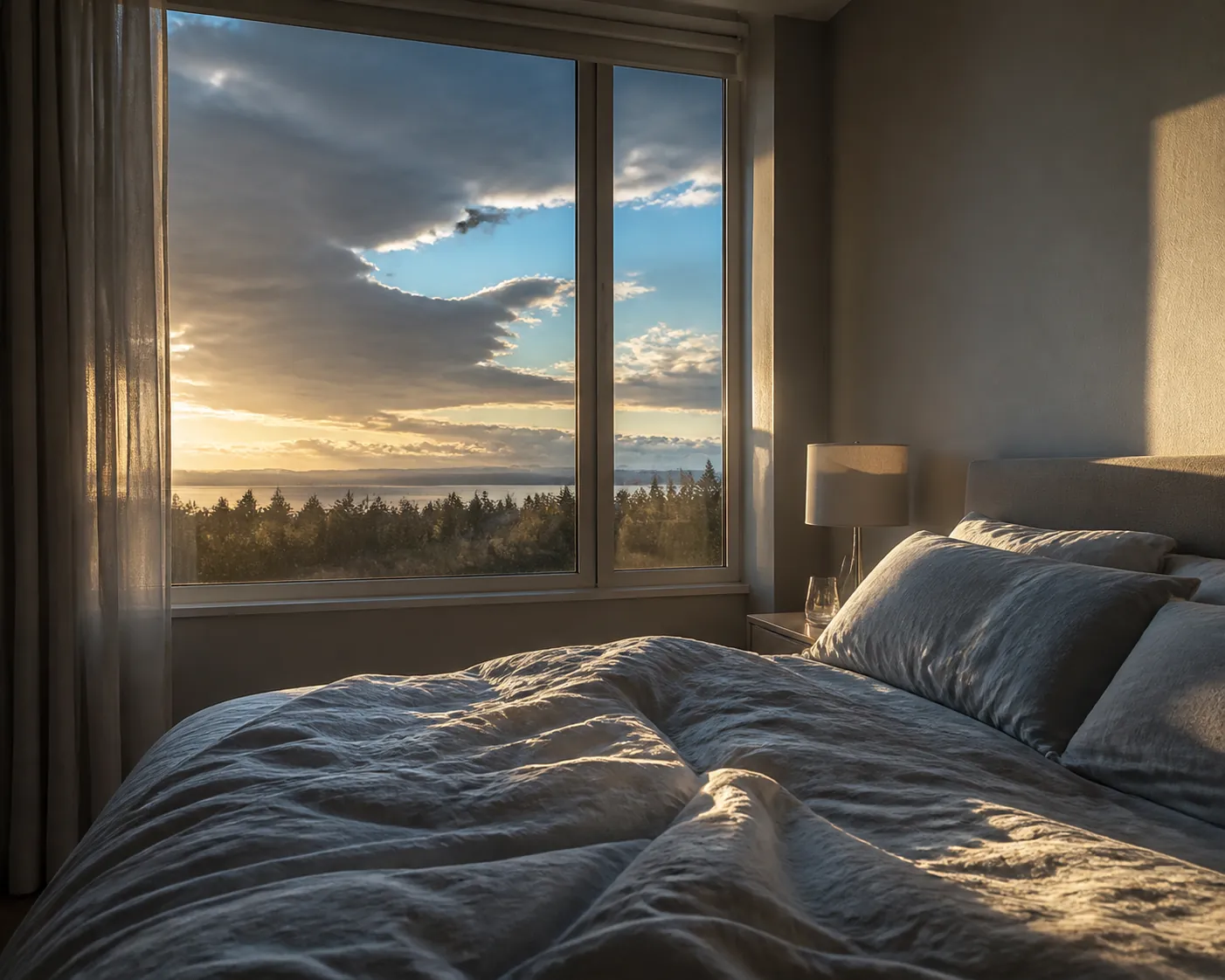
One bad storm night can leave you jumpy, foggy, and oddly tired-but-wired. A week of unsettled weather can do more: it can teach your brain that bedtime is when you have to monitor windows, batteries, trees, flood updates, and the phone on the nightstand. The goal is not to pretend none of that matters. The goal is to help your nervous system stand down when the threat has passed, while still leaving room for real safety checks when the next warning matters.
Why severe storms keep sleep broken after the sirens stop
Post-storm sleeplessness usually has more than one driver. The first is hyperarousal: the body’s alarm system stays partly switched on. You may feel your pulse jump at thunder, wake at a branch scrape, or lie still while mentally rehearsing what you would do if another warning came through. That is not irrational. It is a threat system trying to prevent surprise.
The second driver is the alert problem. Severe weather safety often depends on being reachable at night. People who live with tornado warnings, flash-flood risk, storm surge, or power outages cannot always put the phone in another room and call that good sleep hygiene. The phone may be both the thing that wakes you and the thing that keeps you safe.
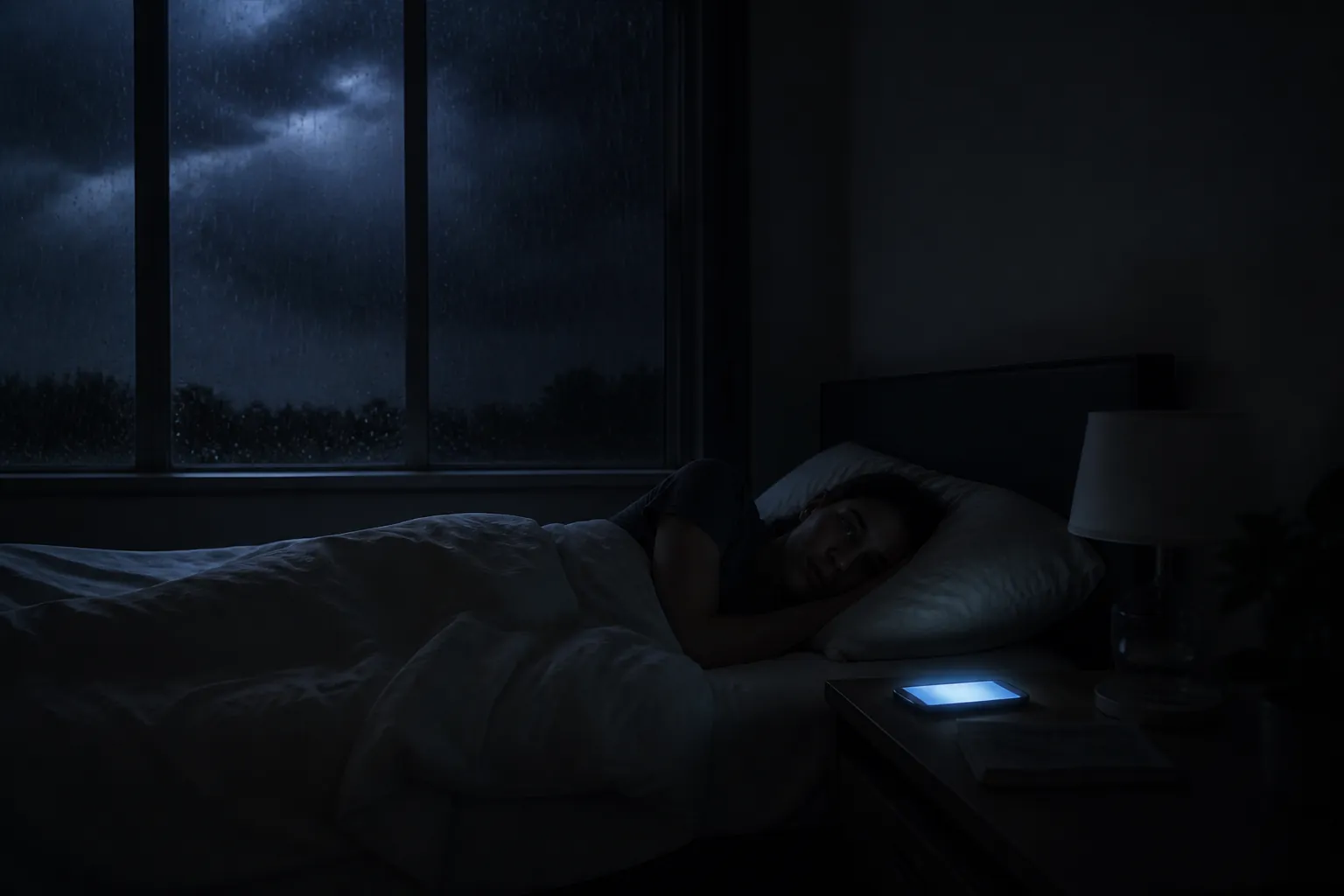
The third driver is anticipatory monitoring. Even after the storm line moves out, the brain may keep scanning: Is the roof leaking? Did the creek rise? Is that another cell forming west of town? Media exposure can feed that loop, especially when radar, damage reports, and social feeds stay open late into the evening. The checking may begin as responsible safety behavior. It becomes a sleep problem when the body never receives a clear “off-duty” signal.
This is why “just relax” lands so badly. A person who has to be alert for weather, children, older relatives, pets, property damage, or a possible midnight evacuation is not simply refusing calm. Recovery works better when it gives that responsibility a container: what must be checked, when it will be checked, and when the body is allowed to stop rehearsing.
What is normal, and for how long?
Sleep research after disasters is useful, but it has to be handled carefully. A typhoon, a hurricane, an earthquake, and a local severe thunderstorm do not produce one clean recovery curve. The best studies tell us that sleep disruption after major events is common and clinically important; they do not let anyone calculate exactly how your body should feel on night four after a storm.
One storm-relevant anchor comes from a Korean study of 1,358 disaster victims exposed to events including typhoons and heavy rain. In that sample, 23% had poor subjective sleep quality, and typhoon exposure was associated with 2.75 times the odds of poor sleep compared with earthquake exposure.[1] That does not mean one in four people will sleep poorly after every severe storm. It does mean that storm-related sleep disruption is a recognized pattern, not a private failure.
Hurricane data point in the same direction. In a study of 296 low-income young women assessed one month after Hurricane Ike, 39% were classified as poor sleepers using a Pittsburgh Sleep Quality Index score of 5 or higher. The more important finding was not only prevalence: perceived stress stayed elevated for a year among poor sleepers, while stress declined among good sleepers.[2] Sleep quality was tied to recovery, not just comfort.
A preliminary conference abstract from a Haiti earthquake cohort reported an even larger figure: 94% of 165 participants reported insomnia symptoms after the disaster.[3] That number is powerful for normalization, but it should not be treated as a forecast for storm survivors. It came from an earthquake cohort and an abstract, not a full paper that can answer every follow-up question about sampling, severity, housing disruption, or long-term sleep course.
Longer-term data make another point that matters after storms: persistent insomnia is often maintained by ongoing stress, not by attitude. In a study of older survivors 2.5 years after the Great East Japan Earthquake, 41.4% had insomnia symptoms. Financial hardship predicted persistence, while instrumental social support was protective, with reported relative risks ranging from 0.46 to 0.70.[4] If your sleep is being kept broken by displacement, repairs, insurance calls, lost income, caregiving, or fear that your home is no longer safe, a bedtime routine may help around the edges, but it is not the whole treatment.
The clinical reason to take post-storm sleep seriously is the two-way relationship between sleep and trauma symptoms. In a 2023 study after the Great East Japan Earthquake, pre-disaster sleep insufficiency predicted onset of post-traumatic stress symptoms, and poor post-disaster sleep was linked with slower recovery from those symptoms; the reported prevalence ratios were 1.40 for onset and 0.77 for recovery.[5] In plain terms, poor sleep can make distress harder to recover from, and distress can keep sleep unstable.
So what is normal? A few rough nights after a severe storm are very common. A week of lighter, more interrupted sleep can still fit a stress-response pattern, especially if alerts, cleanup, heat, power loss, or housing worries continued. Several unsettled weeks deserve attention, not panic. Symptoms that persist, worsen, or start to look like trauma or chronic insomnia should move you from self-management into professional support.
Start recovery the morning after, even if the night was terrible
The most useful recovery move happens before the next bedtime: get up close to your usual rise time and get morning light. Sleep physicians interviewed by NPR’s Life Kit emphasize a consistent rise time, morning light, avoiding sleeping in, keeping naps early and limited, cutting off caffeine around midday, using an evening wind-down, and getting out of bed during prolonged middle-of-the-night wakefulness. They also make the point many tired people need to hear: more time in bed does not automatically equal more sleep.[6]
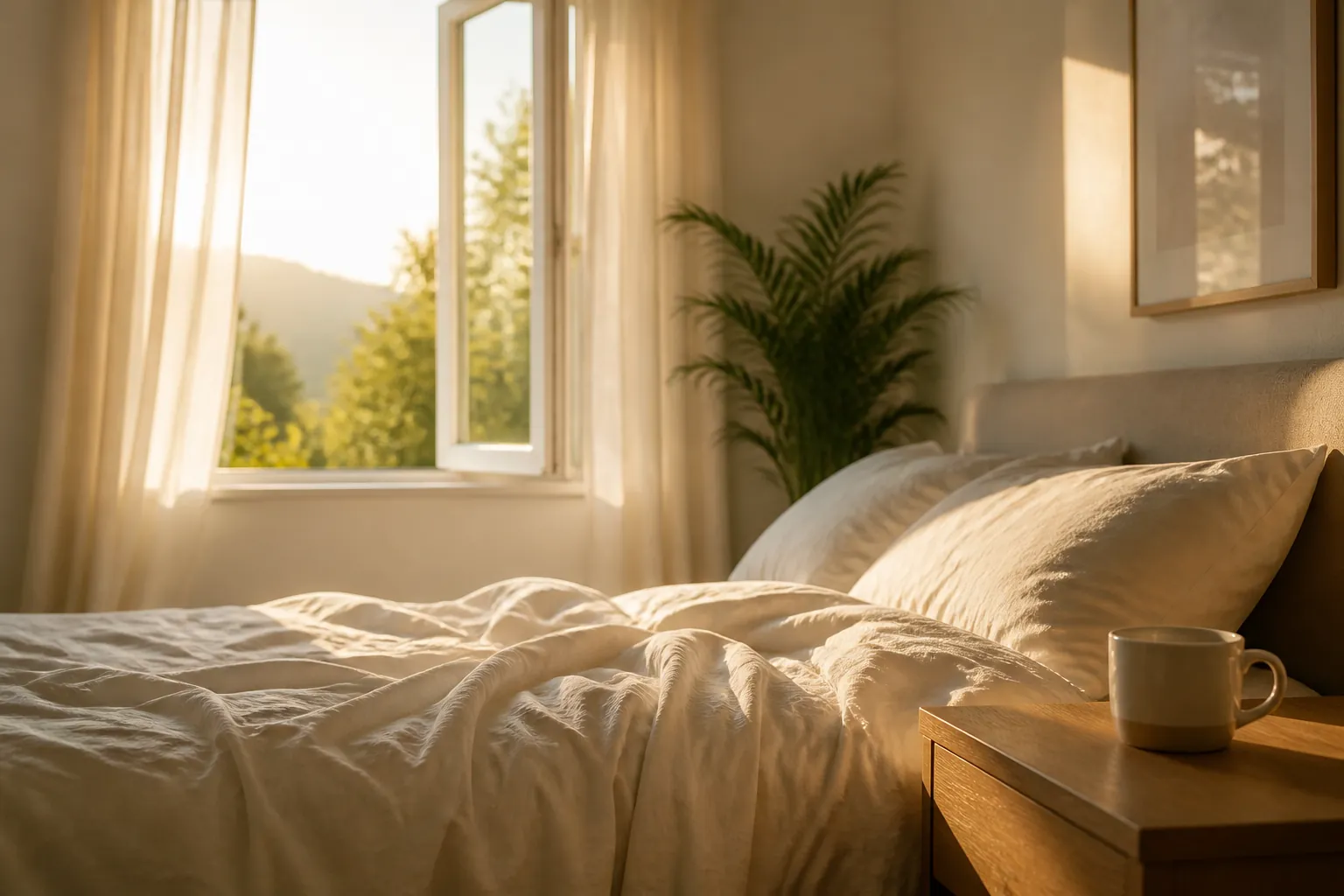
That can feel unfair. After a 2:17 a.m. alert, a long radar watch, and maybe a power outage, the body wants compensation. But sleeping far into the morning can push the next night later, which keeps the storm from being one bad night and turns it into a shifted schedule. If you can, anchor the day with light, food, movement, and the same basic morning order you would use on an ordinary day.
| When | What to do | Why it helps |
|---|---|---|
| Morning | Get up near your usual rise time and get outdoor or bright window light. | Light and timing help reset the sleep-wake rhythm after an interrupted night. |
| Late morning to early afternoon | If you truly need a nap, keep it early and under about 1 hour. | A short early nap can reduce dangerous sleepiness without stealing too much sleep pressure from tonight. |
| Midday | Make caffeine a morning tool, not an all-day rescue plan. | Late caffeine can keep the body alert when it needs to come down. |
| Evening | Create a brief safety check and then a real wind-down. | The brain rests better when it knows what has been handled and when checking is done. |
| Middle of the night | If you are awake too long and there is no active warning, leave the bed briefly for something quiet and dim. | This protects the bed from becoming the place where the storm is mentally replayed. |
Keep the nap useful, not sprawling
A nap after a storm night is not a moral failure. It may be the safest choice if you are too sleepy to drive, use tools, manage medications, or care for someone else. The problem is the late, open-ended nap that starts as recovery and ends as a second sleep schedule. If you nap, make it early enough that bedtime still has a chance, and keep it short enough that you wake before the day disappears.
If you are caring for children, older adults, or neighbors after storm damage, the perfect nap rule may not fit. Use the principle instead: take the smallest rest that makes the day safer, then return to a normal light-dark schedule as soon as conditions allow.
Use caffeine like a tool with an expiration time
Caffeine can help you function after a night of alerts, but it is easy to keep dosing yourself through the afternoon because the day feels unreal. The cleaner plan is morning caffeine, maybe a modest early top-up if you normally tolerate it, and then a cutoff around midday. That gives tonight’s sleep pressure a chance to build instead of making bedtime another fight with your own chemistry.
Give weather checking a boundary before evening
Post-storm monitoring is not the same as pointless worry. If the ground is saturated, another line of storms is forecast, or the power grid is unstable, you may need information. What sleep cannot survive is an undefined checking loop that runs until midnight. For readers who already know they get stuck in alert-driven hypervigilance, a related guide on sleep during severe wind and power outages goes deeper into using one intentional check instead of repeated reassurance checks.
A practical evening boundary can be simple: check the forecast from a reliable source, confirm which alerts must stay audible, charge the phone, place shoes and a flashlight where you can reach them, and then stop updating unless a new alert arrives. That is different from pretending the weather is harmless. It is assigning the safety job to a short routine instead of letting it occupy the whole night.
Build a wind-down that closes the storm file for the night
After severe weather, a wind-down needs to do more than look peaceful. It has to answer the brain’s unfinished questions. Try making two short notes before bed: what has been checked, and what will be handled tomorrow. “Roof looked dry at 8:30. Phone charged. Weather radio set. Call landlord at 9.” The details matter because they reduce the need to keep re-solving the same problems in bed.
Then move into lower-stimulation cues: dimmer light, a shower if conditions allow, familiar music, a boring book, gentle stretching, or a quiet task that does not reopen storm coverage. If you want a broader environmental angle, this guide to weather forecasts and sleep preparation is more useful before the next system rolls in; for tonight, keep the routine short and repeatable.
If you wake at 3 a.m., do not turn the bed into a command center
Middle-of-the-night waking is where post-storm sleep often gets trained in the wrong direction. You wake, listen, check the phone, scan radar, read damage updates, calculate tomorrow’s exhaustion, and now the bed has become a place for threat review. If there is an active warning, safety comes first. Take shelter, check what must be checked, and do not scold yourself for being awake.
If there is no active warning and you are clearly awake, leave the bed for a short, quiet reset. Keep lights dim. Do something dull. Avoid storm footage, insurance research, group chats, and anything that asks your body to mobilize. Return to bed when sleepiness comes back, not when you have forced yourself to “finish” worrying.
This is not about winning the night. It is about protecting the association between bed and sleep. One rough night is easier to recover from than a week of lying in bed alert, frustrated, and braced for the next sound.
The next few nights: expect recovery, but do not demand instant normal
Sleep after a storm may return unevenly. You might get one deep, heavy night and then a vivid-dream night. In the NPR Life Kit interview, sleep physicians described a rough expert rule of thumb after one lost night: the body may prioritize slow-wave sleep first and REM sleep later, so full recovery can take roughly two nights. That is expert opinion, not a controlled severe-storm recovery trial, but it is a helpful counterweight to the belief that one bad night must be fixed in one perfect sleep.[6]
For the next several days, keep the plan almost boring: stable wake time, morning light, cautious naps, midday caffeine cutoff, an evening safety closeout, and the out-of-bed rule if wakefulness turns into rumination. The repetition is the intervention. It tells the body that the storm happened, the response was real, and the schedule is safe to re-enter.
If the house is hot after a power outage, if you are sleeping somewhere unfamiliar, or if repairs are still underway, do not interpret every bad night as anxiety. Heat, noise, crowding, light, and loss of routine can all keep sleep fragmented. Older adults can be especially vulnerable when weather changes disrupt temperature control, medication timing, or daytime activity; this piece on heat domes and sleep in older adults may be useful if the storm left you recovering in unsafe heat.
When self-management is no longer enough
There is a difference between a nervous system settling down and a sleep problem taking root. The Anxiety and Depression Association of America advises seeking help if storm-related anxiety symptoms persist more than a few weeks, and notes that PTSD involves symptoms lasting at least one month, including patterns such as re-experiencing, nightmares, and arousal.[7] The University of Texas Medical Branch advises seeking support if post-disaster symptoms persist for about six weeks or increase in frequency or severity.[8]
A separate insomnia threshold matters too: chronic insomnia is commonly defined as sleep difficulty at least three nights per week for at least three months.[6] You do not have to wait three months to ask for help, especially if sleep loss is affecting driving, work, caregiving, blood pressure, mood, panic symptoms, substance use, or your ability to feel safe in your own home.
Professional support is especially warranted if you are having repeated nightmares or flashbacks, avoiding normal places or routines because they bring the storm back, feeling constantly on guard, or finding that every new forecast sends your body into the same alarm state. It is also warranted when the real-world stressor has not ended: displacement, financial strain, housing damage, or caregiving overload can keep the body awake because the problem is still present.
Sleep recovery after severe storms is not cosmetic self-care. It is one of the earliest ways to keep stress from becoming self-reinforcing. The phone may need to stay on. The weather may need to be checked. But once the immediate danger has passed, the schedule needs protection too: morning light, a steady rise time, contained checking, and a bed that is allowed to become a bed again.
References
- Subjective Sleep Quality and Its Affecting Factors among Korean Disaster Victims, International Journal of Environmental Research and Public Health, 2021.
- Sleep Quality, Perceived Stress, and Psychological Distress in Hurricane Ike Survivors, SLEEP, 2015.
- Disturbed Sleep Linked to Mental Health Problems Among Natural Disaster Survivors, American Academy of Sleep Medicine, 2019.
- Persistent Insomnia Following the Great East Japan Earthquake: A Prospective Cohort Study, SLEEP, 2018.
- Bidirectional Association Between Sleep Insufficiency and Post-traumatic Stress Symptoms After a Natural Disaster, SLEEP, 2023.
- How to Recover From a Bad Night’s Sleep, NPR Life Kit.
- Hurricane Season Is Here: How to Reduce Your Anxiety, Anxiety and Depression Association of America.
- Tips for Self-Care and Recovery Post-Disaster, University of Texas Medical Branch, 2017-10-02.
Supports these guides
Spot an error or have clinical feedback?
Because this article covers clinical, medication, or safety information, we use a moderated correction channel instead of open public comments. Let us know if something about “How to recover sleep after severe storms” needs a closer look.
Send feedback on this article