
The clearest answer to how temperature affects sleep quality does not come from a neat laboratory night with one volunteer and one thermostat setting. It comes from ordinary nights, many of them imperfectly measured, accumulated until the pattern is hard to dismiss. In the USC All of Us analysis, 14,232 adults contributed more than 12 million nights of wearable sleep data, and a 10°C increase in nighttime temperature was associated with 2.63 fewer minutes of sleep per night.[1]
That number is modest enough to sound forgettable if it is treated as a single-night inconvenience. It is not modest when it repeats across heat waves, seasons, and decades. The same study projected that U.S. adults could lose 8.5 to 24 hours of sleep per person each year by 2099 as nighttime temperatures rise.[1] This is the point at which “keep the room cool” stops being a lifestyle phrase and becomes a measurable exposure.

The Large-Dataset Finding Is Small Per Night, Large In Aggregate
A few lost minutes can be clinically and socially invisible in the short term. People round their bedtime. Wearables estimate sleep rather than directly observe brain states. Work schedules, stress, illness, bedding, air conditioning, and neighborhood conditions all move at the same time. Those are real limitations, and they are why a wearable study should not be read as if it were a controlled sleep-lab experiment.
But the All of Us result matters because it is not trying to prove that one hot night ruins everyone’s sleep in the same way. It shows that, across a very large real-world sample, warmer nights are associated with shorter sleep, and the association is not evenly distributed. The reported effects were larger among Hispanic individuals, people with chronic disease, people with lower socioeconomic status, and West Coast residents.[1] Temperature, in this dataset, is not merely a bedroom preference. It tracks with the unequal ability to avoid heat.
That distinction matters for households that cannot simply lower a thermostat. A person in a well-insulated home with affordable cooling experiences nighttime heat differently from a renter in a warmer building, an older adult avoiding a high electric bill, or someone whose chronic disease already fragments sleep. The same outdoor temperature can become different sleep exposures depending on housing, income, health, and local climate.
Indoor Data Shows the Problem Does Not Disappear Behind Walls
The ResMed/Oxford analysis is useful here because it looks directly at bedroom conditions rather than only outdoor heat. In that study, 34,096 individuals contributed sleep and bedroom-temperature data, and 69% of measured nights had bedroom temperatures above 70°F, described as above the evidence-supported optimal range.[2] For each 1°F increase above the optimal range, sleep efficiency dropped by 0.06%, total sleep time decreased, and sleep onset lengthened.[2]
A 0.06% decrease in sleep efficiency per degree is easy to underrate because the unit is small. Sleep efficiency is a ratio: time asleep divided by time in bed. If a bedroom is only slightly warm, the penalty may be barely noticeable. If it is several degrees above the preferred range night after night, the exposure accumulates through shorter sleep, slower sleep onset, and more time awake in bed.
This is also where tracker-based evidence becomes more persuasive in spite of its messiness. A bedroom sensor or connected device does not eliminate confounding. It does, however, catch sleep where people actually sleep: with imperfect routines, uneven cooling, partners, pets, medications, late meals, and inconsistent bedtimes. A signal that survives ordinary life deserves attention, even if it should not be mistaken for a clinical diagnosis.
The Curve Is Not a Straight Line
The most useful temperature evidence is not the familiar advice to keep a bedroom somewhere around the low-to-mid 60s Fahrenheit. That range can be a reasonable starting point for many adults, and it aligns with common clinical guidance, but it can also make the problem sound falsely exact. The more important pattern is nonlinear: small shifts inside a comfortable range may matter little, while movement above a threshold can produce a sharper decline.
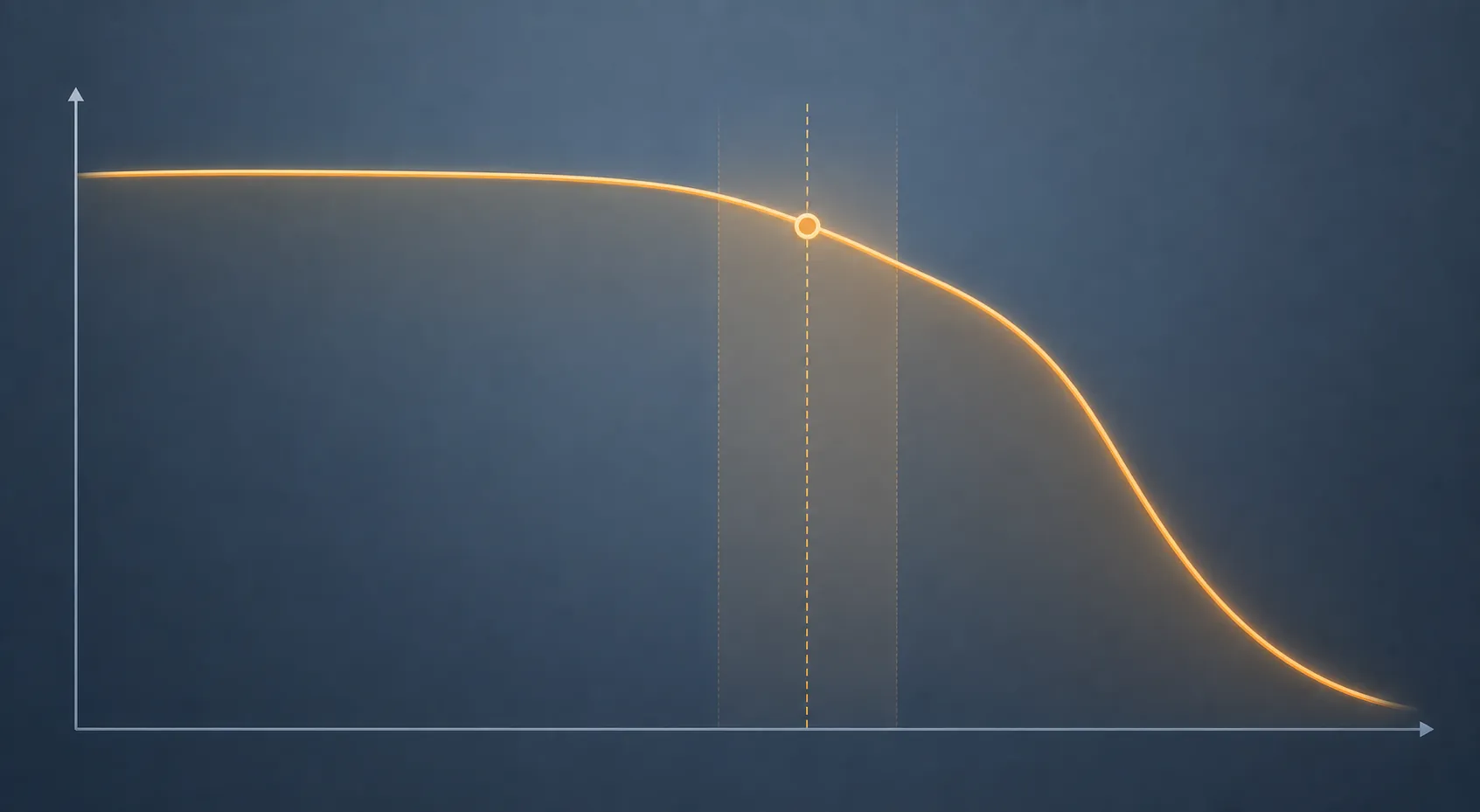
The older-adult study by Baniassadi and colleagues makes that curve visible. In 50 older adults observed across 10,903 person-nights, sleep efficiency was highest when bedroom temperature was 20–25°C, or 68–77°F.[3] When temperature rose from 25°C to 30°C, sleep efficiency fell by 5–10%, an effect size the researchers described as comparable to evening alcohol or nicotine consumption.[3]
That finding does not make the 60–67°F recommendation useless. It makes it less universal. Older adults may have different thermal needs, and the Baniassadi sample was small and not broadly representative: it included 50 participants, most of whom were White, female, and well educated.[3] The proper conclusion is narrower and more useful: for at least this older-adult sample, the best observed range was warmer than the usual clinical bedroom-temperature advice, and the real trouble appeared as temperatures climbed above about 25°C.
| Evidence | What It Measured | Temperature Pattern | Practical Meaning |
|---|---|---|---|
| USC All of Us | More than 12 million wearable-tracked nights from 14,232 adults | A 10°C nighttime increase was associated with 2.63 fewer minutes of sleep | Warm nights have measurable population-scale sleep costs |
| ResMed/Oxford | Bedroom temperature and sleep data from 34,096 individuals | Each 1°F above the optimal range was associated with lower sleep efficiency and longer sleep onset | Indoor warmth still matters in real homes |
| Baniassadi et al. | 10,903 person-nights from 50 older adults | Best observed efficiency at 20–25°C; sharper decline from 25°C to 30°C | Older adults may not fit a single cool-room target |
The table should not be read as three interchangeable thermostat prescriptions. The studies differ by population, measurement method, and temperature exposure. What converges is the direction of the evidence: warmer conditions, especially beyond a comfortable range, are associated with worse sleep duration, efficiency, or continuity.
Why One Ideal Number Keeps Failing
A single ideal bedroom temperature is attractive because it turns sleep into a setting. The evidence is less tidy. Age changes thermoregulation. Bedding changes heat retention. Humidity changes how heat feels and how effectively the body can cool itself. Chronic illness, medications, menopause symptoms, body size, housing quality, and whether someone sleeps alone can all shift the practical comfort zone.
The systematic review by Chevance and colleagues helps place these individual studies in a broader literature. Published in Sleep Medicine Reviews in 2024, it found that higher outdoor and indoor temperatures are associated with degraded sleep quality and quantity across measures, seasons, and populations worldwide, while also noting limited evidence of fast adaptation to heat during sleep.[4]
Limited fast adaptation is an important phrase. People may become accustomed to living in warmer climates in many ways: clothing, daily schedules, architecture, air-conditioning use, and expectations all change. Sleep still appears vulnerable when nighttime heat remains high. The body’s cooling requirements during sleep do not disappear because a person has lived through previous summers.
The Mechanism Is Simple Enough, But It Is Not the Main Story
Sleep is partly a thermoregulatory event. Core body temperature tends to decline around sleep onset, and heat can interfere with the body’s ability to initiate and maintain sleep. Reviews of the thermal environment and sleep describe links between heat exposure, circadian regulation, sleep onset, and sleep continuity.[5][6]
Humidity can make the same temperature more burdensome. Temperature and humidity can interact synergistically, and not all studies controlled humidity in the same way. This helps explain why a threshold from one dataset should not be lifted out of context and treated as a universal cutoff.
Mechanism explains why the association is plausible. It does not, by itself, tell a household what to do on a hot night, or how much sleep a population loses when warmer nights become more common. That is why the real-world datasets carry the center of the argument.
What to Do With This Evidence at Home
The most evidence-consistent response is not to chase one perfect thermostat number. It is to treat bedroom temperature as a trackable sleep exposure. If sleep worsens during warm stretches, compare nights by temperature band rather than by memory: cooler-than-usual nights, mildly warm nights, and nights above the point where sleep onset or awakenings noticeably worsen.
For many adults, a cooler bedroom remains a sensible first experiment. For older adults, the Baniassadi findings argue for more caution: a room that is too cool may not be ideal, and the observed optimal range in that sample was 68–77°F.[3] The practical question is not whether 65°F or 72°F wins in the abstract. It is whether a person’s sleep efficiency, wake-ups, and morning functioning improve when the bedroom is kept out of the range where heat becomes disruptive.
Readers who want a practical cooling checklist can use hot-weather sleep cooling strategies for tactics such as reducing heat buildup before bedtime, and a data-driven sleep environment guide for broader targets across temperature, light, noise, and air quality. The evidence here is the reason those adjustments belong in the same conversation as alcohol, nicotine, chronic pain, and other serious sleep disruptors.
Climate Makes the Personal Pattern Harder to Keep Personal
The climate projection in the USC work is not separate from the nightly data. It follows from the dose-response. If warmer nights are already associated with shorter sleep, and if warmer nights become more frequent, then a small nightly penalty becomes an annual burden. The projected 8.5–24 hours of sleep loss per U.S. adult per year by 2099 should be read in that light: not as a prediction that every person will lose the same amount, but as a population estimate built from observed temperature-sleep associations.[1]
The uneven effects reported in the All of Us study are just as important as the average.[1] Heat resilience is not only a matter of bedtime discipline. It depends on housing quality, cooling access, neighborhood heat exposure, health status, and the cost of keeping indoor environments safe enough for sleep. A person can do everything normally recommended for sleep hygiene and still lose sleep because the night remains too warm.
Temperature belongs beside the major sleep disruptors because it changes sleep in measurable ways and because it can be modified, at least partly, through room conditions, bedding, ventilation, cooling access, and public-health planning. The best answer is not a universal thermostat command. It is a more careful habit: measure the bedroom environment when possible, notice the temperature range where sleep begins to deteriorate, and recognize that future sleep health will depend increasingly on heat resilience as much as bedtime behavior.
References
- USC All of Us study on nighttime temperature and sleep, USC Keck School of Medicine, 2025.
- ResMed myAir data + Oxford Academic analysis, Oxford Academic, 2020.
- Nighttime ambient temperature and sleep in community-dwelling older adults, Science of The Total Environment, 2023.
- Sleep quality and quantity as affected by temperature exposure: A systematic review, Sleep Medicine Reviews, 2024.
- Effects of thermal environment on sleep and circadian rhythm, 2012.
- The Temperature Dependence of Sleep, Current Biology, 2018.
Comments
Join the discussion with an anonymous comment.