
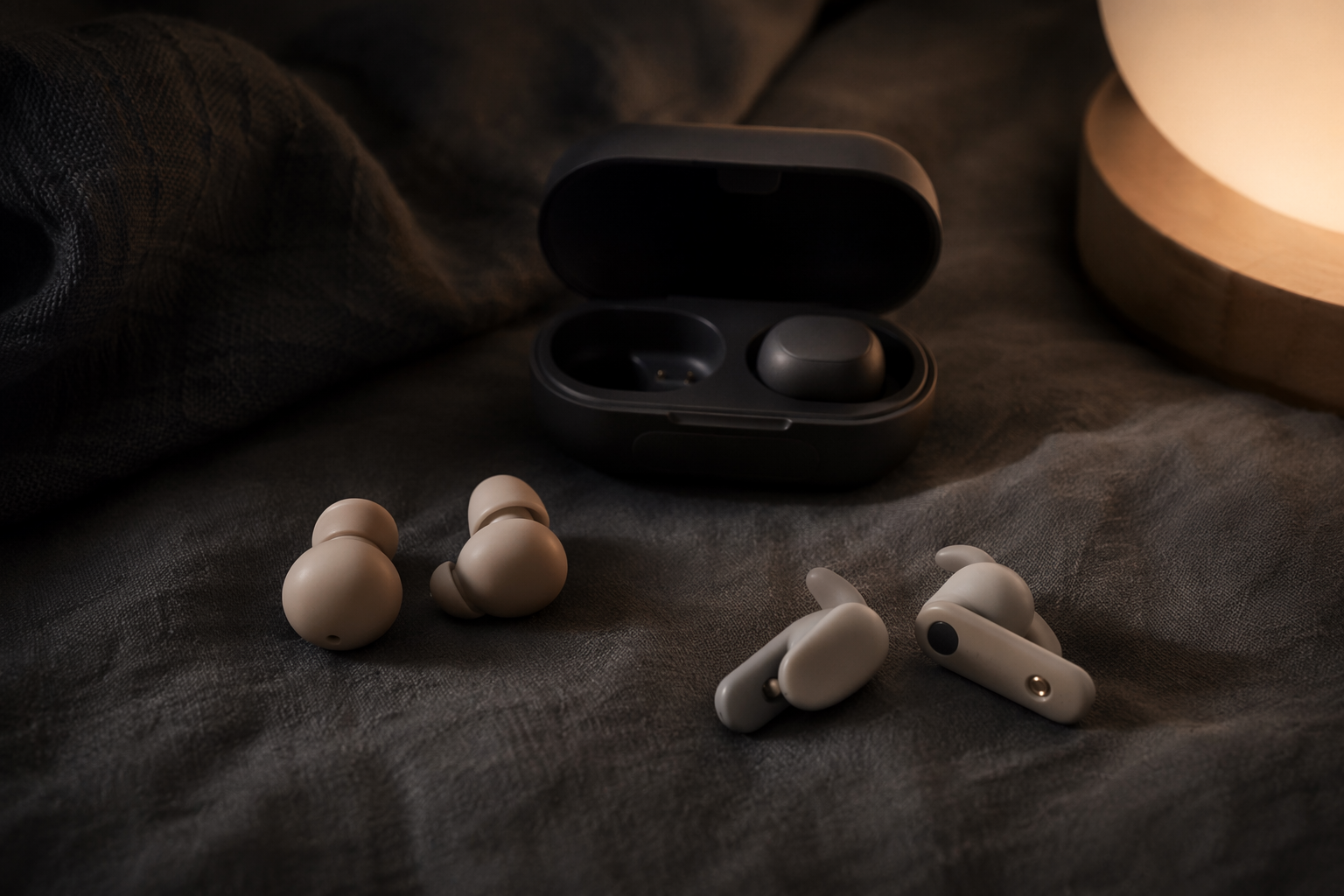
Bose Sleepbuds II are gone in the way that matters to a tired person at 11:47 p.m.: they are discontinued, the app was removed from app stores in 2024, and used or new-old-stock units are a bad bet in 2026. Even if the hardware still looks fine in a drawer, sleep earbuds that depend on a vanished app are not a sleep solution. They are a charging case with memories.
That matters because Bose Sleepbuds II did one unusually specific job well. They were not tiny AirPods for bed. They were small, side-sleeper-friendly buds built around preloaded masking sounds rather than open Bluetooth streaming, and Bose positioned them as a sleep product first when it relaunched the second generation in 2020.[1] The frustrating part is that the idea was not silly. In a pilot study of frontline healthcare workers using Bose Sleepbuds II, Insomnia Severity Index scores fell from 15.7 to 8.0, perceived sleep onset latency fell from 24.7 to 17.2 minutes, and adherence was 93.5%.[2] That does not prove a modern rival will do the same thing. It does give us a useful benchmark: a sleep earbud has to work under sleep conditions, not just win a feature comparison.
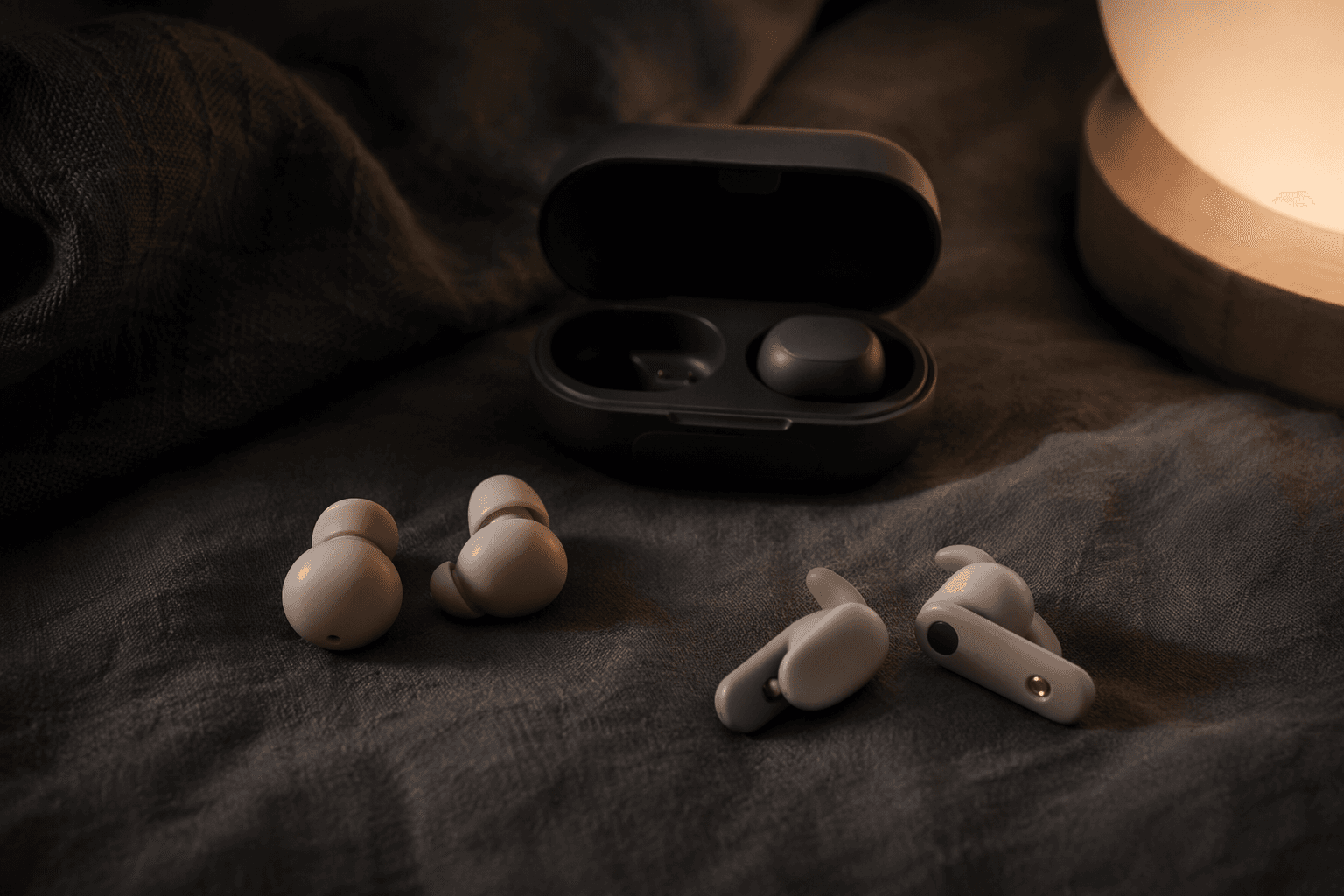
The replacement market did not move in one clean line. It split. Some products kept the Bose-like promise of passive isolation plus masking sounds. Some added active noise cancellation and adaptive snore masking. Some became miniature sleep-tech platforms with streaming, biometric sensors, and room monitoring. Those are different answers to different sleep problems.
| Approach | Best fit | What changed after Bose Sleepbuds II | Main compromise |
|---|---|---|---|
| Passive masking earbuds | Traffic hum, HVAC noise, light household sound, racing thoughts | Streaming or customizable sound libraries replaced Bose’s closed audio model | No ANC, limited help against abrupt snoring |
| ANC plus adaptive snore masking | A bed partner who snores in bursts or changes volume through the night | The earbuds try to reduce noise and respond to snore patterns instead of only covering them | Shorter battery life than simpler modes, more system complexity |
| Hybrid sleep-tracking earbuds | People who want soothing audio plus consumer sleep data in one device | Bluetooth streaming, biometric sensing, and environmental monitoring joined the sleepbud format | Tracking is not the same as clinical-grade sleep measurement |
Match the earbud to the thing keeping you awake
The wrong way to shop for Bose Sleepbuds II alternatives is to ask which one is “the new Bose.” That question leads straight into brand comparison pages, spec tables, and the kind of replacement language that makes every product sound inevitable. A better question is more annoying but more useful: what exactly is preventing sleep?
- If the problem is steady environmental noise — traffic, a neighbor’s TV, an air conditioner, a hotel hallway — passive isolation plus masking may be enough.
- If the problem is a partner who snores unpredictably, especially in bursts, look first at ANC plus adaptive snore masking.
- If the problem is a brain that keeps asking for one more podcast, rain loop, audiobook, or meditation track, audio flexibility matters more than Bose nostalgia.
- If the problem is wanting to know how you slept, treat earbud-based sleep tracking as consumer feedback, not a medical measurement.
Battery figures also need to be read by mode. A sleep earbud that lasts through the night on preloaded sounds may not last as long while streaming. A product using ANC may drain differently from one playing a stored soundscape. For sleep, “up to” is less interesting than “will it survive my actual night in the mode I plan to use?”
Soundcore Sleep A20: the simpler masking-first answer
Soundcore Sleep A20 is the easiest current product to understand if what you miss about Bose Sleepbuds II is the basic idea: small earbuds, sleep-focused fit, and masking audio rather than full headphone behavior. Wirecutter names the Sleep A20 its top pick, citing 14 hours of battery life with preloaded audio, 10 hours while streaming, customizable three-layer soundscapes, and puffy stability wings intended to help the buds stay comfortable for side sleepers.[3]
That combination fixes one of Bose’s most irritating design choices: you are not trapped inside a closed library. The A20 can still behave like a sleep sound machine in your ears, but it can also stream. For people who fall asleep to a familiar podcast, brown noise from a preferred app, or a meditation track they already trust, that is not a luxury feature. It is the difference between using the product and resenting it.
The A20 is not the answer to every noisy bedroom. It does not have active noise cancellation.[3] If the sound you are fighting is steady and moderate, masking can work beautifully. If the sound is a sharp snore arriving at uneven intervals, passive masking may ask too much of volume and too little of physics. That is where the A20 starts to feel less like a Bose successor and more like the best version of Bose’s narrower idea.
Soundcore Sleep A30: when the real enemy is snoring
The Soundcore Sleep A30 is the more interesting Soundcore model for anyone whose sleep problem has a human source six inches away. It adds active noise cancellation and adaptive snore masking, with case sensors that Soundcore says can detect snoring and adjust masking in real time. CNN Underscored selected the Sleep A30 in its 2026 sleep headphones guide, and the reported battery range is 9 to 10 hours depending on use.[4]
That is a meaningful break from the Bose Sleepbuds II template. Bose mostly tried to seal and mask. The A30 tries to participate in the room: listen for snore patterns through the case, adjust the sound response, and combine that with ANC. Soundcore’s own comparison material leans hard into the Bose replacement argument, so it should be read as promotional, not independent testing.[5] Still, the basic product direction makes sense. Snoring is not just “noise.” It is uneven, biological, and often timed perfectly to arrive just as you are drifting off.
The tradeoff is that the A30 is doing more at once. ANC, adaptive masking, microphones or sensors, streaming behavior, and sleep comfort all have to cooperate for an entire night. The 9-to-10-hour battery range is enough for many sleepers, but it gives less slack than the A20’s preloaded-audio figure.[3][4] If you regularly sleep long, forget to charge, or want audio playing before and after sleep, that margin matters.
For the reader who came here because of a snoring partner, the A30 is probably the first product to examine. Not because it is “better than Bose” in some grand category sense, but because it tackles the one thing Bose never really solved: changing noise from another person in the bed.
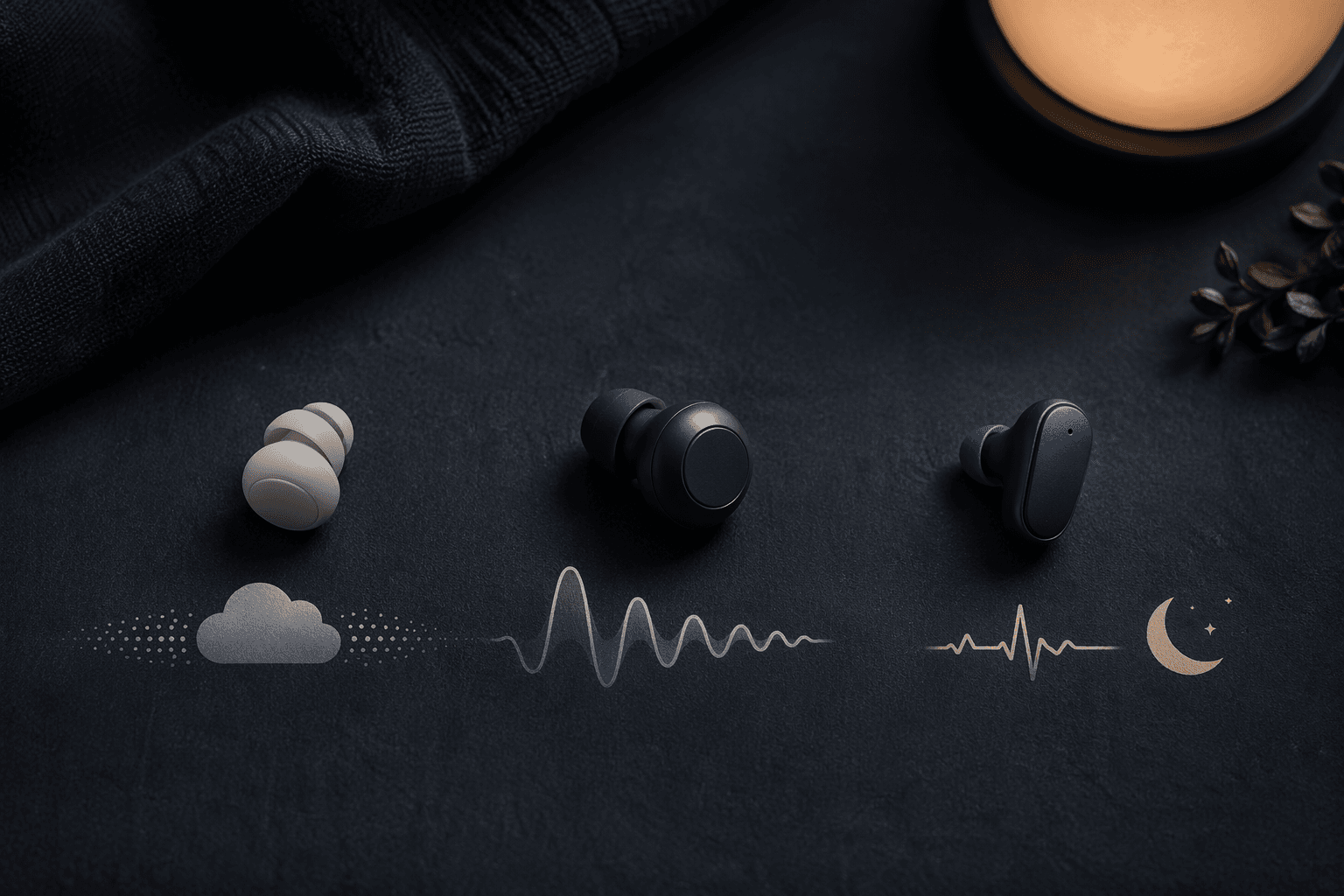
Ozlo Sleepbuds: the spiritual successor, with extra ambitions
Ozlo Sleepbuds deserve more patience than the average “we replaced Bose” pitch because the lineage is real. The company was founded by three former Bose employees, and The Verge covered the project as an attempt to resurrect the Sleepbuds idea after Bose left the category.[6] If the question is which current product most clearly descends from Bose Sleepbuds II, Ozlo has the strongest claim.
But lineage is not performance. Ozlo’s version of the idea is more flexible and more ambitious: Bluetooth streaming, sleep stage tracking through biometric sensors, environmental room monitoring, about 10 hours of battery life, and no ANC.[6][7] Ozlo’s own comparison page naturally presents this as progress over Bose, and it is commercially motivated.[7] Some of it is plainly useful. Streaming removes Bose’s closed-audio problem. Room monitoring may help explain obvious environmental issues. A comfortable all-night fit, if it works for your ears, keeps the core promise alive.
The sleep tracking needs a firmer hand. Earbuds can collect signals. They can estimate sleep stages. They can show trends that may be interesting to a consumer. That is not the same thing as published polysomnography validation, and current evidence does not establish that Ozlo or Soundcore sleep staging has the same kind of clinical footing as the Bose Sleepbuds II sleep intervention study. The Bose study itself was also limited: it was a pilot with a pre-post design, no control group, and devices gifted by Bose to the study team.[2]
So Ozlo is best understood as a sleepbud for someone who wants the old form factor plus modern audio freedom, and who sees tracking as a helpful side channel rather than the reason to buy. If your main sleep obstacle is partner snoring, the lack of ANC is a real omission. If your main obstacle is needing a low-profile, side-sleeper-friendly way to stream or play soothing audio without wearing normal earbuds to bed, Ozlo is much closer to the original Bose job.
SleepPhones Wireless: for people who never wanted earbuds in bed
There is one honest answer that sleepbud comparison charts tend to bury: some people hate sleeping with anything in their ear canal. AcousticSheep SleepPhones Wireless solve a different problem. They are a washable fabric headband with flat speakers, offer 24 hours of battery life, and Wirecutter identifies them as a budget pick.[3]
The compromise is obvious. A fabric headband with speakers will not isolate like a sealed in-ear bud. It is less targeted for blocking external noise. But if in-ear pressure wakes you up, if your ears get sore, or if side sleeping with buds has already failed, less isolation may be a worthwhile price for actually keeping the product on your head until morning.
How to choose without pretending there is one winner
Start with the sound you are trying to survive. Do not start with the brand name.
| Your sleep obstacle | Start here | Why |
|---|---|---|
| Steady environmental noise or racing thoughts | Soundcore Sleep A20 | Longer battery in preloaded mode, streaming support, customizable soundscapes, no ANC complexity |
| Partner snoring, especially irregular bursts | Soundcore Sleep A30 | ANC plus adaptive snore masking directly targets the missing Bose use case |
| You want the closest Bose-like lineage with streaming and consumer sleep data | Ozlo Sleepbuds | Former Bose engineers, low-profile sleepbud format, streaming, biometric and room monitoring |
| You dislike in-ear buds | SleepPhones Wireless | Headband design avoids the ear-canal problem and offers much longer battery life |
Fit deserves more weight than shoppers usually give it. A sleep earbud that measures beautifully at a desk can become useless when pressed between your ear and a pillow. Side sleepers should look closely at bud depth, stability wings, and return policies, because ear shape is one of the few product variables no review can solve for you. The A20’s puffy stability wings are specifically noted in Wirecutter’s testing, but that still does not guarantee comfort in your ear.[3]
Audio source is the next dividing line. Bose Sleepbuds II were limited because they did not behave like normal Bluetooth earbuds. Current major options have mostly moved past that limitation by supporting streaming or more customizable audio libraries. That is progress, but it also changes the temptation. If streaming means you fall asleep to one more episode and wake up to dialogue at 3 a.m., the feature can work against you. Preloaded or saved sleep sounds still have a place.
Finally, be careful with data. Sleep-stage charts feel authoritative because they look precise. A consumer earbud estimating sleep is not the same thing as a lab sleep study, and it is not the same kind of evidence as an intervention that measured insomnia symptoms before and after use. Treat tracking as a way to notice patterns, not as a verdict on whether your sleep was medically good or bad.
The practical 2026 answer
Bose Sleepbuds II do not have a single successor. They left behind a job, not a crown. Soundcore Sleep A20 is the cleanest masking-first option. Soundcore Sleep A30 is the stronger candidate when snoring is the main obstacle. Ozlo Sleepbuds are the closest spiritual successor, with streaming and tracking layered onto the old promise. SleepPhones Wireless are the reminder that the right sleep product may not be an earbud at all.
The useful question in 2026 is not which product replaced Bose Sleepbuds II. It is whether you need masking, snore response, audio flexibility, or simply something comfortable enough to still be there when you wake up.
References
- Bose Presents Sleepbuds II, Bose Global Press Room.
- Harnessing technology to improve sleep in frontline healthcare workers, Haller et al., 2024.
- The 2 Best Sleep Headphones of 2026, Wirecutter.
- Best headphones for sleeping 2026, CNN Underscored.
- A better alternative to Bose Sleepbuds, Soundcore.
- Three ex-Bose employees are resurrecting the Sleepbuds, The Verge.
- Ozlo Sleepbuds vs Bose, Ozlo.

Comments
Join the discussion with an anonymous comment.