
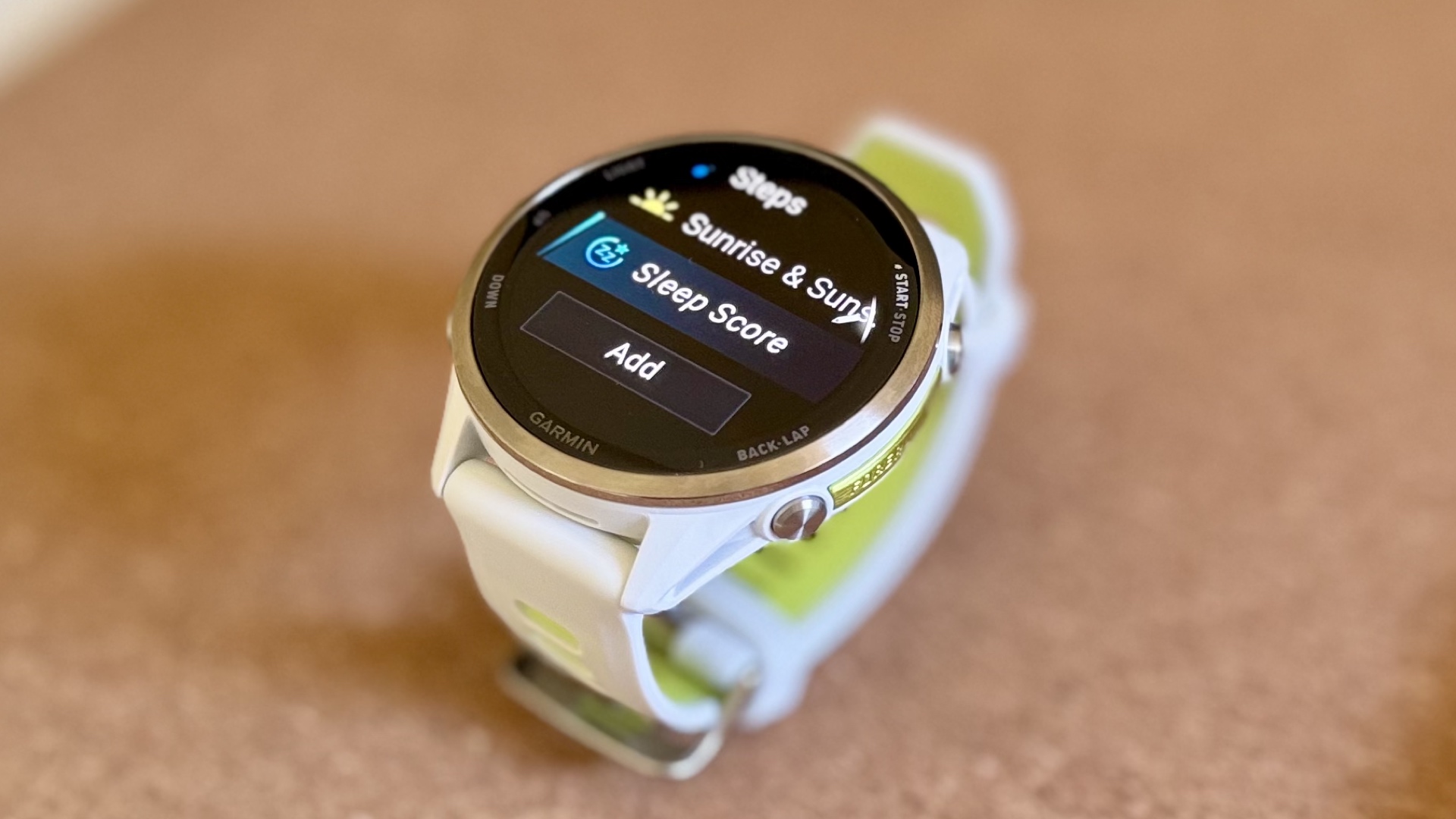
Garmin sleep tracking gives you the thing every tired person both wants and slightly resents in the morning: a single score from 0 to 100. If it says 88, you feel validated. If it says 54 after a night you thought was fine, suddenly the watch has opinions.
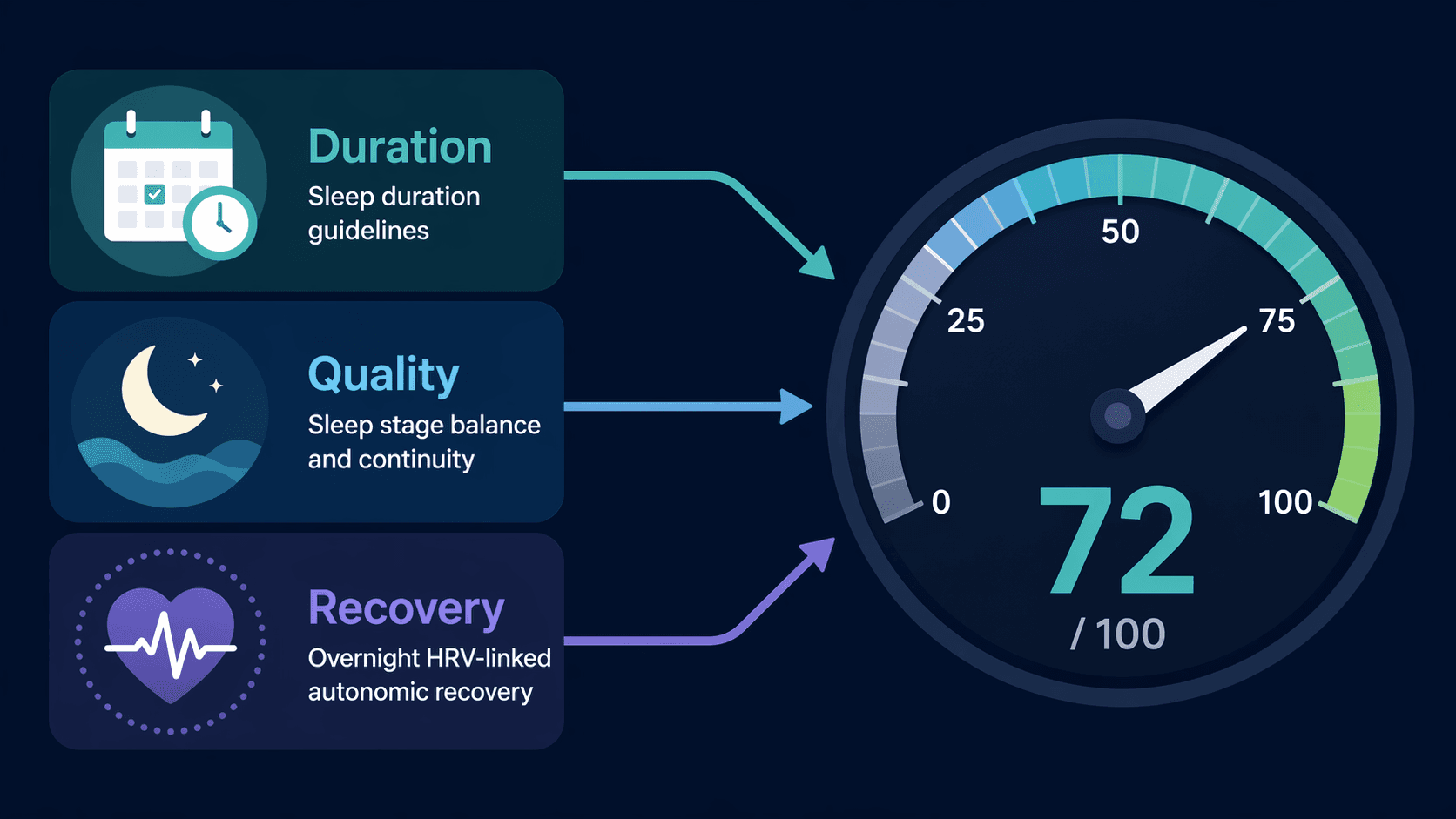
The useful question is not whether the number feels flattering. It is what Garmin actually blended together to produce it. Garmin’s Sleep Score is built from three main inputs: sleep duration, sleep quality, and overnight autonomic recovery, meaning the stress-and-recovery signal Garmin estimates from heart rate variability while you sleep.[1]
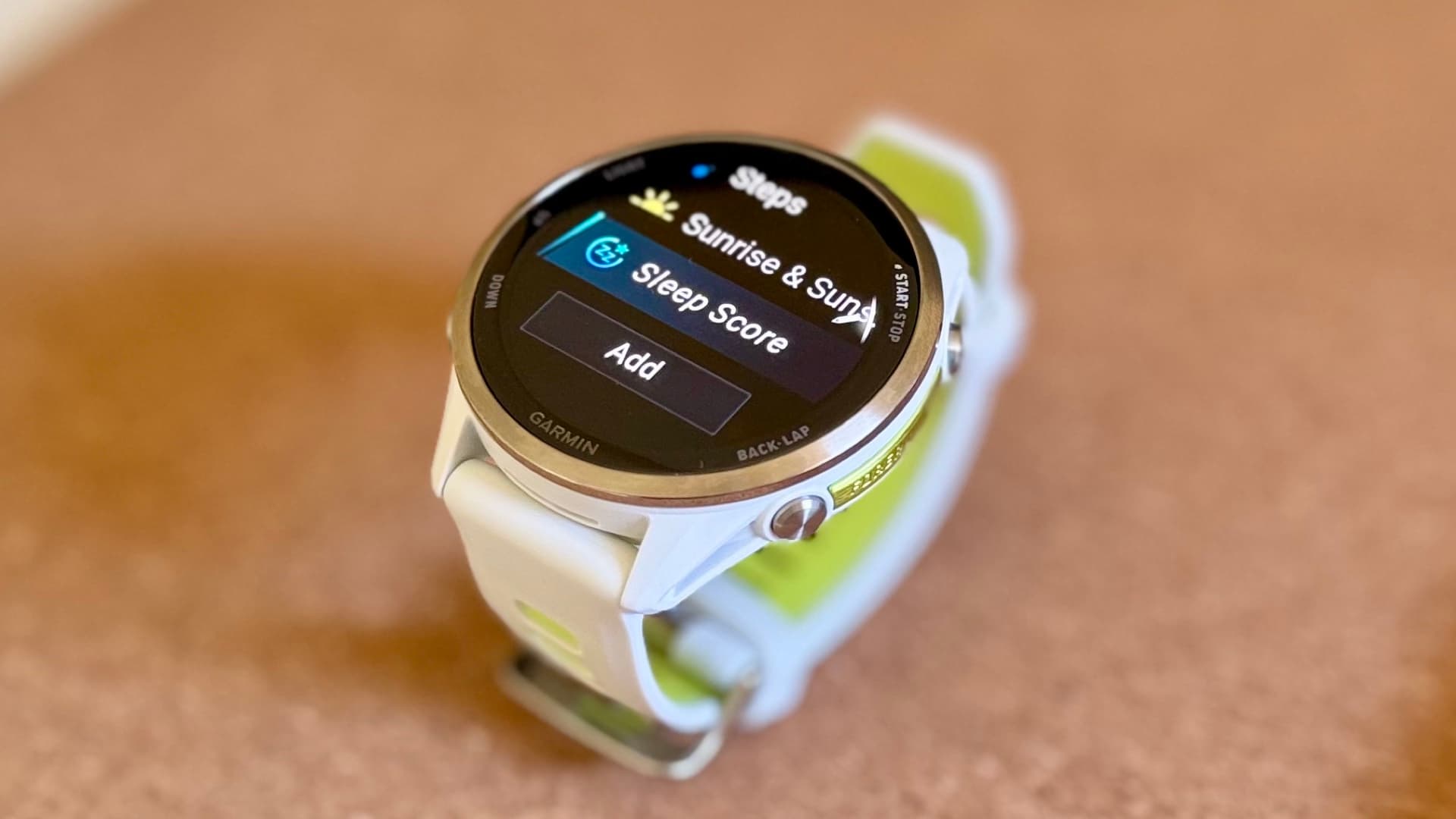
That distinction matters because the top-line score looks cleaner than the ingredients underneath it. Duration is relatively easy to sanity-check. Recovery can be surprisingly actionable if you know what pushed it down. Quality is the slippery one, because it leans partly on sleep-stage detection, and independent research has found Garmin’s stage accuracy to be limited against clinical polysomnography.
What Garmin’s Sleep Score is made of
Garmin describes the Sleep Score as a blended score based on duration, sleep quality, and recovery. The watch is not simply counting hours in bed and handing out points. It is trying to estimate whether you slept long enough, whether the night had a healthy structure, and whether your body moved toward recovery rather than staying physiologically stressed.[1]
| Sleep Score input | What Garmin is looking at | How to read it |
|---|---|---|
| Duration | Total sleep time compared with age-based guidance | The most behaviorally obvious input: did you give yourself enough sleep opportunity? |
| Quality | Sleep stage balance, cycle continuity, and restlessness | Useful as a pattern signal, but the stage portion should be treated as an estimate |
| Overnight recovery | HRV-derived stress and recovery balance during sleep | Often the clearest clue that alcohol, late hard training, illness, or stress affected the night |
For calibration, Garmin reported a 2024 global average Sleep Score of 71, which sits in its fair range. It also reported that only 5% of users averaged in the excellent range of 90–100 in Q4 2022.[2] So if your watch is not casually handing you a 95 every morning, that is not automatically a personal failure. The score is designed to be hard to max out.
Duration: the part you can usually interpret without squinting
Duration is the most straightforward piece of Garmin sleep tracking because it maps to a simple question: did you sleep long enough for your age group? Garmin says the duration component is judged against age-based sleep recommendations, including the National Sleep Foundation’s 7–9 hour guideline for adults.[1]
This is the part of the score where the watch can be blunt in a useful way. If you slept 5 hours and 40 minutes because you stayed up late, there is not much mystery in a low duration sub-score. You do not need an advanced recovery dashboard to explain that one. You need more sleep opportunity.
The caution is that wearables can still misread wake time as sleep. A Naval Health Research Center study of 34 participants found that older Garmin models overestimated total sleep time by about 43.7 to 46.8 minutes, depending on the model, and had poor wake detection specificity of 0.18–0.19.[3] Garmin devices and algorithms have changed since those older models, so those exact numbers should not be treated as current for every watch. They are still a useful reminder: a neat total sleep duration is an estimate, not a lab record.
For everyday use, duration is best read over several nights. If Garmin consistently says you are getting less sleep than you thought, the important move is not to litigate one weird Tuesday. Look at bedtime, wake time, time in bed, and how often the same shortfall repeats.
Quality: useful, but not as precise as the dashboard makes it feel
The quality component is where Garmin’s Sleep Score starts to look more sophisticated, and where it also deserves the most skepticism. Garmin says sleep quality accounts for stage balance, sleep cycle continuity, and restlessness.[1] In plain English: did your night appear to include a reasonable mix of light, deep, and REM sleep; did it look fragmented; and were you moving around enough to suggest disruption?
Garmin’s own sleep-stage guidance gives deep sleep a rough ideal range of 17–35% of total sleep. Garmin also describes deep sleep as supporting muscle repair, cell regeneration, and immune function, while REM sleep supports cognitive restoration and memory consolidation.[1] Those are meaningful categories. The problem is not that sleep stages are irrelevant. The problem is that a wrist-worn device is estimating them indirectly.
That caveat needs to sit right next to the stage chart, not buried under it. A 2026 University of Salzburg study, summarized by WeLoveCycling, found Garmin’s overall sleep-stage accuracy at 63.4% with κ=0.41, ranking sixth among seven tested devices.[4] The study tested Garmin Vivoactive 6 and Venu 3 devices, so it should not be stretched to every newer Garmin model or to the Garmin Index Sleep Monitor. But it is enough to make the central point: the sleep quality sub-score is directional, not clinical.
So when Garmin says you had less REM than usual, the useful interpretation is not, “My brain definitely missed a precise amount of REM sleep.” It is more like, “My night looked different from my usual pattern, and the watch thinks the structure was worse.” That is still useful if it repeats. It is much less useful if you turn one night’s REM bar into a diagnosis.
This is also where total sleep time and stage accuracy need to be separated. Terra Research analyzed real-world data from 4,956 users and found Garmin had the most consistent total sleep time data with the lowest outlier rates, below 1.5%.[5] That supports using Garmin for long-term trend analysis. It does not prove that Garmin is accurately identifying every sleep stage, because the Terra data was observational rather than validated against polysomnography.
That is the practical split: trust the trend more than any single stage readout. If your Sleep Score quality component is repeatedly poor, and the watch also shows frequent restlessness or fragmentation, it is worth paying attention. If it gives you one odd deep-sleep estimate after an otherwise normal night, do not let the graph bully you before breakfast.
Recovery: the overnight signal that often explains the rude score
The recovery part of Garmin’s Sleep Score is based on HRV analysis during sleep. Garmin frames this as a balance between parasympathetic “rest-and-digest” activity and sympathetic “fight-or-flight” activity.[1] You do not need to obsess over the physiology terms to use the signal well. The watch is asking whether your body looked relaxed and recovered overnight, or whether it stayed revved up.
This is where the score can become more helpful than a simple sleep timer. Two nights can both show 7.5 hours of sleep. One can come with a calm recovery profile; the other can show high overnight stress and a mediocre Sleep Score. Garmin specifically identifies alcohol consumption and late strenuous exercise as common reasons this overnight recovery sub-score may drop.[1]
That matches a pattern many Garmin users have seen: the night after drinks, a late race-pace workout, or a stressful day can look “long enough” on duration and still score badly. The watch is not necessarily saying you failed at sleeping. It may be saying your body spent the night processing the cost of what happened before bed.
Recovery is also the component most likely to connect sleep with training decisions. If the duration was fine but overnight stress was high, a hard workout may feel worse than the clock suggests. If recovery looks poor for several nights, that is more important than one ugly stage estimate.
Why the Sleep Score matters beyond sleep curiosity
Garmin’s Sleep Score is not trapped inside the sleep widget. Garmin says sleep data feeds into Body Battery, Training Readiness, and Training Status.[1] That is why the number can become consequential. It can influence whether the watch nudges you toward a hard session, an easier day, or a recovery posture.
This is useful when the inputs are read with restraint. If poor sleep duration, high overnight stress, and low Body Battery all point in the same direction, that is a stronger signal than a single Sleep Score viewed in isolation. If Training Readiness drops after a short, restless night, the watch may be telling you something your calendar does not want to hear.
The risk is treating Garmin’s score as a verdict instead of a prompt. If you are comparing ecosystems or wondering how Garmin’s method differs from Oura, Fitbit, Apple, or WHOOP, the broader mechanics are covered in Sleep Score Explained. For Garmin specifically, the deeper accuracy tradeoff is worth reading separately in Garmin Sleep Tracking Accuracy.
How to read your Garmin Sleep Score in the morning
The best use of Garmin sleep tracking is to break the score back into its ingredients before reacting. A low score does not always mean the same thing.
- If duration is low, start with sleep opportunity. You may simply not have been in bed long enough.
- If quality is low, look for repeated fragmentation, restlessness, or stage-pattern changes rather than trusting one exact REM or deep-sleep number.
- If recovery is low, think about alcohol, late strenuous exercise, stress, illness, heat, or anything else that may have kept your physiology elevated overnight.
- If all three are low, take the warning more seriously. That is different from one shaky sub-score dragging down an otherwise normal night.
This approach also reduces the chance of overreacting. Sleep trackers can become counterproductive when the score creates anxiety about sleep itself. If one bad number sends you into a spiral of checking, rechecking, and trying to force a perfect night, that is no longer recovery tracking; it is sleep performance anxiety. Readers dealing with that pattern may find the discussion in Best Sleep Trackers for People Who Actually Can’t Sleep more relevant than another dashboard tweak.
If you are deciding whether Garmin is the right device family in the first place, that is a different question from interpreting the score you already have. For ecosystem comparisons, see The Best Smartwatch for Sleep Tracking. Once the watch is on your wrist, the daily job is simpler: separate duration, quality, and recovery, then decide whether the pattern is asking for a behavior change.
What your number actually means
A high Garmin Sleep Score usually means the watch saw enough sleep, a reasonably stable night, and good autonomic recovery. A low score means at least one of those inputs looked weak. The score is most useful when it points you toward which one.
The quality component deserves the most humility because sleep-stage detection is only directionally accurate. The duration and consistency trends are often more useful than any single-stage breakdown. The recovery signal can be especially helpful when it lines up with real life: drinks, late intensity, stress, sickness, or a load your body had to absorb overnight.
Read the score as three separate signals. Trust the trend more than the stages. Use the number to guide sleep and recovery decisions, but keep it in the role of a signal, not an authority.
References
- How Garmin watches track your sleep, calculate sleep score — Garmin
- Garmin Sleep Score and Sleep Insights — Garmin
- Consumer Sleep Technologies: A Review of the Landscape — PMC, 2021
- How Do Garmin, Apple Watch, Oura Ring, and Whoop Compare in Sleep Tracking? — WeLoveCycling, 2026
- Sleep Tracking Accuracy — Terra Research

Comments
Join the discussion with an anonymous comment.