
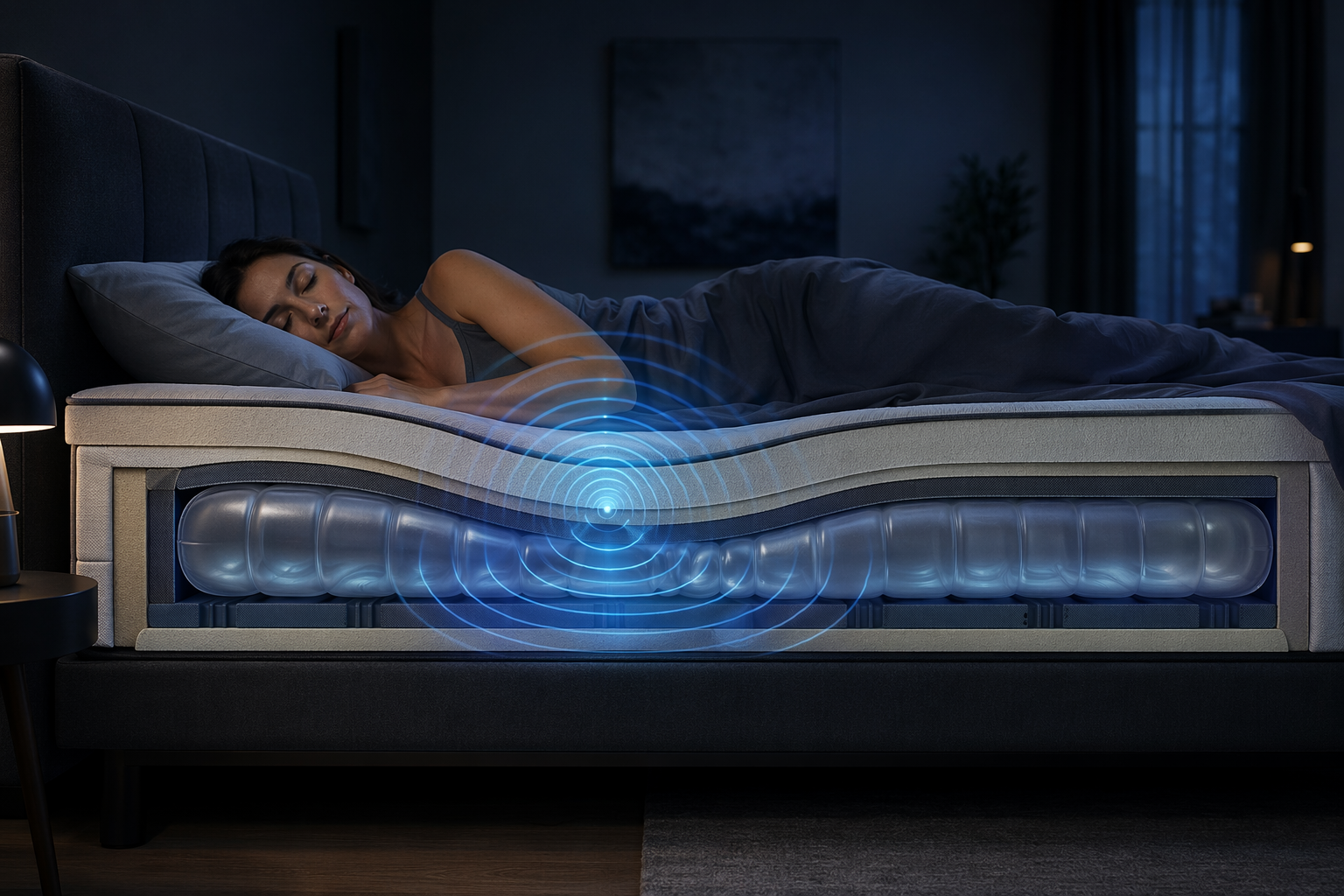
A Sleep Number smart bed does not measure sleep the way a smartwatch does. It is not shining light into your wrist, counting steps, or waiting for you to remember another charger. Its strongest idea is simpler and, in some ways, better suited to sleep: put the sensor under the person who is already lying still.
That passive design is the reason the SleepIQ system is worth taking seriously. It also creates the central problem. A bed can pick up useful signals from the body, especially heart rate and breathing rate trends, but those signals do not always tell the bed whether you are asleep. If you lie awake quietly at 5:10 a.m., your body may look very much like a sleeping body to a mattress sensor. The dashboard may later turn those minutes into sleep.
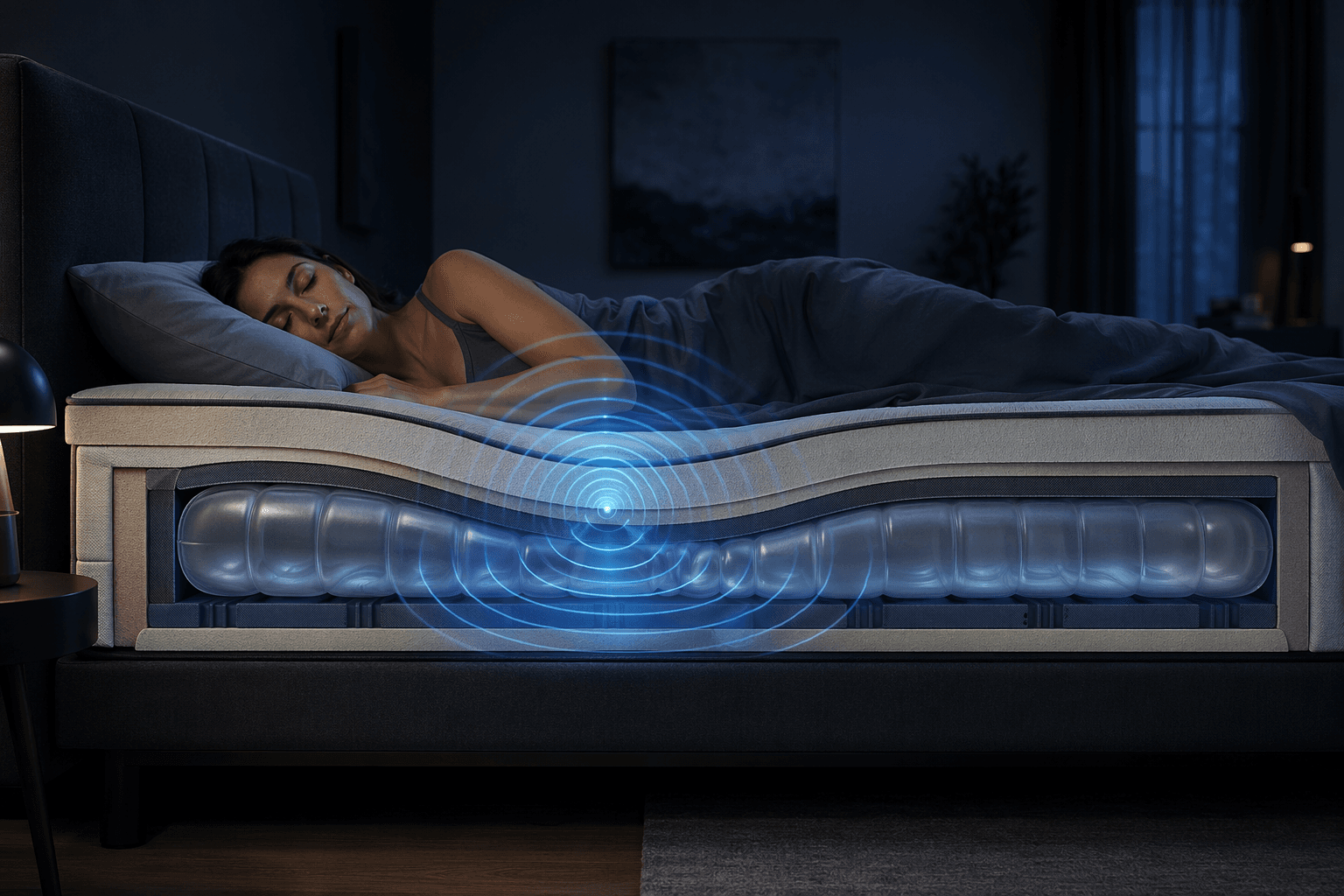
The mattress is listening for body recoil
The sensing method is ballistocardiography, usually shortened to BCG. Each heartbeat moves blood through the body and produces tiny mechanical recoil. Breathing adds a slower rise-and-fall pattern. In the Sleep Number system studied in the peer-reviewed validation paper, the bed’s inflatable air bladder acted as the sensor surface, sampling at 1,000 times per second to capture those small pressure changes while a person slept on the bed.[1]
That matters because the bed is not trying to infer everything from tossing and turning. Movement helps, but the core signal is mechanical: cardiac motion, respiratory motion, and the way those patterns change across the night. A trained model then processes the BCG signal and classifies each 30-second epoch as sleep or wake; the validation study describes a deep neural network trained on more than 1,000 hours of synchronized BCG and polysomnography data.[1]
Polysomnography, or PSG, is the comparison that matters here. In a sleep lab, PSG combines brain activity, eye movements, muscle tone, breathing, oxygen and other signals to score sleep and wake. A mattress sensor has a narrower view. It can see the body’s mechanical rhythms; it cannot directly see the sleeping brain.
That difference explains why some SleepIQ numbers deserve more confidence than others.
Heart rate is the bed’s cleanest signal
Heart rate is where the Sleep Number approach looks strongest. In the 2022 Sensors validation study, 45 normal sleepers spent one night on a Sleep Number Climate360 bed while also being measured with PSG. For epoch-by-epoch heart rate, the bed’s estimates correlated with PSG at r=0.81, with a bias of −0.23 beats per minute. For all-night mean heart rate, the correlation rose to r=0.94.[1]
That does not make the bed a cardiology device. It does make heart rate one of the more reasonable SleepIQ metrics to treat as a trend. If your average overnight heart rate rises after alcohol, illness, heavy training, stress, or a disrupted routine, the bed is measuring a signal that its own validation data supports relatively well at the nightly-summary level.
The caveats are not decorative. The study reported that higher BMI was associated with lower heart-rate concordance, and women showed slightly lower concordance than men.[1] The sample was also a single-night sample of normal sleepers, not a broad test across people with substantial sleep disorders, different body types, different mattress models, and years of home use. The evidence supports cautious trust in the trend, not blind faith in every beat.
Breathing rate is also useful, with the same boundary
Breathing rate follows a similar pattern. In the same validation study, epoch-by-epoch breathing rate correlated with PSG at r=0.71, with a bias of 0.08 breaths per minute. The all-night mean breathing-rate correlation was stronger, at r=0.96.[1]
The practical reading is straightforward: the nightly average is more trustworthy than moment-by-moment interpretation. A bed sensor that follows your respiratory rhythm can show whether your typical night is drifting from your own baseline. That can be useful after a respiratory infection, during travel, or when comparing ordinary nights with obviously disturbed ones.
It should not be used as a substitute for a sleep-apnea evaluation. The validation paper noted that participants with undiagnosed sleep apnea, defined there as AHI greater than 15, or periodic limb movements greater than 10 showed substantial signal discrepancies.[1] That is the exact group for whom a neat consumer dashboard can become too comforting. If symptoms point toward apnea, periodic limb movements, or persistent insomnia, the next step is clinical evaluation, not further score-tuning.
The wake problem is where SleepIQ gets slippery
Sleep/wake detection is the part most owners feel, because it decides whether the dashboard agrees with the night they remember. In the Climate360 validation study, the bed’s sleep sensitivity was 94%. That means it was good at identifying epochs PSG scored as sleep. Its wake specificity was 48%, meaning it correctly identified less than half of PSG-scored wake epochs as wake. The reported AUC was 0.86.[1]
| Metric | What the validation data suggests | How to read it at home |
|---|---|---|
| All-night mean heart rate | Strong correlation with PSG in the studied Climate360 sample | Reasonable for personal trend tracking |
| All-night mean breathing rate | Strong correlation with PSG in the studied Climate360 sample | Reasonable for broad baseline changes |
| Sleep detection | High sensitivity to PSG-scored sleep | Usually catches sleep, but that is only half the job |
| Wake detection | Low specificity for PSG-scored wake | Quiet wakefulness may be counted as sleep |
| Sleep stages | Not differentiated into light, deep, and REM sleep | Do not read SleepIQ as a sleep-architecture report |
This is not a small technical footnote. A device can look accurate if most of the night is sleep and it is very good at saying “sleep.” The harder task is recognizing wake when the person is motionless. Insomnia, early-morning awakenings, reading in bed, lying still after an alarm, or trying not to disturb a partner can all produce the kind of quiet wakefulness that is difficult for body-motion and cardiorespiratory sensors to separate from sleep.
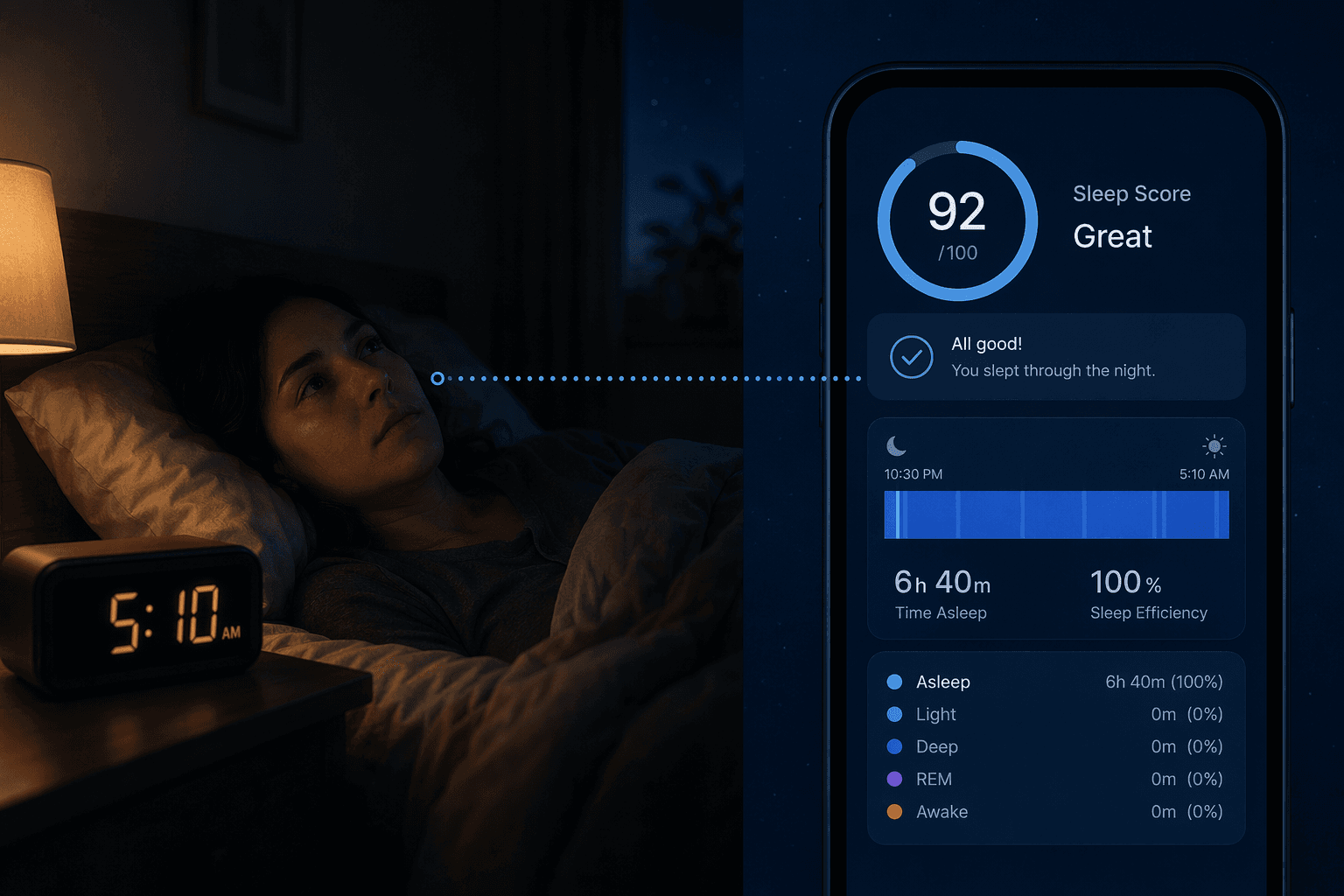
This is the moment when a clean interface can become more persuasive than it deserves. If you know you were awake for 40 minutes and the app shows those minutes as sleep, the problem is not your memory. It is a known limitation of the measurement method, and the 48% wake specificity gives that frustration a number.[1]
For a sound sleeper who mainly wants to compare one month with another, the limitation may not change much. For someone with sleep-maintenance insomnia, long sleep latency, or early-morning wakefulness, it changes the meaning of total sleep time, sleep efficiency, and any score built partly on those estimates. The dashboard may smooth over the very minutes the user most needs to understand.
SleepIQ is not a sleep-stage report
Many people now expect sleep trackers to show light, deep, and REM sleep. The Sleep Number smart bed does not provide that kind of sleep architecture. Its validated sleep/wake model classifies epochs as sleep or wake, not as PSG sleep stages. That distinction is easy to miss if you are used to wearables that display colorful stage charts.
The absence of stages is not automatically a failure. Consumer stage scoring is difficult across the category, and devices that claim more detail are not always more useful. But it changes what the SleepIQ score can mean. A composite score on a 5–100 scale may be convenient, and Sleep Number describes scores of 85 or higher as “extraordinary,” but users cannot independently verify or reverse-engineer the proprietary formula from the dashboard alone.
A score can still be useful if it behaves like a personal trend marker. If it falls after late meals, alcohol, illness, a new medication, a stressful week, or an unusually short night, that pattern may be worth noticing. It becomes less useful when treated as a clinical sleep measure or as proof that a remembered bad night was actually fine.
Why passive tracking still has a real advantage
The case for a bed-based sensor is not that it is magically more accurate than everything worn on the body. The case is adherence. A mattress does not need charging. It is not forgotten on a bathroom counter. It does not irritate the wrist or disappear into a drawer after the novelty fades.
That makes Sleep Number different from a ring or watch before accuracy even enters the discussion. If the goal is a long-term view of resting heart rate, breathing rate, and broad sleep timing, the best sensor may be the one that keeps collecting data when the user stops performing the ritual of tracking. That is the bed’s most persuasive argument.
It is also why the measurement limits matter more, not less. Passive data feels effortless, and effortless data can become background authority. If the numbers arrive every morning without friction, they need to be interpreted with a clear sense of what the bed can and cannot see.
Climate360 evidence does not automatically cover every Sleep Number model
The strongest peer-reviewed evidence available is for the Climate360 bed tested in the Siyahjani et al. study. That model matters because Sleep Number’s lineup is not one static object. Lower-tier models, older models, future models, firmware updates, sensor revisions, and algorithm changes may not map perfectly onto the validation results.
That does not make the study irrelevant. It is still directly about Sleep Number smart-bed technology tested against PSG, which is far more useful than a vague claim about “tracking sleep.” But the narrow reading is the honest one: the study supports the tested system under the tested conditions. It should not be stretched into a blanket guarantee for every mattress carrying the brand name in 2026.
Price makes that distinction practical. The Climate360 starts around $8,500 with the FlexFit 3 base, while lower-tier Sleep Number models start around $1,100. A high-quality traditional mattress plus an Oura Ring and a Withings Sleep Pad can total under $3,000. Those comparisons are not one-to-one: a bed is furniture, a comfort system, and a sensor platform at once. Still, if the tracking feature is part of the price justification, the exact model and its evidence matter.
How it compares with rings, watches, and under-mattress pads
A ring such as Oura measures from the finger, typically leaning on optical pulse signals, temperature, movement, and algorithms. A smartwatch adds wrist-based sensors and convenience tradeoffs. An under-mattress pad such as Withings Sleep is closer in spirit to Sleep Number because it is also passive and bed-based. Sleep Number’s distinguishing feature is that the sensing layer is built into the bed’s own air system rather than added as a separate pad.
If you want a broader form-factor comparison, a smart sleep device accuracy overview is the better frame. If you want a direct owner-style look at this brand’s dashboard behavior, a Sleep Number 360 sleep-tracking review can be more useful than another specification table. The mechanism here is the key distinction: BCG is a legitimate passive method, but the sleep/wake algorithm still has to decide what quiet physiology means.
The privacy question belongs in the buying decision, not the accuracy table
A bed sensor collects unusually intimate data because it works while you are asleep, beside a partner, over months or years. Sleep Number provides a privacy mode, and anyone considering the system should read the current policy language for their model, account settings, research participation options, and data-sharing controls before treating the bed like ordinary furniture.
That privacy decision is separate from whether the sensor estimates heart rate well. Both matter. Accuracy tells you whether a number deserves trust; privacy tells you whether you want that number collected in the first place.
How to read your SleepIQ score without overreading it
The safest way to use SleepIQ is as a relative wellness trend, not a verdict. Look for changes against your own baseline. Treat overnight heart rate and breathing rate as the more credible parts of the dashboard, especially when viewed as multi-night averages rather than single-night drama. Treat total sleep time and sleep efficiency more cautiously if you spend long periods awake but still in bed.
- Use the bed for longitudinal heart-rate and breathing-rate trends.
- Use SleepIQ to notice broad changes in routine, travel, illness, alcohol, stress, or sleep schedule.
- Be skeptical when the app says you slept through periods you clearly remember being awake.
- Do not treat the score as PSG, a diagnosis, or a sleep-stage report.
- Seek clinical evaluation if symptoms suggest sleep apnea, periodic limb movements, or persistent insomnia.
There is also a psychological boundary. The orthosomnia literature describes people becoming preoccupied with improving sleep-tracker numbers, sometimes despite clinical reassurance or contradictory subjective experience.[2] A morning score should help you make calmer decisions. If it turns into another reason to monitor the night, distrust your body, or chase perfect sleep, the dashboard has stopped serving the sleeper.
The Sleep Number smart bed is doing real sensing. Its best-supported outputs are overnight heart rate and breathing rate trends. Its weakest everyday point is quiet wakefulness, which means the SleepIQ score can overstate sleep for the very people most likely to study it closely. Read it as a trend line, not a sleep lab.
References
- Performance Evaluation of a Smart Bed Technology against Polysomnography, Sensors, 2022.
- Orthosomnia: Are Some Patients Taking the Quantified Self Too Far?, Journal of Clinical Sleep Medicine, 2017.

Comments
Join the discussion with an anonymous comment.