
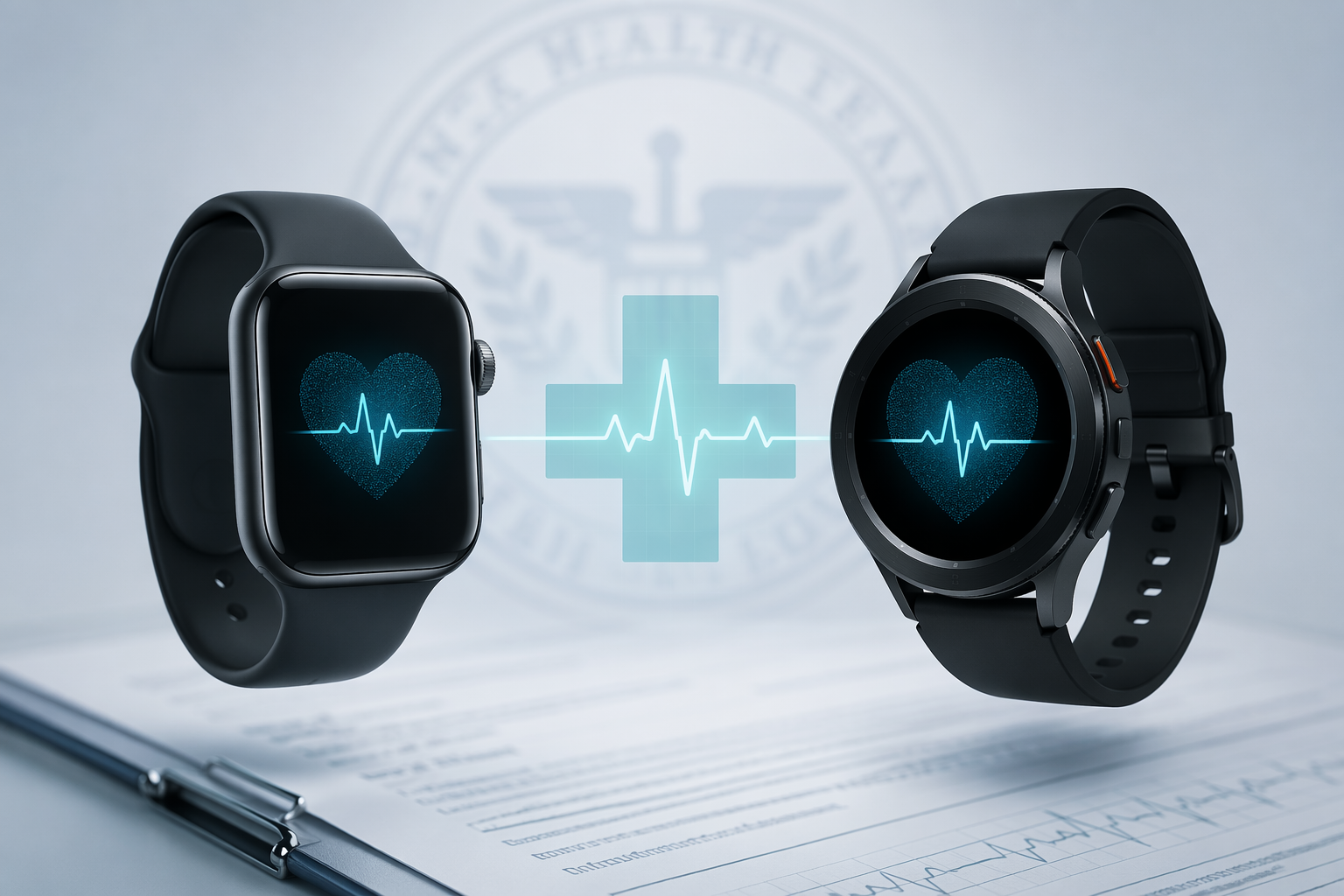
As of mid-2026, the market for FDA-cleared smartwatch sleep apnea notifications is much smaller than the product shelves make it look. The cleared smartwatch ecosystems are Apple Watch Series 9, Series 10, Series 11, Ultra 2, and SE 3, and Samsung Galaxy Watch 7, Galaxy Watch 8, and Galaxy Watch Ultra.[1][2]
That clearance has a narrow meaning. These are over-the-counter notification features for screening adults for signs associated with moderate-to-severe obstructive sleep apnea. They are not diagnostic tests, they are not cleared to detect mild obstructive sleep apnea, they do not detect central sleep apnea, and they are not intended for people who already have a sleep apnea diagnosis.[3]
The Cleared Watches, And The Boundary Around Them
| Smartwatch ecosystem | Models covered as of mid-2026 | Regulatory status | What the feature is cleared to flag |
|---|---|---|---|
| Apple Watch | Series 9, Series 10, Series 11, Ultra 2, SE 3 | FDA 510(k) clearance, September 2024 | Notifications for possible moderate-to-severe obstructive sleep apnea in adults |
| Samsung Galaxy Watch | Galaxy Watch 7, Galaxy Watch 8, Galaxy Watch Ultra | FDA De Novo authorization, February 2024 | Notifications for possible moderate-to-severe obstructive sleep apnea in adults |
Samsung reached the FDA first, receiving De Novo authorization in February 2024 for its Galaxy Watch sleep apnea feature.[1] Apple followed in September 2024 with FDA 510(k) clearance for sleep apnea notifications on Apple Watch.[2] The difference between De Novo authorization and 510(k) clearance matters to regulatory specialists, but for a buyer the practical question is more direct: both features are cleared for screening-style notifications, not for making a medical diagnosis.
The population-level reason these features matter is real. The American Academy of Sleep Medicine has estimated that 80% of obstructive sleep apnea cases, about 23.5 million U.S. adults, remain undiagnosed.[4] A watch that prompts some of those people to discuss symptoms, testing, or treatment with a clinician can be useful. The same statistic does not turn a wrist notification into a sleep study.
Apple And Samsung Are Looking For Different Signals
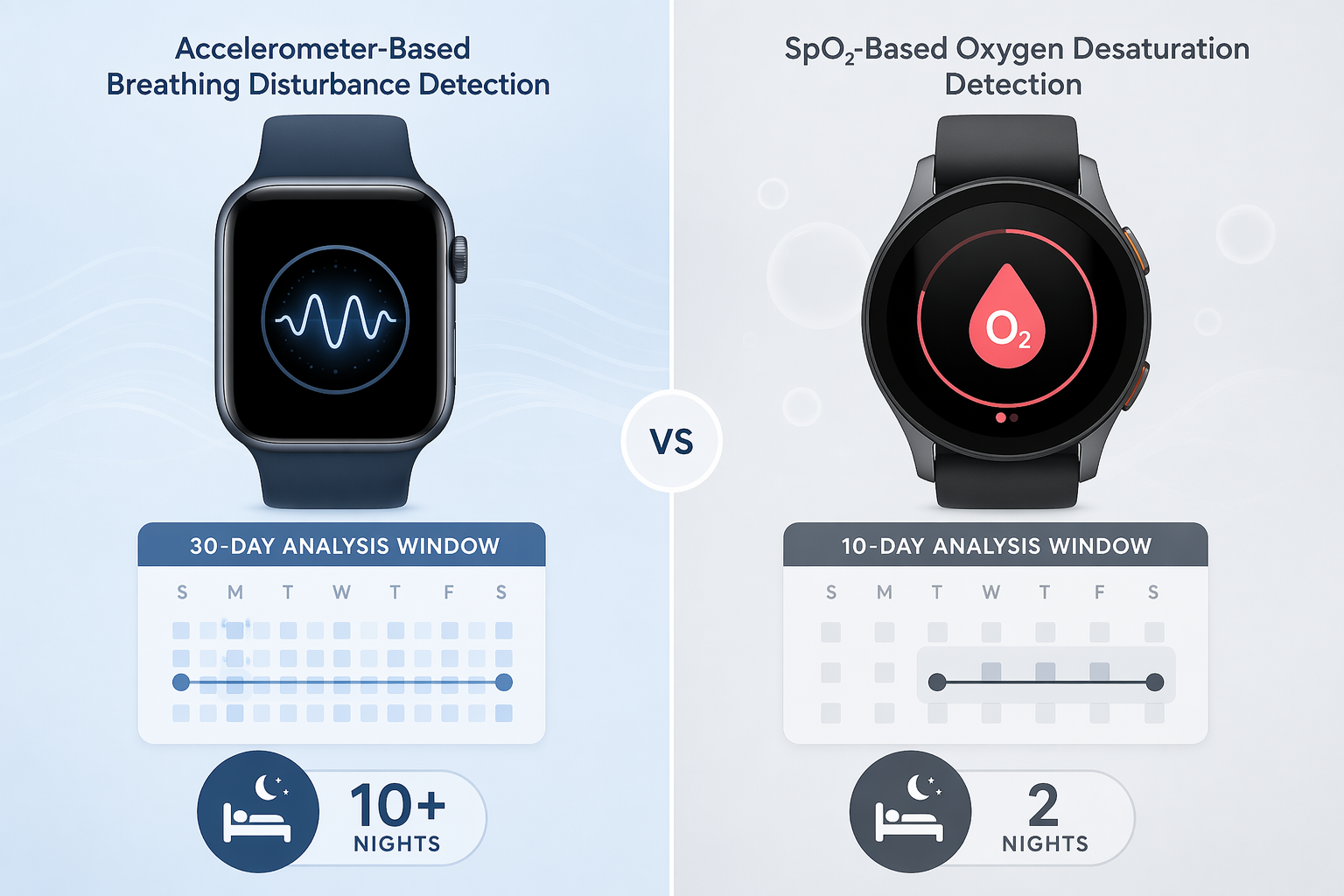
The Apple and Samsung features are often placed in the same sentence because they share an FDA-cleared purpose. They do not measure the same thing.
| Feature | Apple Watch | Samsung Galaxy Watch |
|---|---|---|
| Primary signal | Accelerometer-based breathing disturbances | SpO2-related oxygen desaturation patterns |
| Review window | 30-day period | 2 qualifying nights within a 10-day period |
| Minimum sleep data | At least 10 nights of wear | At least 4 hours of sleep on each qualifying night |
| Minimum age | 18+ | 22+ |
| Cleared condition boundary | Moderate-to-severe obstructive sleep apnea, not mild OSA or central sleep apnea | Moderate-to-severe obstructive sleep apnea, not mild OSA or central sleep apnea |
Apple’s feature uses the watch accelerometer to look for small wrist movements associated with breathing interruptions during sleep. It evaluates breathing disturbance data across a 30-day period and requires at least 10 nights of wear before it can issue a notification.[5][6] That longer window can make the feature feel quiet, especially during the first few weeks. Silence during that period is not the same as a negative clinical result.
Samsung’s feature uses photoplethysmography, the optical sensing method behind SpO2 measurements, to look for oxygen desaturation patterns during sleep. It can flag possible moderate-to-severe obstructive sleep apnea after two qualifying nights of at least four hours each within a 10-day period.[7]
Those design choices explain why two people with similar symptoms might have different watch experiences. One feature is built around repeated breathing-disturbance patterns over a month; the other is built around oxygen-related changes over a shorter qualifying window. Neither design tries to replace the apnea-hypopnea index measured in a formal sleep test.
What “Moderate-To-Severe” Leaves Out
Both Apple and Samsung are cleared around moderate-to-severe obstructive sleep apnea, commonly tied to an apnea-hypopnea index of 15 or higher. Mild obstructive sleep apnea, with an AHI from 5 to 14, sits outside that cleared target. Central sleep apnea also sits outside it. So does ongoing monitoring for someone who has already been diagnosed.[3][8]
That boundary is not a small-print technicality. A person can snore, wake unrefreshed, have morning headaches, or feel unusually sleepy during the day and still never receive a smartwatch notification. The watch may not have enough qualifying nights. The person’s breathing events may not cross the moderate-to-severe threshold. The pattern may not match what that system was cleared to flag. Or the symptoms may need evaluation for a different sleep or medical issue.
If the question is whether a watch can start a conversation about possible sleep apnea, the answer can be yes. If the question is whether no alert rules out sleep apnea, the answer is no.
Accuracy Numbers Need Careful Reading
Apple’s clinical validation numbers are often repeated as 66.3% sensitivity and 98.5% specificity for the FDA-reviewed sleep apnea notification feature. Those figures should be treated as secondary reporting from Pulmonology Advisor and SleepQuest, rather than independently extracted from the original Apple validation PDF.[8][9]
In plain language, high specificity means Apple’s feature was designed to keep false alarms relatively low in the studied setting. Lower sensitivity means it was not designed to catch every person who has the condition. That fits the cleared use: a notification can be meaningful, but the absence of one is not a medical all-clear.
Samsung’s validation has its own nuance. Its clinical study specificity was 87.7%, which did not meet the pre-specified acceptance criterion; a post-hoc adjustment brought specificity to 91.1%, and the FDA accepted that adjusted analysis as surpassing the threshold.[10] That does not erase the authorization. It does mean accuracy comparisons should not be reduced to a single clean winner without reading what each number measures.
For most users, the more important interpretation is operational: these features are conservative screening tools for a specific target group. They are more useful as prompts than as verdicts.
What To Do If Your Watch Sends A Sleep Apnea Notification
A sleep apnea notification is a reason to contact a clinician or sleep medicine provider and ask whether formal evaluation makes sense. It is not proof that you have obstructive sleep apnea, and it is not enough information to choose a treatment on your own.
- Save the notification and any related sleep report your watch or phone app provides.
- Write down symptoms that the watch cannot fully capture, such as witnessed pauses in breathing, loud snoring, daytime sleepiness, morning headaches, or high blood pressure concerns.
- Tell the clinician which watch model you used and when the notification appeared.
- Ask whether a home sleep apnea test or an in-lab sleep study is appropriate for your situation.
- Do not start, stop, or adjust sleep apnea treatment based only on the watch notification.
The next step may be simple or involved depending on symptoms, medical history, insurance, and local access to sleep testing. A home sleep apnea test may be enough for some adults with suspected obstructive sleep apnea; an in-lab study may be more appropriate when the clinical picture is more complicated. The watch does not decide that pathway.
What If You Have Symptoms But No Notification?
Do not let the watch overrule symptoms. The cleared features are not built to detect every form or severity of sleep-disordered breathing, and they require enough usable nights before they can evaluate patterns. A person who keeps waking exhausted, has a bed partner reporting pauses in breathing, or has persistent loud snoring should not wait for a device to make the concern legitimate.
This is the difference between screening and diagnosis in the part of life where it matters. Screening can identify some people who should be evaluated. Diagnosis determines whether a condition is present and what treatment, if any, is appropriate.
Fitbit, Garmin, Pixel Watch, Withings, And Rings
Fitbit, Garmin, Pixel Watch, and Withings devices may track sleep, oxygen-related metrics, movement, breathing-rate estimates, or recovery scores. According to the American Academy of Sleep Medicine’s 2025 comparison of popular smartwatches, they do not have FDA authorization for sleep apnea screening.[3]
That does not make every sleep metric useless. It means those devices should not be described as FDA-cleared sleep apnea notification smartwatches. A nightly oxygen dip chart, a sleep score, or a snoring-related feature is not the same regulatory claim.
Happy Ring belongs in a different category. The FDA cleared Happy Ring by Happy Health for diagnosis, which is a higher and different regulatory use than consumer smartwatch notifications.[11] It should not be lumped into the Apple-versus-Samsung smartwatch choice unless the question is broader than smartwatch alerts.
The Buying Decision
If you are buying specifically for FDA-cleared sleep apnea notifications, the smartwatch choice as of mid-2026 is limited to Apple Watch Series 9, Series 10, Series 11, Ultra 2, and SE 3, or Samsung Galaxy Watch 7, Galaxy Watch 8, and Galaxy Watch Ultra. Other watches may be better for battery life, training tools, general sleep tracking, or phone compatibility, but those are different buying reasons.
Choose Apple or Samsung based on the phone ecosystem you can actually use, the model covered by the cleared feature, and the screening method you understand well enough not to misread. Apple looks for breathing disturbances over a longer period. Samsung looks for oxygen desaturation patterns over a shorter qualifying window. Both are screening prompts for possible moderate-to-severe obstructive sleep apnea in eligible adults.
If you receive a notification, treat it as a prompt to seek evaluation. If you do not receive one but still have symptoms, do not treat silence from the watch as medical clearance.
References
- Samsung Galaxy Watch sleep apnea feature receives FDA authorization, American Academy of Sleep Medicine.
- Apple Watch Series 10 features sleep apnea notifications, American Academy of Sleep Medicine.
- Comparing sleep features of popular smartwatches, American Academy of Sleep Medicine, September 2025.
- National indicator report details importance of OSA diagnosis and treatment, American Academy of Sleep Medicine.
- Sleep apnea notifications on your Apple Watch, Apple Support.
- FDA clears Apple's sleep apnea detection feature for use, CNBC.
- Samsung's Sleep Apnea Feature on Galaxy Watch First of Its Kind Authorized by US FDA, Samsung Newsroom.
- FDA Clears Apple's Sleep Apnea Notification Feature, Pulmonology Advisor.
- Apple Watch Sleep Apnea Detection, SleepQuest.
- DEN230040 Decision Summary, U.S. Food and Drug Administration.
- FDA clears Happy Ring by Happy Health, American Academy of Sleep Medicine.
Comments
Join the discussion with an anonymous comment.