
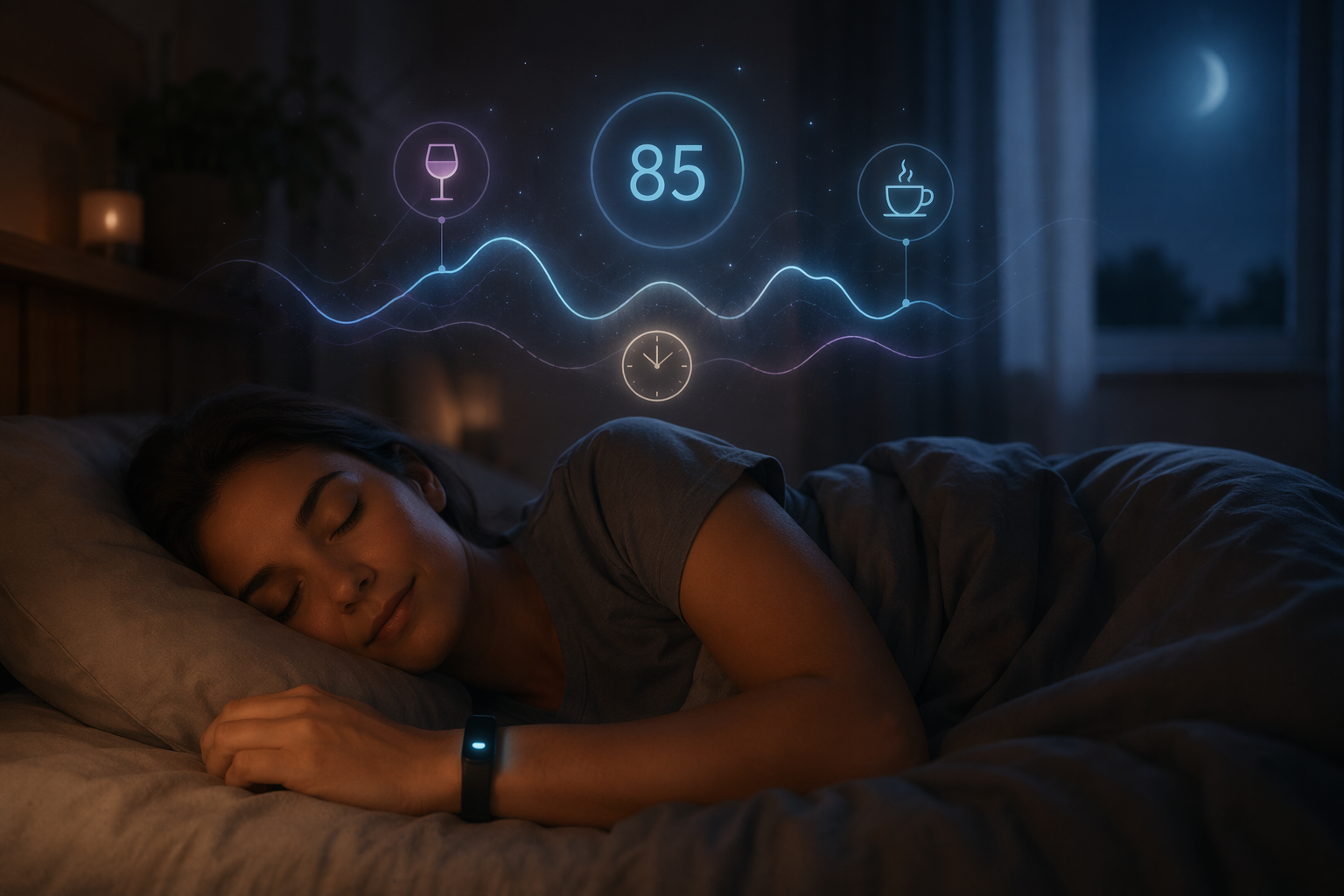
A sleep tracking wearable can tell you more about your nights than you used to know. That is not the same as improving them. Nearly 1 in 3 U.S. adults reported using a smartphone to track sleep as of 2019, a group estimated at roughly 110 million people, yet large-scale evidence has not shown that owning a tracker by itself improves sleep outcomes.[1]
That gap matters because most people do not buy a ring, watch, or band because they want a prettier graph. They buy it because they are tired. They want to know whether the device will change anything after the first week of fascination, when the bedtime score is no longer novel and the same person is still negotiating late email, wine with dinner, caffeine, exercise, children, stress, and the unforgiving alarm.
The answer is narrower than the marketing usually suggests. A tracker can help when it turns a vague suspicion into a pattern you can act on. It can backfire when it turns sleep into a nightly performance review.
Two people, same kind of device, opposite results
In an AP News report on sleep-tracking devices, Atlanta teacher Kate Stoye described noticing a repeated pattern on her Oura Ring: nights when she drank alcohol were associated with poorer sleep quality. She changed a real behavior and stopped drinking.[1]
That is the useful version of sleep tracking. The device did not diagnose her. It did not discover a universal rule that applies identically to every adult. It showed one person a repeated association in her own life, and she cared enough about the result to test a change.
The same AP report included a very different outcome. Mai Barreneche stopped wearing her Oura Ring because checking the score became anxiety-producing and obsessive.[1] That is not a quirky edge case to wave away. For some sleepers, especially people already inclined to monitor their bodies closely at night, a score can become one more thing to fear before bed.
Neither story proves what a tracker will do for everyone. They are qualitative cases, not controlled trial evidence. But together they make the central point cleanly: the device category is not inherently helpful or harmful. The loop it creates is what matters.
When tracking becomes useful
The useful loop is simple, though not always easy to maintain: observe a pattern, choose one variable, change it long enough to see a trend, and judge the result by averages and daytime functioning rather than last night’s REM number.
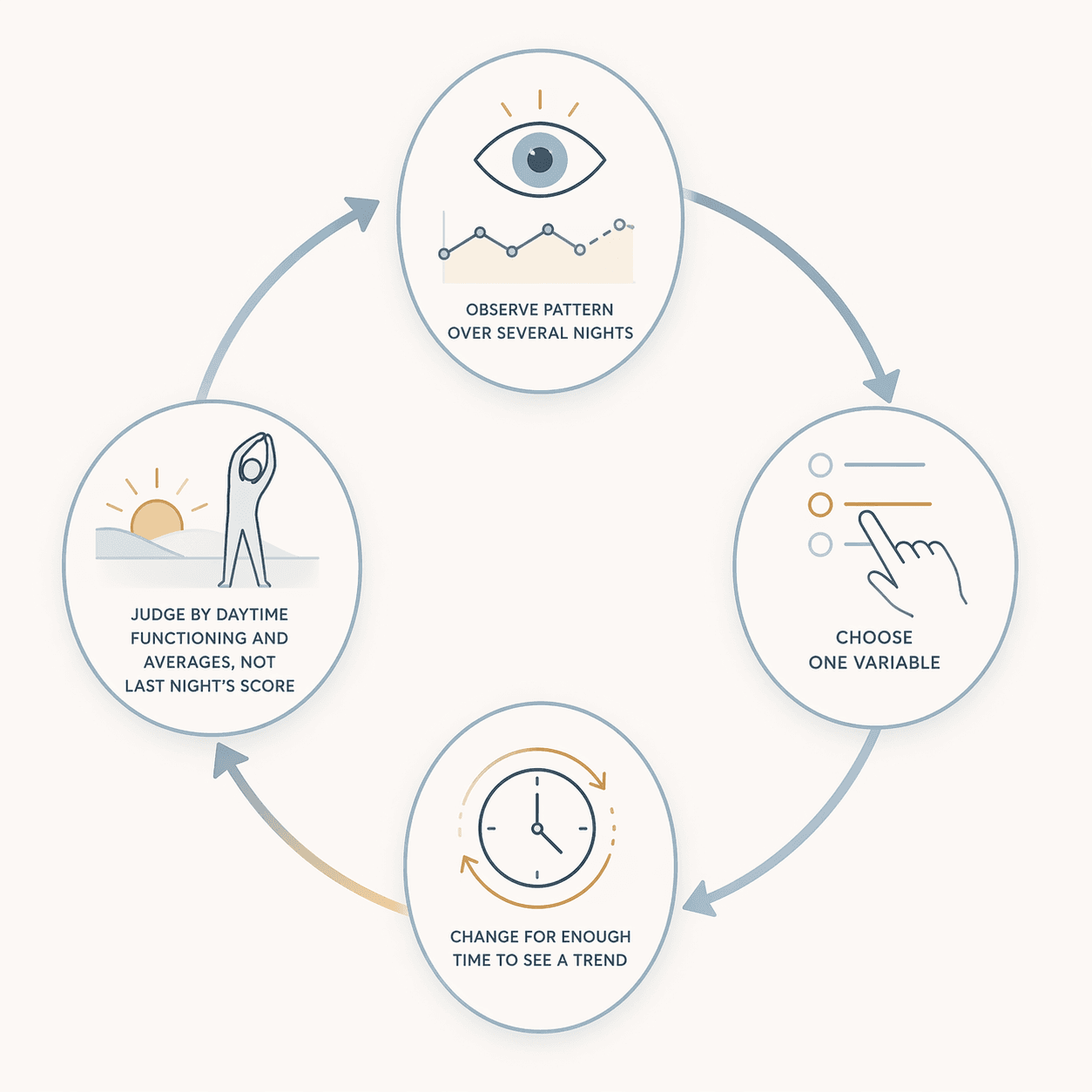
The distinction is not cosmetic. “My sleep score was 72, what is wrong with me?” is a dead end for most people. “When I drink, exercise late, eat later than usual, or shift bedtime, what happens over several nights?” is a question a tracker may actually help answer.
Dr. Vanessa Hill, a CQ University sleep scientist and Samsung Health consultant, told The Guardian that the best potential of trackers is personalized feedback, such as noticing that a walk at a certain time improved sleep, rather than raw scores alone.[2] That is the right emphasis. The number is not the intervention. The behavioral link is.
A wearable is most likely to be worth keeping when it helps answer questions like these:
- Does alcohol reliably correspond with worse sleep for me, as it did for Stoye?
- Does late caffeine show up in longer wake time, later sleep onset, or worse next-day alertness?
- Does late exercise help me sleep more deeply, or does it push my sleep later?
- Do I feel better when my bedtime is steadier, even if the score does not improve every night?
- Do the trends match how I function during the day?
The last question is easy to underrate. If a tracker says your night was poor but you feel clear, steady, and rested, the device should not get automatic veto power over your lived experience. If the tracker says you slept well but you are dragging through the afternoon, that also matters. A wearable is a source of clues, not the final judge of whether you are allowed to feel rested.
A practical way to run the experiment
Do not change five things at once and then ask the app what worked. Pick one variable. Keep the rest of your routine as boring as your life allows. Give the change enough nights to be visible as a trend rather than treating one unusually bad Tuesday as evidence.
| What to do | Why it matters |
|---|---|
| Choose one behavior to test, such as alcohol, caffeine timing, exercise timing, bedtime consistency, or screen-heavy wind-down. | If everything changes at once, the tracker cannot help you separate signal from noise. |
| Look at multi-night averages instead of one-night scores. | Sleep varies naturally. One bad night is not a verdict. |
| Add a simple daytime check: mood, alertness, sleepiness, or ability to concentrate. | The goal is better functioning, not a prettier chart. |
| Turn off nonessential notifications if they make you check the app compulsively. | Useful feedback does not need to interrupt the day or intensify bedtime monitoring. |
This is also where personalization beats general advice. “Alcohol can affect sleep” is information many people have heard before. Seeing the pattern repeat in your own data may be the thing that makes the advice actionable. That was the value in Stoye’s case: not a new biological discovery, but a personal pattern strong enough to motivate a decision.[1]
When the score starts sleeping in the bed with you
The backfire pathway begins when the tracker stops being a notebook and starts becoming a nightly authority. A person wakes up, checks the score, and learns how they are supposed to feel. The next night, they get into bed already wondering what the device will say in the morning. The app is no longer measuring sleep from the outside; it has entered the sleep process itself.
Dr. Chantale Branson, a sleep neurologist at Morehouse School of Medicine, told AP News that she regularly sees patients fixated on nightly REM or deep sleep numbers who would benefit more from basic sleep hygiene than from granular data.[1] That clinical observation fits the concern described in the 2017 Journal of Clinical Sleep Medicine paper that introduced “orthosomnia,” a term for unhealthy preoccupation with improving wearable sleep data.[3]
The point is not that trackers cause insomnia in everyone. That would overstate the evidence. The more careful point is that people who are prone to sleep anxiety, perfectionism, body monitoring, or compulsive checking may find that a device gives their worry a dashboard.
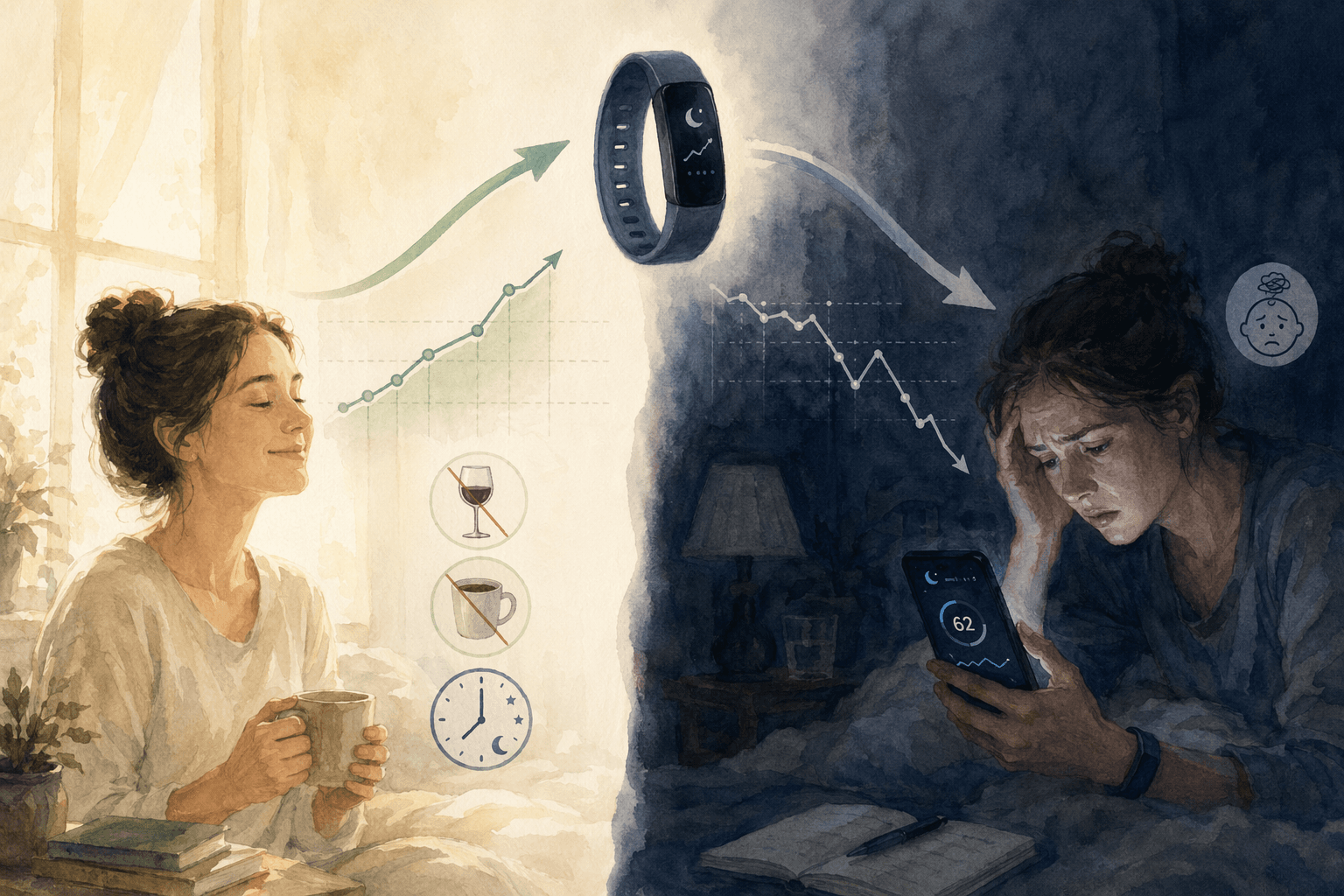
That is why advice to “use the data” needs a condition attached. Use it if the data reduces uncertainty and leads to a concrete experiment. Pause it, hide the score, or stop wearing it if the data makes you more vigilant at night.
For readers already caught in score-checking, the most useful next step may not be a more accurate device. It may be learning what the score is actually made of and where its limits are. Our guide to what your Oura Ring sleep score really measures is a better next read than another night of refreshing the app.
Accuracy matters, but it is not the whole question
Consumer sleep trackers estimate sleep from indirect signals. Depending on the device, those signals may include movement, heart rate, heart-rate variability, temperature patterns, or other sensor-derived measures. That is different from a clinical sleep study, which directly records more detailed physiological signals under controlled conditions.
This is why wearables are generally more useful for broad sleep-wake patterns than for fine-grained certainty about sleep stages. A tracker may give you a reasonable trend line for bedtime consistency, time asleep, or repeated wakefulness. It is on shakier ground when a user treats last night’s exact minutes of REM or deep sleep as a clinical fact.
There are validation studies, and some are worth reading closely. A 2024 study of three commercial wearable devices in healthy adults evaluated sleep-tracking accuracy, but it was funded by Oura Ring Inc., and the paper disclosed Oura-related consulting or advisory roles among several authors.[4] That does not make the study useless. It does mean readers should be careful about turning one model-specific validation result into a blanket claim about all rings, watches, future hardware, or every person with sleep problems.
Johns Hopkins Medicine gives a similarly cautious consumer-level message: sleep trackers can provide useful information about habits and patterns, but they do not replace medical evaluation when someone has symptoms such as persistent insomnia, excessive daytime sleepiness, or possible sleep apnea.[5]
If your main question is device accuracy rather than whether tracking is good for you at all, start with our broader evidence review on smart sleep devices and what the research says about accuracy and efficacy. If you are already leaning toward buying one, comparison guides such as which fitness tracker is most accurate for sleep or Apple Watch vs. Oura Ring vs. Fitbit are the better place for model-by-model differences.
A decision rule before you buy, keep, or stop wearing one
Use a sleep tracking wearable if you can treat it as a trend tool for testing specific habits. The best candidate is not the person who wants a perfect sleep score. It is the person willing to ask a dull, useful question and change one behavior long enough to see whether the pattern moves.
- Keep using it if the data points you toward concrete changes in timing, caffeine, alcohol, exercise, wind-down routine, or sleep consistency.
- Hide the score or reduce notifications if the device is useful in the background but intrusive in daily life.
- Pause or stop wearing it if you start monitoring the night anxiously or letting the app decide how you feel.
- Do not use it as a diagnostic instrument for sleep disorders.
- Do not assume that buying one improves sleep by itself.
Form factor can still matter. Some people tolerate a ring better than a watch; others hate sleeping with anything on their hand. If the decision is no longer “Should I track?” but “What would I actually wear without resenting it?”, our sleep monitoring device form-factor comparison is the more practical next step.
The wearable is not the treatment. If better sleep happens, it happens because the information led to a behavior change the sleeper could live with.
References
- Sleep-tracking devices have limits. Experts want users to know what they are, AP News, Jan 2026
- The rise of the sleep data nerds: "The harder you try, the harder it is to sleep", The Guardian, Oct 2025
- Orthosomnia: Are Some Patients Taking the Quantified Self Too Far?, Journal of Clinical Sleep Medicine, 2017
- Accuracy of Three Commercial Wearable Devices for Sleep Tracking in Healthy Adults, Brigham & Women's / Harvard, 2024
- Do Sleep Trackers Really Work?, Johns Hopkins Medicine

Comments
Join the discussion with an anonymous comment.