
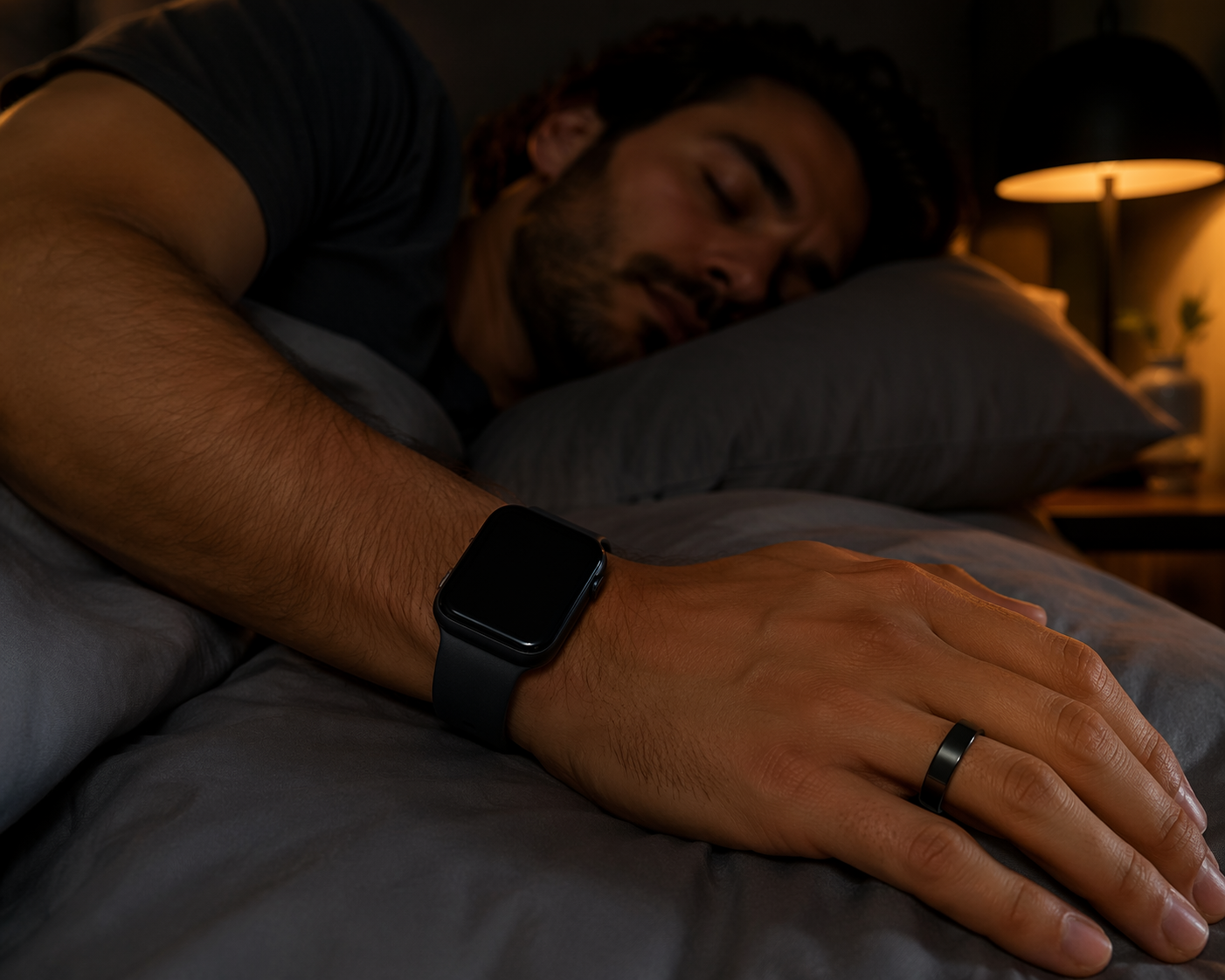
If you are choosing between an Apple Watch and an Oura Ring for sleep tracking, the cleanest answer is also the least headline-friendly one: Oura is the better sleep-first device for most people, while Apple Watch is the better all-around health device that also tracks sleep. The difference matters because “best sleep tracker” can mean two very different things: better sleep-stage estimates overnight, or a device you will keep using because it also handles heart health, workouts, safety features, and notifications without asking for another monthly fee.
| If this is your priority | Leaning |
|---|---|
| Sleep stage tracking, readiness, HRV trends, and overnight comfort | Oura Ring |
| A broader health device with sleep as one metric | Apple Watch |
| No ongoing subscription | Apple Watch |
| Longer battery life for continuous overnight wear | Oura Ring |
| FDA-cleared sleep apnea notifications | Apple Watch Series 9 or later |
| Most actionable sleep-focused coaching | Oura Ring |
That does not mean Oura “wins” and Apple “loses.” It means the devices are built around different kinds of usefulness. A ring that disappears on your hand for a week is solving a different problem than a watch that wants to be charged, worn, tapped, glanced at, and used all day.
What the sleep accuracy data actually says
The most useful head-to-head data comes from a 2024 study comparing Oura Ring Gen 3, Apple Watch Series 8, and Fitbit Sense 2 against polysomnography, the lab standard for sleep measurement. In that study, Oura’s overall agreement with polysomnography was slightly higher than Apple’s: Cohen’s kappa was 0.65 for Oura and 0.60 for Apple Watch. Oura also had a much stronger deep sleep sensitivity score, at 79.5% versus 50.5% for Apple Watch, and better wake detection, at 68.6% versus 52.4%.[1]
Those numbers are worth taking seriously, especially for people who care about sleep architecture rather than just bedtime and wake time. Deep sleep is one of the stages consumer wearables often struggle with, and a gap that large is not just cosmetic. If your main reason for buying a device is to understand whether your nights are fragmented, whether recovery trends are moving in the right direction, or whether late meals, alcohol, travel, or hard training seem to affect your sleep, Oura gives you the more sleep-centered toolset.
The caveat belongs right next to the result: this was a small study of 35 healthy adults, and it was funded by Oura.[1] That does not make the data useless. It does make it the wrong kind of evidence for a sweeping claim that Oura is definitively more accurate for everyone, under every sleep condition, against every current Apple Watch model and software version.
There is also a timing issue on the Apple side. Much of the published Apple Watch sleep-stage accuracy discussion still reflects older watchOS sleep-staging behavior. Apple changed its sleep staging in October 2025, and as of Q2 2026, there is not yet a published independent validation of that newer algorithm in the materials available for this comparison. So the fairest reading is narrower: in the published 2024 head-to-head comparison, Oura performed better on several sleep-stage measures, especially deep sleep and wake detection. That is not the same as proving every current Apple Watch sleep estimate is behind every current Oura estimate.
This is where many Apple Watch sleep tracking comparisons get lazy. Accuracy is not one number. A device can do reasonably well at detecting sleep versus wake, less well at splitting light, deep, and REM sleep, and still be useful if it nudges you toward a more consistent schedule. Another device can produce better sleep-stage estimates and still be a poor fit if you resent the subscription or stop wearing it. The lab comparison helps anchor the conversation, but it does not finish it.
For a deeper look at the Apple-only evidence, see How Accurate Is Apple Watch Sleep Tracking? What the Research Says. For the Oura-only validation picture, see How Accurate Is the Oura Ring for Sleep Tracking?.
The nightly-use problem: battery, comfort, and subscription
Sleep tracking depends on the least glamorous feature in wearables: staying on your body. Oura has the advantage here. Its battery lasts up to about seven days, compared with roughly 24 hours for Apple Watch, which makes Oura easier to wear continuously through the week without planning a charging ritual around bedtime.[2]
Daily charging is not a moral failing, but it is friction. If your Apple Watch is at 18% when you start brushing your teeth, you either charge it and risk forgetting it on the puck, or you wear it and hope it makes it through the night. Plenty of people manage this without drama. Plenty of people also discover that “I’ll charge it before bed” becomes “I skipped sleep tracking three nights this week.”
Oura’s form factor helps for sleep too. A ring is usually less intrusive than a watch under a pillow, sleeve, or blanket, and it does not light up, buzz, or behave like a small phone strapped to your wrist. Fit still matters: a ring that is too tight, loose, or irritating will not feel invisible. But for overnight wear specifically, Oura’s design is better aligned with the job.
The tradeoff is cost after purchase. Oura requires a $5.99 monthly membership after the first month to unlock the fuller app experience, while Apple Watch sleep tracking does not require a subscription beyond owning the device.[2] Over two or three years, that subscription changes the total cost of ownership enough that it should not be waved away as a footnote.
That fee buys more than a pretty sleep score. Oura’s value is in how it connects sleep, readiness, heart-rate variability, temperature trends, and recovery signals into a daily interpretation. The app is more sleep-forward, and its feedback tends to feel more like “here is what your night suggests you may want to adjust” than “here is another chart.” For someone who bought the device mainly to improve sleep habits, that matters.
Apple’s advantage is that sleep arrives inside a much larger health stack. The Apple Watch can track sleep stages, sleeping heart rate, respiratory rate, wrist temperature on supported models, workouts, ECG, fall detection, and other health and safety features in one device. Apple’s own sleep tracking setup also depends on Sleep Focus and a sleep schedule, which makes the system feel more tied to daily iPhone habits than to a standalone sleep-coaching experience.[3]
The apnea-notification difference is real
The Apple Watch has one sleep-related feature Oura does not match: FDA-cleared sleep apnea notifications on Series 9 and later models.[3] That is not the same thing as a sleep apnea diagnosis, and anyone worried about sleep-disordered breathing still needs medical evaluation. But as a consumer wearable feature, it changes the comparison for people who want a device that may flag a health issue they would otherwise miss.
Oura can show breathing-related trends and overnight signals, but it should not be treated as a substitute for Apple’s cleared notification feature. This is one of those places where the broader health-device identity of Apple Watch is not just a marketing advantage. It is a practical distinction.
The question is whether that feature is central to your purchase. If you are buying mainly because you want the strongest consumer sleep-tracking experience night after night, Oura still has the better sleep-first profile. If you want sleep tracking plus a device that also covers more medical-adjacent alerts and day-to-day health functions, Apple Watch becomes harder to dismiss.
Which one will keep you engaged without making sleep a scoreboard?
A sleep tracker should help you notice patterns, not turn every morning into a performance review. Oura’s readiness score, sleep score, chronotype analysis, and HRV trends can be useful because they compress a lot of overnight data into a few clear signals. They can also invite over-interpretation if you treat each night as a verdict.
Apple Watch is a little less sleep-obsessed by design. That can be a weakness if you want guided sleep improvement, but a strength if you are prone to fixating on numbers. For some people, a less elaborate sleep dashboard is the healthier interface. If sleep scores tend to make you anxious, it is worth reading about orthosomnia and the Apple Watch before deciding that more sleep detail is automatically better.
The healthiest use of either device is trend-based. Did your sleep duration become more regular? Are awakenings clustering after late caffeine or alcohol? Does your resting heart rate stay elevated after hard evening workouts? Are recovery signals moving in the same direction over several nights, rather than bouncing around because of one bad Tuesday? These are the questions a wearable can help with. It cannot adjudicate every bad dream, every groggy morning, or every medical concern.
Choose by job, not by brand
Choose Oura Ring if sleep tracking is the primary job. It has the stronger published head-to-head performance in the 2024 polysomnography comparison, especially for deep sleep sensitivity and wake detection, and its battery life, comfort, and app design are better suited to continuous overnight wear.[1][2] It is the device I would point to first for someone who mainly wants sleep and recovery guidance and is willing to pay the subscription.
Choose Apple Watch if sleep is one health metric among many. It gives you sleep tracking without a sleep-specific subscription, adds a much broader set of health and safety features, and includes FDA-cleared sleep apnea notifications on Series 9 and later models.[3] You do have to manage daily charging, and its published sleep-stage comparison against Oura is not as strong, but the overall device may serve more of your life.
There is also a less tidy but very real third option: use both. About 40% of Oura users also wear an Apple Watch, which suggests many buyers do not see them as perfect substitutes.[2] That setup makes sense if you want Oura for sleep and recovery and Apple Watch for workouts, notifications, safety features, and daytime health tracking. It is expensive and unnecessary for most people, but it is not irrational.
If you are still comparing the broader landscape, the three-way Apple Watch, Oura, and WHOOP breakdown is here: How Apple Watch Sleep Tracking Compares to Oura and WHOOP. For a wider device field, see Best Fitness Trackers for Sleep Tracking: A 2026 Comparison and Which Fitness Tracker Is Most Accurate for Sleep?.
Comments
Join the discussion with an anonymous comment.