
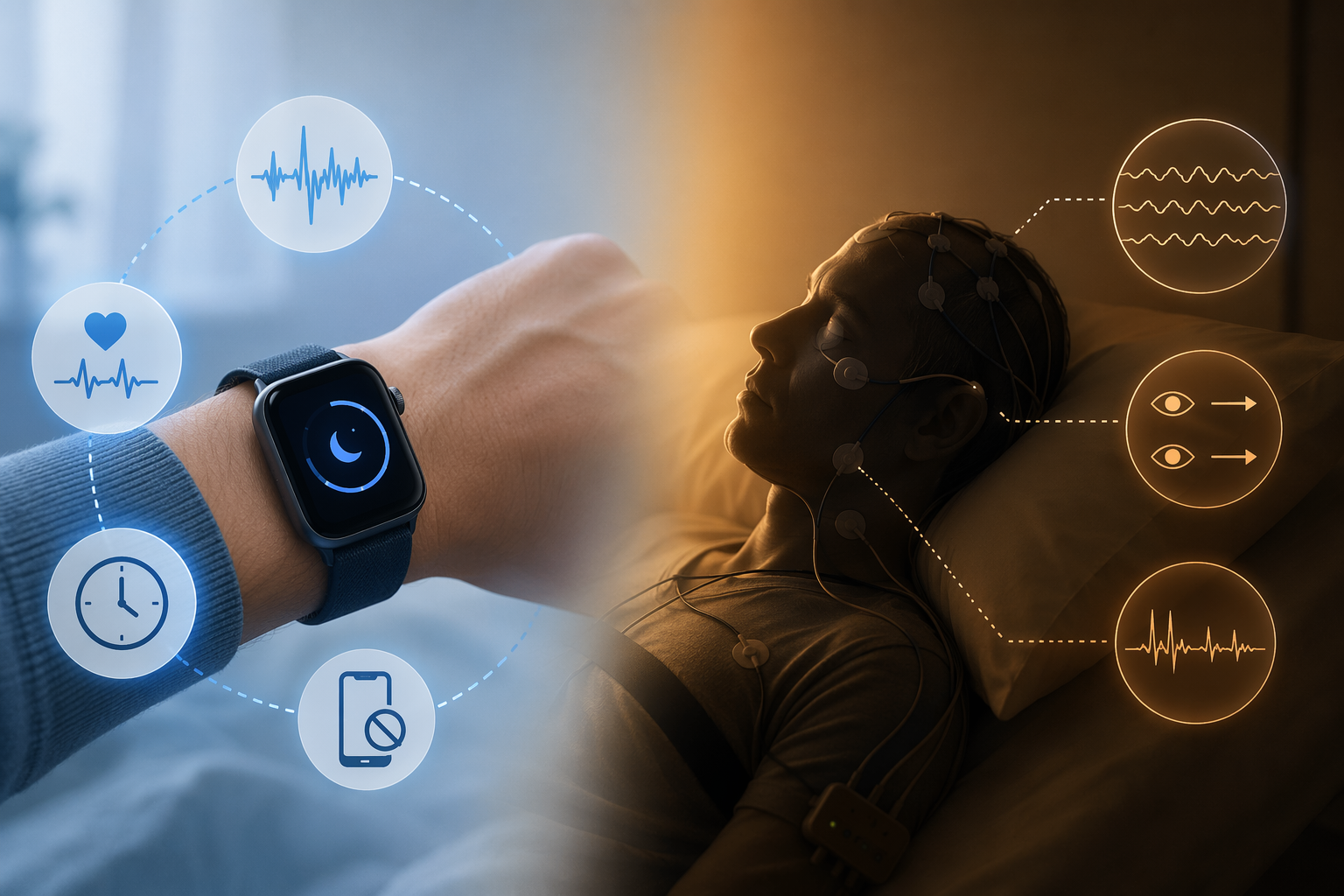
An iPhone sleep tracker sounds as if the phone itself is watching you sleep. In practice, the useful version of Apple sleep tracking is the iPhone plus Apple Watch system: the phone supplies schedule, Sleep Focus, alarm, and usage context, while the watch contributes wrist movement and heart-related signals during the night. The important distinction is that none of this is a small sleep lab on your wrist. The system senses indirect signals, then classifies them into sleep, wake, REM, core, and deep sleep.
That distinction explains why Apple Watch can be genuinely useful and still over-persuasive. Apple’s validation material reports about 86% agreement with polysomnography for sleep versus wake detection, but that figure describes a broad two-state question: were you asleep or awake? It is not a blanket accuracy rating for every colored band in the sleep-stage chart.[1]
What the iPhone and Apple Watch actually measure
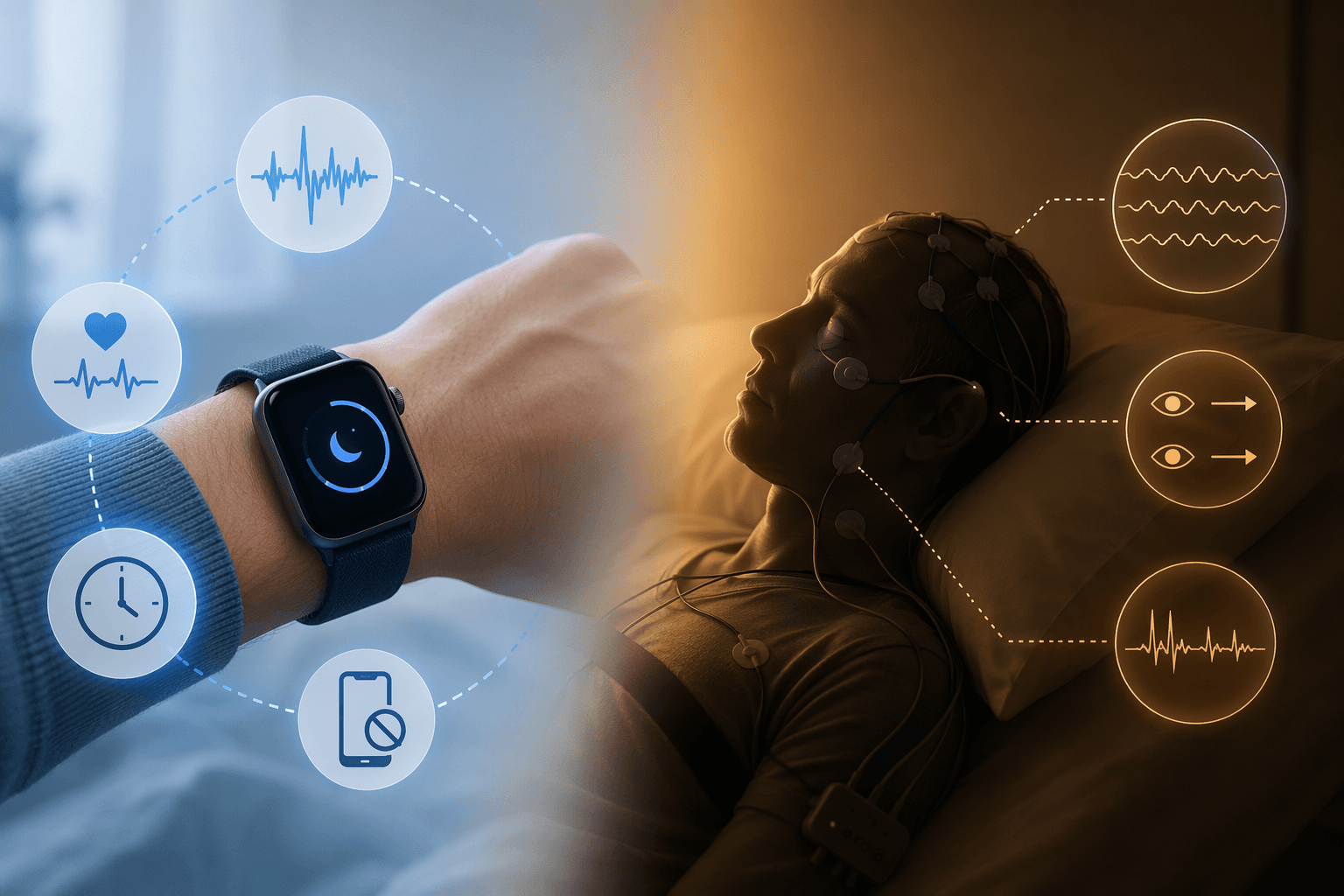
At night, Apple’s system works from signals that are practical to collect from consumer hardware. The watch can detect movement at the wrist, heart-rate patterns, and other heart-related changes; the iPhone contributes schedule and device-context information. The result is a time series that says, in effect: the user appears still, heart patterns look sleep-like, the scheduled sleep window is active, and the phone is not being used.
Clinical polysomnography, by contrast, defines sleep stages using signals consumer watches do not directly measure in ordinary use: brain activity, eye movement, muscle tone, breathing, oxygenation, and related physiological channels. Johns Hopkins Medicine’s clinical guidance makes the same practical point about sleep trackers: they may estimate sleep behavior from indirect signs, but they do not replace clinical sleep testing.[2]
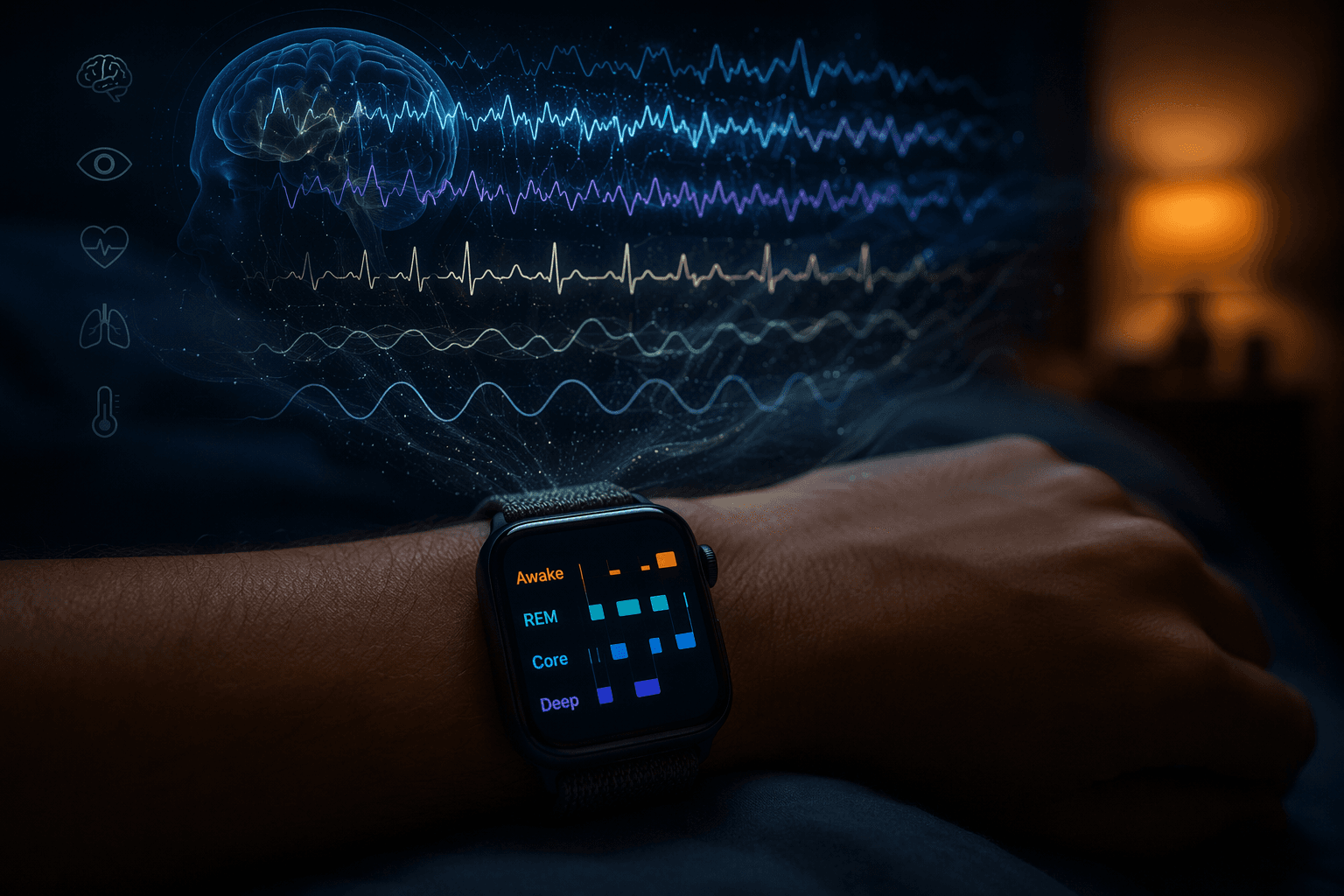
So when the Health app shows deep sleep at 43 minutes, the watch has not observed “deep sleep” in the way a sleep lab scores slow-wave sleep. It has assigned a label because the pattern of indirect signals looked most like the deep-sleep examples in its model. That is still valuable information, especially over many nights. It is also a place where the interface can look more certain than the measurement deserves.
Why sleep versus wake is easier than sleep staging
Sleep/wake detection asks a relatively coarse question. If someone is lying still for a long period, not interacting with the phone, with heart-rate behavior consistent with sleep, the watch has a reasonable basis for saying “probably asleep.” It will still miss some quiet wakefulness and misread some restless sleep, but the categories are broad enough that wrist-based signals can often separate them.
Sleep staging asks for a finer distinction. REM, core, and deep sleep can overlap in the signals a watch can see. A person may be motionless in several stages. Heart rate can change for reasons unrelated to sleep architecture. Wrist movement may disappear during both deep sleep and quiet wakefulness. The model is trying to infer hidden physiology from visible traces.
| Question the system is answering | What Apple Watch can use | How much confidence the number deserves |
|---|---|---|
| Was the user asleep or awake? | Movement, heart-related signals, timing, and device context | Relatively higher confidence for broad trends |
| Which sleep stage was this minute? | The same indirect signals, classified by an algorithm | Lower confidence, especially for deep sleep |
| Does the user have a sleep disorder? | Consumer sleep and breathing-related signals, depending on feature and device support | Not a diagnosis; clinical evaluation is still needed |
This is why the 86% sleep/wake agreement is meaningful and limited at the same time. It supports using Apple Watch as a trend tool for sleep duration and nighttime awakenings. It does not mean that a single night’s REM percentage, core-sleep total, or deep-sleep number should be treated as a physiological fact with lab-grade precision.[1]
The deep-sleep problem is not a small footnote
Deep sleep is the stage most likely to make a careful user uneasy. It is also where the evidence gives the most reason to slow down. Apple’s validation materials and summaries of the underlying confusion matrix show weaker performance for deep sleep than for broad sleep/wake detection: the reported deep-sleep accuracy is about 62%, and 38% of deep sleep is confused with core sleep.[1][3]
That error pattern matters more than the headline number. If the watch frequently labels true deep sleep as core sleep, a user may wake up to a chart that appears to show a disappointing night of restoration when the more cautious interpretation is simpler: the device may have under-detected deep sleep. The body did not necessarily fail. The classifier may have drawn the boundary in the wrong place.
Empirical Health’s Apple Watch user data also reports an average deep-sleep share of 12% among Apple Watch users, which is useful as a population-level observation but should not be converted into a personal target without context.[3] A lower-than-expected deep-sleep percentage on one night can reflect sleep timing, age, alcohol, illness, stress, or measurement error. The watch number alone cannot separate those possibilities.
How Apple compares with other wearables
The deep-sleep weakness is not unique to Apple, but comparison helps calibrate expectations. A 2024 Brigham & Women’s Hospital comparison reported by Sleep Review found that Oura Ring reached 79.5% deep-sleep sensitivity, while Apple Watch reached 50.5% in that comparison.[4] That does not make Oura a clinical sleep lab either. It does show that different wearable designs and algorithms can perform differently on the same hard problem.
For readers comparing devices, the useful question is not which company produces the prettiest hypnogram. It is which metric you plan to act on. If you mainly want bedtime regularity, total sleep time, and broad nighttime disruption, Apple Watch is a strong general-purpose choice. If deep-sleep sensitivity is the deciding factor, the Brigham & Women’s comparison is a reason to look more closely at ring-based systems and other wearables before assuming all sleep trackers fail in the same way. A fuller device-by-device discussion belongs in an Apple Watch, Oura, and WHOOP sleep-tracking comparison, but the interpretation principle is the same: stage-level claims need stage-level validation.
What changed with Apple’s newer sleep model
Apple’s October 2025 validation update for iOS 26 and watchOS 26 describes sleep-stage estimation using foundation models developed from the Apple Heart and Movement Study.[1] That matters because Apple is not simply applying a fixed threshold such as “low movement equals sleep.” The company is using large-scale modeled patterns to classify sleep behavior.
Better modeling can improve classification, especially when the system has access to richer longitudinal patterns. It does not erase the basic measurement gap. A foundation model trained on wearable signals still works from wearable signals. PSG-defined stages remain anchored to brain, eye, and muscle measurements that the watch is not directly collecting during a normal night at home.
That is the cleanest way to read Apple’s progress: sophisticated engineering inside a consumer boundary. The boundary is not a defect; it is the tradeoff that lets millions of people collect nightly sleep data without going to a lab.
Sleep Score is a behavioral index, not a diagnosis
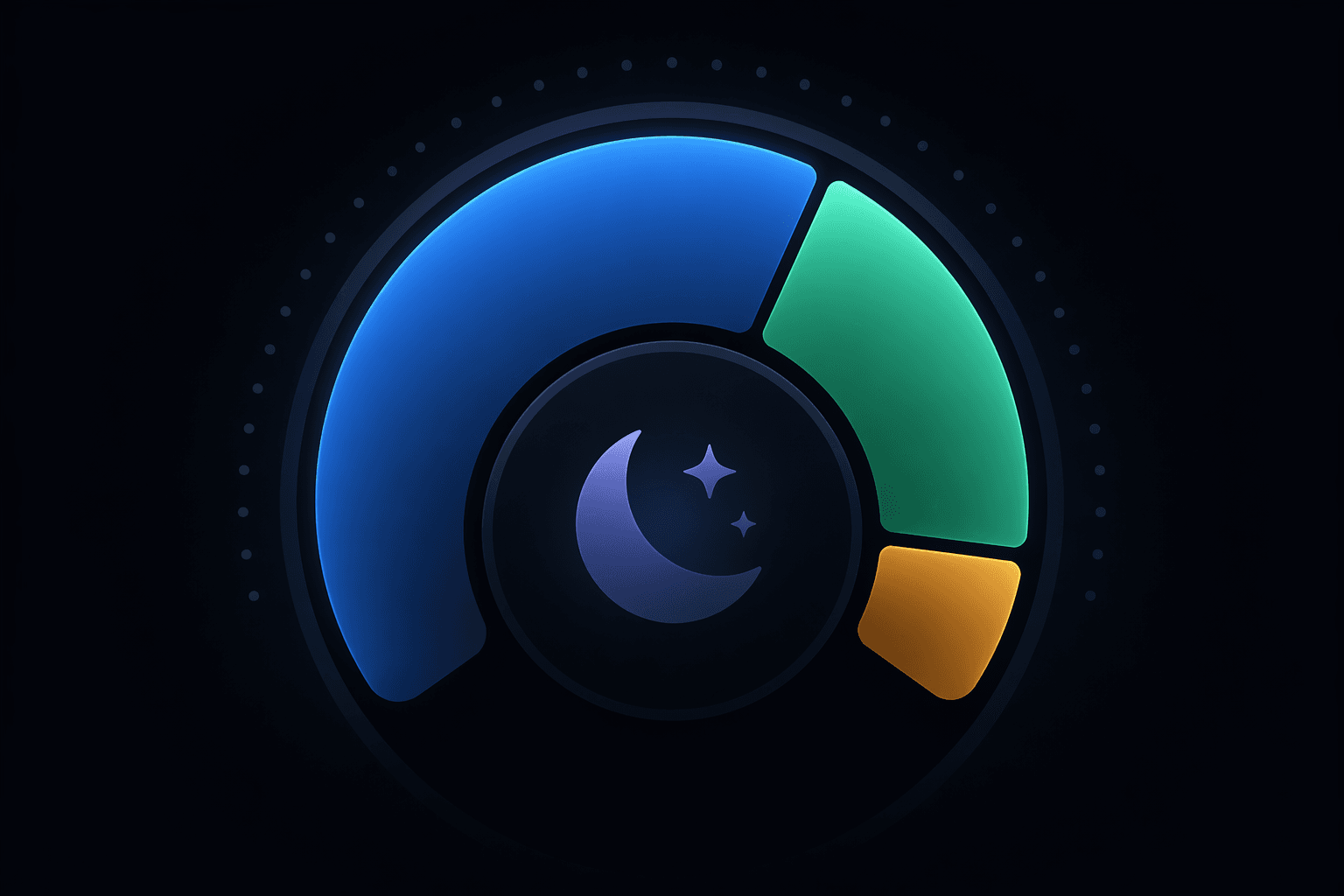
Apple’s Sleep Score is easier to trust if it is read as a designed behavior score rather than a secret medical verdict. The reported formula assigns up to 50 points for duration, 30 for bedtime consistency, and 20 for interruptions. The duration component begins applying nonlinear deductions below 7 hours and 50 minutes.[5]
| Sleep Score component | Maximum points | What it encourages |
|---|---|---|
| Duration | 50 | Enough time asleep across the night |
| Bedtime consistency | 30 | Regular sleep timing |
| Interruptions | 20 | Fewer and shorter awakenings |
That weighting is useful because it points users toward behaviors that are both understandable and repeatable: give yourself enough sleep opportunity, keep the schedule from swinging wildly, and notice nights with unusual fragmentation. It is less useful if treated as a biological grade. A score of 84 does not mean your nervous system earned a B. It means Apple’s chosen inputs produced a relatively favorable composite that night.
The score also inherits the limits of its inputs. If wake periods are missed, interruptions may look better than they were. If quiet wakefulness is classified as sleep, duration may be inflated. If a restless but restorative night produces more movement, the score may punish the night more than your morning body would. For a deeper breakdown of how this score sits beside apnea notifications and other Apple sleep features, see the guide to Apple Watch Sleep Score and apnea notifications.
How to read the numbers without overreacting
The safest use of Apple sleep tracking is not to ignore it. It is to assign different levels of trust to different outputs.
- Trust broad sleep duration more than exact stage percentages. If total sleep time is consistently short, the trend is worth taking seriously, even if individual minutes are imperfect.
- Use sleep/wake trends to spot patterns. Repeated awakenings after alcohol, late meals, stress, travel, or schedule changes are more informative than one noisy night.
- Treat deep sleep as a rough estimate. A low deep-sleep bar may reflect true physiology, but Apple’s known confusion with core sleep means it can also be a classification problem.
- Use Sleep Score longitudinally. A falling two-week pattern deserves more attention than a single score that looks disappointing.
- Do not use the watch to diagnose insomnia, sleep apnea, narcolepsy, periodic limb movement disorder, or another sleep disorder. Symptoms and clinical risk still belong with a qualified clinician.
A simple practical rule helps: act on stable patterns, not isolated colors. If your Apple Watch shows shorter sleep for several weeks and you also feel worse, that is actionable. If it shows 17 minutes less deep sleep on Tuesday but you feel fine, there may be nothing to solve. For more on separating watch-based clues from overinterpretation, see what a sleep tracker watch can and cannot tell you.
There is also a psychological cost to treating every chart as a performance review. Score fixation can make sleep feel like a nightly exam, which is the opposite of helpful for people already prone to worry. The remedy is not to delete the data automatically; it is to stop asking the data to answer questions it was not built to answer. A watch can help you notice that your sleep window has drifted later. It cannot tell you, with clinical certainty, whether your brain produced enough slow-wave sleep last night.
The practical trust map
Apple’s iPhone and Apple Watch sleep system is strongest when it is used as a long-term observer of sleep behavior. Broad sleep duration, sleep/wake timing, bedtime regularity, and recurring interruptions deserve more confidence than the fine-grained stage chart. Sleep Score is best read as a longitudinal behavior signal built from duration, consistency, and interruptions, not as a diagnosis hidden behind a number.
The stage graph deserves a lighter touch. REM, core, and especially deep sleep are algorithmic estimates from indirect signals. Apple’s system is sophisticated, and its sleep/wake performance is strong enough to be useful. Its most clinical-looking numbers are still consumer inferences with known blind spots.
References
- Estimating Sleep Stages from Apple Watch, Apple, October 2025.
- Do Sleep Trackers Really Work?, Johns Hopkins Medicine.
- The average deep sleep on Apple Watch is 12%, Empirical Health.
- Oura Ring, Apple Watch, and Fitbit Tested Against PSG, Sleep Review.
- How Apple Watch's Sleep Score Is Calculated, the5krunner, October 6, 2025.
Comments
Join the discussion with an anonymous comment.