
If you are checking Samsung Galaxy Watch sleep tracking accuracy, the safest short answer is this: trust the watch most for broad sleep duration trends, treat sleep stages as approximate labels, and be cautious when it says you were asleep during long periods of quiet wakefulness. The published validation work is not embarrassing for Samsung. In some places, it is quite strong. But the dashboard can look more certain than the underlying signals deserve.
In the clearest Galaxy Watch 3 polysomnography study, the watch detected sleep with 95.4% sensitivity, but detected wake with only 52.4% specificity; its four-stage epoch accuracy was 65.1% against PSG, the clinical reference test that records brain, eye, muscle, breathing, and other physiological signals during sleep.[1] In a later multicenter study of 11 consumer devices, the Galaxy Watch 5 had a macro F1 score of 0.576 and epoch-by-epoch κ of 0.418 for four-stage classification, while showing a notably small sleep-efficiency bias of −0.4%.[2]
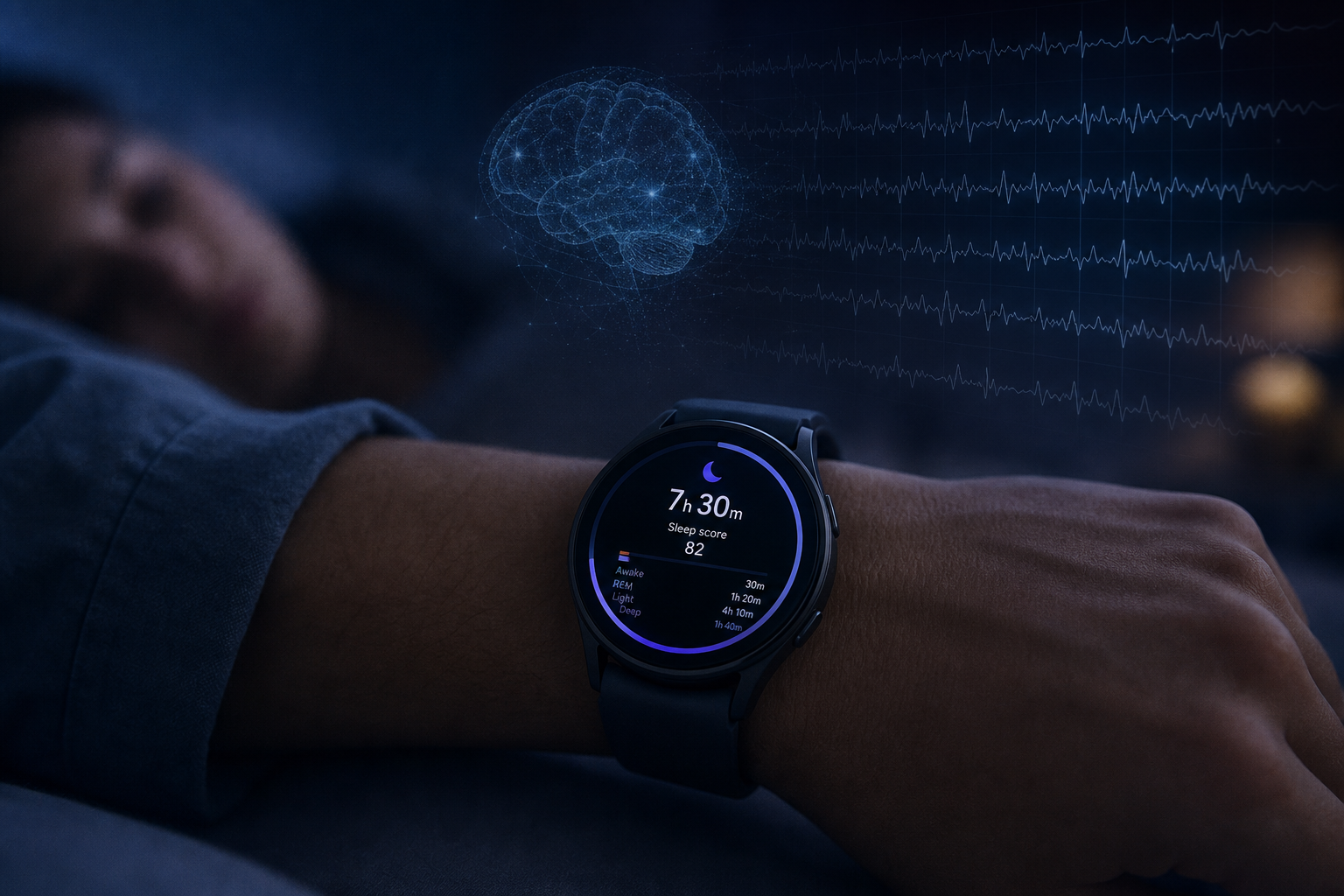
That combination explains why a Galaxy Watch can be genuinely useful after a rough week and still misleading after a restless night. It is good at noticing that you slept. It is less good at proving you were awake while you were lying still, worrying, reading, or trying not to check the time.
What The Main Galaxy Watch Studies Actually Tested
The most useful evidence does not come from a sleep score screenshot. It comes from studies that compare the watch, epoch by epoch, against polysomnography. PSG is not perfect in the philosophical sense; human scorers can disagree. But it is the validation standard that matters when a wrist device claims to estimate sleep, wake, light sleep, deep sleep, and REM.
The Galaxy Watch 3 study was small: 32 adults at a single Korean clinic, with a sample that was 87.5% male.[1] That limits how broadly the results should be stretched. Still, the study is valuable because it shows the core pattern in plain numbers: high sleep detection, weak wake detection, and only moderate stage classification.
The later Galaxy Watch 5 evidence comes from a larger 75-participant multicenter validation study that tested 11 devices, including the Galaxy Watch 5, Fitbit Sense 2, Pixel Watch, Apple Watch, Oura Ring, and others.[2] That study is useful because Samsung is not being judged in isolation. It is being judged beside the other imperfect devices people actually buy.
| Metric | What The Evidence Suggests | How To Use It |
|---|---|---|
| Sleep detection | Strong; GW3 sleep sensitivity was 95.4% | Useful for broad asleep-versus-not-asleep patterns |
| Total sleep time / sleep efficiency | Strongest practical area; GW5 sleep-efficiency bias was −0.4% | Good for trend tracking across weeks |
| Wake after sleep onset | Weak; GW3 wake specificity was 52.4% | Do not assume quiet wake was captured correctly |
| Sleep stages | Moderate; GW3 four-stage accuracy was 65.1%, GW5 macro F1 was 0.576 | Use as rough pattern clues, not clinical staging |
| Sleep score | Derived and algorithm-dependent | Treat as a summary cue, not a verdict |
The Watch Is Better At Finding Sleep Than Finding Wake
The Galaxy Watch 3’s 95.4% sleep sensitivity is the number that should calm the most basic concern. If the question is whether the watch can usually identify sleep when PSG says the person is asleep, the answer is yes.[1] That is why many users find the nightly duration trend plausible even when individual stage blocks look suspicious.
The weak point is the other side of the same calculation. Wake specificity was 52.4%, meaning the watch identified just over half of PSG-scored wake epochs correctly in that study.[1] The practical consequence is easy to miss: a quiet, motionless person can look sleep-like to a wrist device. The watch is reading movement and optical pulse signals, not brain activity.
This matters most for people with fragmented sleep. If you wake at 3:40 a.m., stay still, and drift in and out for an hour, the Galaxy Watch may smooth part of that experience into light sleep. The next morning, the total sleep time can look generous and the sleep score can feel oddly reassuring. The watch has not lied on purpose. It has reached the limit of what wrist signals can infer.
That also means the watch may look best on uncomplicated nights. If you fall asleep, stay asleep, and wake up cleanly, the device has an easier job. If your night is full of still wakefulness, brief arousals, or long periods of trying to fall back asleep, the uncertainty rises exactly where the app often displays its most confident-looking timeline.
Total Sleep Time Is More Trustworthy Than The Stage Chart
The Galaxy Watch 5’s −0.4% sleep-efficiency bias in the 11-device study is a strong result. In that protocol, it was the smallest bias among the tested wearables, smaller than devices such as Fitbit Sense 2 and Pixel Watch in the same comparison.[2] Bias is not the whole accuracy story, but for day-to-day users it is one of the more meaningful ones: it asks whether the device systematically overestimates or underestimates a core sleep measure.
This is where the Galaxy Watch earns some trust. If your average sleep duration drops from a comfortable range to a much shorter one over several weeks, that trend deserves attention. If weekend recovery sleep keeps expanding, the watch may be showing a real pattern. If a new schedule, medication, travel period, or training block changes your total sleep time, the duration trend is more useful than whether Tuesday had 42 minutes more deep sleep than Monday.
The catch is that total sleep time can still be inflated when wake is missed. A very small average bias in a study does not guarantee that every individual night is correct. It means the watch performed well across that tested sample and protocol. For a person who spends long periods awake but motionless, the nightly estimate can still be too optimistic.
Deep Sleep And REM Are The Places To Lower Your Confidence
Sleep stages are where the interface gets seductive. Colored blocks imply a clinical readout: light, deep, REM, awake. But PSG stages are scored from signals a Galaxy Watch does not measure directly. A watch can infer. It cannot see the EEG patterns that define sleep stages in a lab.
The Galaxy Watch 3 study found 65.1% accuracy for four-stage epoch classification.[1] It also found stage-specific distortions: compared with PSG, the watch overestimated deep sleep by about 11.6 minutes and REM by about 26.3 minutes, while underestimating light sleep by about 28.6 minutes.[1] REM reliability was especially poor, with an intraclass correlation coefficient of 0.153.[1]
The Galaxy Watch 5 did not turn the stage chart into a lab substitute. In the multicenter study, its four-stage macro F1 score was 0.576 and κ was 0.418, which the study reported as moderate agreement.[2] That is useful enough to notice broad tendencies. It is not strong enough to treat a single night’s REM or deep sleep number as a precise biological measurement.
A better way to read the stage chart is to look for repeated, coarse changes. If the app shows several unusually restless nights after alcohol, late training, jet lag, or a schedule shift, that pattern may be worth acting on. If it says you got 38 minutes of deep sleep on Wednesday and 54 minutes on Thursday, the difference is too small and too model-dependent to deserve much emotional weight.
Samsung Looks Competitive, Not Clinically Definitive
The fairest comparison is not Galaxy Watch versus a sleep lab. The lab wins. The useful comparison is Galaxy Watch versus other consumer wearables, while remembering that all of them are trying to infer sleep from limited signals.
In the 11-device multicenter study, the Galaxy Watch 5 performed particularly well on sleep efficiency bias, while its four-stage classification remained moderate rather than exceptional.[2] That puts Samsung in a familiar wearable category: quite useful for duration and sleep continuity trends, much less authoritative for exact stage scoring.
For broader device-to-device context, our smartwatch sleep tracker accuracy evidence review and fitness tracker sleep accuracy comparison cover the wider field. The short version here is that Fitbit, Pixel Watch, Apple Watch, Oura, and Samsung are not separated by a magical line between accurate and useless. They differ by metric, algorithm, and validation protocol.
This is also why dismissing all wearables as junk is too lazy. A rough measure can still be useful if the user understands what kind of roughness it has. The mistake is letting a consumer sleep graph borrow the authority of a clinical test.
Do Newer Galaxy Watches Fix The Problem?
As of Q3 2026, the important boundary is simple: Galaxy Watch 7, Galaxy Watch 8, Galaxy Watch 9, and Ultra 2 do not have independent published PSG validation showing that their sleep staging is more accurate than the Watch 3 or Watch 5 evidence discussed here. Newer sensors, updated algorithms, and better health features may improve the experience. They do not automatically create published clinical validation.
That distinction matters because sleep tracking is not just hardware. The same watch can feel different after an algorithm update. The 2025 One UI 8 sleep score inflation complaints, where users reported sudden 99 and 100 scores, illustrate a separate accuracy risk: even if the sensor package is stable, the scoring model can change the meaning of your trend line.
A sleep score is especially vulnerable to this problem because it is a composite. It usually blends duration, regularity, interruptions, stages, and proprietary weighting into one friendly number. If Samsung changes the weighting, two identical nights can stop being comparable in the way a user assumes they are. That does not make the score worthless, but it makes long-term comparisons fragile around major software updates.
What A Galaxy Watch Can And Cannot Tell You Tonight
The American Academy of Sleep Medicine’s position on consumer sleep technology is the right frame: these devices are not licensed for clinical diagnosis, but they can support self-monitoring and patient-clinician conversations.[3] That is a sensible middle ground. The Galaxy Watch can help you notice patterns. It should not be the authority that decides whether symptoms are harmless.
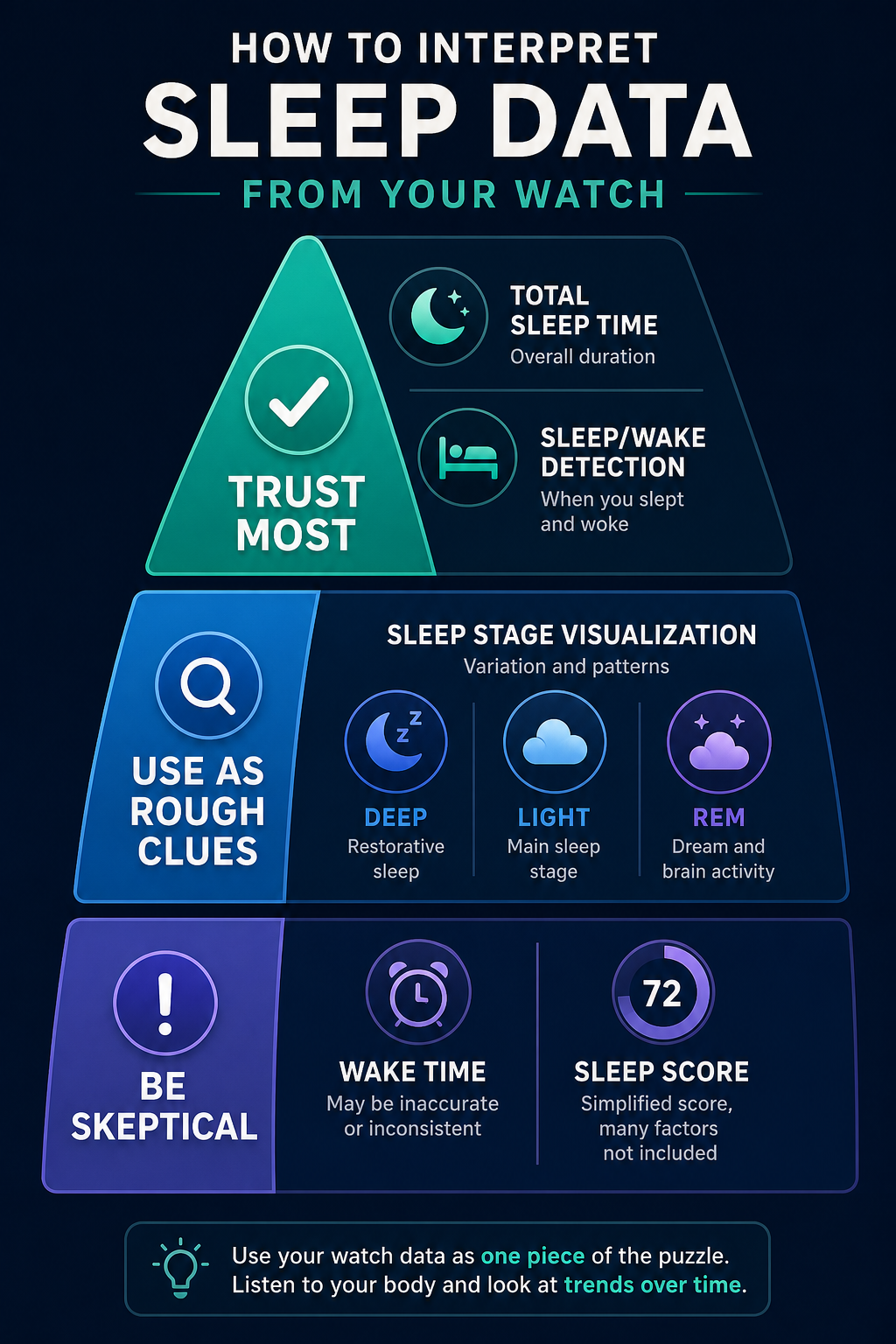
- Trust most: bedtime consistency, wake time consistency, broad total sleep duration, and multi-week changes in sleep efficiency.
- Use as rough clues: deep sleep, REM, light sleep, and stage distribution across repeated nights.
- Be skeptical of: precise wake after sleep onset, unusually perfect sleep scores, and single-night stage changes.
- Ignore as a personal verdict: one bad score after a night you already know was disrupted.
- Escalate beyond the watch: loud snoring, witnessed breathing pauses, severe daytime sleepiness, insomnia that persists, or symptoms that worry you.
The most productive habit is to compare the watch with your own context. Did you go to bed later? Drink alcohol? Train late? Travel? Wake up anxious and still? Share a room with a newborn? Those details often explain the graph better than the graph explains you.
If your Galaxy Watch says you slept seven hours and you feel reasonably restored, the duration estimate is probably doing the job it is best suited to do. If it says you slept beautifully while you remember lying awake for long stretches, believe the experience enough to question the chart. Quiet wake is exactly where the evidence says the device is weakest.
References
- Validation of Sleep Tracking by Samsung Galaxy Watch 3 Compared with Polysomnography, Journal of Sleep Medicine, 2023.
- Consumer Sleep Trackers: Validation Study, JMIR mHealth and uHealth, 2023.
- Comparing Sleep Features of Popular Smartwatches, American Academy of Sleep Medicine.
Comments
Join the discussion with an anonymous comment.