
Why Sleep Tracking Quality Matters More Than Step Count Accuracy
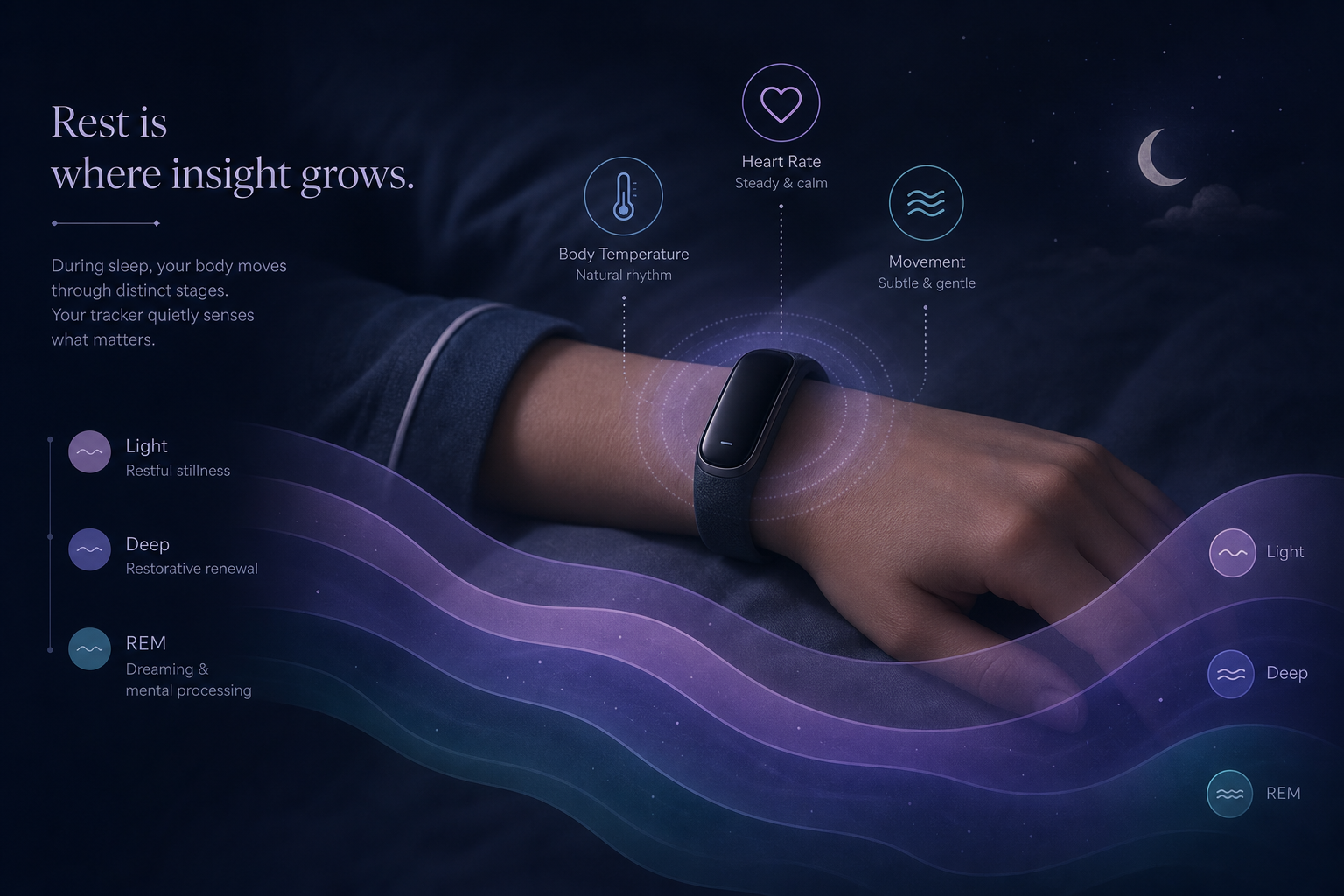
Most fitness trackers on the market in 2026 can count steps with reasonable precision. The gap between devices becomes a chasm, however, when you shift the focus to sleep tracking. Step counting is a relatively simple mechanical problem — detect a gait pattern, tally it. Sleep staging, by contrast, requires a device to infer neurological states (light sleep, deep sleep, REM) using only peripheral signals like movement, heart rate, and heart rate variability. No consumer wearable measures brain waves directly. That fundamental constraint means the quality of the sensor array, the sophistication of the algorithm, and the validation behind it determine whether you get useful trends or misleading noise.
For the adult reader who wants meaningful sleep insights — not just a bedtime reminder — the choice of device matters. A tracker that systematically misclassifies quiet wakefulness as light sleep will tell you that you slept eight hours when you actually lay awake for two. That is not a minor calibration error; it is a fundamentally misleading picture of your sleep health. This guide evaluates the 2026 lineup of fitness trackers using published polysomnography (PSG) validation data, expert testing criteria, and real-world comfort factors to identify which devices deliver sleep data you can actually act on.
What Separates Competent Sleep Tracking From Noise
Before comparing specific devices, it helps to understand the technical factors that determine whether a tracker's sleep data is trustworthy. The evaluation criteria used throughout this guide rest on four pillars:
- Sensor quality and variety. A device that relies solely on an accelerometer (movement detection) will always be less accurate than one that combines accelerometry with optical heart rate, HRV, and SpO2 sensors. The more physiological signals a device can cross-reference, the better its algorithm can distinguish sleep stages from stillness.
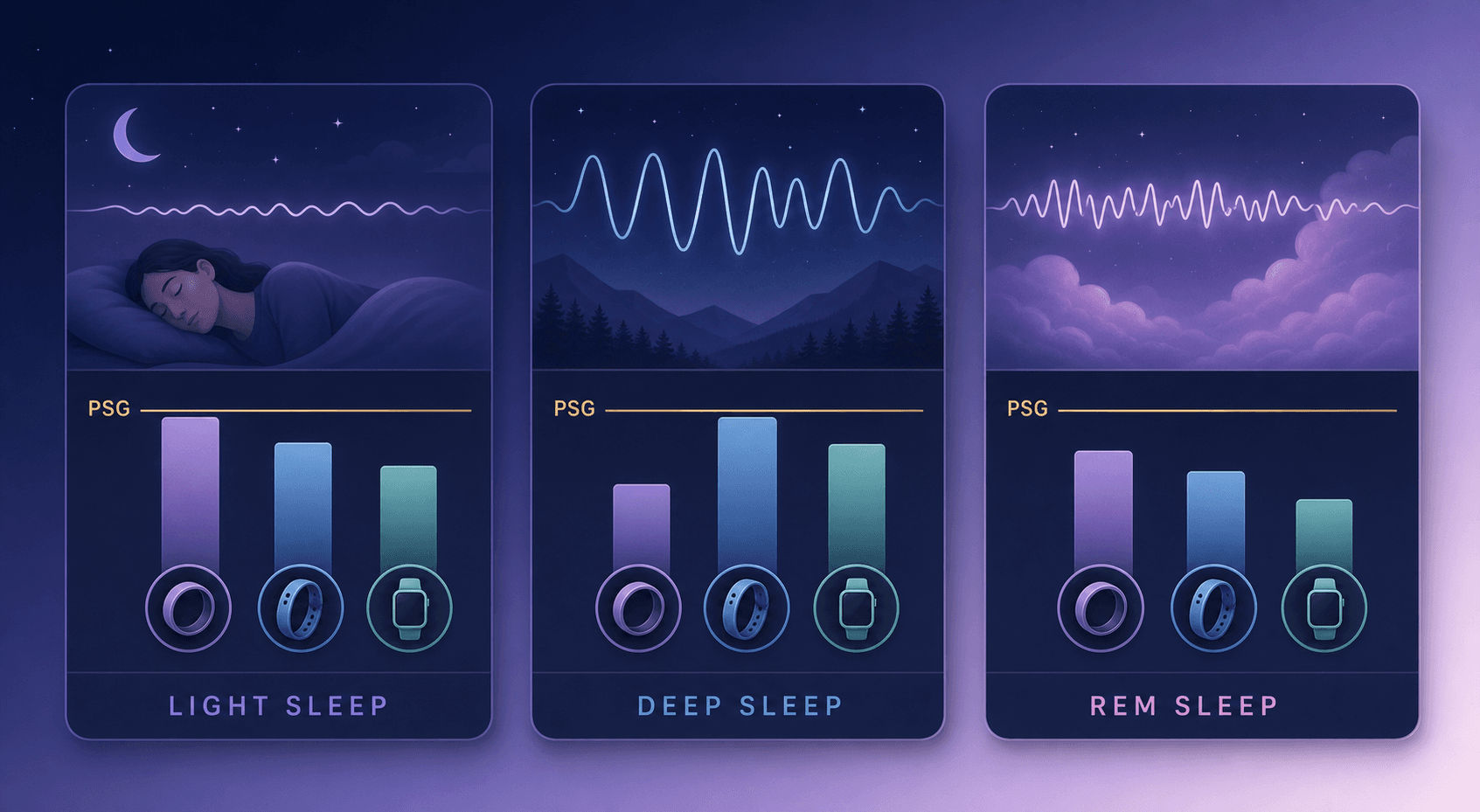
- Epoch-by-epoch performance (macro F1 scores). The gold-standard metric for sleep tracking accuracy is the macro F1 score, which measures how well a device classifies each 30-second epoch of sleep into the correct stage (wake, light, deep, REM) compared to PSG. A macro F1 of 0.70 means the device agrees with PSG 70% of the time across all stages. Scores below 0.50 indicate performance barely above chance for multi-stage classification.
- Sleep/wake discrimination. The most common failure mode of consumer trackers is misclassifying quiet wakefulness as sleep. This is especially problematic for people with insomnia, who may spend significant time lying still while awake. A device that cannot reliably detect wake will overestimate total sleep time and sleep efficiency.
- Independent validation. Manufacturer claims about accuracy are not the same as peer-reviewed validation studies. The most trustworthy devices have been tested against PSG in independent or multi-center trials, with results published in accessible formats.
The 2023 multicenter validation study published in PMC (PMCID: PMC10654909) provides the most comprehensive recent benchmark. Researchers analyzed 349,114 epochs from 11 consumer sleep trackers against PSG across 75 participants at two institutions in South Korea. The study found that among mainstream wearables, macro F1 scores ranged from 0.49 (Apple Watch 8) to 0.58 (Fitbit Sense 2 and Galaxy Watch 5). The Google Pixel Watch scored 0.57, and the Oura Ring 3 scored 0.52. These figures represent moderate agreement — useful for trend tracking but far from clinical-grade precision.
2026 Fitness Tracker Sleep Tracking Comparison Table
The table below summarizes the sleep-specific specifications for seven leading fitness trackers available in 2026. Note that PSG validation data is not available for every new model; where only older-generation data exists, that is noted. The macro F1 scores come from the 2023 multicenter study unless otherwise specified.
| Device | Form Factor | Tracked Sleep Metrics | Subscription Cost | Battery Life (Sleep Mode) | PSG Validation Data (Macro F1 or Agreement) | Key Sleep Feature |
|---|---|---|---|---|---|---|
| Oura Ring 4 | Ring | Sleep stages, HRV, SpO2, body temperature, sleep score | $69.99/year | 5–8 days | 79% agreement with PSG (2021 Gen3 study); 2024 independent study found no significant difference from PSG for TIB, TST, SOL, WASO, light sleep, and deep sleep | 18 sensor pathways; accurate HRV and body temperature trends |
| Fitbit Air | Screenless band | Sleep stages, heart rate, SpO2, sleep score | None | 7+ days | No published PSG validation for this specific 2026 model | Strong heart rate and sleep tracking at $99.99; no screen distraction |
| Fitbit Charge 6 | Fitness band | Sleep stages, HRV, SpO2, sleep score, ECG | None | 7 days | Fitbit Sense 2 (similar sensor platform): macro F1 0.58 (2023 study) | 40 exercise modes; built-in GPS; on-demand ECG |
| Garmin Forerunner 165 | Smartwatch | Sleep stages, HRV, sleep score, nap detection, Body Battery | None | Up to 11 days | No published PSG validation for this specific model; Garmin sleep score powered by Firstbeat Analytics | Sleep Coach; nap detection; HRV tracking; average Garmin user sleep score is 71 (2024 data) |
| Apple Watch Series 11 | Smartwatch | Sleep stages, HRV, SpO2, sleep apnea detection, sleep score (watchOS 26) | None | Nearly 2 days | Apple Watch 8: macro F1 0.49 (2023 study); Series 9+ has FDA-cleared sleep apnea detection | FDA-cleared sleep apnea detection; FDA-approved hypertension notifications |
| Samsung Galaxy Watch 8 | Smartwatch | Sleep stages, HRV, SpO2, sleep apnea detection, AI sleep coaching | None | 2+ days | Galaxy Watch 5: macro F1 0.58 (2023 study); FDA-cleared sleep apnea detection | AI coaching for sleep and fitness; FDA-cleared sleep apnea detection |
| Whoop 5.0 | Band (no screen) | Sleep stages, HRV, SpO2, respiratory rate, skin temperature, strain, recovery | $239/year (Peak membership) | 5 days | Whoop 3.0: 64% agreement with PSG for sleep stage classification (older model); no peer-reviewed PSG data for 4.0 or 5.0 in available sources | Personalized AI Coach; health monitor alerts; in-depth recovery analytics |
Deep Dives: Top Picks for Sleep-Focused Buyers
The following profiles provide detailed assessments of the five devices most relevant to sleep-focused buyers. Each profile includes specific validation data, key sleep features, subscription costs, ideal user profiles, and known limitations. For deeper accuracy analyses, links to the site's dedicated device reviews are provided.
Oura Ring 4: The Sleep-First Champion
The Oura Ring 4 consistently earns top marks from reviewers for its sleep-specific focus. Its 18 sensor pathways (up from 8 in the Gen3) represent a significant hardware upgrade, and the ring form factor is widely considered the most comfortable for overnight wear — no wrist strap to adjust, no screen to distract.
The validation data is among the strongest available for a consumer wearable. A 2021 study found the Oura Ring (Gen3) achieved 79% agreement with PSG, up from 66% in 2016. A 2024 independent study, though funded by Oura, found that the ring "did not significantly differ from PSG for the measures time in bed, total sleep time, sleep onset latency, sleep period time, wake after sleep onset, time spent in light sleep, and time spent in deep sleep." That is an unusually strong validation statement for a consumer device.
- Ideal for: Sleep-focused users who want the most accurate sleep data available in a consumer device and prefer a non-wrist form factor. Also suitable for those interested in HRV trends and body temperature tracking.
- Limitations: Requires a $69.99/year subscription for full feature access. No built-in display for quick time checks. The $349–$499 upfront cost plus subscription makes it one of the more expensive options over a multi-year period.
Fitbit Air: The Value Leader With No Subscription
The Fitbit Air, priced at $99.99, is a screenless fitness band that focuses on core tracking without distractions. PCMag named it the best screenless tracker of 2026, praising its "highly accurate heart rate and sleep tracking" and battery life exceeding one week. The lack of a screen means no late-night notifications and no temptation to check your sleep score the moment you wake up — a design choice that aligns well with sleep hygiene principles.
A critical caveat: no published PSG validation data exists for the Fitbit Air specifically, as it is a new 2026 model. However, Fitbit's sleep tracking technology has been refined over many generations. The Fitbit Sense 2, which uses a similar sensor platform, achieved a macro F1 score of 0.58 in the 2023 multicenter study — the highest among wrist-worn wearables tested. If the Air's algorithm performs comparably, it would represent excellent value.
- Ideal for: Budget-conscious buyers who want strong sleep tracking without a subscription or a screen. Also suitable for those who prefer a minimalist, low-distraction device.
- Limitations: No built-in GPS (requires phone connection for location tracking). No ECG or advanced health sensors. The lack of a screen means you need the phone app to view data.
For a deeper look at Fitbit's sleep tracking technology and accuracy across models, see our Fitbit Sleep Tracking Review.
Whoop 5.0: Deep Analytics for the Data-Driven User
The Whoop 5.0 is not a fitness tracker in the traditional sense — it has no screen, no step counter, and no exercise modes. Instead, it is a 24/7 physiological monitor that measures sleep, strain, and recovery. CNET ranked it as the best overall sleep tracker in 2026, citing its "in-depth sleep information and personalized AI Coach recommendations." The $239/year Peak membership includes sleep, strain, and recovery tracking plus health monitor alerts for respiratory rate and skin temperature.
The validation picture for Whoop is less clear than for Oura. A validation study of the Whoop 3.0 strap showed 64% agreement with PSG for sleep stage classification, but no peer-reviewed PSG validation data for the 4.0 or 5.0 models is available in the pre-crawled research. The CNET review provides subjective testing commentary but no independent accuracy metrics. Buyers should weigh the high subscription cost against the depth of analytics and the absence of current PSG validation.
- Ideal for: Users who want the deepest possible physiological analytics and are comfortable with a subscription-only model. Athletes and recovery-focused individuals will find the strain and recovery metrics particularly valuable.
- Limitations: High ongoing cost ($239/year). No screen. No GPS. No step tracking. The lack of current PSG validation data is a concern for accuracy-focused buyers.
Apple Watch Series 11: The All-Day Smartwatch With Sleep Apnea Detection
The Apple Watch Series 11 is the most capable all-day smartwatch on this list, and its sleep tracking capabilities have improved significantly. As of watchOS 26, it includes a native Sleep Score, and — more importantly — it offers FDA-cleared sleep apnea detection (a feature available since the Series 9). The Series 11 also features FDA-approved hypertension notifications, making it the only device on this list with two FDA clearances for health monitoring.
However, the sleep stage accuracy data is less impressive. The 2023 multicenter study found the Apple Watch 8 achieved a macro F1 score of just 0.49 — the lowest among tested wearables. This suggests that while the Apple Watch excels at detecting sleep apnea events (a distinct clinical task), its ability to classify sleep stages accurately lags behind competitors. The nearly two-day battery life is also a constraint for users who want continuous sleep tracking without nightly charging.
- Ideal for: iPhone users who want a premium smartwatch with sleep apnea detection, FDA-cleared health features, and a rich app ecosystem. The sleep apnea detection alone may justify the purchase for those at risk.
- Limitations: Below-average sleep stage classification accuracy (macro F1 0.49 for Series 8). Battery life requires nightly charging for most users. High upfront cost ($399+).
For a detailed analysis of Apple Watch sleep tracking accuracy, see our Apple Watch Sleep Tracking Review.
Garmin Forerunner 165: The Balanced Fitness and Sleep Option
The Garmin Forerunner 165 is a running-focused smartwatch that also delivers robust sleep tracking. It offers sleep score, Sleep Coach, nap detection, and HRV tracking, with battery life up to 11 days — the longest on this list. The sleep score, powered by Firstbeat Analytics, rates sleep on a scale of 0–100 based on sleep duration (compared to "globally accepted recommendations" of 7–9 hours) and sleep quality (time in sleep stages, restlessness, and average stress score based on HRV).
Garmin's own data shows that the average sleep score for Garmin users in 2024 was a "fair" 71, and only 5% of users averaged in the "excellent" range (90–100) during the last three months of 2022. This context is useful for calibrating expectations — a score of 71 is normal, not a sign of poor sleep.
- Ideal for: Runners and fitness-focused users who want strong sleep tracking alongside excellent activity tracking. The long battery life is a major advantage for those who dislike frequent charging.
- Limitations: No published PSG validation data for this specific model. The sleep score algorithm is proprietary and not independently validated. The Garmin blog and sleep score data are first-party marketing content.
How to Read Your Sleep Data Without Getting Anxious
A 2017 study published in the Journal of Clinical Sleep Medicine identified a phenomenon called "orthosomnia" — a perfectionistic quest for ideal sleep data that paradoxically worsens sleep. The study described patients who became so focused on "hitting their sleep numbers" that they developed anxiety around their sleep tracker data, leading to increased sleep latency and reduced sleep quality.
This is a real risk, and it is worth addressing directly. Sleep trackers are trend-awareness tools, not diagnostic instruments. The data they provide is useful for identifying patterns — Does caffeine after 4 PM reduce your deep sleep? Does evening exercise raise your HRV? — but it is not a report card. A single night of low sleep score is not a medical event. A week of consistently poor data might be worth discussing with a healthcare provider, but only in the context of how you feel, not what the number says.
What the Science Says About Accuracy Limitations
No consumer sleep tracker can measure sleep directly. As Johns Hopkins Medicine explains, these devices "don't measure sleep directly" but instead "measure inactivity as a surrogate for estimating sleep." The only way to measure sleep stages with clinical precision is through polysomnography, which monitors brain waves via EEG electrodes in a sleep lab.
The Cleveland Clinic reinforces this point, noting that sleep trackers "overestimate sleep efficiency" and that "there is no real way to measure sleep stages accurately without getting a sleep study." The 2023 multicenter validation study confirmed this: all wearables tested tended to overestimate sleep efficiency, particularly in individuals with low sleep efficiency. The study also found that wearables primarily misclassify wake as light sleep, meaning that quiet wakefulness — lying still in bed, eyes closed, not yet asleep — is frequently recorded as sleep.
Sleep trackers are useful for recognizing patterns in sleep habits (e.g., how caffeine, exercise, or bedroom temperature affect sleep) but advises taking the numbers 'with a grain of salt.'
These limitations do not mean sleep trackers are useless. They mean that the data should be interpreted as trends, not truths. A device that consistently shows you get less deep sleep after alcohol is providing actionable information. A device that tells you your sleep efficiency is 92% when you feel exhausted is probably wrong about the number but still pointing you toward a conversation with your doctor.
For a deeper dive into the comparative accuracy data across devices, including detailed macro F1 scores and study methodology, see our evidence-based accuracy comparison.
Decision Framework: Which Tracker Suits Your Sleep Needs
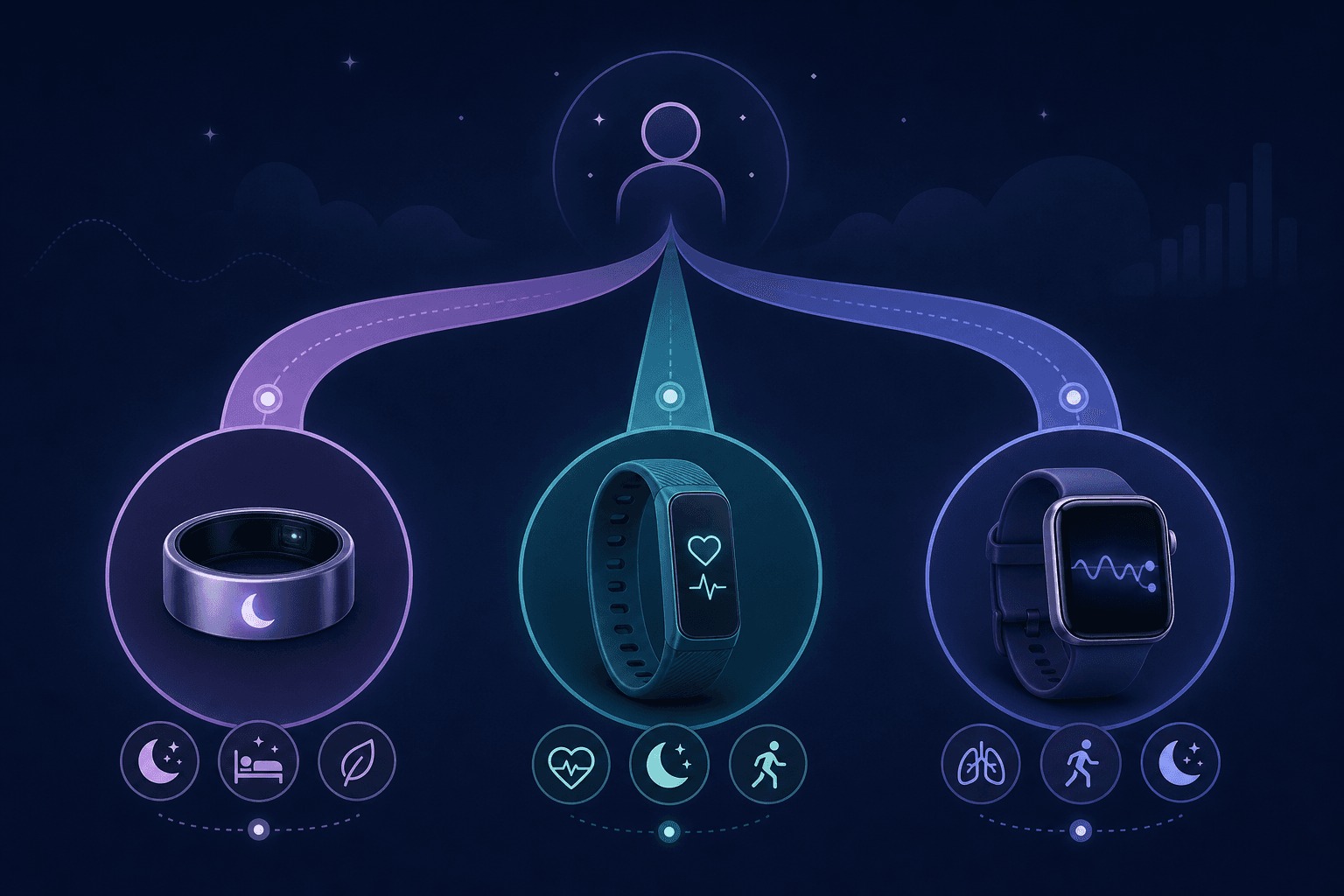
Choosing the right tracker depends on your priorities. The framework below maps each device to a primary use case, helping you match your needs to the right form factor and feature set.
- Sleep-first tracking: Oura Ring 4. If your primary goal is the most accurate sleep data available in a consumer device, and you are comfortable with a ring form factor and a subscription, the Oura Ring 4 is the clear choice. Its validation data is the strongest among the devices reviewed.
- Balanced fitness and sleep, no subscription: Fitbit Air or Garmin Forerunner 165. The Fitbit Air offers strong sleep tracking at a low price with no subscription, but lacks GPS and advanced fitness features. The Garmin Forerunner 165 provides excellent fitness tracking and long battery life, with sleep tracking as a strong secondary feature.
- All-day smartwatch with sleep apnea detection: Apple Watch Series 11. If you want a premium smartwatch with FDA-cleared sleep apnea detection and a rich app ecosystem, the Apple Watch Series 11 is the only device that checks all those boxes. Be aware that its sleep stage accuracy is below average.
- Subscription-based deep analytics: Whoop 5.0. If you want the deepest possible physiological analytics and are comfortable with a subscription-only model, the Whoop 5.0 provides strain, recovery, and sleep data that no other device matches. The lack of current PSG validation is a concern.
Form factor is a critical but often overlooked consideration. A ring is more comfortable for side sleepers than a bulky smartwatch. A screenless band eliminates late-night notification distractions. A smartwatch with a bright screen may disrupt your wind-down routine if you check it in bed. For a detailed comparison of form factors and their trade-offs, see our form-factor comparison guide.
Finally, consider the total cost of ownership. A device with no subscription but a higher upfront cost may be cheaper over three years than a lower-cost device with a mandatory subscription. The Oura Ring 4 costs $349–$499 upfront plus $69.99/year, totaling approximately $560–$710 over three years. The Whoop 5.0 costs $239/year with no upfront hardware cost, totaling $717 over three years. The Fitbit Air costs $99.99 with no subscription, totaling $99.99 over three years. For a full cost comparison across all devices, see our total cost of ownership analysis.


Comments
Join the discussion with an anonymous comment.