
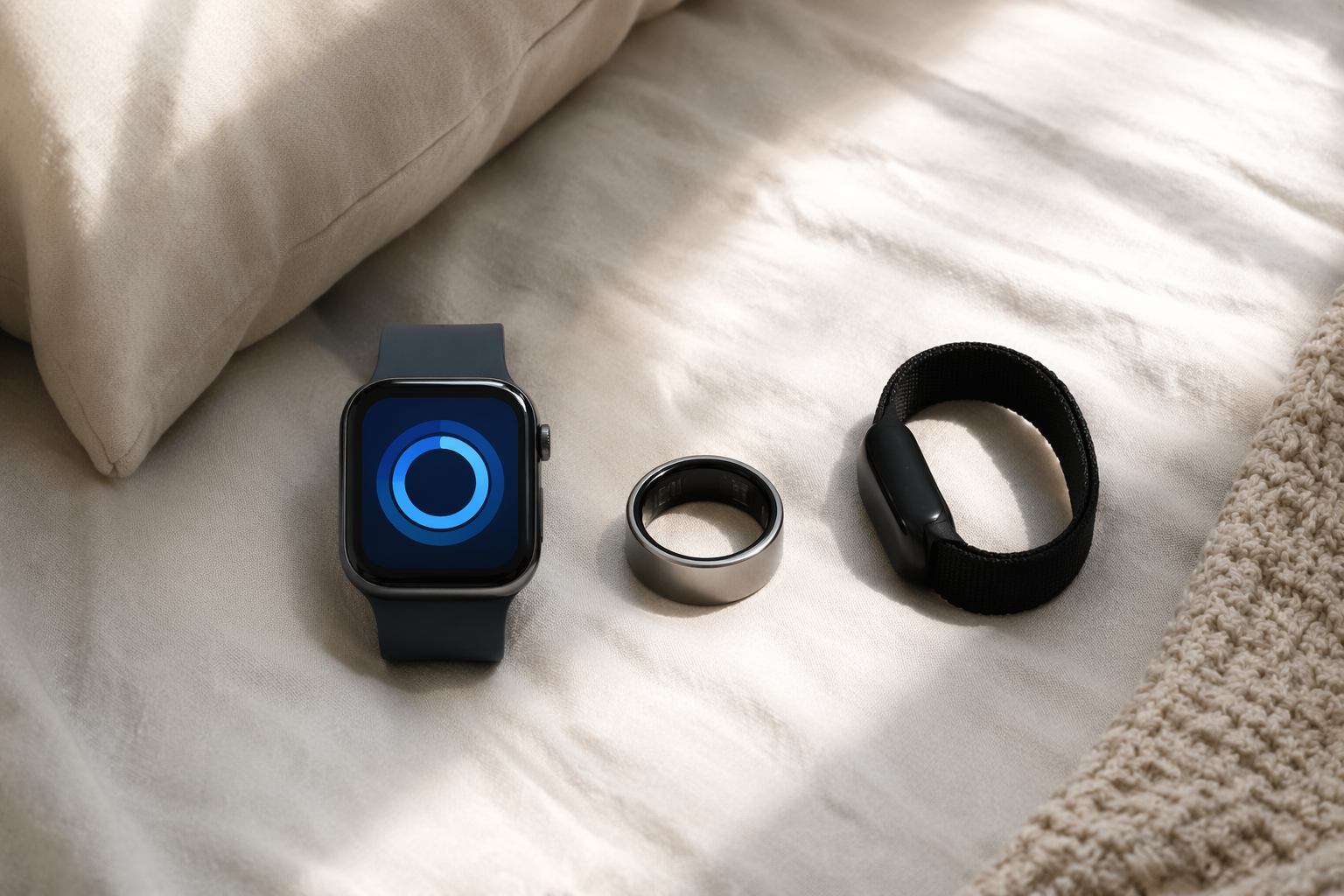
If you own an iPhone and want an apple watch that tracks sleep, the hard part in 2026 is not finding out whether Apple Watch can do it. It can. The harder question is whether Apple’s convenience and no-subscription model are enough to outweigh Oura’s stronger stage-level evidence or WHOOP’s more aggressive recovery coaching.
| Device | Sleep accuracy strength | Main caution | Cost structure | Battery life | Best fit |
|---|---|---|---|---|---|
| Apple Watch | Strong REM and light sleep sensitivity in the Robbins et al. PSG comparison: 82.6% for REM and 86.1% for light sleep [1] | Weakest deep sleep sensitivity in that comparison: 50.5%; overestimated light sleep by about 45 minutes and underestimated deep sleep by about 43 minutes per night [1] | $399+ device purchase; no required sleep subscription in the comparison set [2] | About 24 hours | iPhone owners who want adequate sleep trends inside a broader health and smartwatch device |
| Oura Ring | Best deep sleep sensitivity in the Robbins et al. comparison: 79.5%; the only device in that study that did not significantly misestimate any sleep stage [1] | Full insights require a recurring subscription, so the long-term cost rises after purchase [2] | $349-$499 ring plus about $70/year for full insights [2] | About 8 days | People who care most about passive overnight wear and sleep-stage accuracy |
| WHOOP | Built around recovery, strain, sleep debt, and habit feedback rather than a watch interface | The strongest 2026 comparison evidence here is reported from a preprint, not the same peer-reviewed footing as Robbins et al. [3] | About $200-$360/year; hardware included, subscription required | About 14 days | People who want coaching around training load, recovery, and sleep consistency more than device ownership |
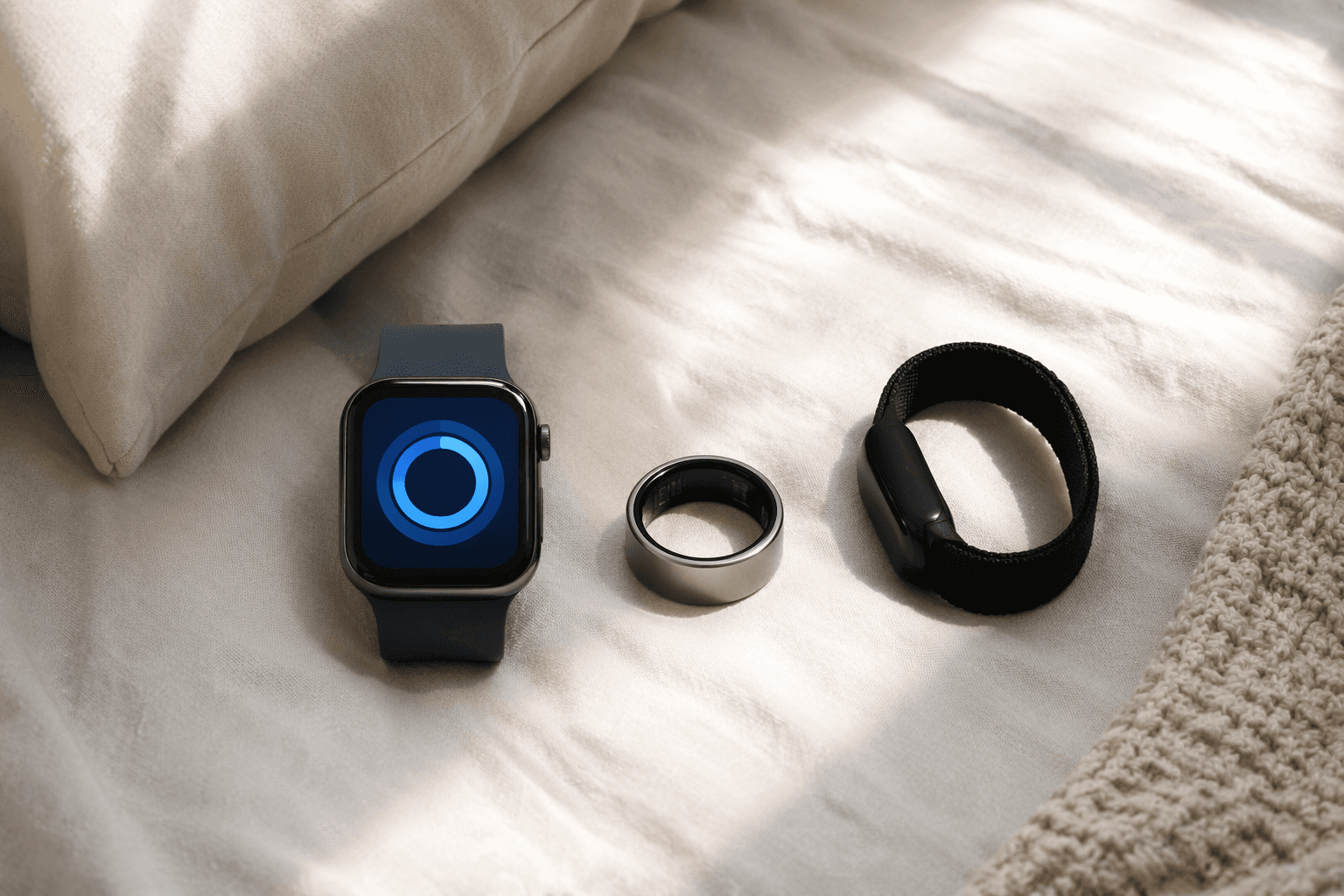
That table is already enough to rule out a few bad purchases. If you mainly want a smartwatch, Oura is the wrong shape. If you want the lowest ongoing cost, WHOOP is the wrong business model. If you plan to stare at deep sleep minutes every morning as if they came from a sleep lab, Apple Watch is the wrong kind of certainty.
What the accuracy data actually says
The most useful head-to-head evidence for Apple Watch and Oura comes from a 2024 Sensors study led by Robbins et al. at Brigham and Women’s Hospital. It compared Apple Watch Series 8, Oura Ring Gen 3, and Fitbit Sense 2 against polysomnography, the lab standard for sleep staging, in 35 healthy adults during a single night in a sleep lab [1].
That setup matters. A single-night lab study in healthy adults aged 20 to 50 is not the same thing as months of messy bedroom data, shift work, insomnia, alcohol, illness, travel, or sleep apnea. The study was also funded by ŌURA, which does not invalidate the results, but does mean the limitations deserve to stay visible [1].
| Sleep/wake category | Apple Watch sensitivity | Oura Ring sensitivity | What that means for a buyer |
|---|---|---|---|
| Deep sleep | 50.5% | 79.5% | Oura was much better at detecting epochs PSG labeled as deep sleep; Apple’s deep sleep number is the one to treat most cautiously [1] |
| REM sleep | 82.6% | 76.0% | Apple had the stronger REM sensitivity in this study [1] |
| Light sleep | 86.1% | 78.2% | Apple was stronger at detecting light sleep, but it also substantially overestimated light sleep time [1] |
| Wake | 52.4% | 68.6% | Both struggled with wake detection; Oura was better, but neither should make you overconfident about brief awakenings [1] |
The deep sleep gap is the part that changes the buying decision. In the Robbins study, Apple Watch underestimated deep sleep by about 43 minutes per night and overestimated light sleep by about 45 minutes per night. Oura was the only device in the comparison that did not significantly misestimate any sleep stage [1].
A separate analysis of Apple’s September 2023 validation work reported 62% deep sleep accuracy, with 38% of deep sleep misclassified as core sleep [4]. That does not map perfectly onto the Robbins study design, but it points in the same practical direction: Apple Watch sleep tracking can be useful, while Apple Watch deep sleep minutes should not be treated as clinically precise.
Apple Watch: the easiest choice to live with, not the cleanest deep sleep signal
Apple Watch is the most natural purchase if you already live inside the iPhone ecosystem. Sleep tracking sits beside workouts, heart rate trends, notifications, ECG on supported models, fall detection, crash detection, and Apple Health integration. You are not buying a sleep tracker alone; you are buying a general-purpose wrist computer that also happens to sleep track.
That is exactly why it works for many people. Apple’s own sleep setup lets users wear the watch to bed, set sleep schedules, track time asleep, view sleep stages, and use Sleep Score features on supported software [5]. For someone who wants bedtime consistency, sleep duration trends, and a single health dashboard, that may be enough.
The tradeoff is that Apple’s most convenient sleep number can become too easy to believe. In the published PSG comparison, Apple Watch was strong for REM and light sleep sensitivity, but weak for deep sleep and wake detection [1]. If the watch says your deep sleep fell by 40 minutes, that may reflect a real change, an algorithmic miss, or some mixture of both.
Battery life is the other practical snag. A roughly 24-hour battery can work if you have a reliable charging ritual, such as charging during a shower or while working at a desk. It fails quietly if you forget. A sleep tracker with a dead battery does not produce inaccurate data; it produces no data, which is worse for trend interpretation.
Apple Watch is strongest when you use sleep as one part of a broader health picture. It is less convincing as a dedicated sleep-stage instrument. If you are leaning this way and want the deeper evidence trail, the dedicated Apple Watch sleep tracking accuracy review is the better next stop.
Oura Ring: the strongest stage evidence, with ownership math attached
Oura’s case is refreshingly specific. In the Robbins study, it had 79.5% sensitivity for deep sleep, 76.0% for REM, 78.2% for light sleep, and 68.6% for wake [1]. Those are not perfect numbers, especially for wake, but Oura was the more balanced sleep-stage performer in the Apple-versus-Oura evidence we have.
The ring form factor also helps the product do its job. A tracker that lasts about 8 days and disappears on the hand is easier to keep wearing overnight than a watch that needs daily charging. That does not make the algorithm better by itself, but it makes consistent data collection more likely.
The annoyance is the subscription. Oura’s hardware price sits around $349-$499, and full insights require about $70 per year [2]. Over several years, that turns a clean one-time ring purchase into an ongoing health-dashboard bill. Some buyers will be fine with that; others will reasonably ask why a sleep score needs rent.
Oura also has features beyond sleep, including readiness scores, illness-related signals, and cycle tracking. Those can matter, but they should not distract from the main reason to choose it here: if deep sleep accuracy and passive overnight wear are the top priorities, Oura has the strongest case in the published Apple-versus-Oura PSG comparison [1]. Readers comparing the ring category more broadly may want the separate Oura sleep accuracy analysis or the guide to smart ring sleep accuracy.
WHOOP: useful coaching, weaker public footing for the accuracy claim
WHOOP belongs in this comparison because many buyers are not only asking, "How did I sleep?" They are asking, "Should I train hard today?" WHOOP’s product language is built around recovery, strain, sleep debt, and journaling. It is less of a smartwatch and more of a behavioral feedback system.
The best available 2026 comparison for WHOOP here comes from a University of Salzburg study reported by WeLoveCycling. It included 18 participants across 5 nights and reported that Oura and WHOOP were best at detecting night-to-night changes, while Apple Watch was weakest for within-person variation [3]. That is useful, but it is not the same as citing a fully peer-reviewed paper directly, and the evidence should not be treated as if it were.
That caveat does not make WHOOP a bad choice. It just changes what kind of choice it is. WHOOP is most attractive if you want the device to turn sleep into a training and recovery plan: reduce strain today, catch up on sleep debt, notice which logged habits line up with better recovery. If you mainly want the most independently grounded sleep-stage comparison against PSG, Apple Watch and Oura have cleaner source material in the evidence available here.
The cost model is also different. WHOOP’s hardware is included, but the subscription is not optional, at about $200-$360 per year. That can be sensible for someone who wants coaching and will use it daily. It is a poor fit for someone who only wants to check sleep stages a few mornings a week.
Sleep Score makes the dashboard simpler, not more clinical
Apple’s newer Sleep Score framing is helpful because most people do not want to interpret four stage graphs before coffee. Apple’s watchOS 26 Sleep Score documentation and reporting describe a score built from sleep duration, bedtime consistency, and interruptions, with involvement from sleep organizations including the American Academy of Sleep Medicine, National Sleep Foundation, and World Sleep Society [5][6].
A score can reduce friction, but it can also hide uncertainty. If a device struggles with wake detection, then a clean-looking interruption score should still be read as an estimate. If deep sleep is undercounted, a lower score may feel more meaningful than the underlying signal deserves. The number is best used as a trend prompt: what changed in bedtime, wake time, alcohol, illness, stress, travel, or training?
For Apple Watch buyers, the useful question is not whether Sleep Score is "right" on a given morning. It is whether the score helps you notice repeatable patterns without turning one imperfect night into a verdict. The companion guide to Apple Watch Sleep Score and sleep apnea notifications goes deeper on that interpretation.
Cost and charging are accuracy issues in disguise
It is tempting to separate accuracy from cost and battery life, but sleep tracking punishes that neat separation. A device only measures sleep on nights you wear it. A tracker that is more accurate in a lab but left on the charger, in a drawer, or canceled after the subscription renewal is not more accurate for your life.
| Question | Apple Watch | Oura Ring | WHOOP |
|---|---|---|---|
| Do you pay a required subscription for core sleep use? | No required sleep subscription | Yes, for full insights | Yes, subscription is the product |
| How often do you think about charging? | Daily or near-daily | Roughly weekly | Roughly every two weeks |
| What are you most likely to keep wearing? | Best if you already wear a watch all day | Best if you prefer not to sleep with a screen on your wrist | Best if you are comfortable wearing a fitness band continuously |
| What cost feels easiest to justify? | Higher upfront price for a multi-purpose device | Hardware plus annual sleep insights | Annual coaching subscription with hardware included |
For a price-sensitive iPhone owner, Apple Watch has the simplest long-term value story: buy the device, use sleep tracking, avoid another annual health subscription. Oura asks for more patience with the total cost because its best sleep experience sits behind a membership. WHOOP asks for the biggest philosophical buy-in because you are not really buying a band; you are renting a coaching system.
Which one should you choose?
Choose Oura Ring if deep sleep accuracy and low-friction overnight wear matter most. The best published Apple-versus-Oura PSG comparison favors Oura for deep sleep sensitivity, wake sensitivity, and overall stage misestimation [1]. It is the least watch-like option and the easiest to keep on through the night, as long as the subscription does not sour the purchase.
Choose Apple Watch if you want good-enough sleep tracking inside a broader iPhone health device without a required sleep subscription. It is the better all-around gadget, the better smartwatch, and a reasonable sleep trend tool. Just do not build your morning mood around its deep sleep minutes.
Choose WHOOP if recovery coaching, strain management, sleep debt, and habit feedback matter more than owning a standalone device. It is the most coaching-centered of the three, but the accuracy evidence available here needs more qualification than the peer-reviewed Apple-versus-Oura comparison.
If you are still comparing beyond these three, use the broader fitness tracker sleep accuracy comparison or the 2026 sleep tracker roundup. If the decision is more about personal priorities than device rankings, the guide to choosing the best sleep and fitness tracker is the more practical route.
None of these devices should be treated as a clinical sleep diagnosis tool. If you are worried about insomnia, possible sleep apnea, unusual nighttime breathing, or unexplained daytime sleepiness, the right next step is medical evaluation, not a better-looking sleep chart.
References
- Accuracy of Three Commercial Wearable Devices for Sleep Tracking in Healthy Adults, Sensors, 2024
- Apple Watch vs. Oura Ring: Which Should You Buy?, CNET
- How Do Garmin, Apple Watch, Oura Ring, and Whoop Compare in Sleep Tracking?, WeLoveCycling, 2026
- Deep Sleep Percent, Empirical Health
- Track your sleep with Apple Watch, Apple Support
- How Sleep Score works on Apple Watch with watchOS 26, AppleInsider
Comments
Join the discussion with an anonymous comment.