
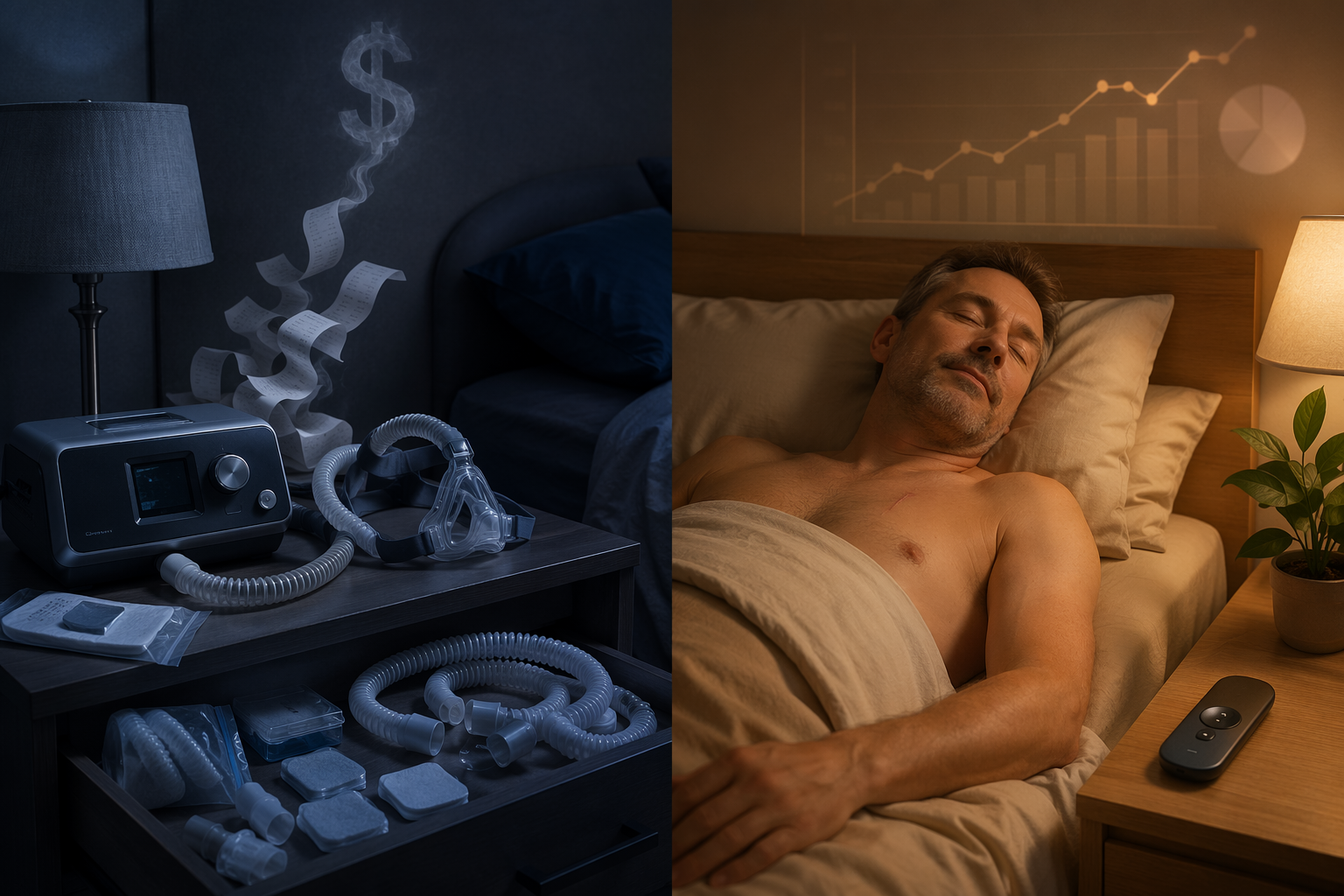
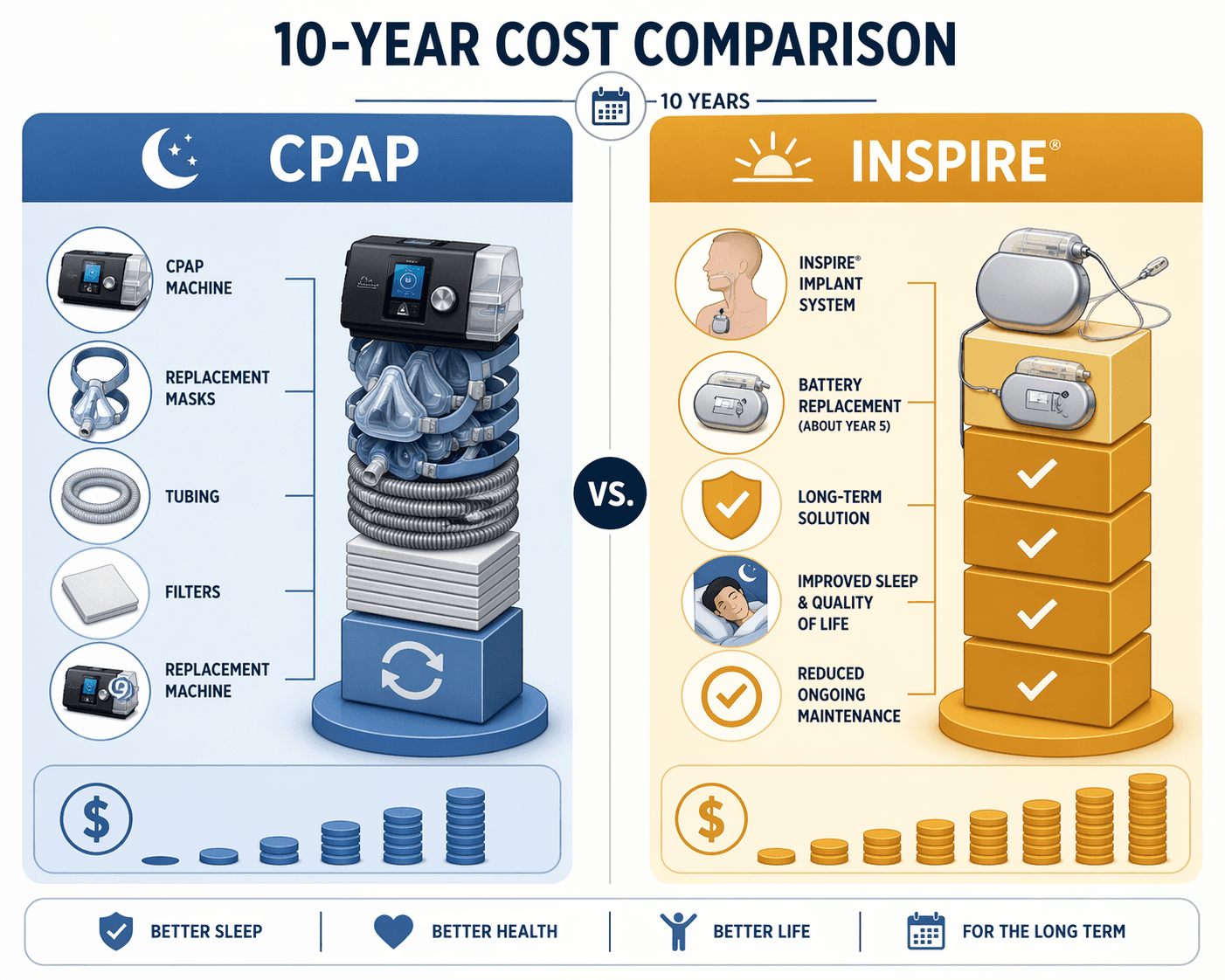
The first thing to look at is not the sticker shock. It is the ten-year bill and whether that bill turns into nights of actual treatment. A CPAP machine may start around $300–$1,000, but once you add masks, tubing, filters, humidifier chambers, and a replacement machine, the ten-year total lands around $8,500. Inspire begins in a very different place: surgery plus the device commonly puts the upfront cost in the $30,000–$45,000 range, before follow-up care and later battery replacement enter the picture [1][2].
Ten-year costs
| Cost item | CPAP | Inspire | What it means over 10 years |
|---|---|---|---|
| Upfront cost | $300–$1,000 for the machine [1] | $30,000–$45,000 for device plus surgery [2] | Inspire requires a much larger day-one outlay. |
| Recurring costs | Masks, tubing, filters, humidifier parts, and machine replacement every 5 years; about $300–$800 per year [1] | Battery replacement surgery around $5,000–$8,000 every 9–11 years, plus follow-up visits [2] | CPAP looks cheap until the supply cycle keeps repeating. |
| Estimated 10-year total | About $8,500 [2] | About $55,000 [2] | The gap narrows, but it does not disappear. |
That number still does not tell the whole story, because the price a hospital bills and the price a patient actually pays can be very different. In a small 9-center study, the median markup over manufacturer price was $20,292, or 87.8%, and the center-to-center range ran from $28,178 to $60,845 [3]. That is not a national average, but it is enough to show why an Inspire estimate can shift sharply with insurance, facility choice, and negotiated rates.
Adherence and outcomes
CPAP is the better economic deal only if it stays on the face. Once it becomes a machine in the closet, the lower price is just a lower price for unused equipment. Inspire's main financial argument is not that it is inexpensive, but that it is more likely to produce actual nightly treatment. In the STAR trial, 86% of patients were using it daily at 12 months, and the median apnea-hypopnea index fell from 32.0 to 15.3, with 66% achieving at least a 50% reduction [5].

That higher use rate is what changes the economics. A long-term cost-effectiveness analysis found Inspire at $39,471 per quality-adjusted life year, while CPAP came in around $15,915 per QALY [4]. Both sit below the commonly used $50,000–$100,000 willingness-to-pay range, but they do not mean the same thing. CPAP's better QALY cost is the better deal only when the patient can actually tolerate it; Inspire's higher cost is more defensible when it is the therapy that stays in place long enough to matter. The same model projected 10-year reductions in myocardial infarction risk of 37%, stroke risk of 25%, and motor vehicle collision risk of 66% [4].
The evidence is still narrower than the marketing usually implies. The cost-effectiveness work was funded by Inspire Medical Systems and built from STAR-trial data drawn from a select group of patients, so the result is useful but not universal [4][5]. Not everyone qualifies for the implant either; coverage and eligibility depend on anatomy, apnea severity, BMI rules, and payer policy, which is why the same therapy can be a practical option for one patient and a non-starter for another.
Risks and limits
This is still surgery, so the tradeoff is not imaginary. The common complaints are discomfort, tongue soreness, and dry mouth, and some patients need time and adjustments before the stimulation feels tolerable. There was also a June 2024 FDA Class I recall involving 32 Inspire IV Model 3028 units, followed by FDA approval of Inspire V in August 2024 [6][7]. The recall was small, but it is the kind of detail that keeps the “permanent fix” pitch from getting too polished.
For the patient who can reliably wear CPAP, the cheaper path is still CPAP. For the patient who has already shown that CPAP does not stay on the face long enough to help, Inspire's larger upfront cost can be the more rational expense because it is more likely to become real treatment instead of recurring supply purchases without meaningful use.
References
- Sleep Apnea Treatment Costs — Verywell Health
- Doctronic - Inspire Sleep Apnea Cost — Doctronic
- Payer-negotiated pricing of the hypoglossal nerve stimulator — Journal of Clinical Sleep Medicine, 2022
- Long-Term Cost-Effectiveness of Upper Airway Stimulation — SLEEP, 2015
- Upper-Airway Stimulation for Obstructive Sleep Apnea — The New England Journal of Medicine, 2014
- FDA Recall Notice for Inspire IV Model 3028 — U.S. Food and Drug Administration, June 2024
- FDA approves Inspire V — American Academy of Sleep Medicine, August 2024


Comments
Join the discussion with an anonymous comment.