
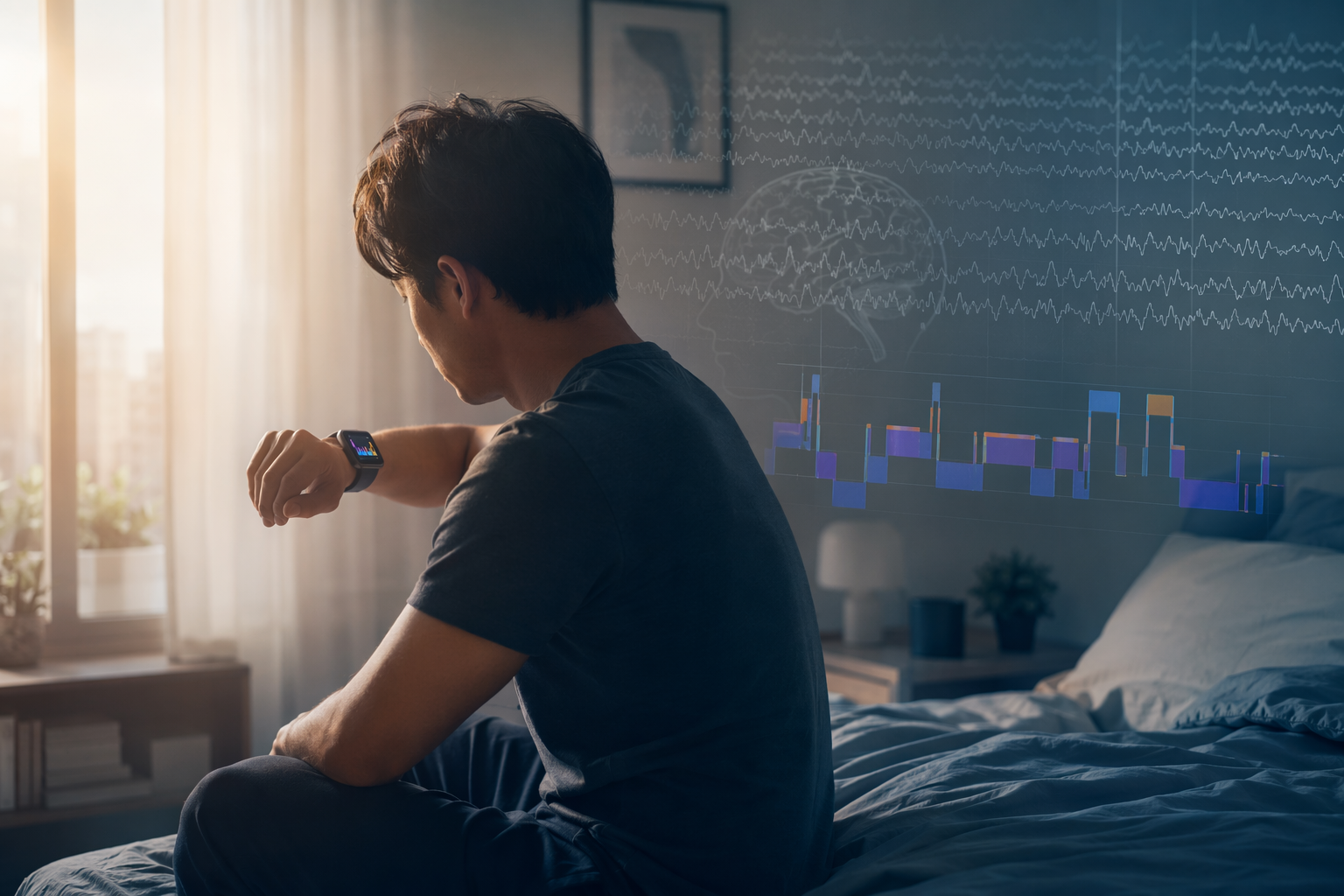
A sleep tracker watch can be useful before it is accurate enough to deserve the last word. That is the awkward truth behind the morning sleep score: the same device that can show your bedtime drifting later all week may also tell you, with great visual confidence, that you were asleep during the hour you remember staring at the ceiling.
For most people, the best use of a sleep tracker watch is trend-spotting: total sleep time, sleep and wake timing, irregular routines, and how late nights accumulate. The weakest use is treating its stage chart — light, deep, REM — as a clinical readout of what your brain did overnight. Those stages are inferred. They are not measured the way a sleep lab measures them.
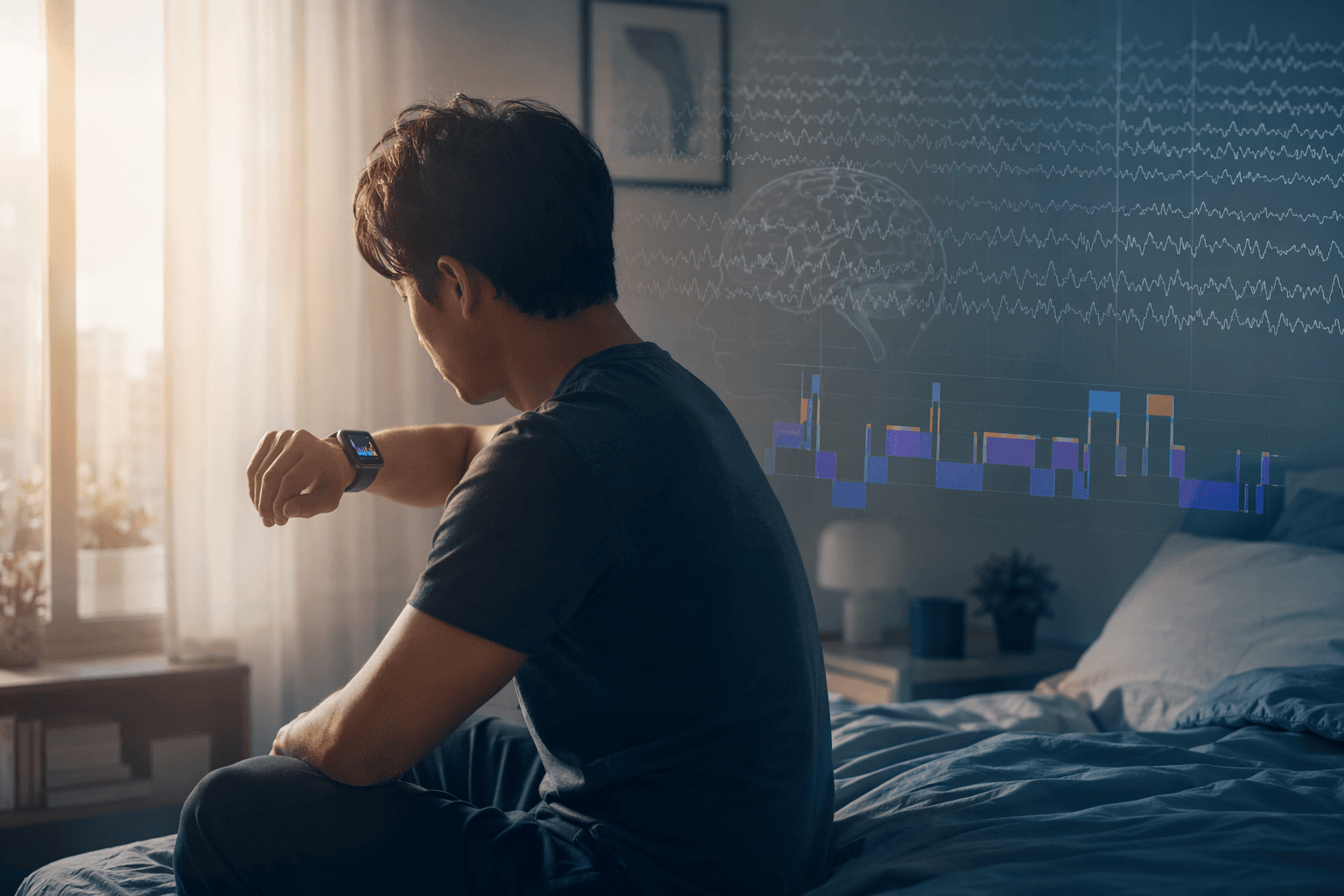
What your watch can tell you, and what it is guessing
The cleanest way to read sleep tracker data is to separate the measurements into hardier and softer categories.
| Watch output | How much authority to give it |
|---|---|
| Bedtime and wake-time patterns | Usually useful for spotting routine drift and irregular schedules |
| Total sleep time trends | Useful over several nights or weeks; less meaningful as a single-night verdict |
| Sleep versus wake | Often good at detecting sleep, but weaker at detecting quiet wakefulness |
| REM, light, and deep sleep stages | Soft estimates; not a substitute for EEG-based sleep staging |
| Sleep score | A simplified dashboard number, not a diagnosis or a complete account of recovery |
That distinction matters because a watch can be right enough to reveal a pattern and wrong enough to mislead you about a particular night. If you went to bed at 12:40 a.m. three nights in a row, it can probably help you notice that. If it says you got “too little deep sleep” last night, the right response is more caution.
How a sleep tracker watch actually estimates sleep
Most consumer sleep tracker watches rely on two main kinds of signals: actigraphy and optical heart-rate sensing, often called photoplethysmography or PPG. Actigraphy uses movement data from the watch. PPG shines light into the skin and reads changes in reflected light to estimate pulse-related signals. From those inputs, plus related measures such as heart-rate variability and timing, the device’s algorithm estimates whether you were awake or asleep and then assigns likely sleep stages.
What it does not do is measure brain waves. Clinical polysomnography, the sleep-lab comparison standard used in validation studies, includes EEG brain-wave measurement along with other physiological signals. Consumer watches do not have that direct view of sleep architecture, so their stage labels are model outputs rather than direct observations.[1]
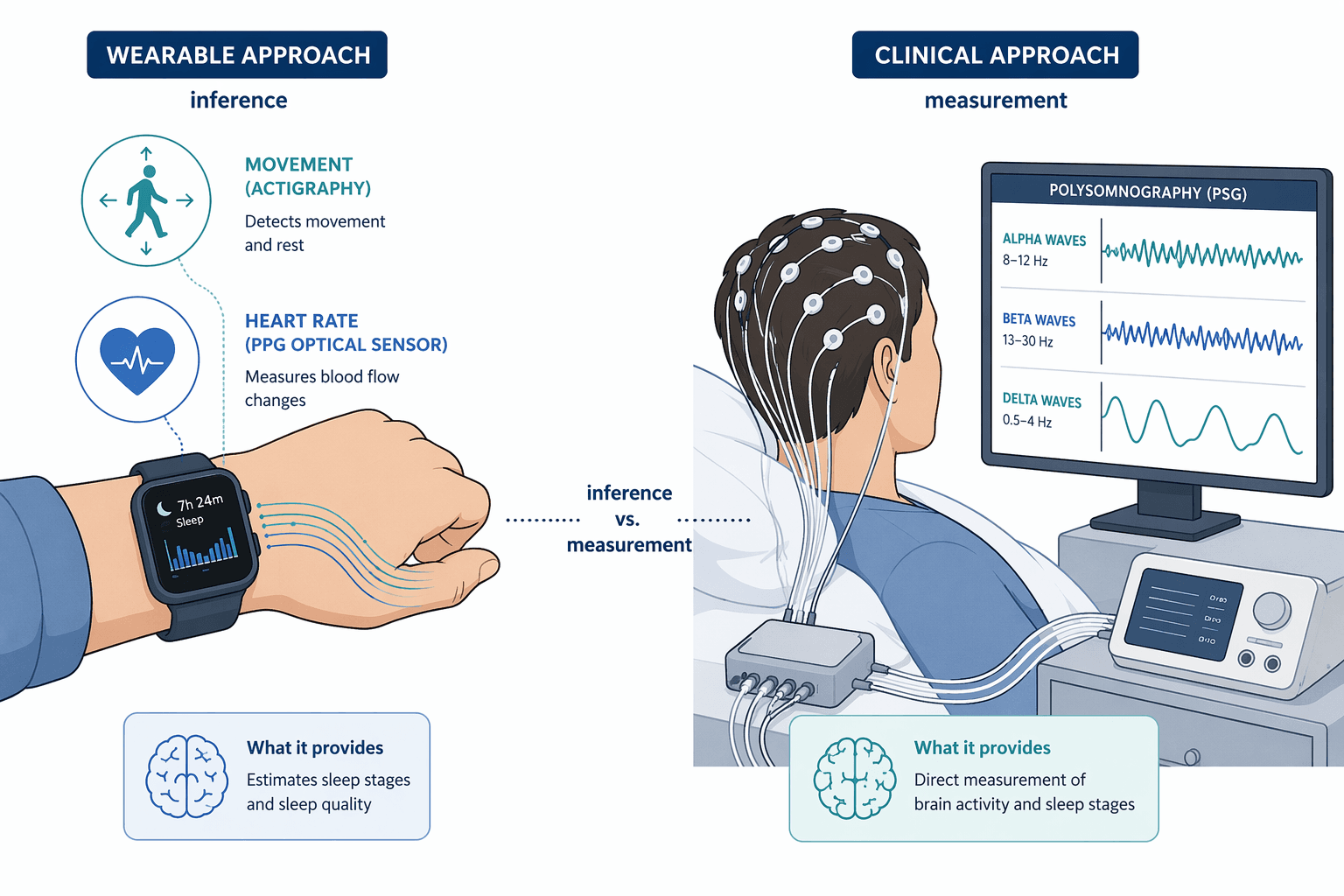
This is why the device can perform better on broad sleep timing than on sleep stages. Sleep usually brings less movement, a different heart-rate pattern, and a different nightly rhythm. Deep sleep and REM sleep, however, are not simply “less movement” or “lower heart rate.” They are brain states. A wrist sensor is trying to infer them from the outside.
The accuracy problem is not one problem
Accuracy claims around sleep wearables often sound cleaner than the evidence is. One number may describe how well a device detects sleep. Another may describe how well it detects wake. Another may describe agreement with polysomnography across several sleep stages. Those are not interchangeable.
In a 2024 Brigham and Women’s Hospital wearable study reported by Sleep Review, major devices showed sleep-detection sensitivity of at least 95%. That means they were very good at identifying epochs that polysomnography also labeled as sleep.[2]
But “95% sensitivity for sleep” does not mean “95% accurate sleep tracking.” It especially does not mean “95% accurate sleep stages.” A device can be excellent at recognizing that you are probably asleep and still be much less reliable at deciding whether that sleep was light sleep, deep sleep, or REM.
Wake detection is the quieter problem. Reported wake-detection accuracy has ranged from 20% to 60% depending on device in one expert summary, and the broader evidence base shows that wake detection can vary widely across products and studies.[3] This is where many people feel the mismatch most sharply: the watch may call a still, frustrated hour “sleep” because the body was quiet enough to resemble sleep from the wrist.
Sleep-stage accuracy is weaker still. A 2022 Sensors study discussed in Oxford Neuroscience reporting found epoch-by-epoch sleep-stage accuracy around 53% to 60%, depending on the device and study conditions.[4] Oxford researchers also reported that some devices underestimated deep sleep by as much as 46 minutes.[4] That is not a tiny rounding error if the dashboard then turns deep sleep into the emotional centerpiece of your morning.
This is the trap in many sleep dashboards. The bars are neat. The colors are persuasive. The score arrives before you have finished deciding how you feel. But the visual polish is not the same as physiological certainty.
A careful look at brand numbers
Brand-specific figures can be useful for scale, as long as they are not treated as a permanent ranking. In the 2024 Brigham and Women’s Hospital study, Oura Ring 4 showed a Cohen’s kappa of 0.65 and deep sleep sensitivity of 79.5%, Apple Watch showed a Cohen’s kappa of 0.60 and deep sleep sensitivity of 50.5%, and Fitbit showed a Cohen’s kappa of 0.55 and deep sleep sensitivity of 61.7%.[2] The Apple Watch also overestimated light sleep by 45 minutes and deep sleep by 43 minutes in that study.[2]
Those numbers suggest meaningful differences, but they should not be stretched beyond the study. Device generations change, algorithms are updated, study populations differ, and lab protocols vary. The study was funded by ŌURA, though it was independently designed by Brigham and Women’s Hospital researchers.[2] That does not make the findings useless. It does mean they belong in the evidence pile, not on a pedestal.
For readers who want the narrower product-comparison layer, a deeper PSG-focused review of smart watch sleep tracker accuracy is the better place to spend time. For deciding how to live with the data, the larger point is simpler: even the better-performing consumer devices are estimating sleep architecture, not measuring it directly.
Why a wrong sleep estimate can feel so convincing
Sleep is unusually vulnerable to suggestion because most of it happens outside conscious memory. If a running watch says your pace was slow, you can compare that with the route, the weather, and your legs. If a sleep tracker watch says your deep sleep was poor, you may not have much internal evidence to argue back.
That makes the interface powerful. It can validate what you already felt: short night, late bedtime, multiple awakenings. It can also create a problem you did not have until the score appeared. A single low number can turn a normal groggy morning into an investigation.
The issue is sharper for people with insomnia. People who are awake but lying very still may be especially likely to fool actigraphy-based systems, because the device sees quiet immobility and may classify it as sleep.[4] This can produce a strange double injury: the person remembers being awake, the watch says they slept, and now they are left doubting both the device and themselves.
Orthosomnia: when sleep data becomes part of the sleep problem
Orthosomnia is not a formal medical diagnosis. The term was introduced in a 2017 Journal of Clinical Sleep Medicine case series involving three patients whose pursuit of “perfect” tracker-defined sleep appeared to worsen their sleep-related distress.[5] Small case series should be handled carefully. They do not tell us how common a problem is. They can, however, name a pattern clinicians are seeing.
The most memorable case was Ms. B. Her polysomnography results were normal and showed above-average deep sleep, but she continued to believe she slept poorly because her Fitbit data told a different story.[5] That is the uncomfortable hierarchy many trackers can create: the laboratory test becomes less persuasive than the consumer dashboard.
A later experimental finding makes the concern harder to dismiss as a few unusual cases. In research described by Oxford Neuroscience, Reid and colleagues manipulated sleep scores shown on a watch. Participants who received worse sleep feedback reported lower mood, worse perceived cognitive performance, and more sleepiness, even though actual sleep was identical between groups.[4]
That finding does not mean every sleep score is harmful. It means the score can become an active ingredient in how a person experiences the day. Once that happens, the watch is no longer just recording sleep. It is helping shape the story the sleeper tells about their own body.
How to use a sleep tracker watch without giving it too much authority
The practical move is not to throw the watch away. It is to demote certain numbers to the level their sensors deserve.
- Use weekly patterns more than single-night scores. Bedtime drift, irregular wake times, and chronically short sleep windows are the kinds of signals a watch can make visible.
- Treat total sleep time as an estimate, not a receipt. It is often useful for trend awareness, especially across multiple nights, but it can still miss quiet wakefulness.
- Do not reorganize your life around REM or deep sleep percentages. Stage labels are inferred from indirect signals and are much less reliable than the charts suggest.
- Notice whether checking the data changes your mood before anything else happens. If the score makes you feel defeated before breakfast, the score is no longer neutral.
- Take tracker breaks if you start doing nightly forensics. A few nights without the dashboard can be useful information too.
This approach is consistent with American Academy of Sleep Medicine guidance that consumer sleep technologies are better suited for trend awareness than diagnosis, and that people should be cautious about overinterpreting sleep-stage percentages or single-night outputs.[6]
A sleep tracker watch can also be useful as a conversation aid. If you are trying to explain to a clinician that your schedule has become irregular, or that your sleep window has been shrinking, several weeks of timing data may help. But persistent insomnia, loud snoring, witnessed breathing pauses, excessive daytime sleepiness, or unrefreshing sleep despite adequate time in bed should not be settled by a consumer score. Those symptoms deserve clinical guidance, even if the watch says the night looked fine.
For a broader look at the difference between consumer sleep tracking and clinical validation, see this evidence review on smart sleep devices. For a deeper discussion of tracker fixation and PSG validation, the guide to sleep tracker accuracy and orthosomnia risk covers that landscape in more detail.
The rule worth keeping
Trust a sleep tracker watch most when it shows repeated patterns: when you usually go to bed, when you tend to wake, whether your sleep window is expanding or shrinking, and whether weekends are pulling your schedule far away from weekdays.
Trust it less when it turns one night into a grade. Trust it least when it claims to know exactly how much deep sleep your brain produced. And if the device’s version of the night conflicts with your symptoms, your recovery, or a clinical test, the watch should be the first thing to lose authority.
References
- Sleep tracker and sleep technology explainers, Cleveland Clinic / Johns Hopkins Medicine
- Brigham and Women’s Hospital 2024 wearable sleep accuracy study, Sleep Review
- Dr. Walch wearable sleep tracker accuracy comments, ABC News
- Consumer sleep trackers, sleep-stage accuracy, and manipulated sleep-score findings, Oxford Neuroscience
- Orthosomnia: Are Some Patients Taking the Quantified Self Too Far?, Journal of Clinical Sleep Medicine, 2017
- Consumer sleep technology guidance and consensus, American Academy of Sleep Medicine
Comments
Join the discussion with an anonymous comment.