
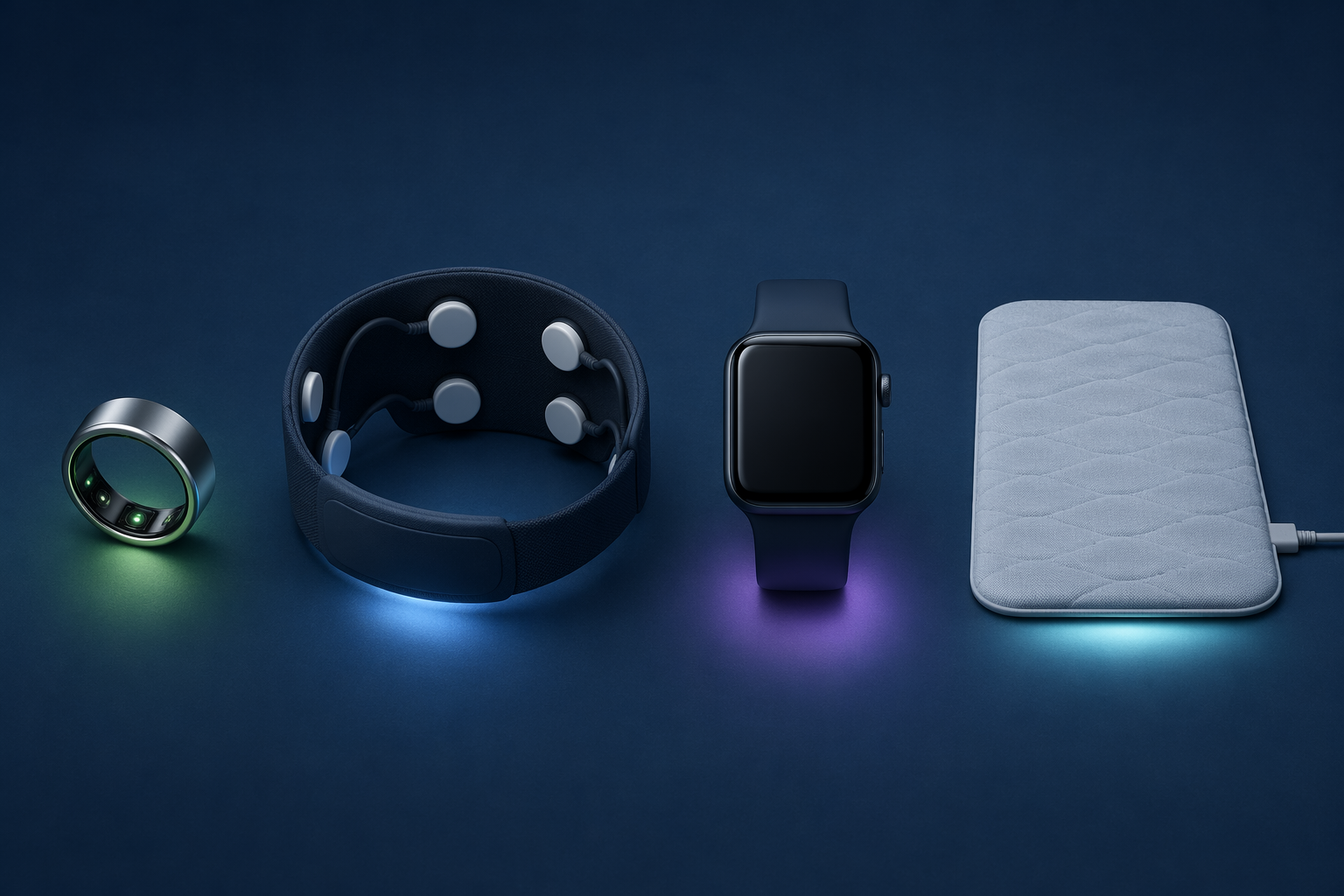
The best sleep monitoring device is not the one with the prettiest sleep score. It is the one that measures the thing you actually need measured, with a wearing burden and ownership cost you can tolerate after the novelty has worn off.
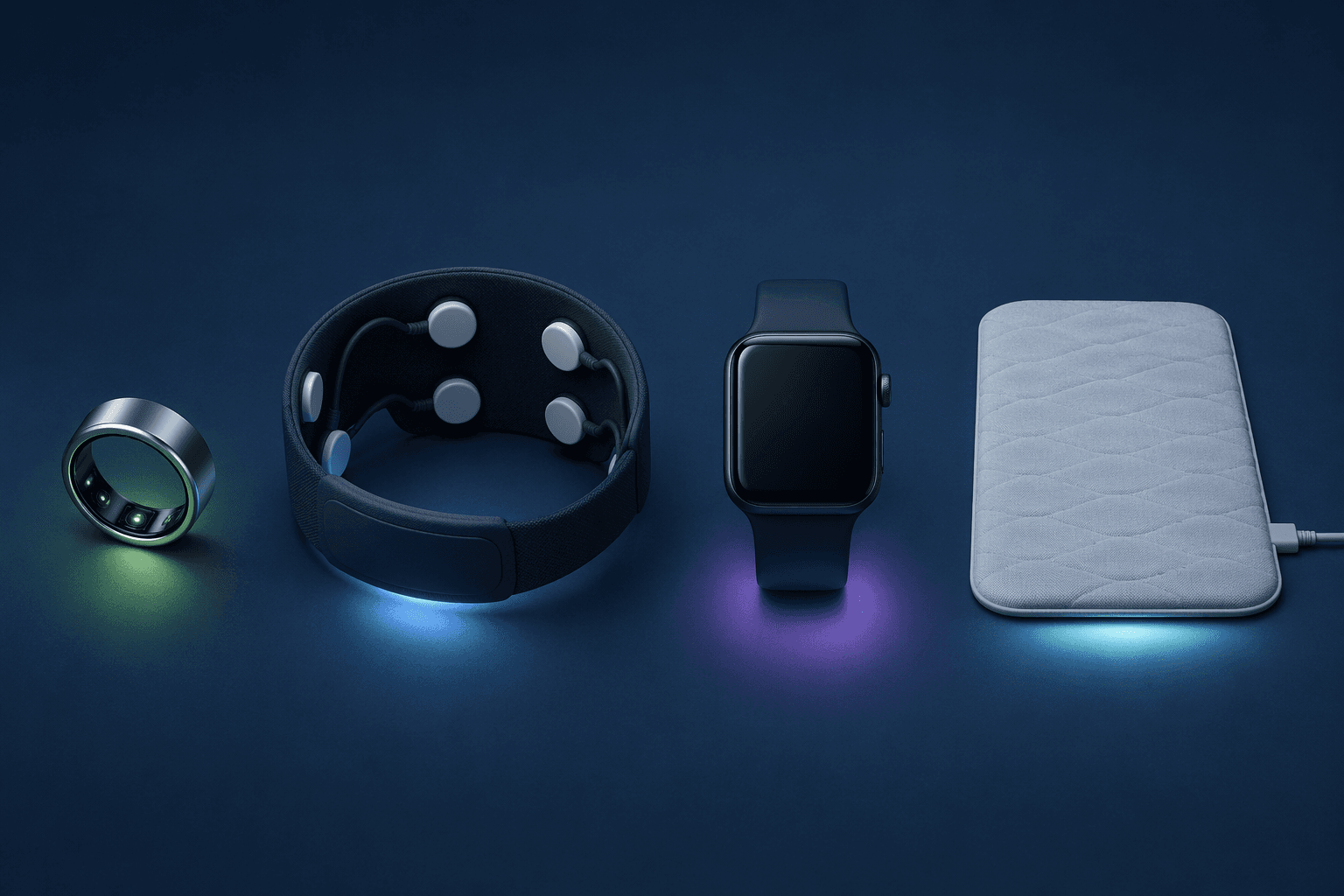
That sounds obvious until the shopping tabs open. A ring, an EEG headband, a smartwatch, and an under-mattress pad may all say they track sleep, but they are not looking at sleep from the same doorway. Some infer sleep from movement and physiology. Some read brain signals. Some are built around a regulated screening feature. Some avoid your body entirely and watch the bed instead.
The first correction is accuracy. In a lab validation study of 53 participants and six consumer devices, PPG-based wearables reached 86–89% accuracy for sleep/wake detection, but only 50–65% accuracy for multi-stage sleep classification against polysomnography, the clinical reference standard often shortened to PSG.[1] In plainer terms: a device may be reasonably good at estimating whether you were asleep, while still being much shakier when it labels light, deep, and REM sleep.
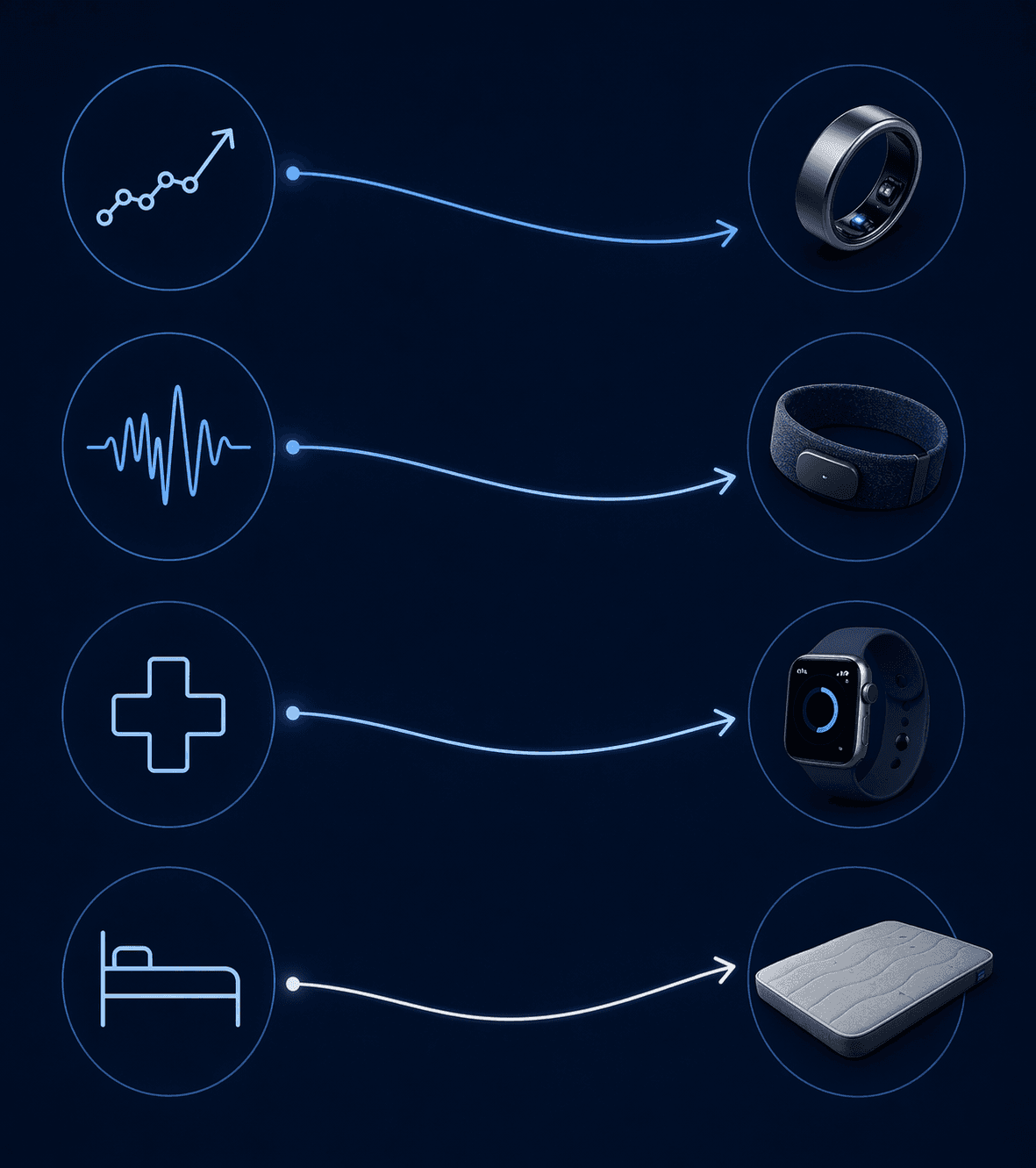
That distinction should sit at the top of every comparison. If your real question is, “Did my sleep schedule improve over the last month?” a comfortable ring may be enough. If your question is, “Can this detect a moderate-to-severe sleep apnea risk pattern?” you are in smartwatch territory. If your question is, “Can anything adjust what happens while I am asleep?” an EEG headband is the more relevant category. If your question is, “Can I avoid wearing anything?” then an under-mattress sensor may be worth the trade.
Start with the sensing method, not the brand
Most bad sleep-monitor comparisons go wrong by flattening different measurement methods into one scoreboard. The device category matters because it determines what evidence the product can reasonably collect.
| Form factor | Primary measurement approach | What it is usually best suited for | Main caution |
|---|---|---|---|
| Smart ring | PPG and motion signals from the finger | Comfortable long-term trend tracking | Sleep stages are inferred, not directly measured |
| EEG headband | Brain-signal sensing from the head | Stage-aware tracking and possible real-time intervention | More intrusive to wear; validation claims need scrutiny |
| Smartwatch | PPG, motion, and platform-specific health algorithms | Sleep plus general health features; apnea notifications on cleared models | Battery and wrist comfort can become daily friction |
| Under-mattress sensor | Bed-based movement, breathing, and cardiac inference | Passive tracking without wearing a device | May confuse stillness in bed with sleep and has bed-sharing limitations |
The table does not crown a winner because the categories are solving different problems. If you already know you only want a lighter overview of device types, a broader sleep monitor form-factor comparison can be enough. If you are about to spend several hundred dollars and possibly subscribe for years, the measurement method deserves more attention.
If your goal is long-term sleep trends, a smart ring is the cleanest fit
For most people comparing sleep trackers, the practical job is not clinical diagnosis. It is pattern recognition: whether bedtimes are drifting, whether short nights are accumulating, whether alcohol or late workouts seem to disturb recovery, whether a new routine changes average sleep duration.
This is where smart rings make sense. A ring is small, has no glowing screen, and is less likely than a watch to feel like another workday object strapped to the body. Oura’s 5–8 day battery matters more than spec-sheet glamour because charging is one of the quiet ways sleep tracking fails. If the device is dead twice a week, its trend line becomes a decoration.
The evidence is encouraging but not magical. Oura has cited a 2024 University of Tokyo validation study in which Oura Ring measurements did not significantly differ from PSG for total sleep time, sleep onset latency, and wake after sleep onset.[2] That supports the ring as a trend device for core sleep continuity measures. It does not turn every stage label into a laboratory finding.
The older multi-device validation study is useful here because it keeps expectations grounded: PPG wearables can do fairly well on sleep/wake estimation while struggling more with multi-stage classification.[1] Also, that study tested earlier Oura and WHOOP generations, not the newest hardware. Newer products may improve, but they have to be validated as newer products, not inherited into accuracy by brand reputation.
A ring is the right kind of compromise if you want a low-burden device that quietly builds a personal baseline. It is less convincing if you plan to treat nightly REM and deep-sleep percentages as instructions. For ring-specific limitations, including wake detection and total sleep time tradeoffs, a deeper smart ring sleep accuracy guide is the better next stop.
If your goal is real-time sleep intervention, the headband category is different
An EEG headband is not just a wearable with a different shape. It is trying to measure closer to the source of sleep staging: brain activity. That changes what the device can plausibly attempt.
Muse S Athena is the interesting example because it moves from recording to participation. Its pitch is not merely that it can show sleep stages in the morning, but that it can use EEG signals to time audio cues during sleep. In category terms, that is a meaningful difference: a ring or watch mostly observes, while an EEG headband can attempt brain-state-aware intervention.
The validation claim is also where caution belongs. Muse reports 88–96% PSG validation for Muse S Athena sleep staging.[3] That is higher than the PPG wearable range cited above, but the figure is manufacturer-published and, based on the research materials available here, not independently replicated in a non-sponsored setting. It is promising, not a free pass.
The more ordinary problem is comfort. A headband asks more of a tired person than a ring does. It has to sit on the head, maintain contact, and remain acceptable at 2 a.m., not just during a product demo. If you are buying because you want intervention rather than passive tracking, that burden may be justified. If you only want a monthly sleep-duration trend, it is probably too much device for the job.
If your goal is apnea notification, look at the cleared smartwatch feature—not the sleep score
Sleep apnea screening is the place where the form-factor question becomes more specific. You are no longer asking which device has the nicest dashboard. You are asking whether a product has a regulated notification pathway for a defined risk pattern.
Apple Watch Series 9 and later models are notable because Apple’s sleep apnea notification feature received FDA clearance for moderate-to-severe obstructive sleep apnea notification. The reported performance was 66.3% sensitivity and 98.5% specificity over a 30-day monitoring window.[4] Those numbers are important partly because they are not “one-night diagnosis” numbers.
Sensitivity tells you how often the feature caught the target condition in the validation context. Specificity tells you how often it correctly avoided flagging people who did not have it. A high specificity figure reduces needless alarms, while the lower sensitivity figure means some cases can be missed. The correct reading is not “the watch diagnoses apnea.” It is that the watch can provide a cleared notification for possible moderate-to-severe OSA risk over time, after which medical follow-up matters.
That makes the Apple Watch compelling for one narrow job. It does not automatically make it the best sleep monitoring device for everyone. A person who hates wearing a watch to bed, forgets to charge it before sleep, and only wants long-term sleep regularity may be better served elsewhere. A person already in the Apple ecosystem who wants general health tracking plus apnea notifications has a much stronger reason to tolerate the wrist form factor.
If your goal is no wearable at all, under-mattress sensors buy convenience with ambiguity
Under-mattress sensors solve one of the most underrated problems in sleep tracking: they do not ask you to wear anything. No ring sizing. No watch band. No headband. No bedtime charging ritual on the body. For a reluctant tracker, that can be the difference between using a device for years and abandoning it in a drawer.
The tradeoff is that bed-based inference is not the same as body-worn measurement. The research brief flags several practical limitations: these sensors may be unable to distinguish bed partners, do not measure HRV, and can overestimate sleep when someone is awake but still in bed. That last problem is not theoretical in the life of a poor sleeper. Lying still at 3 a.m. can look deceptively sleep-like to a passive sensor.
This does not make mattress pads useless. It makes them better suited to people who value passive, low-friction bed monitoring more than fine-grained personal physiology. If the priority is climate control plus a broad view of time in bed and sleep regularity, the category has a place. If the priority is stage accuracy, individual HRV trends, or reliable separation between two sleepers, the convenience starts to cost too much.
The ownership cost can change the answer
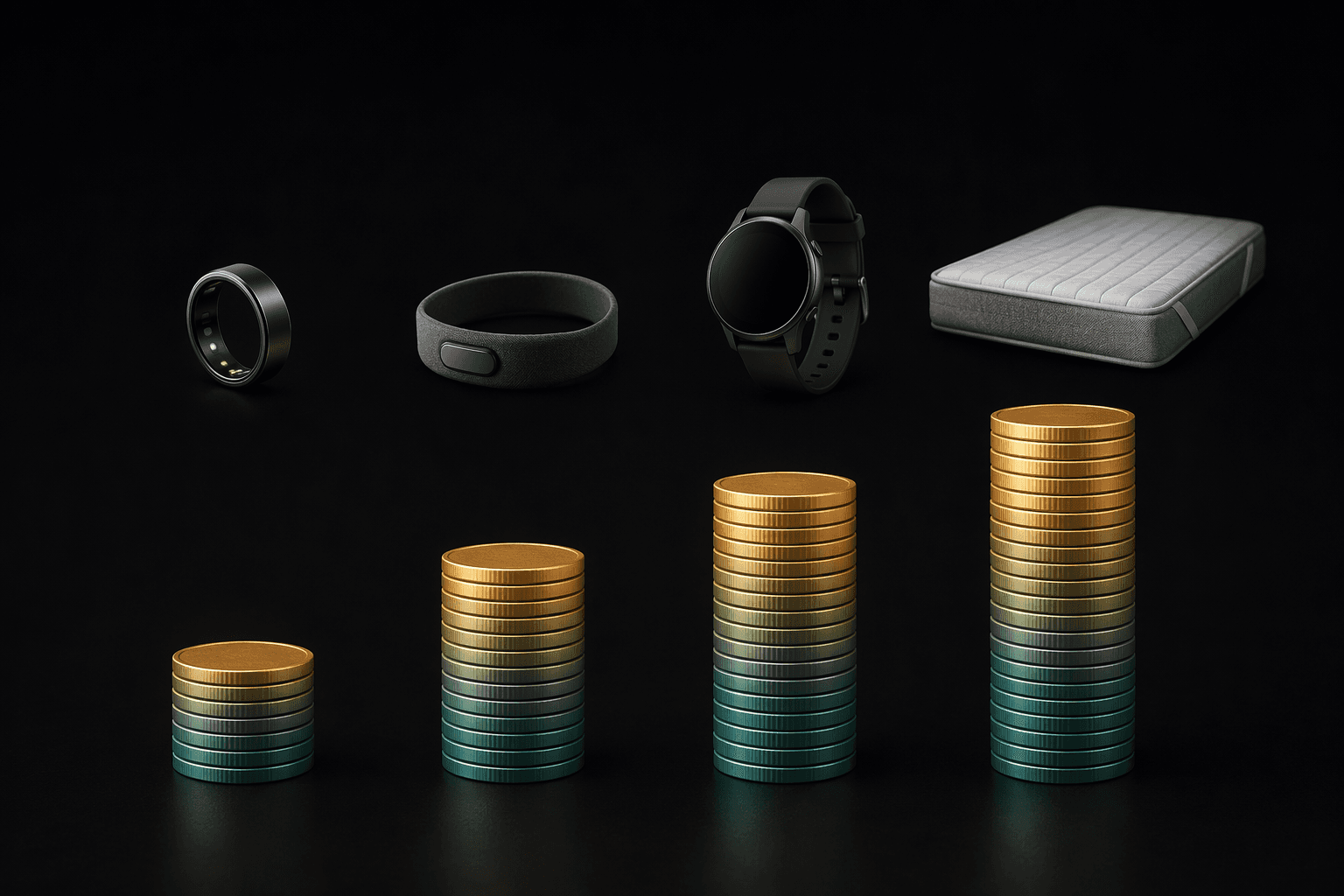
Checkout price is the least honest version of sleep-tracker cost. The more relevant question is what the device costs after two to four years, because sleep tracking only becomes useful after it has enough ordinary nights to compare against.
A subscription that sounds small in a product listing becomes part of the device. Oura’s $6/month subscription is easy to underestimate because the hardware is the object you hold. WHOOP’s model is more explicit, with a mandatory membership listed in the research materials at $199–359/year. Across the examples in the brief, estimated three-year ownership cost ranges from about $200 for a Sleepon Go2Sleep with no subscription to more than $1,500 for an Eight Sleep Pod 5 plus Autopilot.[7]
| Buying situation | Cost question to ask before choosing |
|---|---|
| You want a ring for nightly trends | Will the subscription still feel acceptable after 24–48 months? |
| You want WHOOP-style recovery and sleep coaching | Are you buying a device, or committing to an annual membership model? |
| You want an EEG headband | Is the intervention use case valuable enough to justify a more intrusive wearable? |
| You want a premium mattress system | Are you paying for sleep tracking, bed climate control, or both? |
| You want the cheapest tracker that produces sleep data | What evidence supports the measurements you plan to act on? |
This is why a cheap device is not automatically sensible, and an expensive one is not automatically indulgent. If a mattress system solves a bed-temperature problem that ruins sleep, its cost belongs in a different mental bucket than a simple tracker. If a subscription only unlocks charts you check anxiously and never use constructively, it is a recurring tax on worry.
A practical match by sleep goal
The cleanest buying path is to name the job first and let the form factor follow.
| Primary goal | Best-matched form factor | Why | What to verify |
|---|---|---|---|
| Comfortable long-term sleep trends | Smart ring | Low wearing burden, multi-day battery, useful baseline tracking | Subscription cost, ring fit, and how the app explains uncertainty |
| Real-time sleep-stage-aware intervention | EEG headband | Closer to brain-state measurement and capable of timed audio cues | Independent validation status, comfort, and whether intervention is the real reason you are buying |
| Moderate-to-severe apnea notification | Cleared smartwatch feature | Regulated notification pathway over a defined monitoring window | Model eligibility, 30-day requirement, and follow-up plan with a clinician |
| Passive bed-based monitoring | Under-mattress sensor or smart mattress system | No wearable burden and easy long-term adherence | Bed partner handling, HRV limitations, and risk of counting quiet wakefulness as sleep |
Notice what is missing from that table: generic sleep score, app polish, and a brand-by-brand feature pile. Those details matter after the device has passed the measurement-method test. A beautifully designed score is still the wrong tool if it answers a different question than the one that brought you shopping.
If you narrow the field to Oura and WHOOP, the next decision is less about ring versus band as jewelry and more about what each system claims to infer from PPG, motion, recovery metrics, and subscription-supported coaching. A separate Oura Ring vs. WHOOP sleep validation comparison is better for that narrower fork. If you also care about workouts, the broader question becomes the best sleep and fitness tracker, which is a different purchase than sleep-only monitoring.
What not to overread
Consumer sleep trackers are not PSG. That does not make them useless, but it should stop anyone from treating a nightly sleep-stage chart as if it came from a sleep lab. Johns Hopkins Medicine has warned that consumer sleep trackers may offer useful clues while still being limited in what they can measure and diagnose.[5]
The World Sleep Society’s 2025 recommendations also support a careful reading of consumer sleep technology: these tools can be useful for longitudinal behavior and screening contexts, but interpretation should account for device limitations and the difference between consumer metrics and clinical assessment.[6]
Validation can also lag the shelf. A study that tested Oura Ring Gen2 and WHOOP 3.0 cannot automatically settle how Oura Ring 4 or WHOOP 5.0 performs.[1] Hardware changes, algorithms change, and app outputs change. The honest question is not whether a brand has ever been validated, but whether the current device and metric you care about have been validated in a comparable setting.
Then there is the user. Orthosomnia—the pattern in which sleep-tracker data fuels unhealthy preoccupation with achieving perfect sleep—cuts across every form factor. The prevalence estimate cited in the research brief, 3–14%, comes from a single cross-sectional study and should be treated as preliminary, not as a settled population rate.[7] The practical warning is still worth taking seriously: a device that makes you more vigilant in bed may worsen the very experience it is supposed to improve.
The right sleep monitor is the one whose sensing method matches the job: a ring for low-friction trends, an EEG headband for brain-state-aware intervention, a cleared smartwatch feature for apnea notification, or a mattress-based sensor when passive tracking matters most. After that, check comfort, charging, subscription terms, and the real 2–4 year cost before treating any sleep score as an instruction.
References
- PMC9412437 lab validation study, PMC.
- 2024 University of Tokyo validation study, Oura Blog, 2024.
- Muse S Athena PSG validation claim, Muse.
- Apple Watch Sleep Apnea Notification Receives FDA Clearance, Pulmonology Advisor / AASM.
- Do Sleep Trackers Really Work?, Johns Hopkins Medicine.
- World Sleep Society 2025 recommendations, Sleep Medicine, 2025.
- Orthosomnia, Sleep Foundation.

Comments
Join the discussion with an anonymous comment.