
The Core Tension: Why No Device Tracks Sleep and Activity Perfectly
If you are shopping for a single device that delivers both excellent sleep tracking and robust activity/fitness monitoring, you have likely noticed a frustrating pattern: the devices that excel at one tend to compromise on the other. This is not a marketing oversight — it is a consequence of physics, sensor placement, and design priorities.
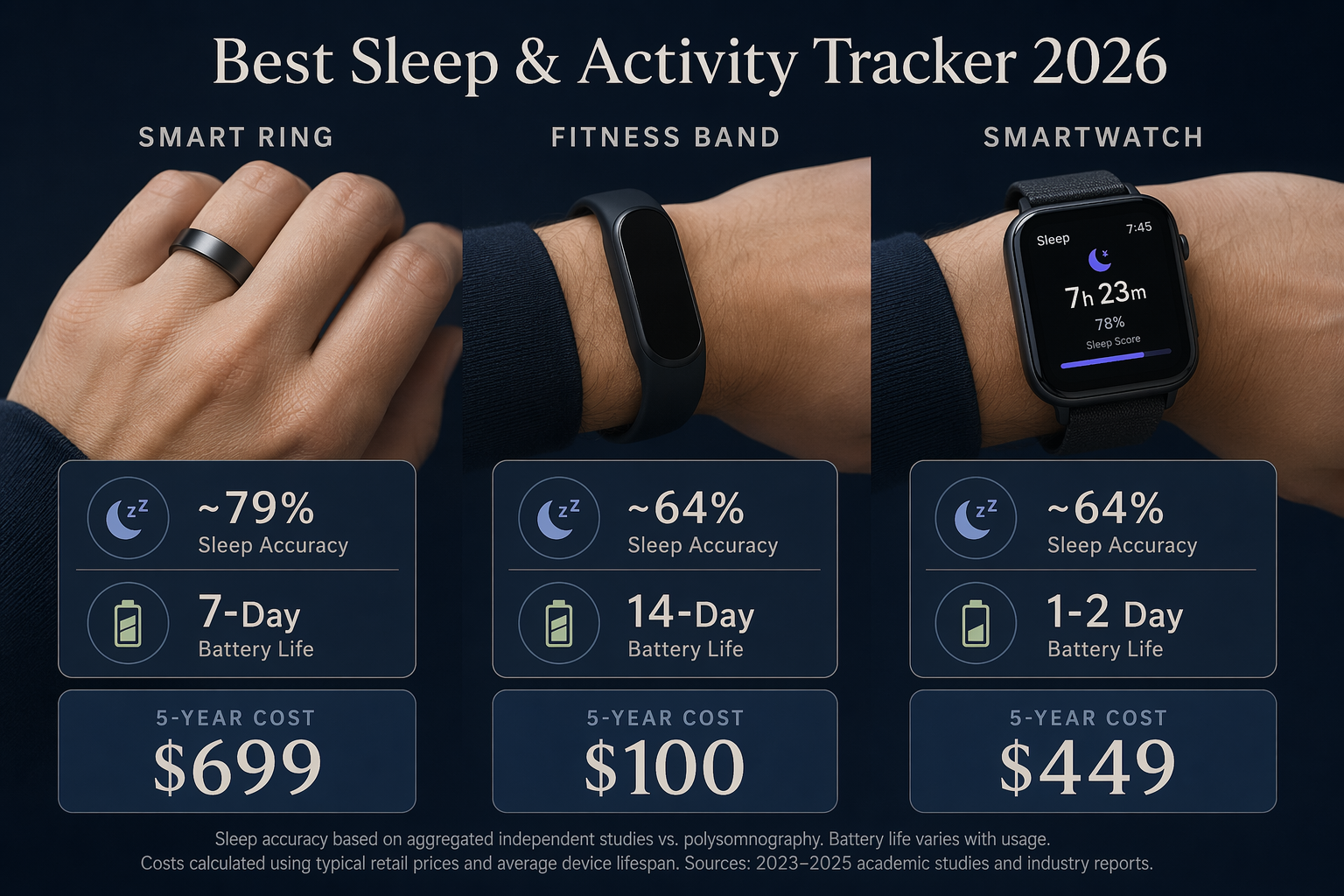
Smart rings, such as the Oura Ring 4, are optimized for sleep. Their form factor allows for continuous wear with minimal discomfort, and their sensor placement on the finger — where blood volume pulse signals are strong — enables accurate heart rate and HRV readings throughout the night. A 2021 validation study found the Oura Ring achieved 79% epoch-by-epoch agreement with polysomnography (PSG), the gold standard for sleep staging. However, rings lack a built-in display and GPS antenna, making them poor tools for real-time workout tracking or navigation during a run.
Wrist-worn devices — fitness bands and smartwatches — take the opposite approach. They are designed for daytime use, with bright screens, GPS chips, and a wide array of workout modes. But the wrist is a noisier location for optical sensors. Motion artifacts from daily activities and the anatomical differences in blood flow mean that wrist-based sleep staging is generally less accurate. A 2023 multicenter validation study published in the Journal of Medical Internet Research (JMIR) tested 11 consumer sleep trackers against PSG and found that wrist wearables consistently overestimated total sleep time and showed significant proportional bias — meaning their error grew larger as a person's sleep efficiency decreased. The Oura Ring 3 was the only wearable in that study that showed no proportional bias for any sleep measure.
The practical implication is clear: if your primary goal is understanding your sleep architecture — how much time you spend in deep, light, and REM sleep — a smart ring is likely the better choice. If you need GPS tracking for outdoor runs, structured workout programs, and on-wrist coaching, a fitness band or smartwatch is the more practical tool. The decision is not about which device is "better" overall, but about which compromise you are willing to make.
Form-Factor Deep Dive: Ring vs. Band vs. Watch vs. Nearable
Understanding why different form factors produce different results requires looking at sensor placement, battery constraints, and wear compliance. The table below summarizes the key differences based on the available validation data and product specifications.
| Form Factor | Sleep Accuracy (vs PSG) | Activity/GPS Tracking | Typical Battery Life | Wear Compliance (Overnight) | Key Limitation |
|---|---|---|---|---|---|
| Smart Ring (e.g., Oura Ring 4) | ~79% epoch agreement (Ring 3); no proportional bias | Basic step count, no GPS, no real-time workout modes | 5–8 days | High (98% per manufacturer claims) | No display; cannot replace a fitness watch for workouts |
| Fitness Band (e.g., Fitbit Inspire 3) | ~64% epoch agreement; overestimates sleep onset | GPS via phone, basic workout modes, step counting | 7–14 days | Moderate (may be removed for charging) | Small screen; limited on-wrist coaching |
| Smartwatch (e.g., Apple Watch Series 11) | ~49–58% macro F1 (JMIR study); overestimates TST | Built-in GPS, advanced workout modes, music, apps | 1–2 days | Moderate (daily charging required) | Short battery life; sleep tracking may be missed during charging |
| Nearable (e.g., Withings Sleep Tracking Mat) | Variable; no proportional bias for some metrics | None (passive bed sensor) | N/A (plugged in) | 100% (no wear required) | No daytime activity tracking; single-person use |
The JMIR study, which analyzed 349,114 epochs from 75 participants across two sleep centers, provides the most rigorous available comparison. The macro F1 scores — a measure of epoch-by-epoch agreement with PSG — ranged from 0.26 to 0.69 across all device categories. Among wearables, the Google Pixel Watch (0.57), Galaxy Watch 5 (0.58), and Fitbit Sense 2 (0.58) performed similarly, while the Apple Watch 8 scored lower (0.49). The Oura Ring 3 scored 0.52, but its lack of proportional bias means its errors are more consistent across different sleep quality levels.
For readers who want a deeper dive into the form-factor tradeoffs specifically for sleep monitoring, see our separate guide: Best Sleep Monitoring Device: A Form-Factor Comparison.
Device-by-Device Comparison: Sleep Accuracy, Activity Depth, and Key Tradeoffs
The following table provides a structured comparison of eight popular devices that combine sleep and activity tracking. Each device is evaluated on its sleep accuracy evidence, activity/fitness tracking depth, battery life, and known limitations. The goal is not to declare a winner, but to help you map your priorities to the right device.
| Device | Form Factor | Sleep Accuracy Evidence | Activity/Fitness Depth | Battery Life | Subscription Required | Key Limitation |
|---|---|---|---|---|---|---|
| Oura Ring 4 | Smart Ring | 79% epoch agreement (Ring 3); no proportional bias; accurate HR/HRV vs Polar H10 | Basic step count, no GPS, no real-time workout modes; Readiness Score guides activity | 5–8 days | Yes ($70/yr or $6/mo) | No display; cannot track workouts in real time; expensive with subscription |
| Whoop 5.0 | Fitness Band (no display) | 64% epoch agreement (Whoop 3.0); accurate sleep/activity recovery metrics | Recovery score, HRV, RHR, respiratory rate; personalized coaching; no GPS (uses phone) | 5–7 days | Yes ($199–$359/yr depending on tier) | No display; labor-intensive app; high subscription cost |
| Fitbit Inspire 3 | Fitness Band | Overestimates sleep onset; decent total sleep time estimates per Wirecutter testing | GPS via phone, basic workout modes, step counting, sleep score | 7–14 days | Optional ($10/mo or $80/yr for Premium) | Small screen; sleep staging less accurate than rings; no FDA sleep apnea features |
| Apple Watch Series 11 | Smartwatch | Macro F1 0.49 (Watch 8); overestimates TST; FDA-authorized sleep apnea screening | Built-in GPS, advanced workout modes, ECG, blood oxygen, Vitals app | 1–2 days | No (but requires iPhone) | Short battery life; sleep tracking may be missed during daily charging |
| Garmin Forerunner 165 | Smartwatch (fitness-focused) | Fair to good total sleep time; mixed staging accuracy per AASM | Built-in GPS, sleep coach, Body Battery, nap detection, advanced workout modes | 10–14 days | No | Sleep staging accuracy lags behind rings; no FDA sleep apnea screening |
| Samsung Galaxy Ring | Smart Ring | No published PSG validation data found; snore detection, no HRV | Basic step count, no GPS; Samsung Health integration | 5–7 days | No | No HRV tracking; limited activity features; no FDA sleep apnea screening (unlike Galaxy Watch) |
| Google Pixel Watch 4 | Smartwatch | Macro F1 0.57 (Pixel Watch); decent total sleep estimates per AASM | Built-in GPS, Fitbit-powered workout modes, sleep score | 1–2 days | Optional (Fitbit Premium) | Short battery life; sleep apnea screening not FDA-authorized |
| Withings ScanWatch 2 | Hybrid Smartwatch | No REM tracking; FDA-cleared ECG and SpO2; 30-day battery | Built-in GPS, workout modes, ECG, AFib detection | 30 days | No | No REM sleep staging; no FDA sleep apnea screening; limited smartwatch features |
For readers who want a deeper dive into the PSG validation data behind these accuracy claims, see our dedicated evidence review: Which Fitness Tracker Is Most Accurate for Sleep?.
Subscription Cost Analysis: 5-Year Total Cost of Ownership
The upfront price of a device is only part of the story. Many sleep and activity trackers require ongoing subscriptions to unlock their full feature sets, and these costs can significantly exceed the initial purchase price over time. The table below calculates the 5-year total cost of ownership for each device, including the upfront price and any mandatory or strongly recommended subscriptions.
| Device | Upfront Price | Subscription Cost (Annual) | 5-Year Total Cost | Subscription Required for Core Features? |
|---|---|---|---|---|
| Fitbit Inspire 3 | $99.95 | $0 (optional $10/mo Premium) | ~$100 | No |
| Garmin Forerunner 165 | $249 | $0 | ~$249 | No |
| Withings ScanWatch 2 | $369 | $0 | ~$369 | No |
| Samsung Galaxy Ring | $399 | $0 | ~$399 | No |
| Apple Watch Series 11 | $449 | $0 | ~$449 | No (but requires iPhone) |
| Oura Ring 4 | $349 | $70/yr | ~$699 | Yes (for detailed insights) |
| Whoop 5.0 (Peak tier) | $0 (band included) | $239/yr | ~$1,195 | Yes (mandatory) |
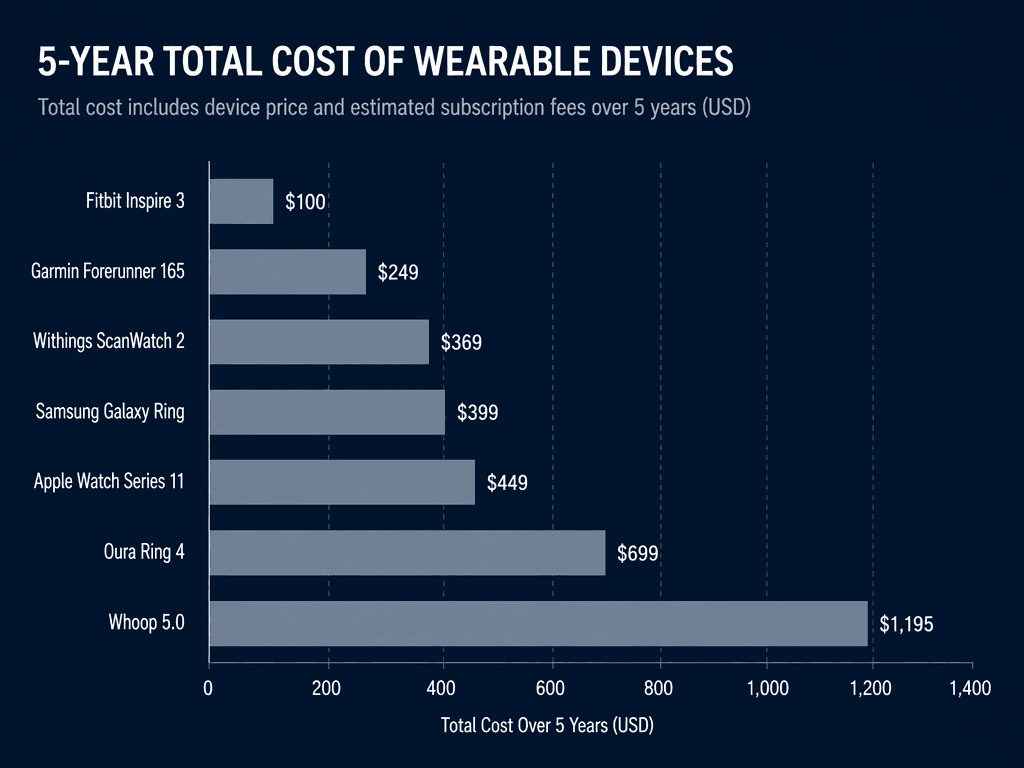
The key takeaway: devices without mandatory subscriptions (Garmin, Withings, Samsung Galaxy Ring, Apple Watch) offer significantly lower long-term costs. However, the subscription fees for Oura and Whoop include ongoing software development, personalized insights, and — in Whoop's case — a new device every time you renew. Whether that value justifies the cost depends on how deeply you engage with the data.
FDA-Authorized Sleep Apnea Screening: A Growing Differentiator
One of the most significant recent developments in consumer sleep tracking is the introduction of FDA-authorized sleep apnea screening features. As of 2026, two major smartwatch platforms offer this capability: Apple Watch (Series 9 and later, including Series 11) and Samsung Galaxy Watch (7, 8, and Ultra models). These features use the device's accelerometer to monitor breathing disturbances during sleep and can notify users if consistent patterns suggestive of moderate to severe sleep apnea are detected.
It is critical to understand what this authorization means — and what it does not. The FDA has authorized these features as screening notifications, not as diagnostic tools. A notification from your Apple Watch or Galaxy Watch does not confirm that you have sleep apnea; it simply indicates that your breathing patterns during sleep warrant further evaluation by a healthcare provider. The American Academy of Sleep Medicine (AASM) explicitly states that no consumer sleep tracker replaces polysomnography, and all devices overestimate total sleep time and underestimate wake after sleep onset.
No smart ring currently offers FDA-authorized sleep apnea screening. This is a meaningful differentiator for readers who have risk factors for obstructive sleep apnea — such as obesity, hypertension, or a family history — and want an early warning system. For a detailed explanation of how Apple Watch's breathing disturbances feature works and how to use it, see our dedicated guide: Can Your Apple Watch Detect Sleep Apnea?.
Decision Matrix: Which Device Should You Choose?
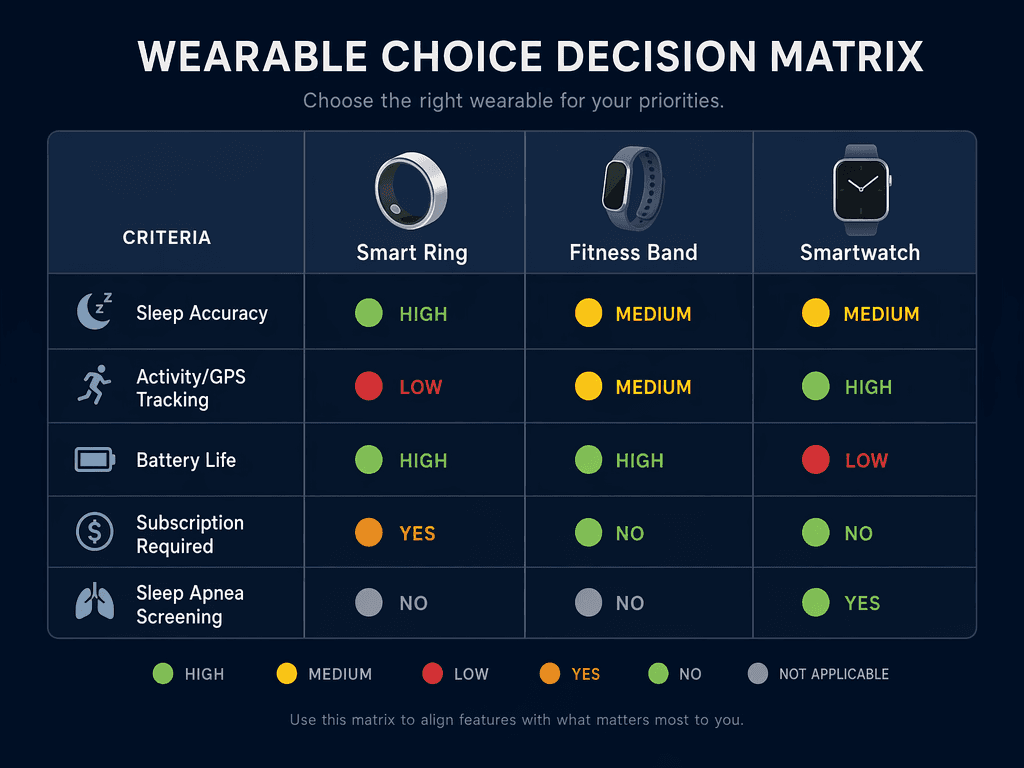
The following decision matrix is organized by reader priority. Identify your primary concern in the left column, and the recommended device type and specific model will follow.
| Your Priority | Recommended Form Factor | Top Pick | Runner-Up | Why This Choice |
|---|---|---|---|---|
| Sleep accuracy above all else | Smart Ring | Oura Ring 4 | Whoop 5.0 | Rings show higher epoch agreement with PSG and no proportional bias; Oura has the strongest validation data |
| Activity/fitness tracking depth | Smartwatch (fitness-focused) | Garmin Forerunner 165 | Apple Watch Series 11 | Built-in GPS, advanced workout modes, and long battery life; Garmin offers no subscription |
| No subscription wanted | Smartwatch or Fitness Band | Garmin Forerunner 165 | Withings ScanWatch 2 | Both offer robust features without mandatory subscription; Garmin has better sleep tracking |
| Best battery life | Hybrid Smartwatch | Withings ScanWatch 2 | Garmin Forerunner 165 | 30-day battery on Withings; 10-14 days on Garmin; both far exceed smartwatch battery life |
| Sleep apnea screening | Smartwatch | Apple Watch Series 11 | Samsung Galaxy Watch Ultra | Only smartwatches with FDA-authorized screening features; no ring currently offers this |
| Lowest total cost of ownership | Fitness Band | Fitbit Inspire 3 | Garmin Forerunner 165 | Under $100 upfront with no mandatory subscription; basic but functional sleep and activity tracking |
| Balanced sleep and activity | Smart Ring + Phone GPS | Oura Ring 4 | Whoop 5.0 | Use ring for sleep, phone for GPS; Whoop offers better activity recovery integration |
Summary Recommendations and Next Steps
Choosing the best sleep and activity tracker for your needs comes down to a single honest question: what do you care about most? If the answer is understanding your sleep architecture — how much deep sleep you get, how your HRV trends overnight, and whether your readiness score aligns with how you feel — a smart ring like the Oura Ring 4 is the strongest option available. Its 79% epoch-by-epoch agreement with PSG and lack of proportional bias make it the most reliable consumer device for sleep staging, even if you have to accept basic activity tracking and a $70/year subscription.
If your priority is activity and fitness tracking — GPS routes, structured workouts, on-wrist coaching, and long battery life — a fitness-focused smartwatch like the Garmin Forerunner 165 offers the best combination of depth and value. It requires no subscription, delivers 10-14 days of battery life, and provides a sleep coach and Body Battery feature that give you actionable recovery data. The tradeoff is that its sleep staging accuracy is fair to good at best, and it lacks FDA-authorized sleep apnea screening.
For readers who want a single device that does both reasonably well without a subscription, the Withings ScanWatch 2 is a compelling hybrid. Its 30-day battery life and FDA-cleared ECG are standout features, but the lack of REM sleep staging means you will not get a complete picture of your sleep architecture.
- If sleep accuracy is your top priority: choose a smart ring (Oura Ring 4) and accept limited activity tracking.
- If activity/fitness tracking depth is your top priority: choose a fitness-focused smartwatch (Garmin Forerunner 165) and accept moderate sleep accuracy.
- If you want sleep apnea screening: choose a smartwatch with FDA-authorized features (Apple Watch Series 11 or Samsung Galaxy Watch Ultra).
- If you want to avoid subscriptions: choose Garmin, Withings, Samsung Galaxy Ring, or Apple Watch.
- If you want the lowest total cost of ownership: choose the Fitbit Inspire 3 ($100, no subscription needed for basics).
- If you want the best battery life: choose the Withings ScanWatch 2 (30 days) or Garmin Forerunner 165 (10-14 days).
For further reading, explore our other evidence-based comparisons: Best Fitness Trackers for Sleep Tracking: A 2026 Comparison for a deeper dive into fitness band sleep accuracy, and How Accurate Is the Oura Ring for Sleep Tracking? for a detailed analysis of Oura's PSG validation studies.


Comments
Join the discussion with an anonymous comment.