
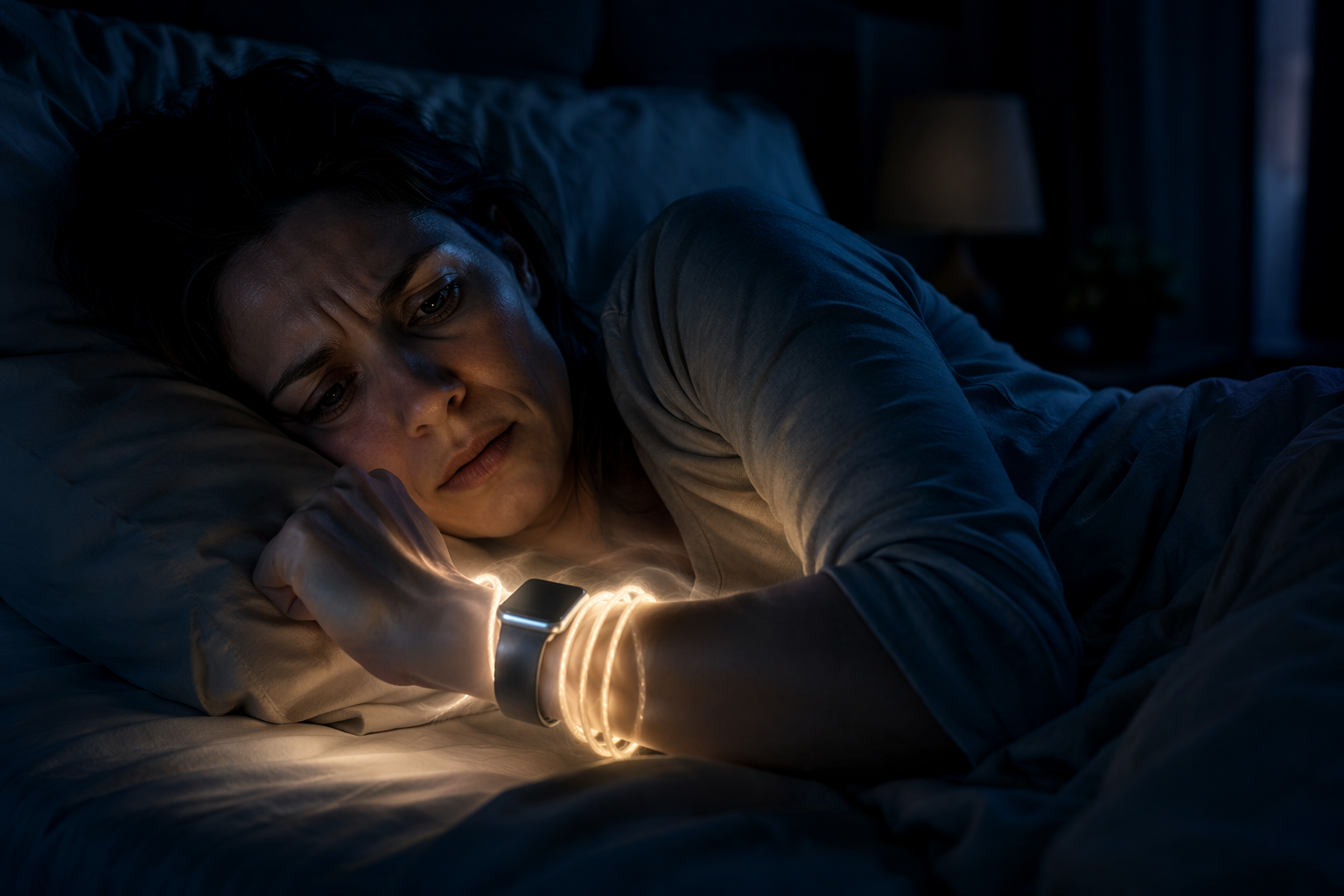
If your first thought after waking is “please let the deep sleep number be better today,” Apple Watch sleep tracking has probably moved from helpful background information into something more like a morning verdict. The watch says you had too little deep sleep. You feel tense before your feet touch the floor. Then the day gets filtered through that number: the fog, the irritability, the extra coffee, the fear that tonight has to be fixed.
That reaction is not a character flaw, and it is not proof that you are bad at sleeping. It is a predictable response to being shown a precise-looking health score about a state you cannot consciously control. Sleep is already fragile when watched too closely. Add a graph, a score, and a low deep-sleep estimate, and some people begin trying to sleep correctly instead of sleeping.
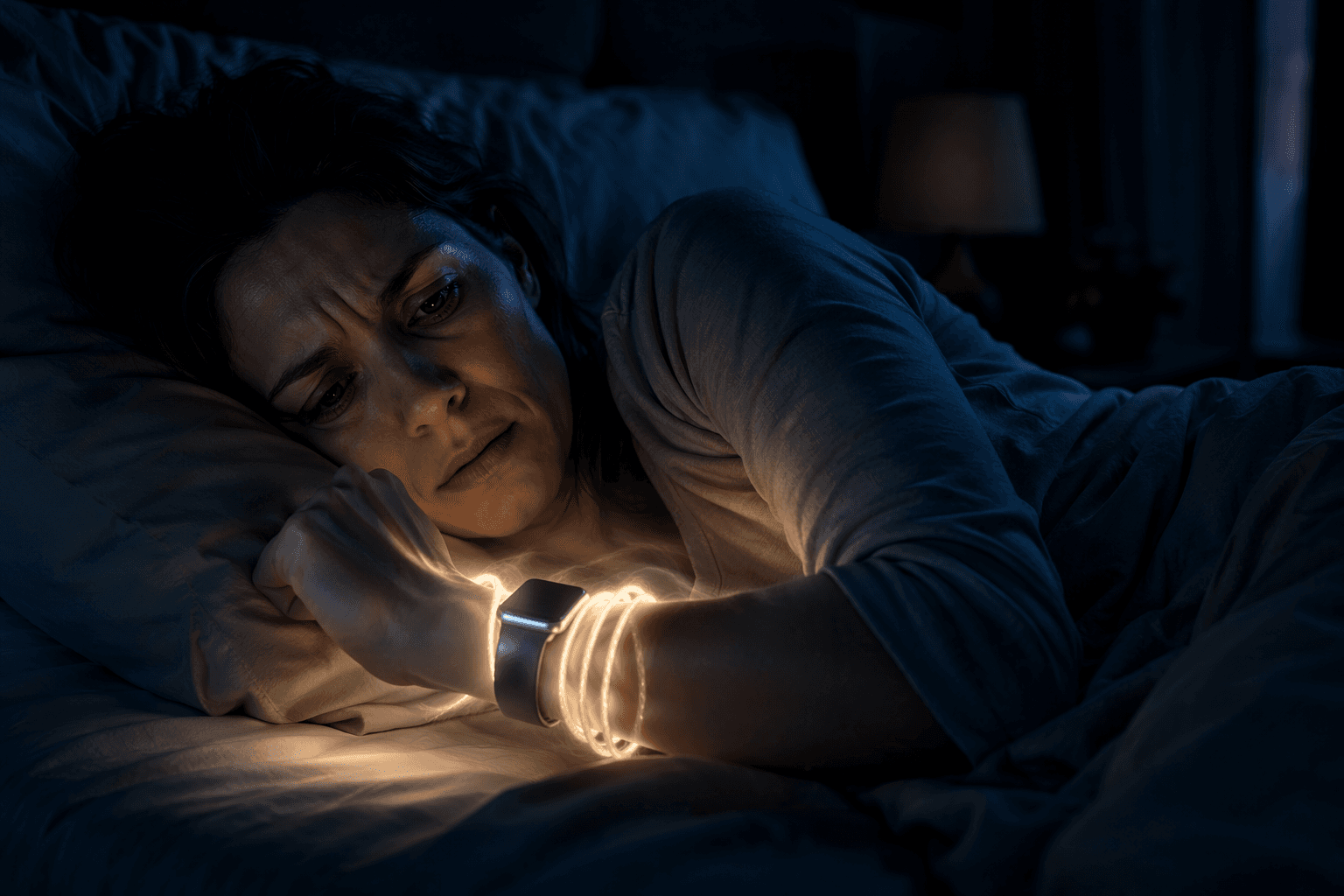
Sleep clinicians have a name for this pattern: orthosomnia. The term was introduced in 2017 to describe patients whose pursuit of “perfect” sleep tracker data appeared to worsen their sleep concerns and sleep-related behavior. [1]
It is not just a few unusually anxious users. A 2024 cross-sectional study of 523 adults estimated that orthosomnia affected roughly 3% to 14% of sleep-tracker users, depending on how strictly it was defined. [2]
The Apple Watch adds a particular twist to this problem: the sleep-stage number people often fear most — deep sleep — is also one of the least reliable parts of the measurement.
The deep sleep number has not earned the right to scare you
The strongest Apple Watch sleep-stage evidence we have comes from a 2024 validation study by Robbins and colleagues, which compared the Apple Watch Series 8 with polysomnography, the laboratory sleep test that uses brain waves and other physiologic signals to classify sleep. The study included 35 healthy adults ages 20 to 50 without sleep disorders. [3]
In that study, the Apple Watch identified deep sleep with 50.5% sensitivity. [3] That is the load-bearing number here. It means that when deep sleep was actually present according to PSG, the watch detected it only about half the time. For a metric that can send people into a day of worry, that is not sturdy ground.
The direction of the error matters too. The Apple Watch underestimated deep sleep by about 43 minutes per night, overestimated light sleep by about 45 minutes, and underestimated wake after sleep onset by about 7 minutes. [3] Thirty-eight percent of deep sleep epochs were misclassified as core sleep. [3] So the anxious interpretation — “I barely got any deep sleep” — is exactly the kind of interpretation the device’s bias can encourage.
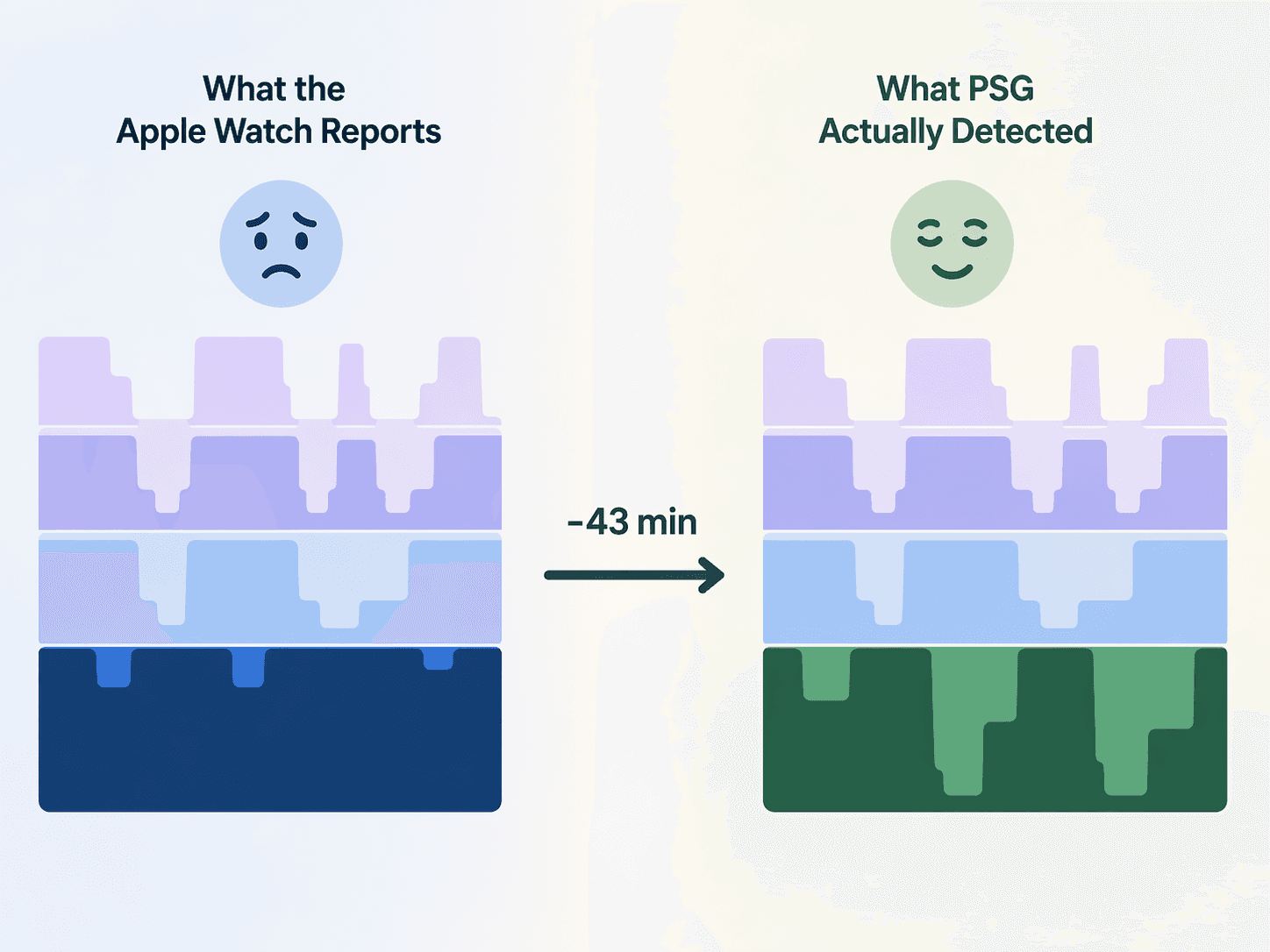
This does not mean your Apple Watch is useless. It means the deep sleep minutes should not be treated as a nightly health grade. A number can be interesting without being decisive. A number can be beautifully displayed and still be too noisy, too biased, or too indirect to deserve your alarm.
What the Apple Watch is better at
The Apple Watch performs much better when the question is simpler: were you asleep or awake, and roughly how long did you sleep? In the same validation study, the watch showed 97% sensitivity for detecting sleep and an intraclass correlation coefficient of 0.85 for total sleep time compared with PSG. [3]
That distinction is the whole practical issue. Duration and timing are broad signals. They are also easier to act on. If your sleep window keeps shrinking because bedtime drifts later, the watch may help you see that. If weekends are pushing your schedule several hours off your weekday rhythm, the watch may make the pattern visible. If your sleep opportunity is consistently too short, no stage graph is needed to explain why you feel under-rested.
| Apple Watch sleep data | How much weight to give it | Why |
|---|---|---|
| Total sleep time | Useful as a trend | The validation study showed stronger agreement with PSG for total sleep time than for stage details. |
| Bedtime and wake-time consistency | Useful for behavior change | Timing is easier to observe and adjust than individual sleep stages. |
| Deep sleep minutes | Do not treat as a nightly score | Deep sleep sensitivity was 50.5%, and the watch underestimated deep sleep by about 43 minutes. |
| One-night sleep score | Use cautiously, if at all | A single night can reflect measurement error, normal variation, schedule disruption, illness, alcohol, stress, or a mix of factors. |
The trap is that the least actionable number often feels the most personal. Deep sleep sounds like the hidden truth. It sounds more biological, more elite, more worth optimizing. But you cannot will yourself into more deep sleep at 2:17 a.m. by worrying about last night’s graph. The levers you actually control are more ordinary: enough time in bed, a reasonably stable sleep window, light exposure, caffeine timing, alcohol choices, wind-down behavior, and how you respond when sleep is imperfect.
How the tracker loop makes a bad score feel true
A low sleep score can change the way you experience the day. That does not mean the score accurately measured your physiology. It may mean the score shaped your expectations.
Placebo sleep research has shown that experimentally manipulated beliefs about sleep quality can affect cognitive performance, even when those beliefs are not based on actual sleep quality. [4] That finding is uncomfortable because it matches what many tracker users describe: they feel acceptable before checking the app, then worse after seeing a poor result. The data did not merely describe the morning. It helped create the morning.
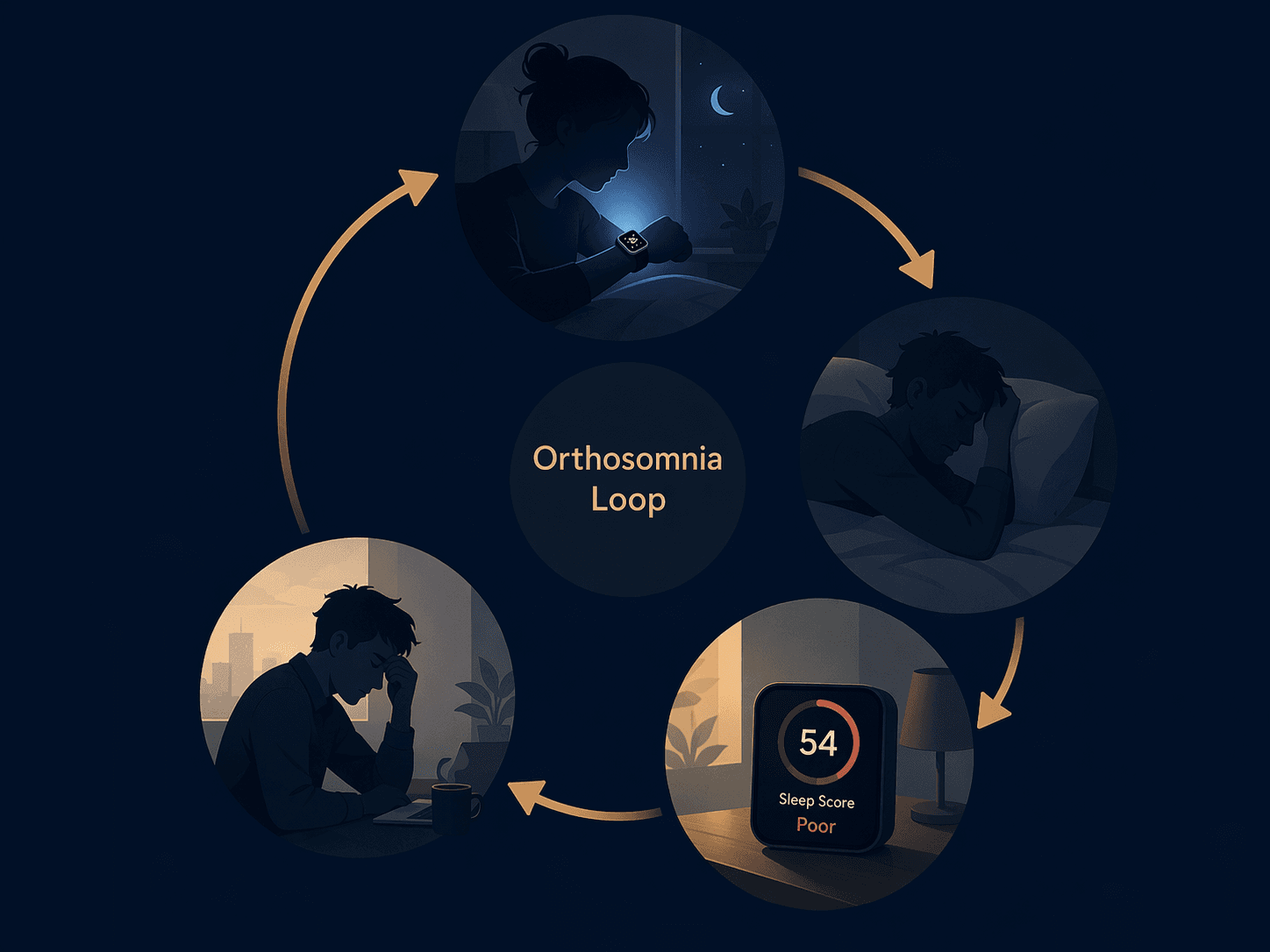
The loop is simple enough to miss:
- You check the sleep data with anxiety.
- The deep sleep number looks low.
- You monitor your body for signs that the night was bad.
- Normal tiredness, stress, or a slow morning becomes evidence that the score was right.
- At bedtime, you try harder to produce a better graph.
- Trying harder makes sleep feel higher stakes.
This is especially rough for people who already have insomnia or a habit of second-guessing their sleep. Insomnia is not just “not enough sleep.” It often includes conditioned arousal around the bed, the clock, and the consequences of not sleeping. A wearable can become one more clock: more polished, more colorful, and more persuasive, but still a cue to evaluate a process that works best with less evaluation.
The newer-watch caveat is real, but it does not rescue the deep-sleep obsession
The Robbins validation study tested the Apple Watch Series 8. [3] Newer models and later algorithm updates may perform differently. Apple has also continued to expand sleep features, including sleep score and sleep apnea-related notifications, and product software is not frozen in time.
But that caveat cuts in a narrow direction. It means we should not pretend that a Series 8 validation result permanently describes every later Apple Watch system. It does not mean we should assume newer stage estimates are accurate enough to guide your mood, self-worth, or bedtime anxiety. As of June 2026, independent PSG validation for the newer hardware and algorithm changes has not been published.
When independent validation is missing, the safer habit is not panic and not blind trust. It is restraint. Treat stage estimates as rough, consumer-grade inferences from movement, heart rate, and related signals — not as a direct measurement of your brain’s sleep architecture.
How to keep Apple Watch sleep tracking without feeding orthosomnia
You do not have to throw the watch in a drawer to break the fixation loop. For many people, the better move is to change what the device is allowed to mean.
Demote deep sleep to background noise
If the deep sleep number is the first thing you check, move it out of the center of your attention. Do not use it to decide whether you had a good night. Do not compensate for it with elaborate sleep rituals the next evening. Do not compare it with someone else’s screenshot. The number is too error-prone, and in the Series 8 validation study it was biased toward undercounting the stage people are most likely to worry about.
Look at weekly patterns, not morning verdicts
A single night’s data is noisy. A week or two of bedtime, wake time, and total sleep time can be more useful. The question becomes less “Did I get enough deep sleep last night?” and more “Am I giving myself a consistent enough sleep opportunity?” That is a calmer question, and it points toward behavior you can actually adjust.
Check the data later in the day
If the morning check reliably makes you feel worse, delay it. Eat breakfast first. Get light. Start the day before asking a device to narrate your biology. For anxious sleepers, the timing of feedback matters. Data that might be mildly useful at noon can be destabilizing at 6:30 a.m.
Use a “data holiday” if sleep has become performative
A short break from wearing the watch at night can be informative. Not as a grand anti-technology statement, just as a test: do you fall asleep with less pressure when there is no morning graph waiting? If the answer is yes, that tells you something important about the role of monitoring in your sleep system.
Let symptoms outrank the score
If you are sleepy while driving, nodding off unintentionally, snoring heavily, gasping, or struggling with persistent insomnia, the problem deserves clinical attention whether the watch looks good or bad. A wearable is not a diagnostic sleep study. It can raise a question; it cannot settle one.
A better rule for Apple Watch sleep data
Keep the Apple Watch if it helps you notice broad patterns: short nights, irregular schedules, late bedtimes, or changes after travel, illness, alcohol, stress, or schedule disruption. Those are reasonable uses. The device is much stronger at estimating sleep duration and detecting sleep than it is at telling you, with nightly precision, how much deep sleep your brain produced.
But stop letting deep sleep minutes run the story. A low number can be wrong. It can be biased low. It can make you feel worse simply because you saw it. And even when it reflects a real variation, it is usually not a useful target for minute-by-minute control.
The watch can stay on your wrist. The report card does not get to be in charge.
References
- “Orthosomnia: Are Some Patients Taking the Quantified Self Too Far?” — Journal of Clinical Sleep Medicine, 2017
- “Orthosomnia: How Sleep Trackers Are Making Us Anxious About Sleep” — Sahha Blog, June 2026
- “Accuracy of Three Commercial Wearable Devices for Sleep Tracking in Healthy Adults” — Robbins et al., 2024
- “Placebo Sleep Affects Cognitive Functioning” — Journal of Experimental Psychology: Learning, Memory, and Cognition, 2014
Comments
Join the discussion with an anonymous comment.