
Why Consumer Sleep Trackers Can’t Replace a Sleep Lab (And Why That’s Okay)
If you search for “best fitness tracker for sleep,” you’ll find hundreds of articles claiming a single device is the winner. Almost none of them cite a polysomnography (PSG) validation study. This article does the opposite: it starts with the hard truth that no consumer wearable matches the accuracy of a clinical sleep study, then builds a practical framework around the data that actually exists.
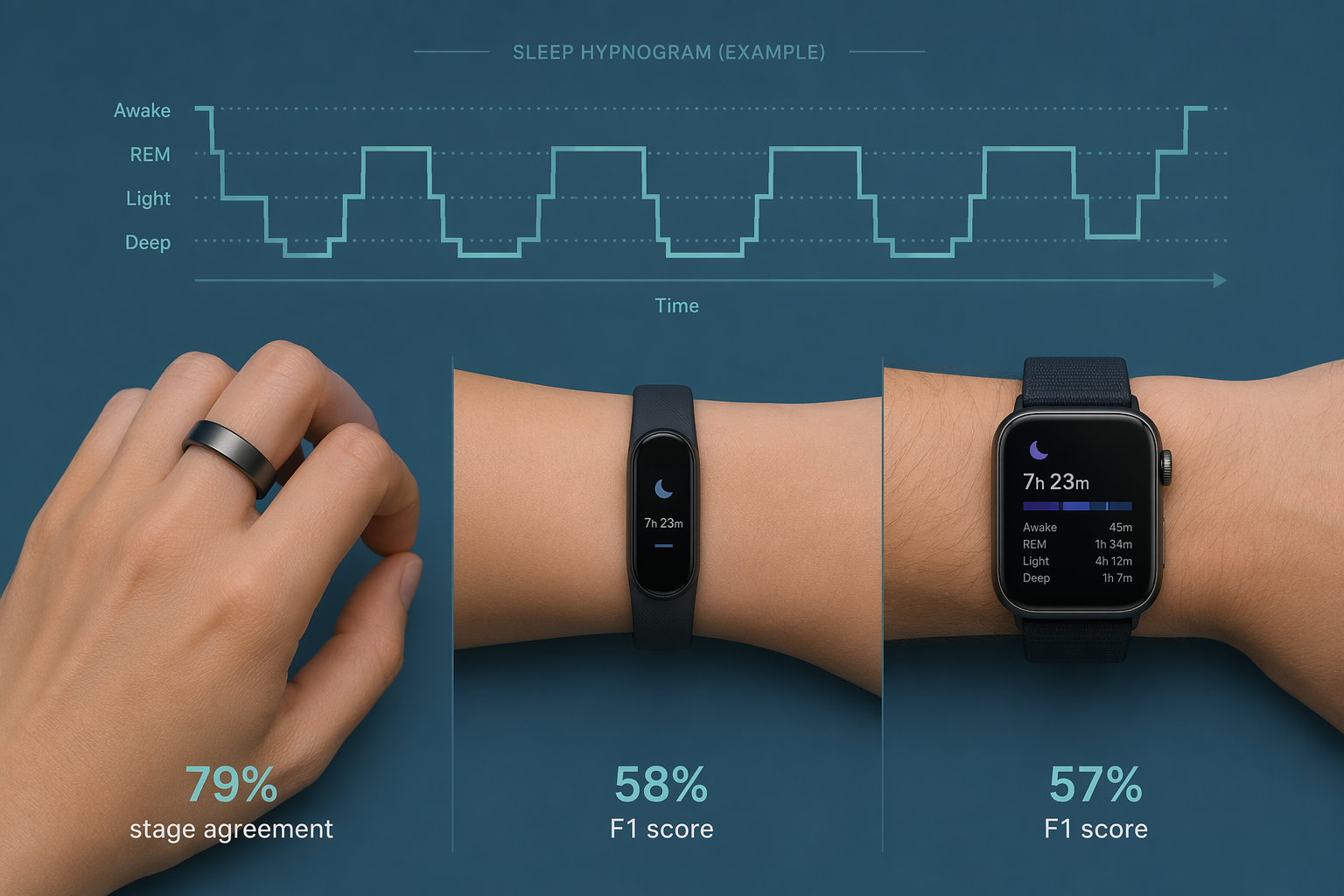
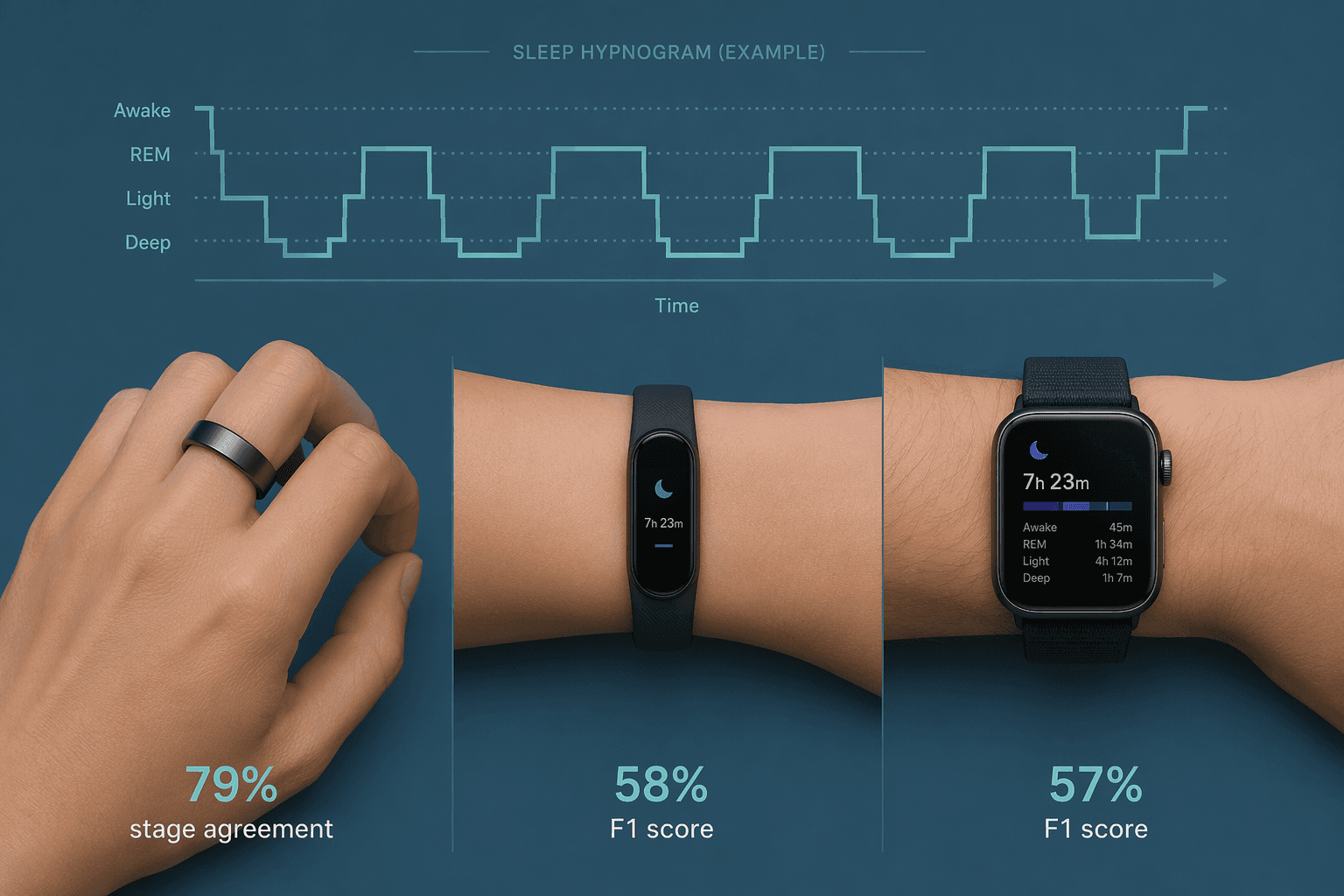
The gap between consumer trackers and PSG is real. A 2024 study from Brigham and Women’s Hospital tested three leading devices — Oura Ring Gen3, Fitbit Sense 2, and Apple Watch Series 8 — against PSG in 35 healthy adults. All three hit ≥95% sensitivity for detecting sleep versus wake. That part is excellent. But when the task shifted to classifying which sleep stage a person was in — light, deep, or REM — the numbers dropped sharply. Stage-level sensitivity ranged from roughly 50% to 79%, depending on the device and the stage.
This doesn’t mean trackers are useless. It means you need to know what each device measures well and where it fudges the numbers. A tracker that overestimates light sleep by 45 minutes (as the Apple Watch did in that same study) will give you a misleading picture of your sleep architecture if you take the numbers literally. But the same device can still be useful for tracking trends over weeks — how your total sleep time changes after adjusting your bedtime, for example — because the bias is consistent night to night.
This article extends our previous multi-device accuracy comparison by adding an accuracy-tier framework anchored to specific PSG validation numbers, covering additional devices like the Google Pixel Watch and Garmin, and structurally including guidance on how to use tracker data without developing orthosomnia — the anxiety-driven obsession with perfect sleep scores.
How Fitness Trackers Estimate Sleep: PPG, Accelerometers, and Algorithms
To understand why accuracy varies, you need a basic picture of what’s happening inside the device while you sleep. Consumer trackers rely on three main sensing technologies:
- Photoplethysmography (PPG): An optical sensor shines light into the skin and measures changes in blood volume. This gives the device your heart rate and, by analyzing beat-to-beat intervals, heart rate variability (HRV). PPG is the primary signal most wearables use to estimate sleep stages, because heart rate and HRV follow predictable patterns across light, deep, and REM sleep.
- Accelerometer: A three-axis motion sensor detects movement. The device uses this to distinguish sleep from wake — if you’re not moving, you’re probably asleep. The Apple Watch sleep staging algorithm, for example, relies primarily on accelerometer patterns rather than PPG, which may partly explain its larger discrepancies with PSG.
- Temperature sensor: Some devices (notably the Oura Ring) include a skin temperature sensor. Core body temperature drops slightly during sleep and reaches its lowest point in the early morning hours. Temperature data can help the algorithm confirm sleep onset and detect circadian phase shifts.
None of these sensors measure brain waves. PSG uses electroencephalography (EEG) to directly record electrical activity in the brain, which is the gold standard for staging sleep. Consumer trackers are essentially making educated guesses based on indirect signals. A 2022 study of several popular trackers found that while most correctly identified more than 90% of sleep epochs, wake detection ranged from 26% to 73%, and sleep stage precision averaged between 53% and 60%.
The practical takeaway: trackers are excellent at telling you when you’re asleep versus awake, but their stage-by-stage breakdowns should be treated as estimates, not measurements.
Key Sleep Metrics: What Each One Actually Tells You
Not all sleep metrics are created equal. Some are backed by reasonably strong validation evidence; others are essentially algorithmic guesses dressed up as data. Knowing the difference helps you focus on the numbers that matter and ignore the ones that will mislead you.
| Metric | What It Measures | Validation Strength | Practical Use |
|---|---|---|---|
| Total sleep time (TST) | Total minutes scored as sleep | Good — trackers consistently achieve >90% epoch-level agreement with PSG for sleep/wake discrimination | Useful for tracking nightly duration trends; expect a small overestimate because quiet wakefulness is often misclassified as sleep |
| Sleep stages (light, deep, REM) | Classification of each 30-second epoch into a sleep stage | Moderate to poor — stage-level sensitivity ranges from 50% to 79% depending on device and stage | Useful for rough pattern recognition (e.g., “I seem to get less deep sleep on nights I drink alcohol”), but not reliable for absolute stage minutes |
| Wake after sleep onset (WASO) | Minutes scored as wake after initial sleep onset | Poor — most devices underestimate WASO because they misclassify quiet wake as light sleep | Not a metric to track closely; the device will likely undercount your nighttime awakenings |
| Sleep latency | Minutes between lying down and falling asleep | Poor — trackers cannot distinguish quiet rest from sleep onset; they rely on movement cessation and heart rate drop | Not reliable; ignore this number unless you have a consistent bedtime routine and want to look at relative changes |
| Heart rate variability (HRV) | Beat-to-beat variation in heart rate | Good — PPG-based HRV correlates reasonably well with ECG in healthy adults during sleep | Useful for tracking recovery and autonomic nervous system balance; look at 7-day rolling averages, not single-night values |
| SpO2 (blood oxygen saturation) | Oxygen saturation level | Moderate — wrist-based SpO2 is less accurate than finger pulse oximetry but can detect sustained desaturations | Useful as a screening signal for potential sleep-disordered breathing; not diagnostic |
| Sleep score (proprietary) | A composite score combining multiple metrics | Variable — each manufacturer uses a different algorithm; no independent validation of composite scores exists | Useful as a relative trend indicator if you stay within one device ecosystem; meaningless for cross-device comparison |
The pattern is clear: metrics that rely on sleep/wake discrimination (total sleep time) are reasonably accurate. Metrics that require stage classification (deep sleep minutes, REM duration) are much less reliable. If you’re choosing a tracker primarily for sleep stage data, you need a device that has been independently validated for that specific purpose.
Accuracy Tiers: What the PSG Validation Studies Show
Two large validation studies provide the most comprehensive head-to-head accuracy data currently available. The first is the Brigham and Women’s study (Robbins et al., 2024), which tested Oura Ring Gen3, Fitbit Sense 2, and Apple Watch Series 8 against PSG in 35 healthy adults aged 20–50. The second is the JMIR multicenter study (2023), which evaluated 11 consumer sleep trackers — including 5 wearables — against PSG in 75 participants, collecting 3890 hours of sleep sessions and 543 hours of PSG recordings.
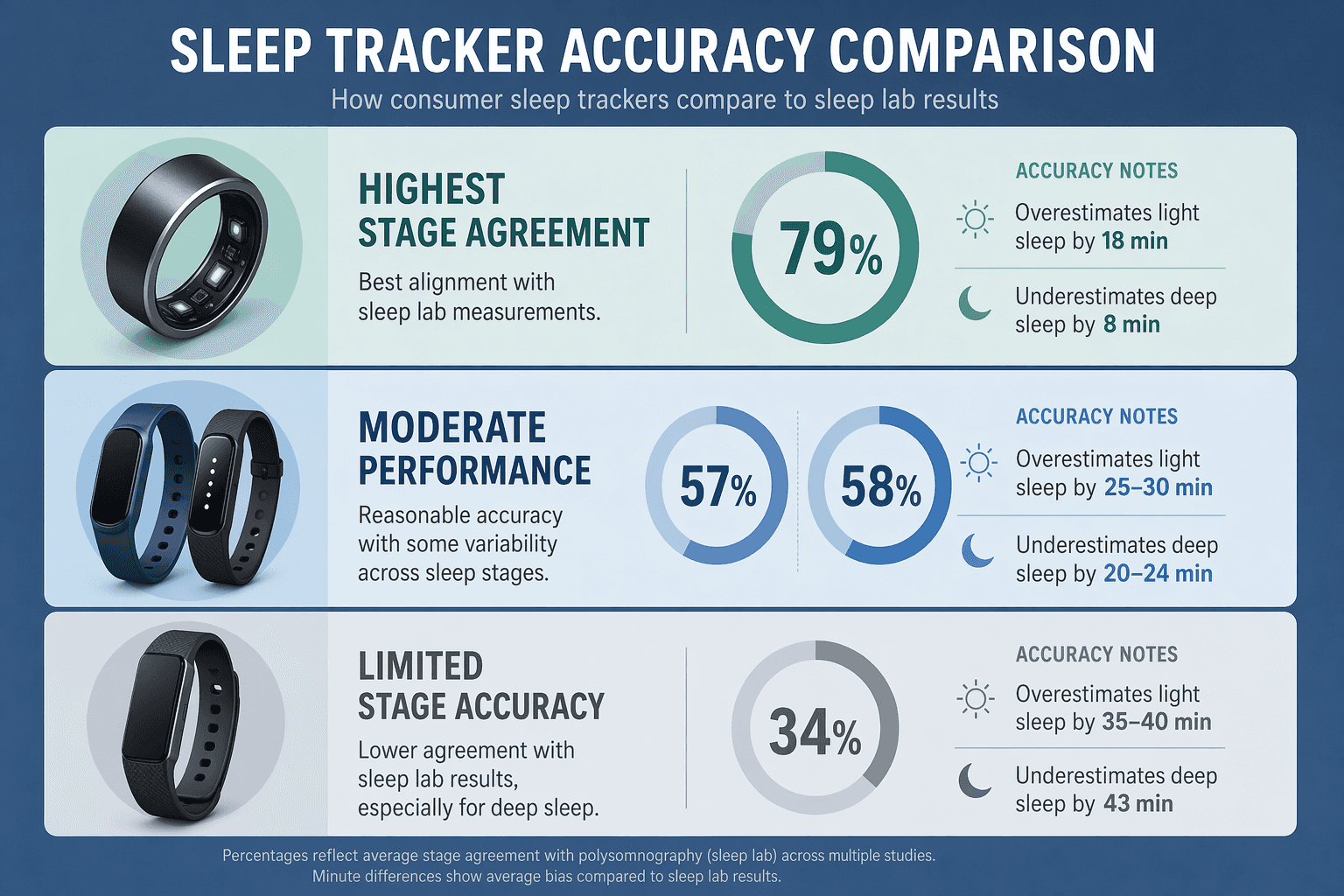
The data from these studies reveals three clear accuracy tiers:
Tier 1: Highest Stage Agreement
The Oura Ring Gen3 stands alone in this tier. In the Brigham and Women’s study, it showed 76–79.5% sensitivity for sleep stage classification and was not statistically different from PSG for wake, light sleep, deep sleep, or REM estimation. Its intraclass correlation coefficient (ICC) for deep sleep was 0.32 — poor in absolute terms, but better than the other devices tested. The JMIR study confirmed this pattern: Oura Ring showed no proportional bias for any sleep measure, meaning its errors were not systematically skewed in one direction. Its macro F1 score (a combined measure of precision and recall across all stages) was 0.52.
Tier 2: Moderate Performance with Known Biases
The Fitbit Sense 2 and Google Pixel Watch fall into this tier. Both show moderate overall accuracy with systematic biases that you can account for.
Fitbit Sense 2 overestimated light sleep by an average of 18 minutes (p<0.001) and underestimated deep sleep by 15 minutes (p<0.001) compared to PSG in the Brigham and Women’s study. Its ICC for deep sleep was 0.36 — slightly better than Oura’s 0.32, but still poor. In the JMIR study, Fitbit Sense 2 achieved the highest macro F1 score among wearables at 0.58, and performed best for deep stage detection with an F1 of 0.56.
The Google Pixel Watch scored a macro F1 of 0.57 in the JMIR study and achieved the best deep stage detection F1 among all wearables at 0.59. This suggests its algorithm may be particularly good at identifying slow-wave sleep, though independent replication is needed.
Tier 3: Limited Stage Accuracy
The Apple Watch Series 8 showed the largest discrepancies with PSG in the Brigham and Women’s study. It underestimated deep sleep by 43 minutes (p<0.001), overestimated light sleep by 45 minutes (p<0.001), underestimated wake by 7 minutes (p<0.01), and underestimated WASO by 10 minutes (p=0.02). Its ICC for deep sleep was 0.13 — the lowest of the three devices tested. In the JMIR study, the Apple Watch 8 had the lowest macro F1 score among wearables at 0.49.
These numbers do not mean the Apple Watch is a bad device. They mean its sleep staging algorithm — which relies primarily on accelerometer data rather than PPG — produces a systematically distorted picture of sleep architecture. If you own an Apple Watch, you should treat its deep sleep and light sleep numbers as directional at best. For a detailed breakdown of the Apple Watch validation literature, see our Apple Watch sleep tracking accuracy review.
The Samsung Galaxy Watch 5 scored a macro F1 of 0.58 in the JMIR study, placing it alongside Fitbit and Google Pixel Watch in overall accuracy. However, its deep stage detection F1 was lower than both the Pixel Watch and Fitbit Sense 2.
Head-to-Head Comparison Table: Accuracy, Battery, Comfort, and Cost
The table below brings together the key decision variables for six popular sleep-tracking devices. Accuracy figures come from the two PSG validation studies cited above. Battery life, form factor, subscription costs, and FDA clearance status are based on manufacturer specifications as of Q2 2026.
| Device | Form Factor | Macro F1 Score (JMIR 2023) | Key PSG Bias (Brigham 2024) | Battery Life | Subscription Required | FDA Sleep Apnea Clearance |
|---|---|---|---|---|---|---|
| Oura Ring Gen3/4 | Ring | 0.52 | No statistically significant bias for any stage | 4–7 days | Yes ($5.99/month or $69.99/year) | No |
| Fitbit Sense 2 | Smartwatch | 0.58 | Overestimates light sleep by 18 min; underestimates deep sleep by 15 min | 6+ days | Yes ($9.99/month or $79.99/year) | No |
| Apple Watch Series 8/9/10 | Smartwatch | 0.49 | Underestimates deep sleep by 43 min; overestimates light sleep by 45 min | ~24 hours | No | Yes (Series 9+, for sleep apnea screening) |
| Google Pixel Watch 2 | Smartwatch | 0.57 | Not separately tested in Brigham study; JMIR shows best deep stage detection (F1 0.59) | ~24 hours | No | No |
| Samsung Galaxy Watch 5/6/7 | Smartwatch | 0.58 | Not separately tested in Brigham study | 30–40 hours | No | Yes (Watch 7+, for sleep apnea screening) |
| Whoop 4.0 | Band (no screen) | Not tested in JMIR or Brigham studies | No published PSG validation data for sleep stages | 4–5 days | Yes ($30/month or $288/year) | No |
| Garmin Venu 3 | Smartwatch | Not tested in JMIR or Brigham studies | No published PSG validation data for sleep stages | 10–14 days | No | No |
Which Device for Which Sleep Goal?
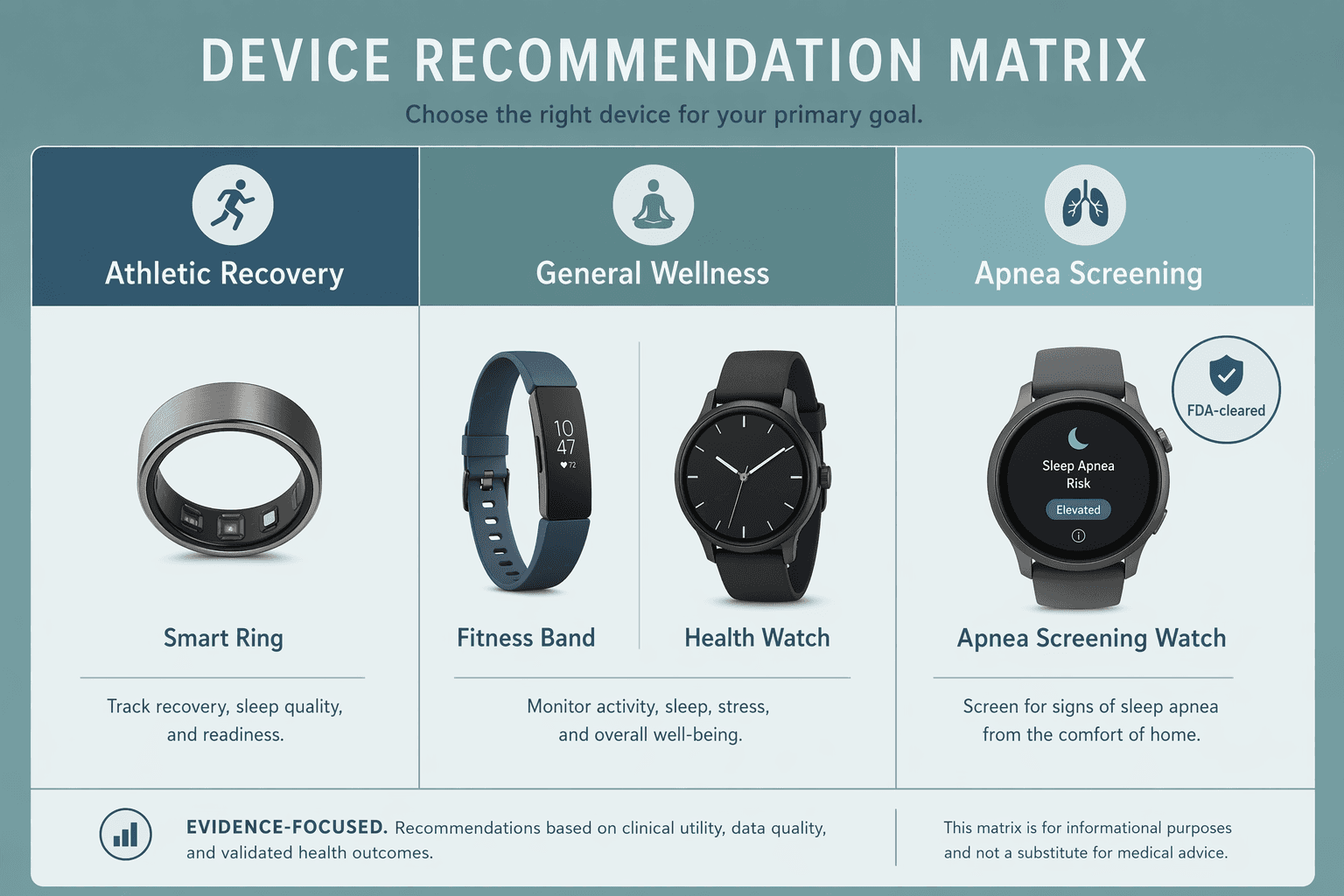
The “best” fitness tracker for sleep depends entirely on what you want to track and why. The table below maps devices to common sleep-related goals so you can self-select based on your primary use case.
- If sleep stage accuracy is your priority: Choose the Oura Ring. It is the only consumer device that was not statistically different from PSG for any sleep stage in a head-to-head validation study. The tradeoff is the subscription fee and the fact that a ring may not fit comfortably if you have larger fingers or sleep with your hands in a position that compresses the sensor.
- If you want a balance of accuracy and fitness tracking: Choose the Fitbit Sense 2 or Google Pixel Watch. Both show moderate stage-level accuracy with known, consistent biases. Fitbit’s longer battery life (6+ days) is a practical advantage for continuous wear. The Pixel Watch’s strong deep-stage detection is notable if slow-wave sleep is your primary concern.
- If sleep apnea screening matters: Choose the Apple Watch Series 9 or later, or the Samsung Galaxy Watch 7 or later. Both have FDA clearance for sleep apnea screening notifications. The Apple Watch feature uses accelerometer data to detect breathing disturbances over a 30-day period and is authorized for adults 18 and older with moderate-to-severe obstructive sleep apnea. The Samsung feature has FDA De Novo authorization for users 22 and older. For more on what this clearance means in practice, see our Apple Watch sleep apnea detection explainer.
- If athletic recovery is your focus: Choose Whoop or Garmin. Whoop’s strength is its recovery framework (HRV, resting heart rate, respiratory rate) rather than sleep staging. Garmin’s advantage is battery life — the Venu 3 lasts 10–14 days, making it practical for athletes who don’t want to charge daily. Note that neither device has published PSG validation data for sleep stage classification in the studies cited here.
- If you want no subscription and decent sleep tracking: Choose the Google Pixel Watch or Samsung Galaxy Watch. Both offer sleep tracking without a monthly fee, and both have moderate accuracy based on the JMIR study. The tradeoff is 24–40 hour battery life, which means nightly charging is required.
How to Use Tracker Data Without Developing Orthosomnia
Orthosomnia — a term coined by sleep clinicians to describe the unhealthy obsession with achieving perfect sleep tracker scores — is a real risk for people who take their device data too literally. The condition can paradoxically worsen sleep quality by creating anxiety around metrics that were supposed to help.
Here are evidence-informed strategies for using tracker data without falling into the orthosomnia trap:
- Focus on trends, not single-night scores. A single night of “poor” sleep is normal and not meaningful. Look at 7- to 14-day rolling averages for total sleep time, HRV, and resting heart rate. These trends are more reliable than nightly stage breakdowns.
- Ignore sleep stage minutes unless you have a specific reason to track them. As the validation data shows, stage-level accuracy is limited. If you do track stages, use them to identify patterns (e.g., “I get less deep sleep after drinking alcohol”) rather than to evaluate whether you got “enough” deep sleep on a given night.
- Do not compare your numbers to another person’s. Different devices use different algorithms, and even the same device will produce different numbers for different people due to physiology, sensor placement, and sleep environment. Your friend’s Oura Ring data is not a benchmark for yours.
- Use the device as a hypothesis generator, not a diagnostic tool. If your tracker consistently shows low HRV or high resting heart rate, it might be worth examining your stress levels, hydration, or recovery practices. But the tracker cannot tell you why the numbers are what they are — that requires self-experimentation or clinical evaluation.
- If you find yourself anxious about your sleep score, take the device off for a week. A 2023 review in the Journal of Clinical Sleep Medicine noted that orthosomnia can be effectively managed by a temporary break from tracking, combined with cognitive behavioral strategies.
Summary Decision Framework: Choosing Your Sleep Tracker by Accuracy Priority
The evidence from the two largest multi-device PSG validation studies available as of mid-2026 supports a clear, tiered decision framework:
| Your Priority | Best Device Choice | Key Tradeoff |
|---|---|---|
| Highest sleep stage accuracy | Oura Ring | Subscription fee; ring form factor may not suit everyone |
| Balanced accuracy + fitness tracking | Fitbit Sense 2 or Google Pixel Watch | Fitbit requires subscription for advanced metrics; Pixel Watch has 24-hour battery life |
| Sleep apnea screening | Apple Watch Series 9+ or Samsung Galaxy Watch 7+ | FDA clearance is for screening notifications, not diagnosis; requires consistent wear for 30 days |
| Athletic recovery focus | Whoop 4.0 or Garmin Venu 3 | No published PSG sleep stage validation; Whoop requires subscription; Garmin has excellent battery life |
| No subscription, decent accuracy | Google Pixel Watch or Samsung Galaxy Watch | Short battery life (24–40 hours); no FDA sleep apnea clearance on Pixel Watch |
The most important takeaway from this analysis is also the simplest: the best fitness tracker for sleep is the one you will wear consistently. A device with perfect accuracy that you take off every other night because it’s uncomfortable or requires constant charging will produce less useful data than a moderately accurate device you wear every night without thinking about it. Use the validation data to set realistic expectations, focus on long-term trends, and treat your sleep score as a conversation starter with yourself — not a report card.

Comments
Join the discussion with an anonymous comment.