
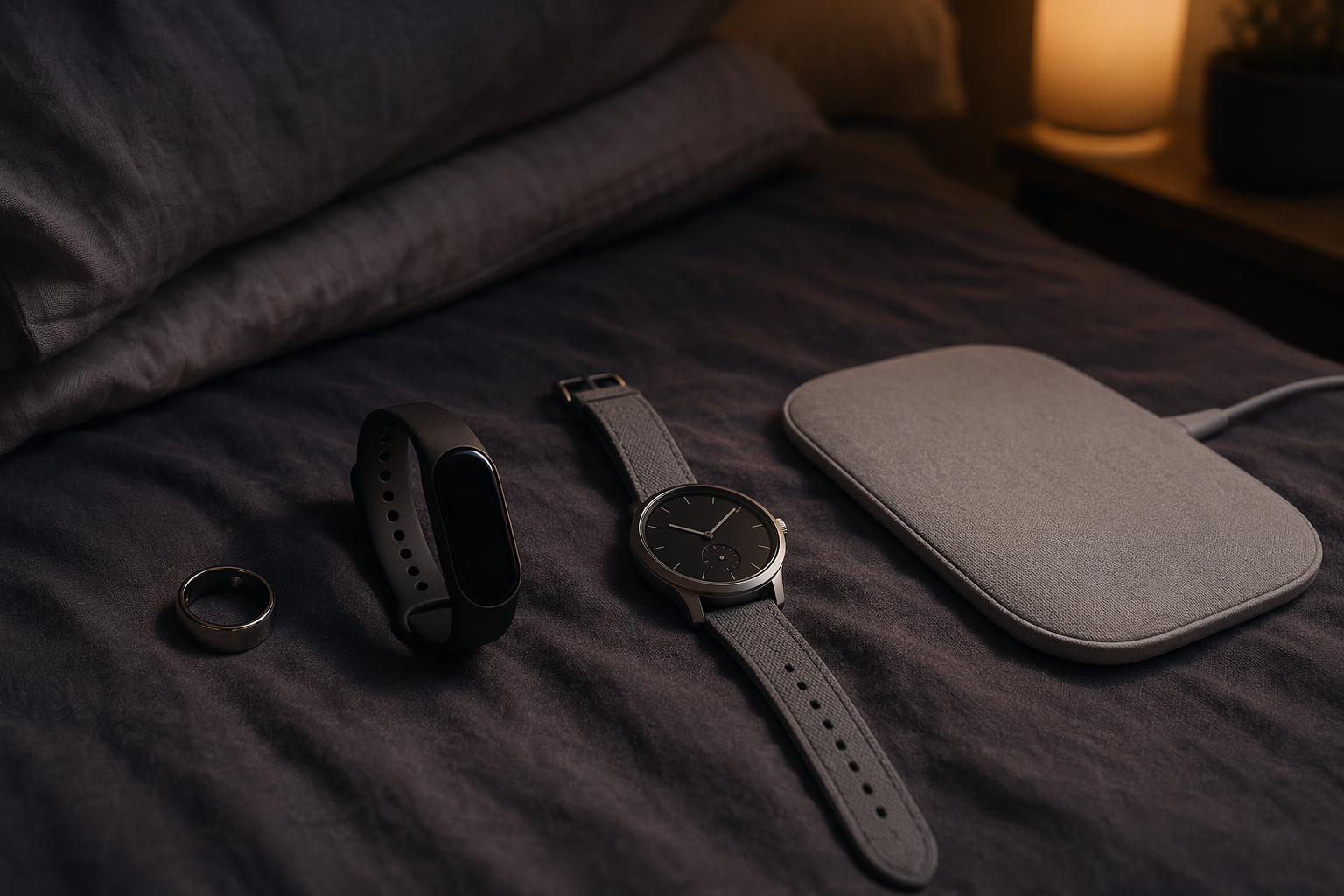
If you are comparing the best sleep trackers, start somewhere less glamorous than sensor specs: what can you tolerate at 2 a.m., and what question are you actually trying to answer? A tracker that stays charged, stays on your body, and does not make you dread tomorrow morning's score will usually beat a technically impressive device you abandon after a week.
That means the right choice often starts with form factor. Smart rings, wristbands, smartwatches, hybrid watches, under-mattress sensors, and phone-only apps all ask for different compromises. If you want the sensor-level comparison first, the form-factor guide to sleep monitoring devices is the deeper place to go. Here, the question is more practical: which one fits your sleep life well enough to produce useful trends?
Match the Tracker to the Problem, Not the Other Way Around
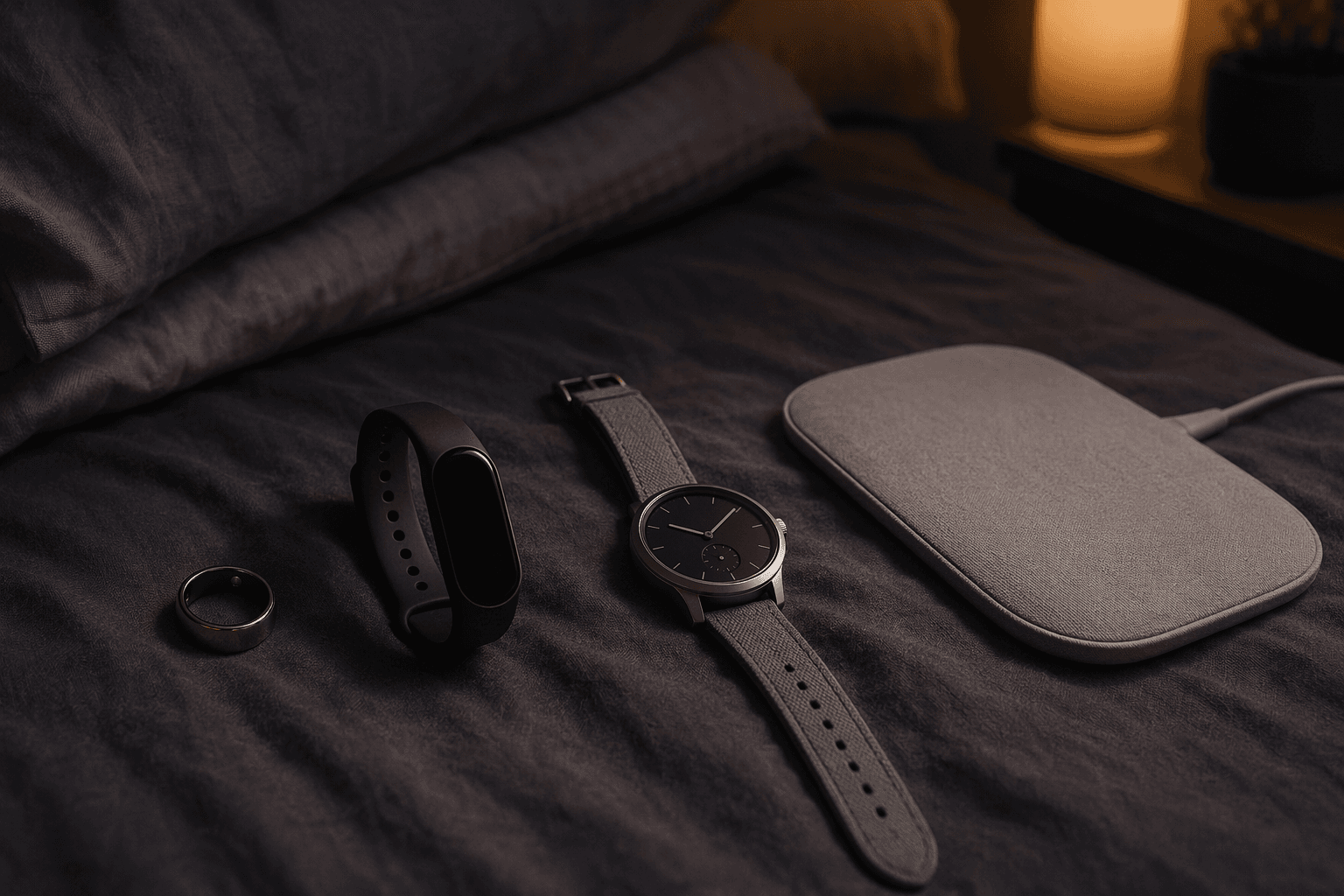
A useful sleep tracker decision usually has one main job. It might help you notice whether late caffeine is pushing bedtime later, whether travel is hurting recovery, or whether a new routine is making your sleep more regular. It should not become a nightly referendum on whether you slept "correctly."
| Your situation | Most sensible starting point | Why this is the better first filter |
|---|---|---|
| Insomnia, sleep anxiety, or score-checking tendencies | Phone-only app, very basic band, or no tracker for now | Less stage-by-stage data can reduce fixation and morning score anxiety. |
| General curiosity or sleep hygiene improvement | Smart ring | Low-profile wear usually makes nightly consistency easier. |
| Athlete or recovery-focused training | Whoop or Garmin-style training wearable | Recovery, strain, and training load matter more than sleep tracking alone. |
| Traditional watch preference | Hybrid smartwatch | You get a familiar watch shape and longer battery life than many full smartwatches. |
| Cannot stand wearing anything in bed | Under-mattress sensor | It removes body-worn friction, though bed partners and pets can muddy the data. |
| Budget-conscious first tracker | Fitbit Inspire 3 or similar slim band | Low upfront cost and long battery life matter more than premium dashboards. |
| Trying to avoid orthosomnia entirely | Phone-only trend app | Sleep debt and schedule trends are often safer than nightly sleep-stage judgment. |
If Insomnia Is Part of the Story, Be More Conservative
People with insomnia are often sold sleep trackers as clarity machines. That can backfire. The term "orthosomnia" came from a 2017 Journal of Clinical Sleep Medicine paper describing people who became preoccupied with achieving perfect tracker-defined sleep, sometimes despite clinical sleep testing telling a more reassuring story.[5]
The most useful warning is not that sleep trackers are always wrong. It is that the number can change how you feel about the same night. In an Oxford-described manipulated-score study, participants were given false sleep-quality feedback; worse reported scores were linked to worse mood and cognitive performance, even though actual sleep had not changed in the way the score implied.[5]
For an insomnia reader, that matters more than whether a ring estimates REM a little better than a band. If checking the app first thing in the morning changes your mood, makes you cancel plans, or sends you into a search spiral, choose a lower-drama setup. A phone-only app such as RISE focuses on sleep debt trends rather than a stage-by-stage sleep report, and Wirecutter lists it at about $70 per year.[2]
A basic band can also work if you use it narrowly: bedtime consistency, wake time, and rough duration. Turn off pushy notifications if they make the tracker feel like a supervisor. For a fuller discussion of this exact branch, use the sleep trackers for insomnia and orthosomnia risk guide before buying a premium device.
For General Curiosity, a Ring Is Usually the Easiest Habit
For many people who simply want to understand sleep patterns, the strongest general starting point is a smart ring. Oura Ring 4 is repeatedly treated by major sleep-tech roundups as the most comfortable or forgettable form factor, which matters because a sleep tracker only becomes useful after it has gathered enough ordinary nights to show a pattern.[1][2][3]
The ring advantage is not magic. It is behavioral. A ring does not press a watch case into the wrist, does not flash a screen, and usually survives several nights before needing a charger. Rings commonly land in the 5-to-8-day battery range, which gives them more forgiveness than a daily-charge smartwatch.[1]
The tradeoff is cost. Wirecutter lists Oura Ring 4 at $499 plus a $6 monthly subscription, so it is not the gentle entry point for someone who mostly wants to know whether they sleep seven hours or six.[2] Oura also has a stronger validation trail than many consumer sleep products, but validation evidence should be read carefully: brand-funded studies and older device-generation studies are not the same thing as proof that every current metric is clinically definitive. If accuracy is the deciding variable for you, move to the smart sleep device accuracy guide rather than turning a buying choice into a validation rabbit hole.
Recovery Tools Are a Different Category
Whoop and Garmin make the most sense when sleep is only one part of a training loop. If you care about strain, recovery, training load, GPS workouts, and whether to push or back off, a recovery wearable can earn its place. If you only want a calmer bedtime routine, it may be too much dashboard.
Whoop 5.0 is especially subscription-shaped: CNET describes it as having no separate hardware cost but annual plans in the $199-to-$359 range as of its 2026 coverage.[3] That model can be reasonable for athletes who live in the app. It is harder to justify for someone who will open the sleep tab twice, feel vaguely judged, and stop wearing it.
Garmin belongs in the same broad recovery conversation, especially for runners and cyclists who already want longer battery life and built-in GPS. The point is not that Garmin or Whoop is the universal best sleep tracker. It is that they become more persuasive when the sleep data feeds a training decision. For a direct comparison of the two most common recovery-style lanes, see Oura Ring vs. WHOOP for sleep tracking.
Budget Buyers Should Care About Battery Before Fancy Scores
Fitbit Inspire 3 is the clean budget answer because it is inexpensive, slim, and low-maintenance. Sleepopolis places it under $100 and lists a 10-day battery life, with sleep staging included.[4] That combination is more important than it sounds: a tracker that needs charging every day creates one more way for the habit to fail.
Fitbit Premium complicates the price math. The subscription is listed at $10 per month in the research materials, so the cheap device can become less cheap if the features you want sit behind the recurring fee. Before buying, decide whether you need the premium interpretation layer or whether basic duration, consistency, and sleep score trends are enough.[4]
The best use of a budget band is modest and practical. Look for repeated patterns: later bedtimes after alcohol, shorter sleep before early meetings, more awakenings during stressful weeks. If you already own a Fitbit and want to use the score without over-reading it, the Fitbit Sleep Score guide is the better next stop than another product page.
Smartwatches Add Features, but Charging Can Break the Nightly Chain
Full smartwatches are attractive if you already live on the platform. The problem is bedtime logistics. Apple Watch-style daily charging can create a small but persistent failure point: charge it before bed and risk forgetting it, or wear it overnight and wake up with a low battery. Some people solve this with a routine. Many do not.
Hybrid watches are more forgiving. CNET lists Withings ScanWatch 2 at about $400, with a 30-day battery, no subscription requirement, FDA-cleared ECG, and AFib detection.[3] That makes it a better fit for someone who wants a traditional watch shape and health features without managing yet another daily charger.
Be careful with the medical-feature halo. ECG clearance or rhythm notifications do not mean a consumer sleep tracker can diagnose a sleep disorder. The American Academy of Sleep Medicine has warned against using consumer sleep technology for self-diagnosis or self-treatment, and that boundary is especially important for suspected sleep apnea.[6]
If apnea notifications are the reason you are considering a smartwatch, read the narrower Apple Watch sleep score and sleep apnea notifications guide. Loud snoring, witnessed breathing pauses, gasping, severe daytime sleepiness, or cardiovascular risk factors belong in a clinical conversation, not in an app-only decision.
If You Cannot Wear Anything, Under-Mattress Sensors Are a Fair Compromise
Some people know exactly what will happen: the wristband comes off in the night, the watch feels sweaty, the ring feels strange, and by Thursday the tracker is on the nightstand. For them, an under-mattress sensor is not a lesser choice. It is the only form factor with a chance of collecting consistent data.
The category ranges from passive sleep mats to active temperature systems. Sleep Foundation lists Eight Sleep Pod 5 at $2,999 plus a $17-to-$25 monthly subscription, with active temperature control as part of the appeal.[1] That is a very different purchase from a budget band. You are not just buying tracking; you are buying a bed system.
The main caveat is the bed itself. Partners, pets, and shared mattress movement can complicate under-mattress data. If a dog jumps onto the bed at 4 a.m. or a partner tosses beside you, the sensor has less clean separation than a device attached to your body. For that tradeoff in more detail, see the Tempur-Pedic Sleeptracker-AI accuracy comparison.
Run the Real Cost and Friction Check
Before choosing, compare the parts that affect the next 90 nights, not just the launch-day excitement.
- Comfort: Will you keep it on when you are hot, restless, traveling, or already annoyed?
- Charging: Does the battery schedule fit your routine, or will it quietly remove the tracker from your night?
- Subscription: Add the monthly or annual fee before deciding a device is affordable.
- Data style: Do you want recovery coaching, sleep hygiene trends, or fewer numbers on purpose?
- Clinical expectations: If you suspect a disorder, use the tracker as context, not as a diagnosis.
This is where a lot of ranking lists become less useful. Oura's $6 monthly subscription, Whoop's annual subscription model, Fitbit Premium's $10 monthly layer, and Withings' no-subscription approach create different long-term costs even before you compare comfort.[2][3][4] Battery life spreads out just as much: smart rings commonly last several days, Fitbit Inspire 3 is listed at 10 days, Withings ScanWatch 2 at 30 days, and daily-charge smartwatches ask for a much tighter habit.[1][3][4]
What to Do After You Buy One
Give the tracker enough ordinary nights to show a baseline. Do not reorganize your life around one bad score after a late dinner, a flight, or a stressful day. Single-night data is noisy; repeated patterns are where consumer trackers become useful.
The best metrics are the ones that connect to behavior or health decisions: sleep timing, regularity, rough duration, awakenings you can corroborate, and recovery signals you actually use. If you want a stricter hierarchy of which wearable sleep metrics deserve attention, use the wearable sleep metrics evidence-tier guide.
Choose the least intrusive form factor that answers your actual question, fits your budget after subscriptions, and can remain part of your nightly routine. That may be a smart ring, a $100-ish band, a recovery wearable, a hybrid watch, a bed sensor, a phone-only app, or no tracker for now.
References
- Best Sleep Trackers of 2026, Sleep Foundation
- The 2 Best Sleep Trackers of 2026, Wirecutter
- The 7 Best Sleep Trackers of 2026, CNET
- Best Sleep Trackers (2026), Sleepopolis
- Are sleep trackers accurate? Here’s what researchers currently know, Oxford Neuroscience
- How do sleep trackers work, and are they worth it? A sleep scientist breaks it down, The Conversation / Oxford Neuro

Comments
Join the discussion with an anonymous comment.