
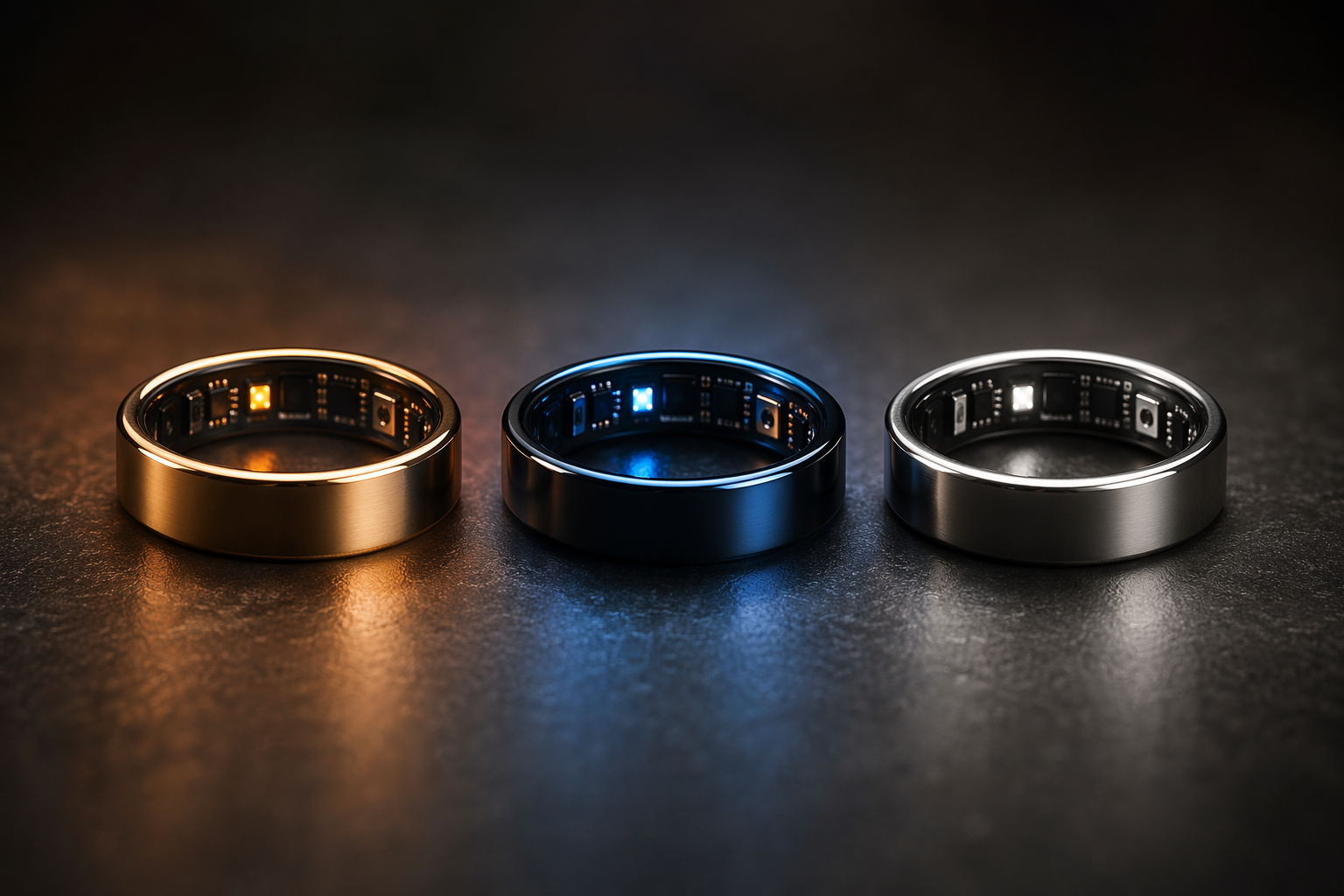
If you already know you want a ring on your finger at night, the real question is not whether sleep tracking rings are comfortable. It is which compromise you are willing to live with: Oura Ring 4 for the most convincing validation and coaching layer, RingConn Gen 2 for subscription-free ownership with sleep apnea detection, or Samsung Galaxy Ring for the cleanest fit inside the Android ecosystem.
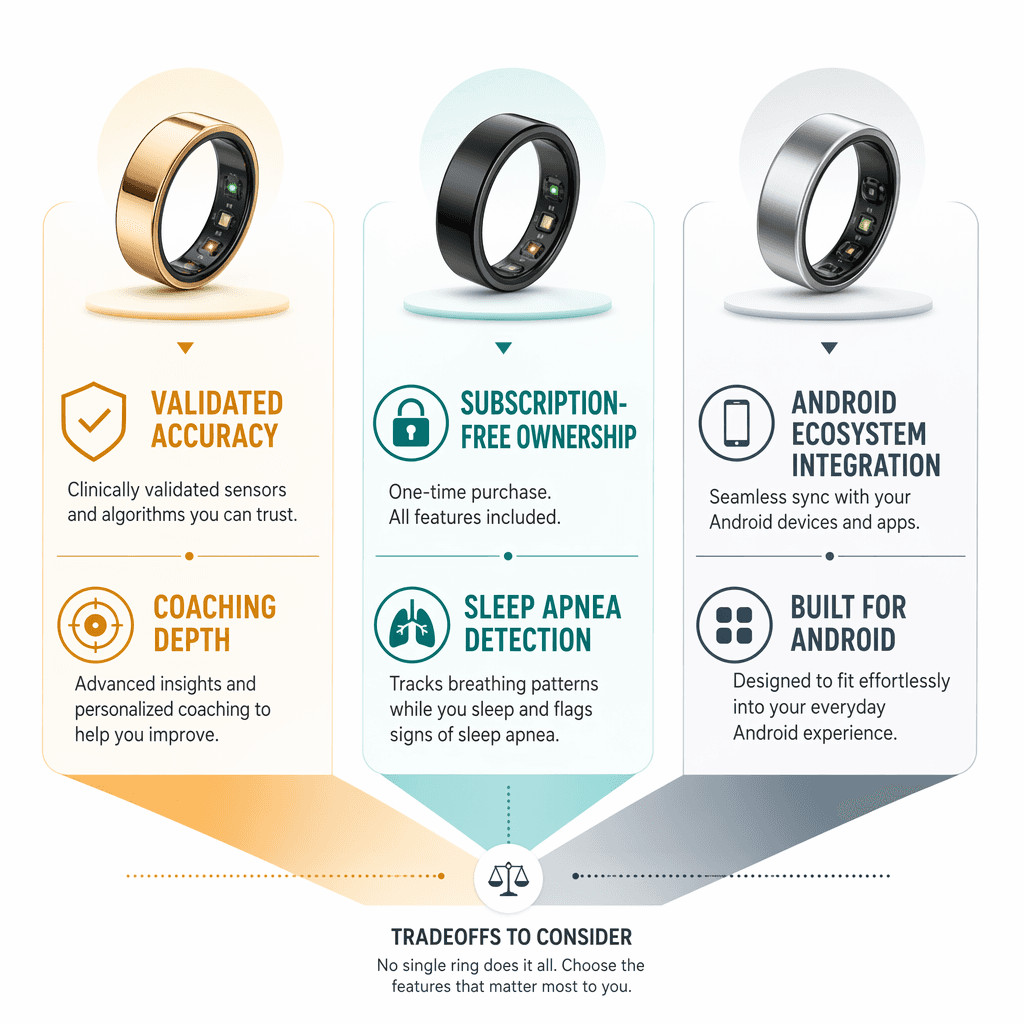
The choice is really about the tradeoff you hate least
These three rings do not fail in the same place. Oura is the one most people reach for when they want the strongest sleep-stage evidence and the richest coaching experience, even if that means paying for the software around the hardware. RingConn is the pick for someone who wants to avoid a recurring fee and cares about sleep apnea detection enough to make that feature central. Samsung is the ring for an Android user who wants the device to feel native to the phone stack and is willing to give up some sleep-specific credibility to get there.
| Ring | What it does best | Main tradeoff | Best fit |
|---|---|---|---|
| Oura Ring 4 | Most validated sleep staging and the deepest coaching layer | Subscription cost over time | The reader who wants the strongest sleep data story and can accept a paid membership |
| RingConn Gen 2 | No monthly fee and built-in sleep apnea detection | Less independent validation and shorter battery in apnea mode | The reader who values apnea screening and wants to own the ring outright |
| Samsung Galaxy Ring | Best ecosystem fit for Android and Samsung Health users | Less independent validation for sleep staging | The reader who wants the ring to behave like part of a Samsung phone setup |
The cost split is not subtle over time: Oura is about $349 for the ring plus $5.99 per month, or roughly $699 over five years. RingConn is closer to $299 over the same period because there is no subscription, while Samsung lands around $400 for fitness tracking features without a monthly fee.
What “accuracy” means in this category
In rings that track sleep, accuracy is usually closer to trend-following and stage approximation than to clinical truth. The best case for Oura Ring 4 comes from a 2024 Brigham and Women’s Hospital study of 35 people published in Sensors: it was the only device tested that did not significantly overestimate or underestimate any sleep stage versus polysomnography, and its deep-sleep sensitivity reached 79.5%. The same study still found wake sensitivity of only 68.6%, so even the best-performing ring missed wake often enough to matter. The paper also disclosed Oura funding and noted that a lead author serves on Oura’s Medical Advisory Board, which does not erase the result but does affect how carefully it should be read [1].
A 2025 systematic review and meta-analysis, pooling six studies with 388 participants, found no statistically significant difference between Oura and polysomnography or actigraphy for total sleep time, sleep efficiency, or sleep-stage duration at the group level. That supports the ring as a self-monitoring tool, but it is still a group-level statement, not a promise that any one night will be right for any one person [2].
That limit matters more once sleep becomes messy. A 2025 Nature Scientific Reports study in a sleep-clinic population found that Oura sleep-stage accuracy dropped to 53.18% in patients with diagnosed sleep disorders, with individual total-sleep-time error ranging from 54 minutes short to 97.5 minutes long. That study tested Oura Ring Gen 3, not Gen 4, so it does not map perfectly onto the current hardware, but it is a useful warning that healthy-volunteer validation does not automatically generalize to people whose sleep is already impaired [3].
That is the point most product pages skip. A ring can be good enough to show direction, timing, and broad stage balance while still being too noisy to treat as verdict. The most honest reading is usually: did sleep look better, worse, or unchanged over several nights?
Where each ring actually earns its place
Oura Ring 4 makes sense when the reader wants the most defensible sleep data and is willing to pay for it. The hardware matters, but the subscription is part of the product because the coaching, insights, and longer-term trend layer sit behind it. That is annoying if you want a one-time purchase, but it is also why Oura keeps showing up in validation discussions instead of disappearing into the “good enough” pile.
RingConn Gen 2 is the most straightforward answer for someone who hates recurring fees and wants FDA-registered sleep apnea detection as a real buying criterion, not a marketing footnote. The tradeoff is obvious: the apnea mode reduces battery life sharply, and the public validation trail is thinner than Oura’s. If the sleep-apnea feature is the reason you are shopping, that may still be the right bargain. If accuracy is the reason, it is harder to justify on evidence alone.
Samsung Galaxy Ring is the least interesting ring if the only thing you care about is sleep-stage validation, and the most interesting one if your phone already runs your life. Its value is ecosystem integration: Samsung Health, Android compatibility, and the feeling that the ring belongs to the same stack as the rest of the device. For some buyers, that friction reduction is enough. For others, it is not a substitute for stronger sleep-specific evidence.
Battery life, apnea mode, and the hidden cost of asking for more
Battery life sounds like a simple spec until sleep apnea detection enters the picture. RingConn’s roughly 12-day standard runtime is part of its appeal, but that advantage shrinks to about 5–6 days when apnea mode is switched on. Oura and Samsung are closer to an around-a-week experience, which is less dramatic but also less delicate to manage. In practice, the useful question is not which ring has the biggest headline number; it is which one stays on your finger long enough that you stop thinking about charging it.
That practical burden matters because sleep tracking only works when the device disappears into routine. A ring that is uncomfortable, too fragile to wear consistently, or too often off the charger will produce worse data than a slightly less ambitious device worn every night.
Women’s health features are useful, but they should not decide everything
This is one of the few places where feature differences can matter without becoming inflated. Oura has the most developed women’s health stack, including Natural Cycles integration, which is FDA-cleared for contraception, plus pregnancy-oriented tracking. RingConn and Samsung offer more basic cycle features. That can make Oura the obvious choice for someone using the ring as part of a broader fertility or cycle-tracking routine. It should not, by itself, be treated as a universal reason to choose one ring for sleep if the rest of the fit is wrong.
Sleep apnea is the other feature that deserves real weight. RingConn’s apnea detection changes the buying conversation because it addresses a problem many consumers want screened in the background without buying a separate medical device. But a feature being useful is not the same thing as a feature being equally validated across products. That distinction matters here.
The real risk is not a bad score; it is a bad relationship with the score
The most useful sleep ring can still make sleep worse if the data starts running the night. That is the trap behind orthosomnia: the more a person treats a tracker as a judge, the easier it is for the tracker to turn into a source of anxiety rather than insight. Consumer rings are especially vulnerable to this because they are good at producing numbers every morning and not nearly as good at telling you when to ignore them.
That is why the sane use case is trend tracking. Look for direction over several nights, not moral meaning in a single sleep score. Use the ring to notice whether bedtime, alcohol, travel, illness, stress, or exercise changed the pattern. Do not let one rough night become evidence that you are bad at sleeping.
Taken together, the choice is not hard once the priority is clear. If you want the strongest validation and the most polished coaching layer, Oura is the safest bet. If you want no subscription and care about apnea detection, RingConn is the more direct trade. If you live in Android and want the ring to sit neatly inside Samsung Health, Samsung is the pragmatic choice. None of them is a sleep lab, and none of them is trying to be. The best one is the one whose compromise you will actually live with.
References
- Comparison of Sleep Stage Classification of the Oura Ring 4, Apple Watch, and Fitbit Sense 2 Versus Polysomnography — Sensors / PMC, 2024 — source
- Systematic review and meta-analysis of Oura Ring sleep monitoring accuracy — Journal of Sleep Research / PMC, 2025 — source
- Validation of Oura Ring sleep staging in patients with sleep disorders — Nature Scientific Reports, 2025 — source


Comments
Join the discussion with an anonymous comment.