
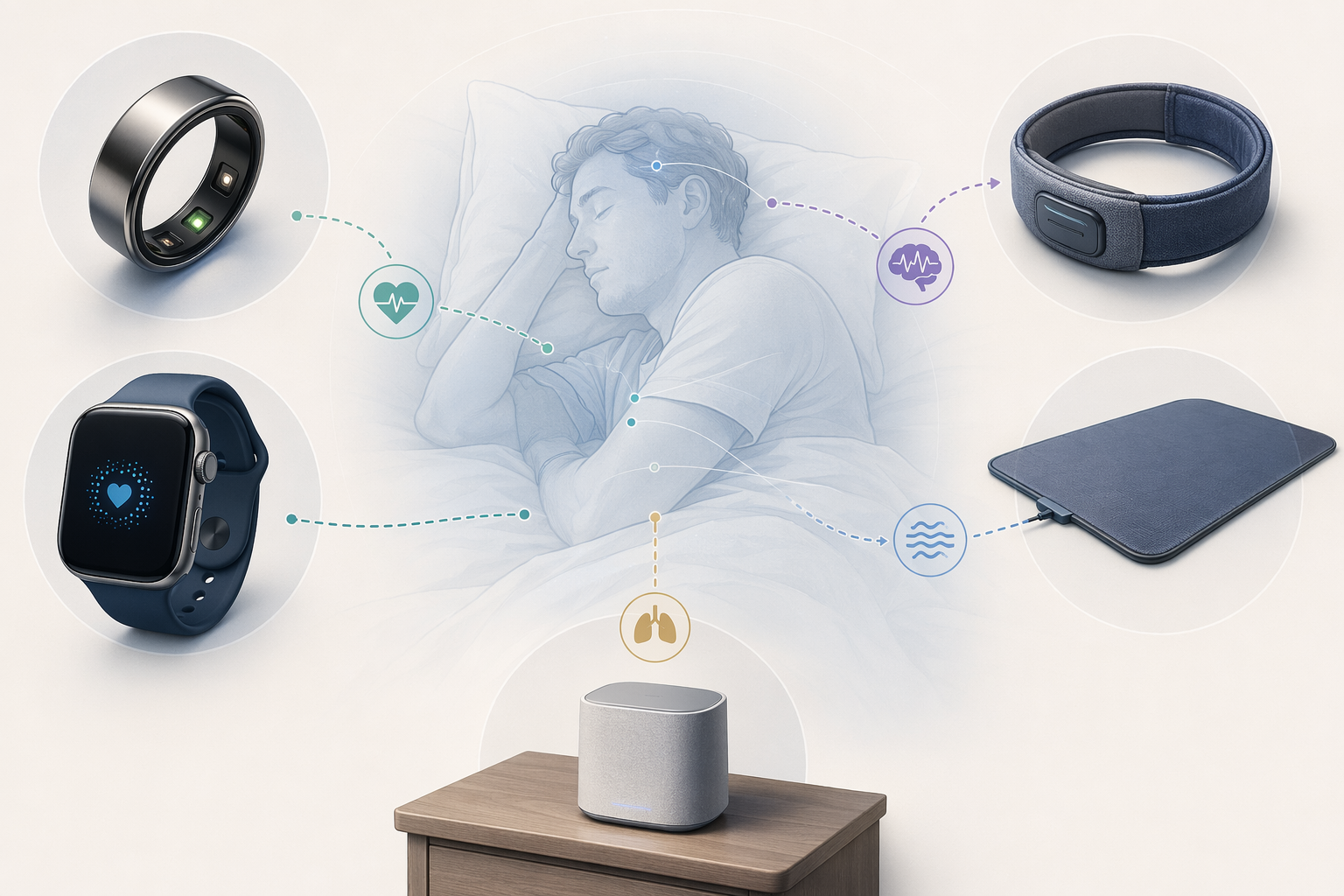
Choosing a sleep monitoring device is less about finding the most impressive dashboard and more about deciding which compromise you can live with every night. A ring can be easy to forget you are wearing, but it still infers sleep from signals outside the brain. A watch can track workouts, heart rate, notifications, and sleep in one place, but that convenience can hide weak wake detection. A headband gets closer to what a sleep lab actually measures, then asks you to sleep with electronics on your forehead. A mat or bedside device removes the wearable problem, but gives up direct body contact or adds a larger hardware-and-service commitment.
That is the useful way to compare sleep monitors: by form factor first, brand second. The shape of the device decides where the sensors sit, what signals they can plausibly measure, how likely you are to keep using it, and where its mistakes will show up.
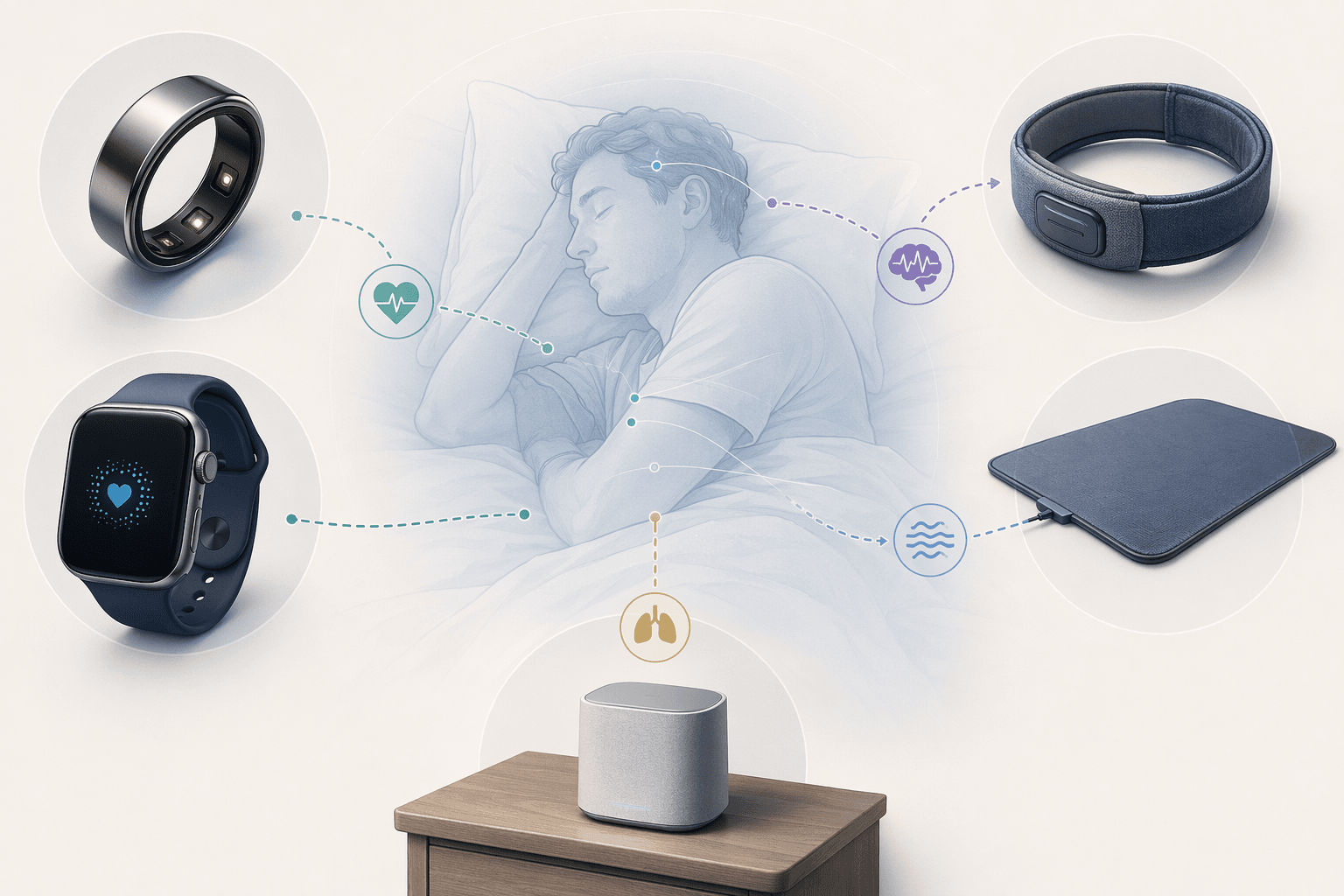
The form-factor map
| Form factor | What it usually measures | Main advantage | Main tradeoff | Best fit |
|---|---|---|---|---|
| Ring | Heart rate, heart-rate variability, blood oxygen in some models, skin temperature, movement | High overnight comfort with useful sleep/wake estimates | No direct brain activity measurement; sleep stages remain approximate | Most people who want nightly sleep trends without wearing a watch to bed |
| Watch or band | Heart rate, HRV, blood oxygen in some models, movement, daytime activity, sometimes temperature | Broadest all-day tracking ecosystem | Wake detection can be poor, especially for quiet wakefulness | People who want one device for fitness, health, and sleep |
| EEG headband or sleep mask | Brain electrical activity, often plus movement and heart-related signals | Closest consumer approximation to lab-style sleep staging | More intrusive, shorter battery constraints, adjustment period | People who specifically care about sleep stages and can tolerate head-worn gear |
| Under-mattress mat | Movement, breathing-related motion, heart-related ballistocardiography signals; some systems add temperature control | No device on the body | Bed-partner, mattress, and positioning complications; premium systems can be expensive | People who hate wearables or want bed climate features |
| Bedside radar | Movement and breathing patterns from a nearby device | Fully contact-free | Further from the body; limited signal depth | People who will not wear anything and mainly want rough sleep continuity trends |
The table already rules out a common mistake: treating every sleep monitoring device as if it is trying to do the same job. It is not. A ring and a headband may both produce a “deep sleep” number, but they arrive there through different sensors and different assumptions. That matters most when your concern is not simply “Did I sleep roughly seven hours?” but “Was I awake more than this app says?”
Rings: the best comfort-for-accuracy balance for many buyers
A smart ring is usually the easiest sleep monitor to recommend first because it solves the problem that quietly ruins many trackers: people stop wearing them. A ring does not press a watch case into the wrist, light up with notifications, or make you choose between charging your daytime device and tracking the night. For many sleepers, that comfort advantage is not cosmetic. The best sensor is still useless on the charger.
The stronger reason to take rings seriously is that recent validation data is no longer limited to healthy convenience samples. In a 2025 clinical sleep-lab study comparing finger-ring trackers with polysomnography, Oura reached 53% sleep-stage classification accuracy, SleepOn reached 50%, and Circul reached 35% in a patient population; Oura overestimated total sleep time by 11.7 minutes, while SleepOn overestimated it by 50.5 minutes. [1]
Those numbers are useful because they cut through two opposite exaggerations. A ring is not a miniature sleep lab. It is not reading brain waves, eye movements, or chin muscle tone, which are central to polysomnography. But it is also not just a bedtime step counter. A well-designed ring can give a reasonably stable view of sleep timing, sleep continuity, resting heart rate, HRV, and temperature-related trends, and it can do that in a form most people can tolerate night after night.
The practical interpretation is blunt: use a ring for patterns, not verdicts. If your bedtime drifts, your sleep duration compresses during stressful weeks, or your resting heart rate stays elevated after alcohol or illness, a ring can make those patterns visible. If the app tells you exactly how much REM sleep you got last night, treat the precision as interface design, not as lab certainty.
Rings are especially attractive for people who suspect their existing watch is changing their behavior. A lighter device with fewer daytime interruptions may produce better compliance simply because it creates less friction. The tradeoff is that rings usually do not replace a full sports watch for training, maps, screen-based coaching, or smartwatch features. If the sleep data matters more than the screen, the ring is often the cleaner choice.
For a closer look at the evidence behind this category, see the ring-specific guide to smart ring sleep tracking accuracy.
Watches and bands: broad tracking, weak wake detection
Wrist wearables are the default sleep tracker for a reason. Many people already own one, the hardware is familiar, and the same device can track exercise, heart rate, recovery, notifications, and sleep. If you want one health dashboard rather than a dedicated sleep device, a watch or band is the obvious candidate.
The problem is that “comprehensive” can be mistaken for “more accurate.” In a seven-device comparison against polysomnography, Garmin devices correctly identified only 18% to 27% of PSG wake epochs. [2] That is not a small edge-case error if your main complaint is fragmented sleep, insomnia, or lying still while awake. Quiet wakefulness is exactly the condition a wrist tracker is likely to struggle with, because stillness and a lowered heart rate can look sleep-like from the wrist.
A broader wearable validation study tells a more forgiving but still limited story. In healthy adults, six devices including Apple Watch, Garmin, Polar, Oura, WHOOP, and Somfit showed 86% to 89% sleep/wake agreement and 50% to 65% sleep-stage accuracy. [3] That is good enough for many trend questions. It is not good enough to treat every short awakening, stage shift, or readiness score as a factual record of the night.
The weakness becomes more important in people who are not healthy sleepers. Garmin Health reported that its overall sleep-tracking accuracy was 69.7% in healthy participants and dropped to 49.9% in a participant with a self-reported sleep disorder. [4] That source is a company disclosure rather than an independent trial, so it should not be inflated into a universal estimate. Still, the direction is exactly what a cautious buyer should expect: algorithms trained and tested on cleaner sleep can degrade when sleep becomes irregular.
This does not make wrist wearables bad sleep monitors. It makes them specific. They are strong if you want sleep in context with workouts, daily movement, resting heart rate, and recovery. They are weaker if your highest-value question is whether you were awake for long stretches the device smoothed over.
If you want the sensor mechanics behind this problem, the deeper explainer on how smartwatches track sleep is the better next stop. If daytime activity tracking is just as important as sleep, the buying guide to the best sleep and activity tracker for 2026 may be more relevant than a sleep-only comparison.
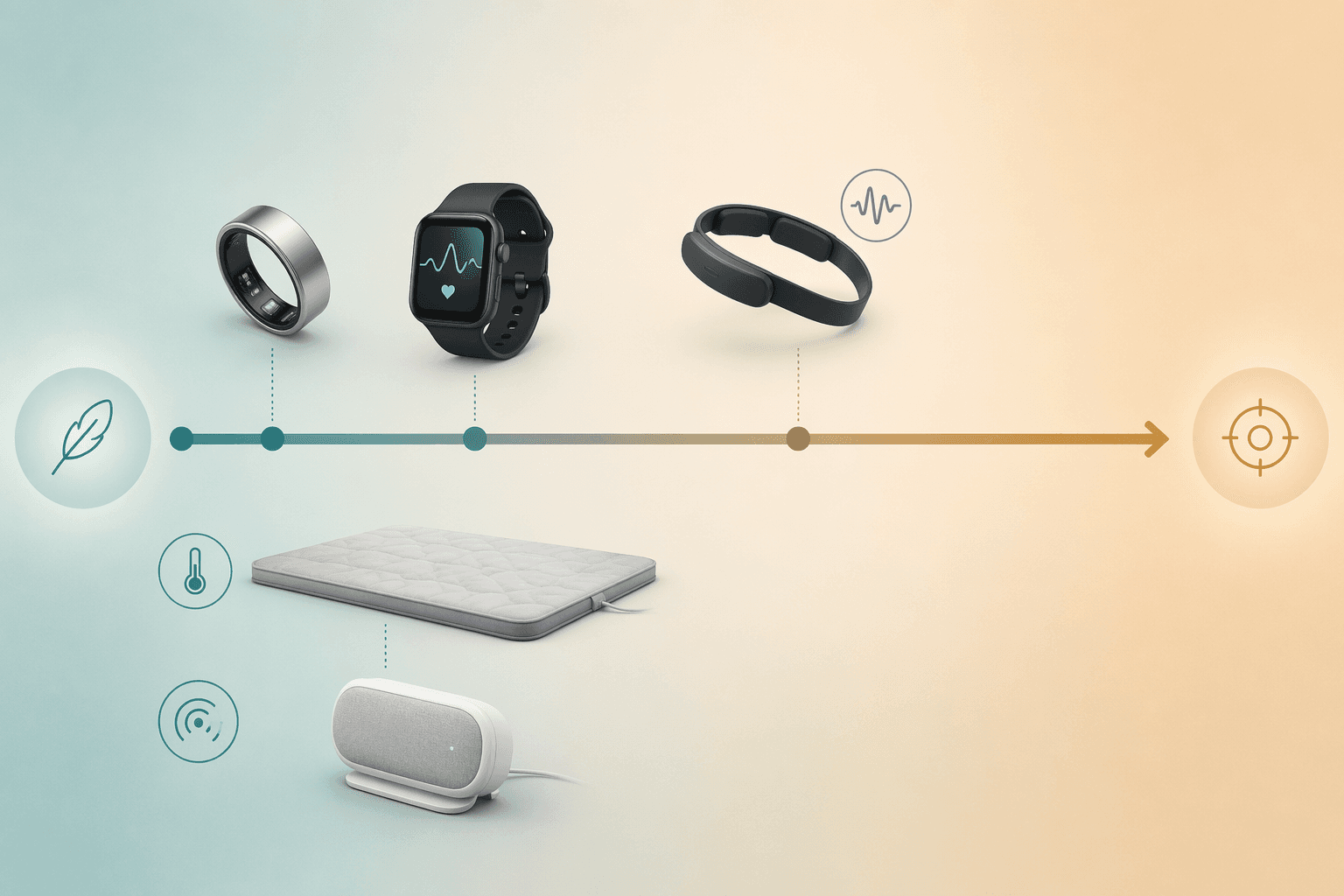
Headbands: closer to sleep-lab signals, harder to live with
The clearest technical advantage of an EEG headband is that it tries to measure brain activity directly. That matters because sleep stages are, at root, brain-state categories. A wrist device or ring estimates stages from proxies such as motion, heart rate, and temperature. A headband is at least aiming at the signal sleep labs care about most.
That advantage should be kept in proportion. A consumer EEG headband is not the same as full polysomnography, which uses multiple channels and trained scoring. The published, peer-reviewed validation base for current consumer headband models is also thinner than the evidence base for mainstream wrist and ring devices. So the honest claim is narrower: a headband is the closest consumer form factor to sleep-lab-style measurement, not a replacement for a clinical sleep study.
The livability costs are real. A headband can shift, feel warm, press on the forehead, or become one more thing to charge and position correctly. Some people adapt after a few nights. Others will remove it half-asleep and learn nothing except that they dislike headbands. This is the category where sensor ambition most visibly collides with bedtime tolerance.
Consider a headband if your main question is about sleep staging and you are willing to accept a trial period. Do not buy one because an app score looks more scientific. Buy it only if the head-worn form factor is something you can realistically keep on through ordinary, imperfect nights.
Under-mattress mats: comfort solved by moving the sensor into the bed
Under-mattress systems approach sleep tracking from below rather than from the body. They typically infer sleep from movement, breathing-related motion, and heart-related mechanical signals. Some premium systems add active bed temperature control, which can become as important as the monitoring itself.
This category makes sense for people who know they will not wear anything to bed. It is also appealing for couples if the system supports each side of the bed separately. The limitation is that the sensor is now separated from the body by bedding, mattress structure, sleep position, and sometimes another person moving nearby. A bed sensor can be useful for long-term regularity and sleep continuity trends, but it should not be treated as a more intimate measurement simply because it is physically larger.
The buying decision is also different. With a ring or watch, you are mainly buying a personal sensor. With a bed system, you may be buying sleep climate hardware, a mattress accessory, an app subscription, and a household device all at once. Eight Sleep Pod 5, for example, starts at $2,999+ before ongoing subscription fees. If temperature control is the feature that would actually change your sleep environment, that may justify the category. If you only want a sleep score, it is an expensive way to avoid a ring.
For more on bed-based sensing, see the guide to ballistocardiography sleep tracking accuracy and the comparison of bed-based sleep tracking versus wearables.
Bedside radar: no contact, narrower claims
Bedside radar devices solve the compliance problem more completely than any wearable: you do not put anything on. They monitor from nearby, using movement and breathing patterns rather than direct skin contact. That makes them attractive for people with sensory sensitivity, skin irritation, charging fatigue, or a firm refusal to sleep with hardware attached.
The same distance that makes radar comfortable also limits what it can know. It is further removed from pulse, skin temperature, and the subtle body signals rings and watches try to capture. It is also not measuring the brain. For rough sleep timing and breathing-related pattern tracking, the form factor can be useful. For fine-grained staging or quiet wake detection, the claim should stay modest.
This is a reasonable category when wearing a device is the deal-breaker. It is not the obvious choice for someone who is willing to wear a ring and wants the best balance of comfort and signal depth.
How the sensors shape the mistakes
Most consumer sleep trackers estimate sleep from combinations of movement, heart rate, heart-rate variability, temperature, breathing, or related signals rather than from the full set of measurements used in a sleep lab. [5] That is why the same basic error keeps appearing in different forms: devices are generally better at noticing consolidated sleep than at identifying quiet wakefulness.
Oxford researchers have summarized the broader evidence by noting that consumer trackers can estimate sleep versus wake at around 78% accuracy, while sleep onset estimation has been reported at about 38% accuracy. [6] Those figures should not be pasted onto every current model, because devices and algorithms change quickly. They do, however, describe the buyer’s recurring problem: a sleep graph can look precise in the app while being least reliable at the moments an insomnia-prone person cares about most.
Clinical organizations generally frame consumer sleep trackers as potentially useful for habits and trends, not as diagnostic tools. [7] That distinction is not a disclaimer to ignore. It is the line between using a device as a diary with sensors and treating it as a medical instrument.
Match the device to the sleep problem
A better buying decision starts with the sleep problem you actually have, not with the device that has the longest feature list.
Start with a ring if you want nightly trends with minimal friction
A ring is the safest starting point for most people who want a dedicated sleep monitoring device. It is comfortable enough for long-term use, gives useful sleep/wake and recovery trends, and avoids the bulk and notifications of a watch. It is especially sensible if your main goals are bedtime consistency, total sleep trend, resting heart rate, HRV, and temperature-related changes.
Do not choose a ring if you need clinical answers about apnea, periodic limb movements, narcolepsy, or another suspected disorder. A consumer ring can give you observations to discuss with a clinician; it should not be asked to rule conditions in or out.
Choose a watch if sleep is only one part of the health picture
A watch or band still makes sense if you care equally about workouts, steps, heart-rate zones, notifications, safety features, and sleep. It is also the practical choice if you already wear one all day and do not mind it at night.
Be more cautious if your central complaint is waking repeatedly or spending long periods awake in bed. In that case, the device may give you a reassuring sleep total while undercounting wake. That mismatch can be more frustrating than having no tracker at all.
Consider a headband if staging matters enough to tolerate it
A headband is the form factor to consider when you are specifically interested in brain-based sleep staging and are willing to accept lower convenience. Give this category a personal trial standard: if it disrupts sleep, slips off, or becomes a nightly negotiation, its better signal target will not help you.
Look at under-mattress systems when the bed itself is part of the intervention
Under-mattress systems are most compelling when you want more than tracking. If active temperature control, bed-side separation for partners, or a no-wearable setup is central to the purchase, the category has a clear role. If those features are not important, a body-worn sensor usually gives a cleaner personal signal for less complexity.
Use bedside radar when wearing anything means you will quit
A contact-free device is a compromise worth making when the alternative is abandonment. Choose it for low-friction sleep timing and general continuity trends. Do not choose it because you expect it to see more from across the room than a ring can see from your finger.
A simple selection rule
- If you want the best balance for most nights: start with a ring.
- If you want one device for training, daily health, and sleep: choose a watch or band, but be skeptical of wake detection.
- If sleep staging is the main reason you are buying: consider an EEG headband and test whether you can actually sleep with it.
- If you refuse wearables or want bed temperature features: look at under-mattress systems.
- If zero contact matters more than signal depth: bedside radar is the cleanest fit.
The device you can wear comfortably and interpret cautiously will beat the more ambitious device you abandon or overtrust. If you want a broader evidence review before buying, read the guide to smart sleep device accuracy and efficacy. If your concern is becoming anxious or compulsive about the numbers, the orthosomnia evidence guide on sleep tracker accuracy and data anxiety is the more important next read.
References
- Performance of wearable finger ring trackers for diagnostic sleep measurement in the clinical context — Scientific Reports — 2025
- Performance of seven consumer sleep-tracking devices compared with polysomnography
- A Validation of Six Wearable Devices for Estimating Sleep, Heart Rate and Heart Rate Variability in Healthy Adults — Sensors — 2022
- Garmin Health Announces Sleep Study Results — Garmin Health — 2019
- How do sleep trackers work, and are they worth it? — The Conversation
- Are sleep trackers accurate? Here’s what researchers currently know — Oxford Neuroscience
- Do Sleep Trackers Really Work? — Johns Hopkins Medicine

Comments
Join the discussion with an anonymous comment.