
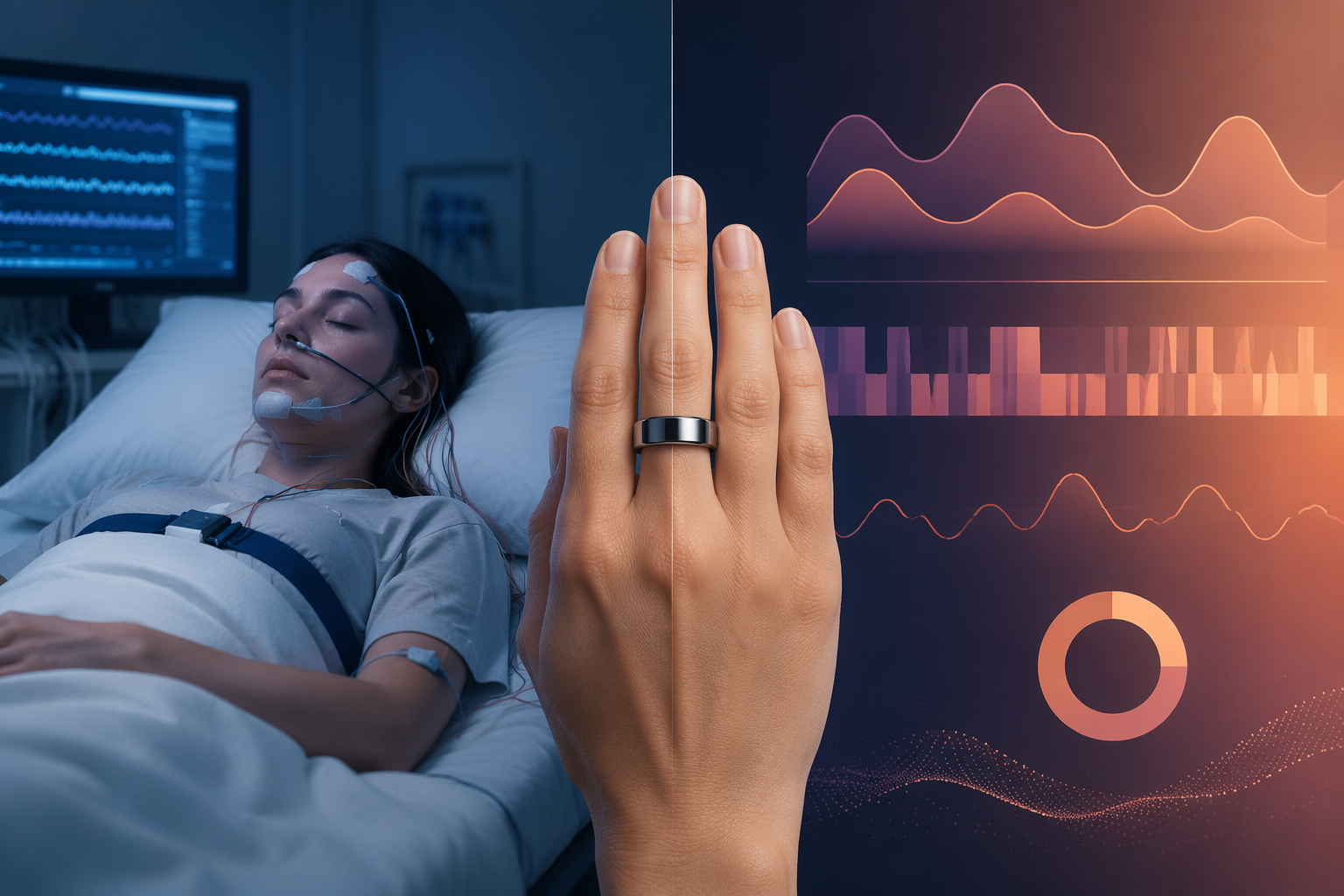
A smart ring for sleep is trustworthy for some questions and too blunt for others. If the question is, “Am I generally sleeping seven hours or six?” or “Did my sleep schedule drift later this month?” the better-validated rings can be useful. If the question is, “Was I awake for 12 minutes at 3:40 a.m.?” or “Do these REM and deep-sleep bars match what a sleep lab would score?” the answer gets much shakier. In a PSG comparison of healthy adults, the Oura Ring showed high sleep sensitivity but detected only 68.6% of wake epochs, which is the kind of number that explains why a ring may say you slept through a period you clearly remember being awake for.[1]
That does not make the data useless. A 2025 systematic review and meta-analysis of six Oura studies with 388 participants found no statistically significant difference between Oura and PSG or actigraphy for total sleep time, sleep efficiency, sleep onset latency, or time spent in sleep stages, although the confidence intervals were wide.[2] The sensible reading is narrow: rings are promising for long-term sleep trend monitoring, especially total sleep time and broad sleep/wake patterns; they are not clinical-grade tools for diagnosing insomnia, sleep apnea, or fragmented sleep.
What “Accurate” Means Depends on the Sleep Metric
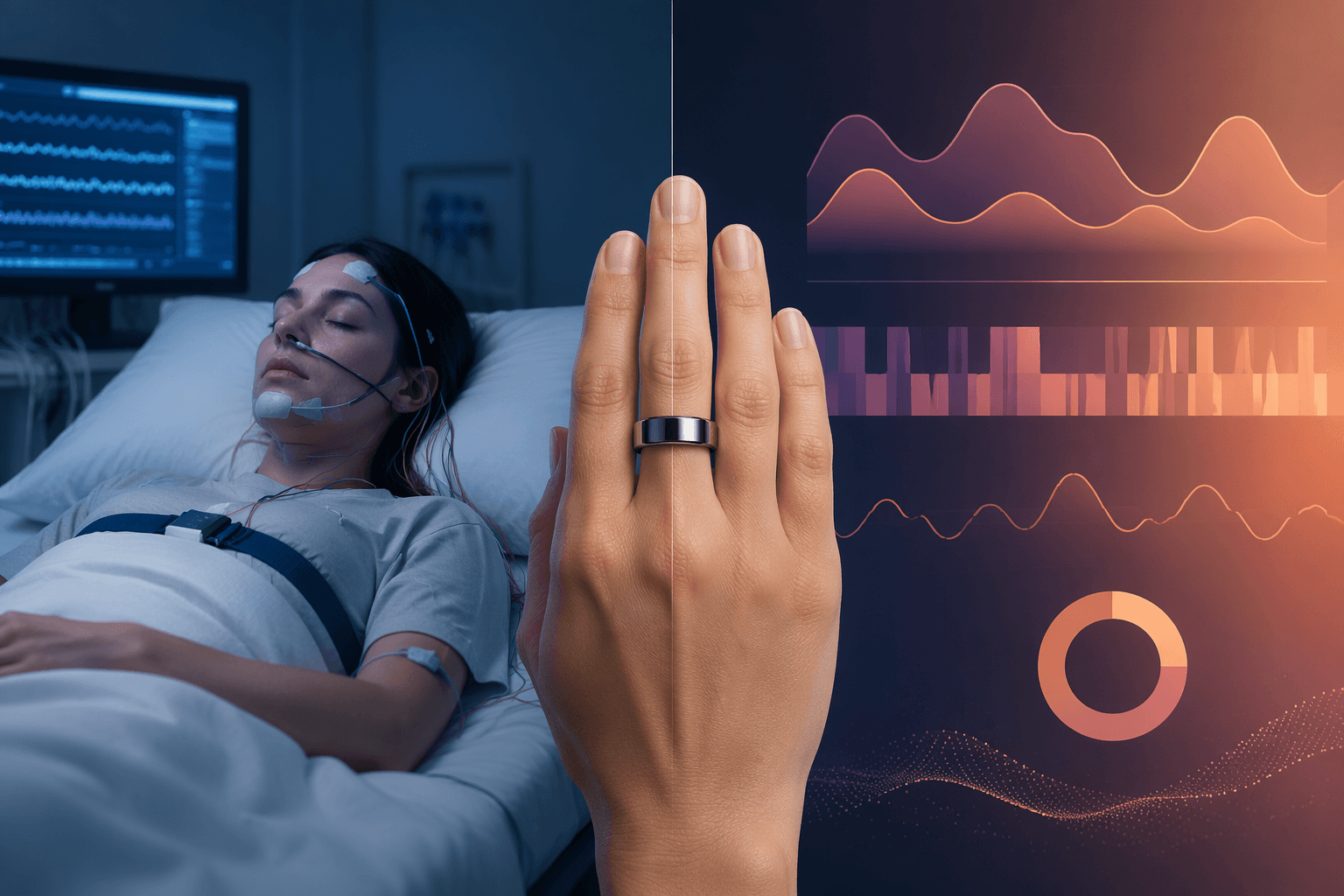
Sleep accuracy sounds like one score, but it is several different jobs. A ring can estimate total sleep time reasonably well and still be mediocre at spotting brief awakenings. It can assign a plausible sleep score and still mislabel light sleep as REM. Product pages often compress these tasks into a single confidence signal, which is exactly where buyers can get misled.
The usual comparison standard is polysomnography, or PSG: a clinical sleep study that records brain activity, eye movement, muscle tone, breathing, oxygen, and other signals. A smart ring does not measure brain waves. It estimates sleep from indirect signals such as motion, heart rate, heart rate variability, temperature, and blood-flow changes measured at the finger. Finger placement can be an advantage because pulse signals are often easier to capture there than at the wrist, but it does not turn a ring into a miniature sleep lab. For a broader form-factor comparison, see Best Sleep Monitoring Device: A Form-Factor Comparison; for the wrist-based sensor contrast, see How Smartwatches Track Sleep.
| Metric | What the evidence supports | How to use it |
|---|---|---|
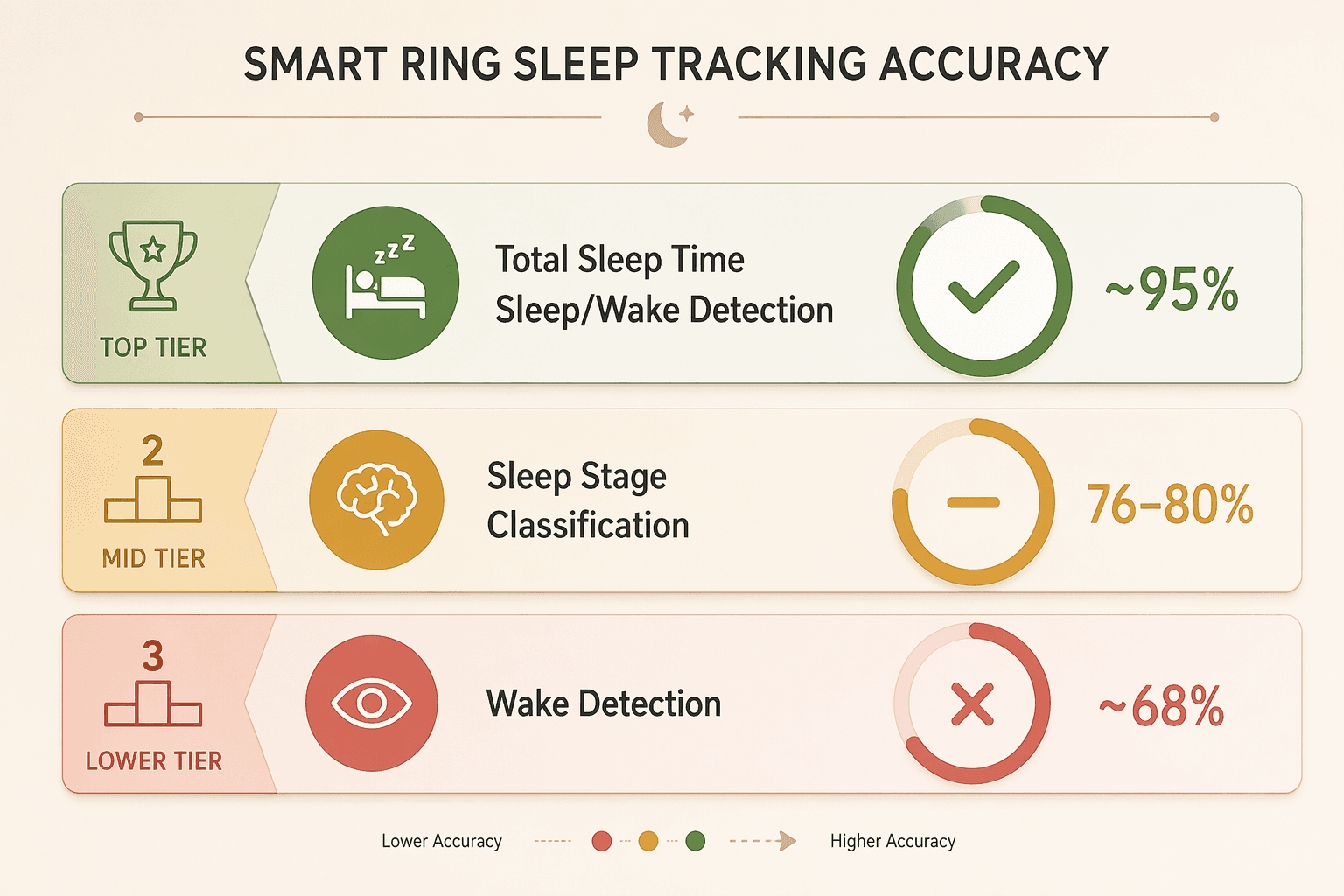
| Total sleep time | One of the stronger ring metrics; meta-analysis found no statistically significant difference between Oura and PSG/actigraphy | Good for weekly and monthly trend tracking |
| Sleep/wake detection | Strong at detecting sleep, with high sleep sensitivity in validation work | Useful for broad sleep windows, less reliable for quiet wakefulness |
| Wake epochs | Weakest area; Oura detected 68.6% of PSG-scored wake epochs in one healthy-adult comparison | Do not treat missed awakenings as proof you were asleep |
| Sleep stages | Moderate rather than clinical; leading-device staging accuracy is commonly reported around 76-80% | Use as a rough pattern, not a lab-style hypnogram |
Total Sleep Time Is the Ring’s Strongest Everyday Use Case
Total sleep time is not a trivial metric. People often buy a ring because they want to know whether their sleep is actually improving after changing caffeine timing, training load, alcohol use, bedtime consistency, or work schedules. For that kind of question, a slightly imperfect but consistently worn device can be more useful than a perfect one-night measurement that never repeats.
The Khan meta-analysis is the most reassuring evidence here. Across six Oura studies and 388 participants, it found no statistically significant difference between Oura and PSG or actigraphy for total sleep time, sleep efficiency, sleep onset latency, or time in any sleep stage.[2] That finding should not be inflated into “Oura equals PSG,” especially because wide confidence intervals leave room for meaningful individual error. But it does support the practical conclusion that total sleep time is one of the more defensible things to track with a ring.
The important shift is from single-night adjudication to pattern recognition. If your ring reports 7 hours and 12 minutes last night, that number should not be treated as a courtroom transcript. If it shows that your average sleep time dropped by 45 minutes after a schedule change, or that weekend recovery sleep is masking short weekdays, that is a much better use of the device.
Sleep Detection Looks Better Than Wake Detection
Rings tend to be better at recognizing that a person is asleep than at recognizing quiet wakefulness. That distinction matters because lying still in bed can look physiologically sleep-like from the outside. A person with racing thoughts, insomnia symptoms, or repeated awakenings may know they were awake; the ring may see low movement and stable physiology and score part of that time as sleep.
The Robbins 2024 study makes this visible. In a PSG comparison of three commercial wearable devices in healthy adults, Oura’s sleep sensitivity was high, but its wake detection was weaker; the ring detected only 68.6% of wake epochs scored by PSG.[1] That is not a minor footnote. It is the difference between “this ring can usually tell when you are asleep” and “this ring can reliably identify every period you were awake.”
This is also where many user complaints come from. A ring may report a clean-looking night even when the wearer remembers being awake for a while. The user is not necessarily imagining the wake period, and the ring is not necessarily broken. The metric is simply hard. Without EEG and the rest of a PSG montage, quiet wake can be difficult for consumer wearables to separate from light sleep.
Sleep Stages Are Useful as Texture, Not as Diagnosis
Sleep stages are the seductive part of the app: deep sleep, REM, light sleep, tidy colors, a score that seems to explain how the night went. They are also the part most likely to be overread. A ring estimates stages from indirect physiological patterns; PSG stages are scored from signals that include brain activity, eye movement, and muscle tone. Those are different inputs.
The category has improved. Oura-specific validation has moved from roughly 66% PSG alignment in earlier 2016-era work to roughly 79% in 2021 validation, which is meaningful progress.[2] Current leading-device sleep-stage classification is often discussed in the 76-80% range, a level that can make trends interesting but not definitive. A REM estimate that runs low for several weeks may be worth noticing; a single night’s REM percentage should not decide whether you panic, change supplements, or self-diagnose a disorder.
The safest way to read stage data is comparatively and softly. Look for repeated shifts under similar conditions. Did late alcohol consistently reduce your recovery signals and change your stage profile? Did a more regular wake time coincide with a steadier sleep window? Those are reasonable questions. “Did I get exactly 43 minutes of deep sleep?” is not.
The Evidence Is Mostly About Oura, Not Every Ring
The strongest validation literature is Oura-heavy. The Khan meta-analysis included six studies, all using Oura, with a combined sample of 388 participants.[2] That is useful if you are evaluating Oura. It is much less useful if you are trying to make equal claims about RingConn, Ultrahuman, Samsung Galaxy Ring, Amazfit, or a newer device with a different sensor package and algorithm.
A ring’s shape alone does not guarantee accuracy. The sensor quality, sampling decisions, firmware, app algorithms, and stage-scoring model all matter. Two rings can sit on the same finger and still produce different sleep outputs. Until a device has independent PSG validation, category-level evidence should be treated as a reason for cautious optimism, not a transferable certificate.
There is also a transparency problem. Consumer sleep algorithms are often proprietary, and researchers have warned that unreleased “black box” methods make validation harder to interpret because the scoring rules can be hidden and may change over time.[3] A study can validate one version of an algorithm; the app a buyer uses months later may not be identical. That does not invalidate all findings, but it does make sweeping claims age quickly.
The study populations matter too. Much of the validation work uses healthy adults, often in controlled or single-night lab settings. That is not the same as testing people with insomnia, suspected sleep apnea, periodic limb movements, shift-work disorder, chronic pain, or highly fragmented sleep at home. The exact people most tempted to use a ring as a sleep-disorder detector may be the people least represented by the cleanest validation samples.
How to Use Smart Ring Sleep Data Without Overusing It
The best use of a smart ring is boring in the right way: wear it consistently, ignore small nightly drama, and watch multi-week patterns. A ring can help show whether your sleep window is stable, whether bedtime is drifting, whether short weekdays are accumulating, and whether certain behaviors repeatedly coincide with worse recovery signals. That is different from asking it to explain every bad night.
- Trust the direction more than the decimal: a persistent drop in average sleep time matters more than whether last night was 6 hours 41 minutes or 6 hours 56 minutes.
- Treat awakenings as undercounted: if you remember being awake and the ring disagrees, especially during quiet wakefulness, do not let the app erase your experience.
- Use sleep stages as context: repeated changes may be interesting, but single-night REM and deep-sleep numbers are too fragile to carry medical meaning.
- Compare like with like: look at your own trend under similar schedules, not one night after travel against one night after a perfect routine.
- Escalate symptoms, not scores: loud snoring, witnessed breathing pauses, severe daytime sleepiness, chronic insomnia, or frequent awakenings deserve clinical evaluation regardless of what the ring says.
This is where sleep tracking can become either helpful or counterproductive. If the data nudges you toward a steadier schedule, earlier wind-down, or a clearer view of short sleep, it is doing useful work. If it makes you inspect every stage bar until you sleep worse, the device has crossed into the kind of measurement anxiety often discussed in tracker and orthosomnia research. For the broader wearable landscape, see Sleep Trackers: What the Largest Validation Studies Reveal. For a separate look at which wearable sleep metrics are actually tied to health outcomes, see Which Wearable Sleep Metrics Actually Predict Real Health Outcomes?.
So, Is a Smart Ring Worth Buying for Sleep?
A smart ring is a strong choice if you want comfortable, low-friction sleep tracking over weeks and months. The form factor helps because many people tolerate a ring overnight better than a bulky watch, and finger-based sensing is a reasonable place to capture pulse-derived signals. The evidence is strongest for total sleep time and broad sleep/wake patterns, especially when the device is worn consistently.
It is a poor substitute for clinical evaluation if the real concern is a sleep disorder. A reassuring sleep score does not rule out sleep apnea. A smooth-looking night does not prove you had no awakenings. A colorful sleep-stage chart is not a PSG hypnogram. If symptoms are present, the next step is medical assessment, not a more careful reading of the app.
For readers specifically considering Oura, the category evidence leads naturally into the more focused Oura Ring Sleep Tracking Accuracy and Features review. For everyone else, the cleanest buying expectation is simple: use a smart ring to understand your sleep patterns, not to diagnose your sleep.

Comments
Join the discussion with an anonymous comment.