
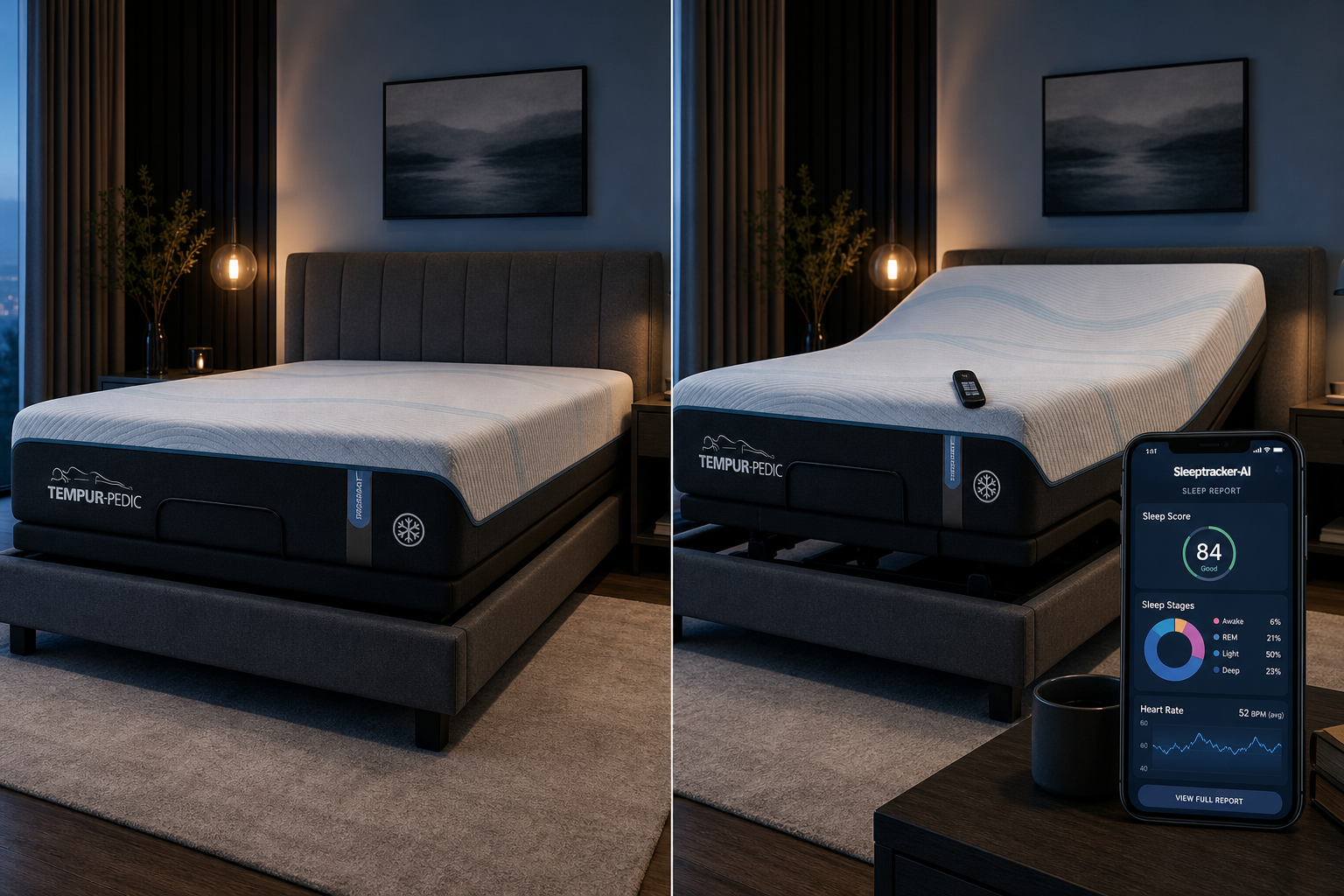
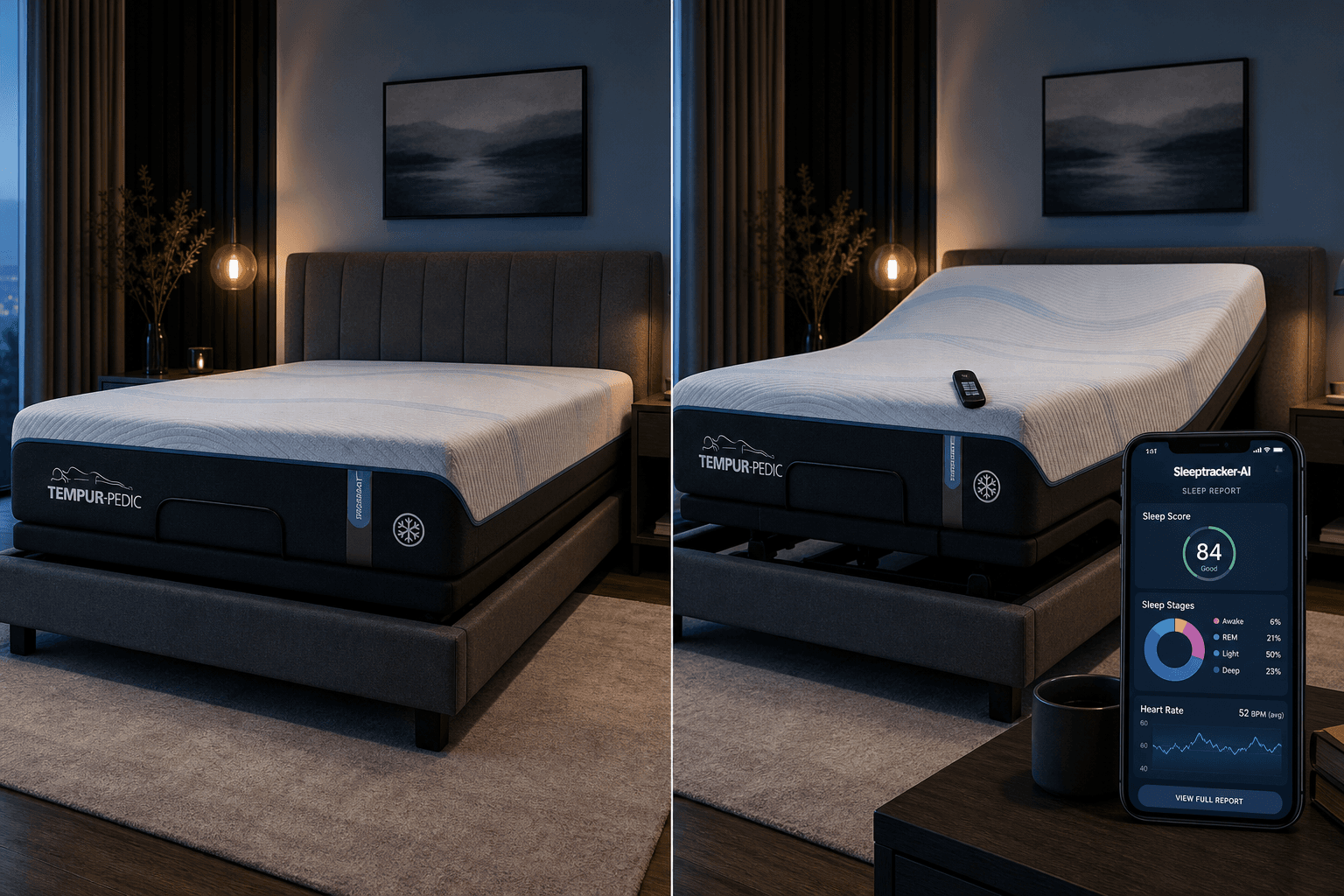
The Promise of Non-Wearable Sleep Tracking
For anyone who has tried to sleep with a smartwatch or ring on, the friction is real. The strap digs in. The ring feels tight when fingers swell overnight. You forget to charge it, or you take it off before bed and lose a night of data. Tempur-Pedic's Sleeptracker-AI, embedded in the Tempur-Ergo Smart Base and ProSmart Base, promises to eliminate that friction entirely: you get detailed sleep metrics without wearing anything at all.
The proposition is compelling, but it comes with a significant price tag. The Ergo Smart Base currently retails for around $1,949 in queen size, which is roughly $400 to $600 more than the standard Tempur-Ergo base that lacks the tracking module. Before committing to that premium, it is worth understanding exactly what Sleeptracker-AI measures, how its accuracy holds up in real-world conditions, and whether it can genuinely replace a dedicated wearable like the Oura Ring or Apple Watch.
How Sleeptracker-AI Works: Ballistocardiography Under the Mattress
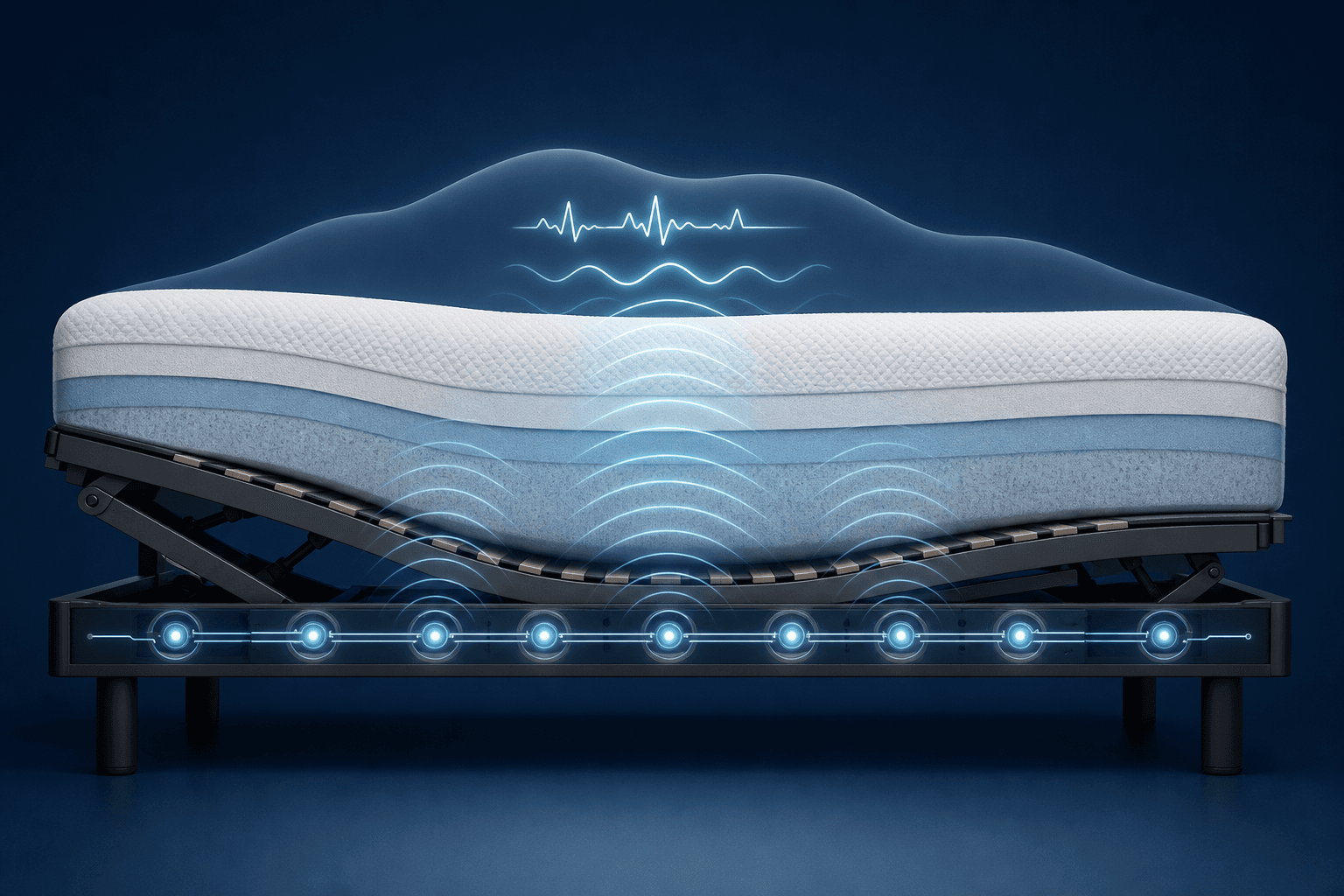
Unlike wearables that rely on accelerometers and photoplethysmography (PPG) to detect movement and blood flow, Sleeptracker-AI uses a technique called ballistocardiography. The base contains pressure sensors that measure the subtle mechanical vibrations your body transmits through the mattress — the thump of your heartbeat, the rise and fall of your chest as you breathe, and the micro-movements of shifting positions during the night.
Because the sensors sit in the base beneath the mattress, there is nothing to charge, nothing to strap on, and nothing to remember before climbing into bed. The system is always on, always recording, as long as the base is plugged in and connected to Wi-Fi. The data is processed in the Sleeptracker app, which generates a daily sleep report and feeds an AI coach that learns your patterns over time.
What Sleeptracker-AI Tracks: A Complete Metric Breakdown
Sleeptracker-AI captures a broad set of metrics that rival most consumer wearables. The table below summarizes what the system tracks and how it compares to what you would get from a typical wrist or finger device.
| Metric | Sleeptracker-AI | Typical Wearable (Oura / Apple Watch) |
|---|---|---|
| Total sleep time | Yes | Yes |
| Sleep stages (deep, light, REM) | Yes | Yes |
| Heart rate | Yes (via ballistocardiography) | Yes (via PPG) |
| Breath rate | Yes | Yes (on most devices) |
| Sleep efficiency | Yes | Yes |
| Snoring episodes | Yes (audio-based detection) | Limited or absent |
| Room CO₂ | Yes | No |
| Room humidity | Yes | No |
| Room temperature | Yes | No |
| HRV | No | Yes (most wearables) |
| SpO₂ | No | Yes (many wearables) |
The room-environment sensors are a genuine differentiator. Knowing that your bedroom CO₂ level is elevated or that humidity is outside the ideal range can be useful for troubleshooting poor sleep that is not explained by timing or stress. Most wearables cannot provide that context.
Real-World Accuracy: What the Tests and Users Say
The accuracy question is the central tension of this product. Sleeptracker-AI can generate impressively detailed reports, but how reliable are those numbers? The available evidence comes from a mix of editorial testing, user reports, and one notable gap in independent validation.
Mashable's Two-Month Test
A Mashable reviewer who tested the Tempur-Ergo Smart Base for two months rated it 4.6 out of 5 and reported that sleep and wake timing was "pretty spot on" compared to the clock. The system correctly identified when the tester fell asleep and when they woke up, which is the most basic and important function of any sleep tracker. However, the bed randomly went offline during some nights and missed tracking entirely. For a device that costs a premium specifically for its tracking capabilities, lost data nights are a meaningful reliability concern.
Snore Detection: A Known Weak Point
The snore detection feature, which can automatically trigger the Snore Response function to raise the head of the bed by approximately 12 degrees, has drawn criticism. Mashable noted that the Smart Snore Pulse activated three times after a night of heavy drinking, creating what they described as a "solid line" of snoring detection. More concerning, Reddit users have reported that the system can be triggered by pets moving on the floor near the bed — not by snoring at all. This suggests the acoustic or vibration-based detection algorithm may lack the specificity needed for reliable snore monitoring.
The Validation Data Gap
Tempur-Pedic maintains an official Sleeptracker-AI accuracy validation page, but it requires JavaScript to render and could not be crawled during research. As a result, independent clinical validation data for the system's sleep stage classification accuracy — the kind of peer-reviewed, PSG-comparison study that companies like Oura and Apple have published — remains opaque. Without published validation against polysomnography, it is difficult to know how accurately Sleeptracker-AI distinguishes between deep sleep, light sleep, and REM stages.
The AI Sleep Coach: Personalization or Gimmick?
Beyond raw data collection, Sleeptracker-AI includes an AI sleep coach that learns your patterns over time and offers personalized recommendations. In a two-week trial conducted by Self.com, the tester initially received an average sleep score of 65 — 10 points below the app's recommended threshold of 75 or higher. After following the app's bedtime reminders and cutting down on pre-sleep screen time, the score improved to 70 or higher for four consecutive nights.
The coach's recommendations fall into several categories:
- Bedtime reminders that adjust based on your historical sleep patterns and wake-up goals
- Wake-up timing suggestions designed to align with light sleep phases for a gentler morning transition
- Wind-down routine prompts that encourage reducing screen time and other stimulating activities before bed
- Room environment tips based on the built-in CO₂, humidity, and temperature sensors
The Self.com trial's results are encouraging, but they come with an important caveat: the tester was following basic sleep hygiene advice — reduce screen time, go to bed earlier — that any sleep tracker or even a simple alarm clock could prompt. The question is whether the AI coach's personalization meaningfully outperforms a standard set of sleep hygiene reminders. The available data does not answer that question definitively.
Who Benefits Most from Bed-Based Tracking — and Who Doesn't
Sleeptracker-AI is not a universal solution. Its strengths and weaknesses map to specific user profiles.
Ideal Candidates
- Consistent bed-sharers who sleep in the same bed every night and want tracking without wearing a device
- People who find wearables uncomfortable or disruptive to their sleep
- Users who want room-environment data (CO₂, humidity, temperature) alongside sleep metrics
- Couples where one partner wants tracking but the other does not want to wear a device
Less Suitable Candidates
- Frequent travelers who would lose tracking data on nights spent away from home
- Shift workers with irregular sleep schedules that do not align with a fixed bed setup
- People who share a bed with a partner who moves a lot — the system may struggle to isolate one person's signals
- Households with pets that sleep on or near the bed, which can trigger snore detection and movement artifacts
- Users who need HRV or SpO₂ data, which Sleeptracker-AI does not provide
Sleeptracker-AI vs. Oura Ring vs. Apple Watch: A Side-by-Side Comparison
For readers trying to decide whether Sleeptracker-AI can replace a wearable, the following comparison covers the key decision dimensions.
| Dimension | Sleeptracker-AI | Oura Ring (Gen 3/4) | Apple Watch (Series 9/10) |
|---|---|---|---|
| Form factor | Bed base (no wearable) | Finger ring | Wristwatch |
| Sleep stages | Yes | Yes | Yes |
| Heart rate | Yes (ballistocardiography) | Yes (PPG) | Yes (PPG) |
| HRV | No | Yes | Yes |
| SpO₂ | No | Yes | Yes |
| Snore detection | Yes | No | No |
| Room environment | Yes (CO₂, humidity, temp) | No | No |
| Subscription cost | None (included with base) | $5.99/month | None |
| Upfront cost (tracking only) | $400–$600 premium over standard base | $299–$399 | $399–$799 |
| Accuracy validation | Opaque (no published PSG study found) | Multiple PSG validation studies published | Multiple PSG validation studies published |
| Best for | Non-wearable preference, room data | Sleep-focused tracking, HRV | General health + sleep, ecosystem users |
The most striking difference is in validation transparency. Oura and Apple have both published peer-reviewed studies comparing their sleep stage classification against polysomnography, the clinical gold standard. Tempur-Pedic's validation data, by contrast, is not publicly accessible in a comparable format. This does not mean Sleeptracker-AI is inaccurate — it means there is no way to independently verify the manufacturer's claims.
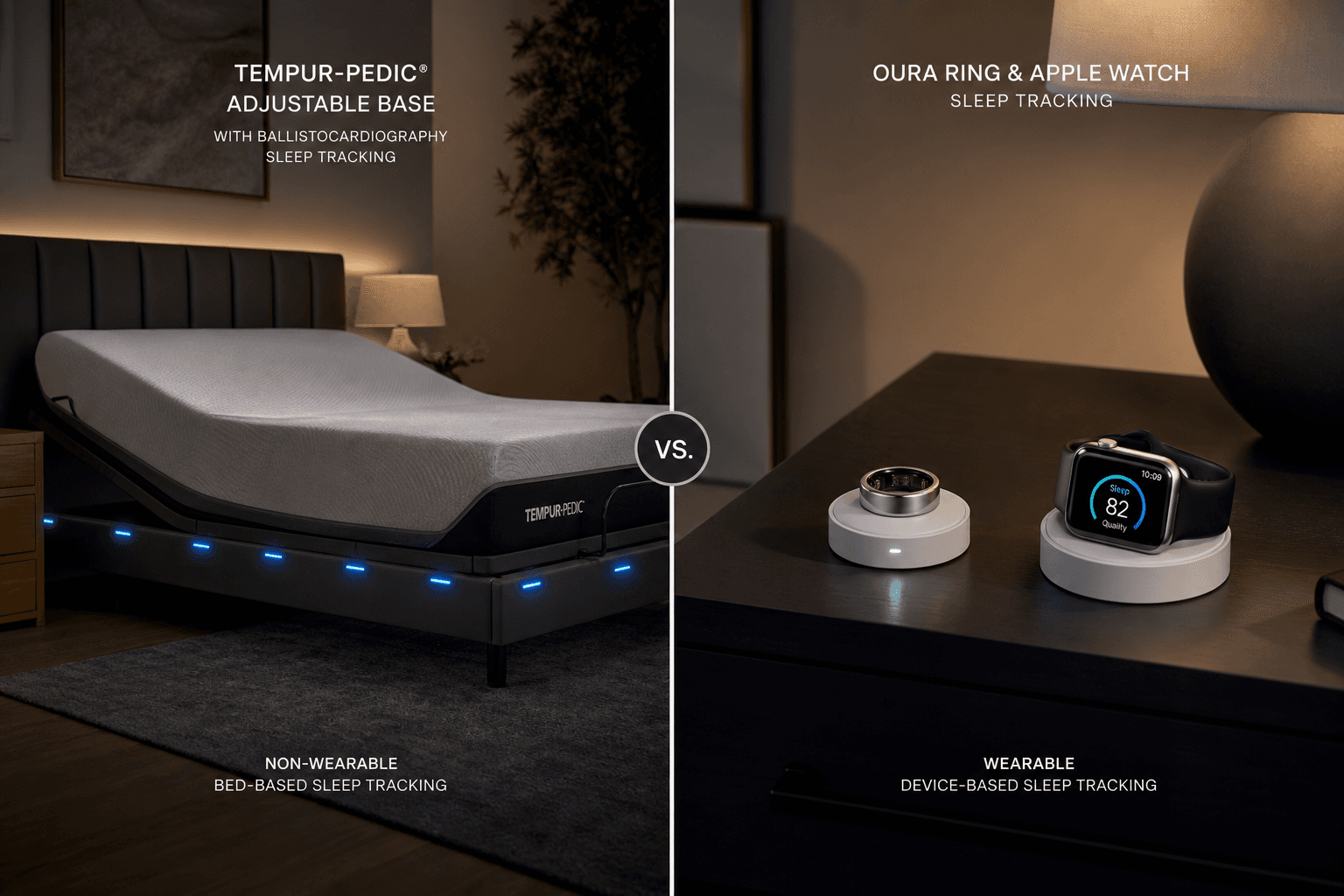
Verdict: A Useful Supplement, Not a Clinical Replacement
Sleeptracker-AI occupies a genuine niche. It is the only consumer sleep tracking system that combines non-wearable convenience with room-environment monitoring and automated snore response. For the right user — someone who sleeps at home every night, finds wearables uncomfortable, and values the contextual data that wearables cannot provide — it can be a useful tool for spotting trends and improving sleep habits.
However, the system has meaningful limitations that buyers should weigh carefully. The occasional offline nights reported by Mashable mean you cannot rely on it for 100% data capture. The snore detection false positives undermine its utility for anyone who needs accurate snore monitoring. And the absence of published, peer-reviewed validation data makes it impossible to assess how accurately it classifies sleep stages compared to clinical-grade equipment.
For most people, the smartest approach is to treat Sleeptracker-AI as a supplement rather than a replacement. If you already own a Tempur-Pedic mattress and are considering the smart base upgrade, the tracking features add genuine value — especially the room-environment data and the automated snore response. But if you are buying a Tempur-Pedic base solely for the sleep tracking, you may be better served by a dedicated wearable with published validation data, plus a standard adjustable base that costs significantly less.
The SLEEP 2022 study on adjustable bed bases — which found that users gained an average of 21 minutes of total sleep time and 5 additional minutes of REM sleep per night — did not specifically test Tempur-Pedic products, but it does suggest that the adjustable base itself, regardless of the tracking module, may improve sleep quality through better positioning. That benefit applies to the standard Ergo base as well as the Smart Base, which is worth keeping in mind when evaluating the $400–$600 premium for the tracking features.


Comments
Join the discussion with an anonymous comment.