A 5-Day Buck Moon Sleep Protocol for Perimenopause
This 5-day protocol bridges the Buck Moon's spiritual meaning of renewal with evidence-based sleep medicine to help perimenopausal women navigate the July 2026 full moon's sleep disruption, offering practical steps from July 26–31 that mitigate lunar melatonin-suppression effects.
The July 2026 Buck Moon arrived on July 29 at 10:36 a.m. EDT, but if your sleep tends to wobble around the full moon, the useful plan started before the moon looked perfectly full in the sky.[1] For a perimenopausal body already negotiating warmer nights, earlier awakenings, and less forgiving circadian timing, waiting until the “big night” can mean arriving tired before the hard part begins.
The Buck Moon’s spiritual meaning gives this a gentler doorway. In North American naming traditions, July’s full moon is associated with the season when male deer grow new antlers; contemporary spiritual sources often extend that image into renewal, release, growth, and stepping into personal power.[2][3] That symbolism can be emotionally useful. It is not, however, sleep physiology. The moon can be a marker for a short planning window without being asked to explain every 3 a.m. awakening.

The practical reason to start early comes from lunar sleep research. In a 2021 field study, Casiraghi and colleagues found that sleep duration dropped by about 20 to more than 90 minutes, sleep onset was delayed by about 30 to 80 minutes, and deep sleep was reduced in the nights before a full moon, with disruption peaking about 3 to 5 nights before fullness rather than only on the full-moon night itself.[4] The study did not directly prove that moonlight suppressed melatonin; moonlight and evening illumination remain a plausible pathway, not a settled mechanism.
That distinction matters. A woman in perimenopause does not need a dramatic lunar theory to explain why this window may feel unusually personal. She may already be closer to the edge. Let’s Talk Menopause cites Dr. Sara Nowakowski’s estimate that roughly 50% of women experience clinical insomnia during the menopause transition, while other reviews use different definitions and report different ranges.[5] A 2022 study in The Journal of Clinical Endocrinology & Metabolism found sleep-continuity disruption in 56% of perimenopausal participants.[6] Pines also describes declining melatonin secretion across the menopausal transition, and clinical menopause sources describe circadian and temperature-regulation changes that can make sleep more fragile.[7][8]
So the question behind “buck moon spiritual meaning and sleep quality in perimenopause” is not whether the moon is secretly controlling your sleep. It is whether a predictable July window can help you stop improvising. This protocol treats July 27 through July 31 as a short, testable sleep-protection period, with July 26 as the setup day if you have time.
Before July 27: set the room, not your expectations
If you had time on July 26, the best use of the evening was logistics. Put the blackout curtains, sleep mask, fan, cooling layer, water, and a light blanket where they will actually be used. Do not turn preparation into a new bedtime project. The point is to remove small decisions from the nights when you are more likely to be warm, alert, or annoyed.
A useful setup has three parts: less light before bed, less heat in the room, and less negotiation after a bad night. If hot flashes or heat waves are part of your pattern, use a dedicated cooling strategy rather than hoping the room will feel different at midnight. For a deeper cooling plan, see How to Cool Both Heat Waves and Hot Flashes for Sleep.
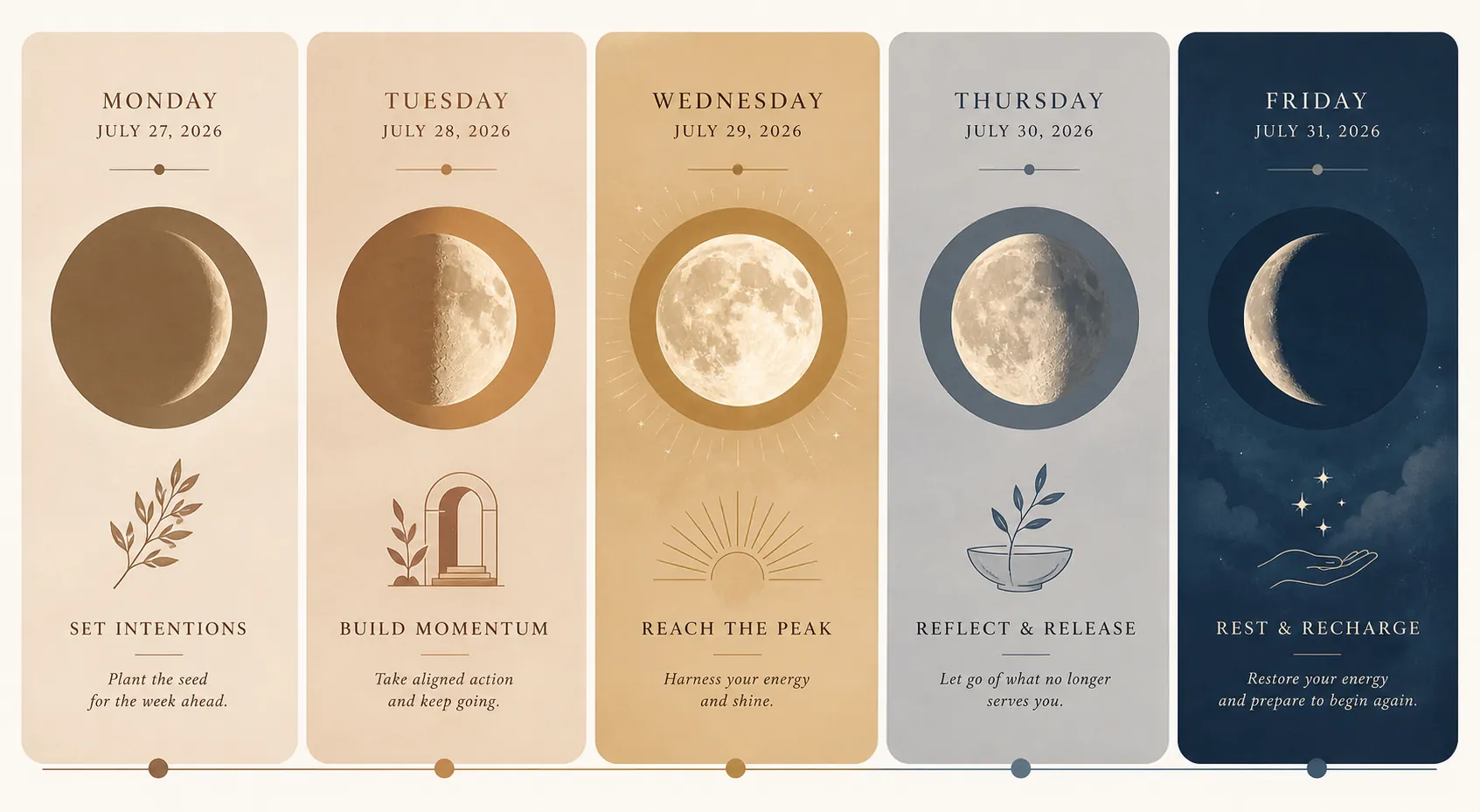
| Date | Moon-window task | What changes tonight |
|---|---|---|
| July 27 | Dim the evening early | Lower indoor light and keep wake time fixed |
| July 28 | Protect the bedroom | Blackout, cool the room, and remove late-night decisions |
| July 29 | Contain the ritual | Moon-gaze briefly, then return to a low-stimulation wind-down |
| July 30 | Hold the rise time | Do not repay a rough night by sleeping in for hours |
| July 31 | Read the pattern | Separate heat, light, timing, and rumination before drawing conclusions |
July 27: dim the evening before you feel affected
July 27 is not a dramatic night on the calendar, which is exactly why it matters. If sleep disruption can peak several nights before the full moon, this is the night to stop treating light as an afterthought.[4] Keep the evening visually quiet: lower overhead lights after dinner, avoid bright task lighting near the face, and make the last hour before bed boring enough that your nervous system does not have to sort through a dozen signals.
This does not require pretending screens do not matter or turning the house into a retreat center. It means choosing the least stimulating version of the evening you can reasonably keep. If you need a device, reduce brightness and content intensity. If you can move one task to daylight, move it. If you normally check whether the moon is visible right before bed, check earlier instead.
Hold your morning rise time steady on July 28, even if July 27 is imperfect. CBT-I uses consistent rise time and stimulus control because the wake-up anchor helps rebuild sleep pressure for the next night; Let’s Talk Menopause describes CBT-I as the gold-standard treatment for insomnia in this life stage.[5] That does not mean forcing yourself through dangerous sleepiness. It means not letting one poor night expand into a drifting, irregular sleep schedule.
July 28: make the bedroom less available to moonlight and heat
On July 28, protect the sleep environment before bedtime. Close blackout curtains before the room fills with evening light. If curtains are not available, use a sleep mask and reduce reflective light from mirrors, pale surfaces, or uncovered windows. This is not because moonlight has been proven to be the single cause of full-moon sleep disruption. It is because light is one modifiable input in a window when sleep may already be easier to delay.
Cooling belongs in the same category. Perimenopause can make small temperature changes feel much larger at night, especially when a hot flash is followed by alertness instead of a quick return to sleep. Put the fan where air reaches your torso, choose layers you can remove without fully waking, and keep a dry top nearby if sweating tends to keep you awake. These are not luxuries; they reduce the number of decisions required from a tired brain.
If you wake hot, do the smallest effective intervention first. Remove a layer, sip water if needed, adjust airflow, and return to bed when you are cooling. If you are awake long enough to become frustrated, stimulus control is cleaner than bargaining with the pillow: leave the bed for a quiet, dim activity and return when sleepy. The bed should not become the place where you rehearse how unfair this feels.
July 29: keep the Buck Moon ritual contained
The full moon was Wednesday, July 29. If the Buck Moon’s renewal imagery matters to you, give it a place in the evening rather than letting it stretch across the night. A contained ritual might be 5 to 10 minutes outside or at a window earlier in the evening: notice the moon, name one thing you are ready to release, name one thing you are growing into, then come back inside and dim the environment again.
That boundary is the difference between a wind-down ritual and open-ended stimulation. Moon-gazing at 8:30 p.m. with a shawl and a clear ending is different from standing in bright outdoor light, taking photos, texting friends, and checking sleep forums at 11:45 p.m. The symbolism can support sleep when it helps you close the day. It works against sleep when it becomes another source of novelty.
For some readers, the full-moon night is less disruptive than the nights before it. That would fit the Casiraghi timing better than the folk expectation that the full moon itself must be the worst night.[4] If July 29 goes well, do not go looking for a problem. Keep the wake time steady, keep the room cool, and let a good night count.
If you want the deeper mechanism discussion, read Why Perimenopause Makes Full Moon Sleep Disruption Worse. If your main question is how strong the moon-sleep evidence really is, use Does the full moon actually affect perimenopause sleep? as the evidence companion rather than trying to settle the debate at bedtime.
July 30: do not let recovery become schedule drift
The morning after the full moon is where many careful sleepers accidentally lengthen the problem. After a rough night, the temptation is to sleep late, nap long, cancel movement, and start the next evening already worried. A short recovery is humane. A full schedule collapse can make the next night harder.
Keep the rise time close to normal. Get morning light. If you nap, keep it early and modest rather than using the afternoon as a second night. If caffeine is part of your life, do not let a lunar-window experiment become the week you quietly move coffee later and later. The cleaner the day, the easier it is to interpret the night.
This is also the day to be kind without being vague. “I slept badly because I have no discipline” is not data. “I woke hot twice, checked the time, then started thinking about work” is data. The second sentence points to an intervention. The first one only punishes the person who needs help.
July 31: evaluate the pattern without making the moon carry everything
On July 31, look back over the five days with four simple categories: light, heat, timing, and rumination. You are not trying to prove the Buck Moon caused your sleep changes. You are trying to learn which part of the window is worth preparing for next time.
- Light: Were the worst nights also the brightest evenings, latest screen nights, or least protected bedroom nights?
- Heat: Did awakenings begin with warmth, sweating, bedding changes, or a need for airflow?
- Timing: Did sleeping in, late naps, late caffeine, or inconsistent wake time make the next night harder?
- Rumination: Did the moon become a worry cue, or did the ritual help you close the day?
One month of observation is not a diagnosis. A few nights of worse sleep around a full moon can be meaningful without being medically alarming. But if insomnia continues outside the lunar window, if hot flashes are frequent and disruptive, if mood symptoms are escalating, or if sleepiness affects driving or safety, the next step is clinician-guided care rather than another moon-specific protocol. CBT-I, menopause-informed medical care, and evaluation for other sleep disorders are more appropriate when the problem is persistent.
For broader timing, the 2026 Full Moon Calendar can help you mark future windows, and How to Manage Full Moon Sleep Disruption During Aquarius 2026 gives a companion plan for this same July moon. Use those calendars as planning tools, not verdicts on your body.
The Buck Moon does not have to be treated as magic or nonsense. For perimenopause, its value may be simpler: it gives a name to a short, predictable stretch when sleep can be more fragile, and it invites preparation instead of self-blame. After July 31, the most useful question is not “Was it the moon?” It is “Which part of my sleep system needed support, and did I give it that support early enough?”
References
- Full moon calendar 2026: When to see the next full moon, Space.com
- What Is the Buck Moon?, Mental Floss
- Buck Moon Spiritual Meaning, California Psychics
- Moonstruck sleep: Synchronization of human sleep with the moon cycle under field conditions, Science Advances, 2021
- Sleep and Menopause, Let’s Talk Menopause
- Sleep Continuity Disruption in the Menopause Transition: The Study of Women’s Health Across the Nation, The Journal of Clinical Endocrinology & Metabolism, 2022
- Melatonin, sleep and menopause, Climacteric, 2016
- Perimenopause and Sleep: How Hormonal Changes Affect Your Circadian Rhythm, TārāMD
Safety & eligibility read
Cross-check against other interventionsExplore the mechanism
Next step
Spot an error or have clinical feedback?
Because this article covers clinical, medication, or safety information, we use a moderated correction channel instead of open public comments. Let us know if something about “A 5-Day Buck Moon Sleep Protocol for Perimenopause” needs a closer look.
Send feedback on this article