
How perimenopause rewrites your beauty sleep routine
Learn why perimenopause causes skin and sleep to decline together, and how to build a nighttime routine that treats both as a single system rather than separate problems.
In perimenopause, a beauty sleep nighttime skincare routine cannot really begin at the bathroom sink. It begins with the thing many women notice first: the same stretch of life brings drier, thinner, more reactive skin and the new habit of waking at 3 AM feeling hot, alert, or strangely unable to settle back down.
That pairing matters. Perimenopause commonly begins 2–8 years before the final menstrual period, so these changes can arrive while periods are still happening and while “menopause” still feels like something off in the distance.[1] Treating the skin change as a product problem and the sleep change as a discipline problem misses the more useful explanation: the hormonal conditions for both overnight skin repair and sleep continuity are shifting at the same time.
The skin side is not imaginary: estrogen helps keep skin structurally resilient
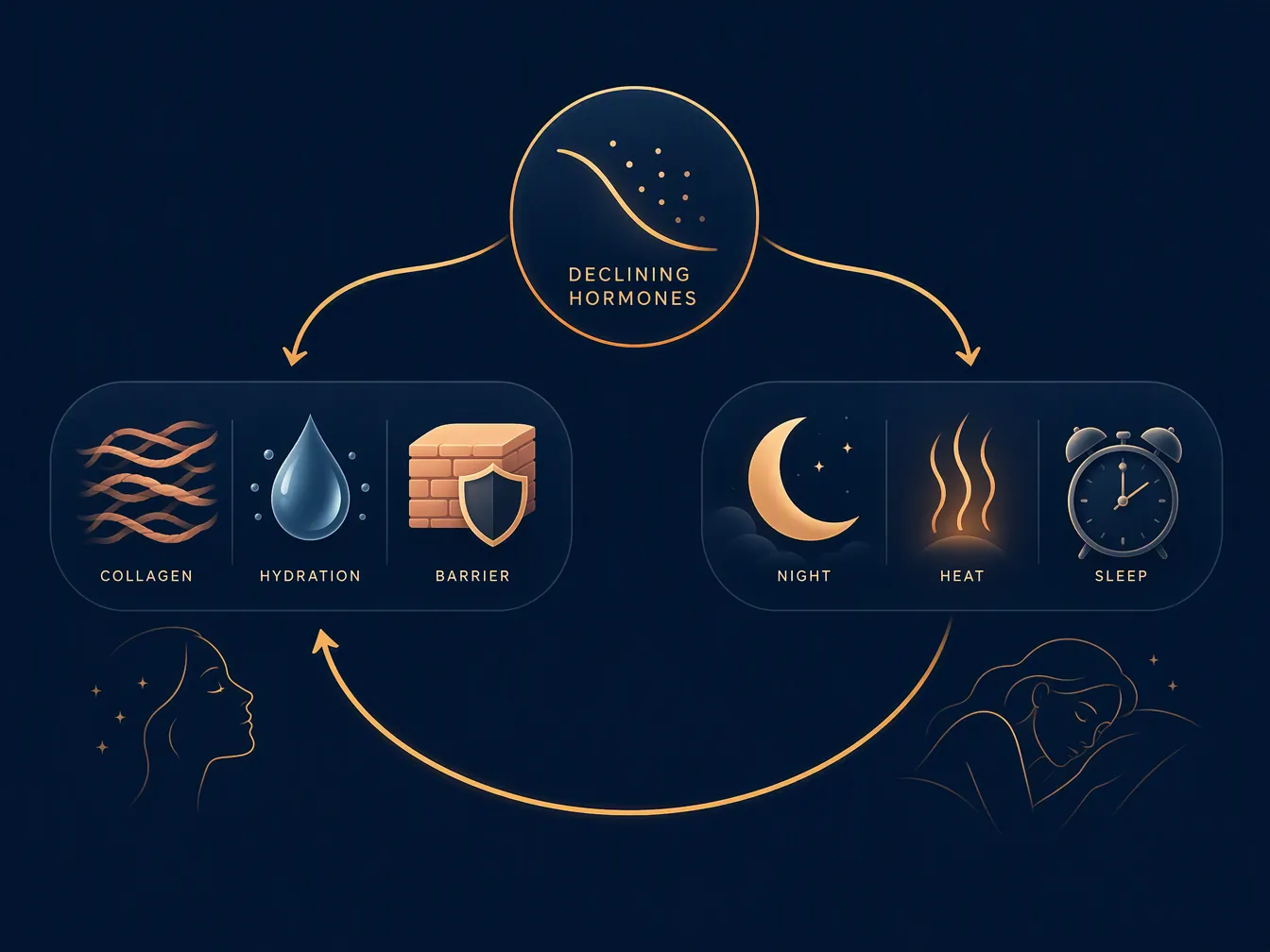
Skin does not suddenly become vain in midlife. It becomes hormonally different. Estrogen is involved in collagen content, elasticity, hydration, sebum production, and barrier function; as estrogen declines across the menopause transition, skin tends to become drier, thinner, less elastic, and more easily irritated.[1]
The collagen numbers give this complaint some deserved weight. The American Academy of Dermatology tells patients that skin loses about 30% of its collagen during the first five years of menopause, followed by roughly 2% collagen loss per year for the next 20 years.[2] That trajectory is postmenopausal, not a neat stopwatch for every perimenopausal woman, but it explains why the years around the final menstrual period can feel less like ordinary “dry skin season” and more like a structural change.
Barrier changes are part of that story. When estrogen support falls, skin may hold water less effectively and produce less sebum. A routine that used to tolerate exfoliating acids, retinoids, fragranced products, or long hot showers may start protesting. The face that feels tight after washing, stings under familiar products, or looks creased in the morning is not necessarily “aging badly.” It may be working with less hormonal support for the same repair job.
The sleep side is the same transition showing up through a different system
The sleep disruption of perimenopause is often described too politely. “Trouble sleeping” can mean repeated awakenings, night sweats, waking before dawn, feeling tired but wired, or needing hours to come down after a hot flash. Stanford Lifestyle Medicine summarizes the menopause literature by noting that an estimated 40–60% of perimenopausal and menopausal women report sleep difficulties.[3]
The mechanism is not just that sweat wakes you up. Johns Hopkins Medicine notes that many women wake just before a hot flash, suggesting the brain change that triggers the flash can disturb sleep before the heat is even fully felt.[4] That point is small but clarifying: the awakening is not merely poor bedding, poor willpower, or a bedroom that is one degree too warm. It is a thermoregulation event occurring inside a nervous system whose hormonal signaling has become less stable.

Estrogen appears to influence thermoregulation, while progesterone has sleep-promoting effects; a 2025 narrative review of sleep disturbance and perimenopause describes hormonal changes, vasomotor symptoms, and melatonin changes as contributors to sleep disruption during this life stage.[5] That helps explain why a woman can do many standard sleep-hygiene things correctly and still have nights that fracture around heat, arousal, and early-morning alertness.
The bedroom environment still matters. It just belongs inside the mechanism, not outside it. If hot flashes and a narrowed comfort zone are part of the problem, then cooling is not a lifestyle flourish; it is an attempt to reduce one of the triggers that keeps breaking sleep. For a deeper look at the microclimate question, see whether cooler weather improves perimenopause sleep. If you are comparing tools, recovery devices for perimenopause sleep are most useful when judged by whether they reduce heat-driven awakenings, not whether they sound futuristic.
Poor sleep then becomes a second hit to the skin
The hormonal shift can directly make skin more vulnerable. Fragmented sleep can then make the repair environment worse. This is where “beauty sleep” becomes more than a phrase on a jar.
The best concrete bridge is a small observational study by Oyetakin-White and colleagues. In 60 healthy Caucasian women, researchers compared good and poor sleepers using the Pittsburgh Sleep Quality Index, assessed intrinsic skin aging with SCINEXA, and measured barrier recovery after tape stripping. Good sleepers had significantly lower intrinsic-aging scores and showed about 30% greater barrier recovery at 72 hours than poor sleepers.[6]
That 30% number is memorable, but it should not be stretched past what it can prove. The study was observational, small, PSQI-based, not perimenopause-specific, and limited to healthy Caucasian women.[6] It does not prove that improving sleep will reverse perimenopausal skin changes. It does, however, support the more careful and more useful claim: poorer sleep quality is associated with worse skin-aging measures and slower barrier recovery in that sample.
A 2025 review also links sleep deprivation with reduced collagen production, worse hydration, and increased transepidermal water loss, although its collagen-supplementation conclusions are not a perimenopause-specific skincare answer.[7] The sleep-skin connection is biologically plausible because skin follows circadian patterns: barrier function, permeability, water loss, and repair-related processes vary across the day and night.[8][9]
This is the part many routines skip. A serum can be well chosen and still be asked to perform on skin that spent the night overheated, cortisol-primed, and repeatedly awakened. The product is not useless. It is simply operating in a repair window that has been interrupted.
What a perimenopause beauty-sleep routine should prioritize
The practical translation is not a longer shelf of products. It is a hierarchy: reduce the awakenings that keep breaking repair time, protect the barrier that has become easier to irritate, and keep the circadian cues steady enough that the body can recognize night as night.
| Priority | What it means at night | Why it matters in perimenopause |
|---|---|---|
| Lower heat pressure | Use a cooler sleep setup, breathable layers, and cooling tools only if they actually reduce awakenings. | Vasomotor instability can wake the brain before or during a hot flash. |
| Protect the barrier | Keep cleansing gentle, moisturize reliably, and pause aggressive actives when skin is stinging or unusually reactive. | Lower estrogen support can leave skin drier, thinner, and less tolerant. |
| Anchor circadian timing | Keep wake time, light exposure, and wind-down cues as regular as possible. | Skin and sleep both follow circadian patterns; irregularity can make nights more fragile. |
| Treat tools as support, not substitutes | Use supplements, devices, and skincare extras only after the basic skin-sleep system is addressed. | A product cannot fully compensate for repeated heat-driven or breathing-related awakenings. |
Start with the awakenings, especially heat-driven ones
If the night repeatedly breaks at 2 or 3 AM, the routine has to include the bed, room, clothing, and evening triggers. That may mean lighter layers, a cooler room, a fan, a temperature-regulating mattress pad, fewer heat-retaining fabrics, or avoiding the personal triggers that reliably precede night sweats. The point is not to chase a perfect sleep environment. It is to reduce the number of times the brain is pulled out of sleep.
This is also where exercise can belong, though not as a late-night punishment for being awake. A consistent strength program may support midlife sleep as part of a broader non-pharmacological approach; if you want a practical version, the 12-week weight training routine for perimenopause sleep is a better place to put that effort than a 3 AM spiral.
Make the skincare routine calmer, not more theatrical
Reactive perimenopausal skin often needs less drama. A reasonable night routine can be as plain as gentle cleansing, a moisturizer that supports the barrier, and selective use of active ingredients only when the skin is tolerating them. If a retinoid, exfoliating acid, vitamin C product, or fragranced formula starts causing persistent burning or flaking, the answer is not automatically to add another corrective product on top. The first move is usually to reduce irritation and rebuild tolerance.
There is still room for pleasure here. A simple routine can give an anxious, overtired person a sense of control at the edge of a night she cannot fully control. That emotional steadiness is not trivial. It just should not be confused with evidence that a product can replace sleep continuity, estrogen-related skin support, or medical care when symptoms are persistent.
Keep circadian cues boringly consistent
Regular wake time, morning light, dimmer evenings, and a predictable wind-down are not glamorous instructions. They are ways of reinforcing the timing system that sleep and skin both use. In perimenopause, when thermoregulation and arousal are easier to disturb, regular cues do not guarantee a perfect night. They reduce avoidable noise in an already noisy system.
The same restraint applies to sleep trackers and recovery scores. A device can reveal patterns, especially around awakenings and temperature, but it can also make a fragile sleeper more vigilant. Use data when it changes a decision: room temperature, alcohol timing, exercise timing, bedding, or a clinician conversation. Do not let it become another blue-lit judge at midnight.
What not to expect from collagen products or “beauty sleep” claims
Collagen loss is real, but that does not make every collagen-adjacent product a perimenopause solution. The 2025 review on sleep quality and oral collagen supplementation discusses sleep deprivation, skin function, and collagen supplementation, but its supplementation conclusions mostly concern women in their third and fourth decade, so it should not be treated as proof that collagen supplements solve perimenopausal skin changes.[7]
The safer use of that review is narrower: sleep quality appears relevant to skin function, and perimenopause makes sleep harder for physiological reasons. If a nighttime skincare routine ignores repeated awakenings, hot flashes, and non-restorative sleep, it is leaving out one of the conditions under which skin repair happens.
Midlife sleep disruption also matters beyond the mirror. If you want the wider health context, see how poor midlife sleep may affect women’s heart disease risk. Skin may be the visible clue, but it is not the only system listening to broken sleep.
The honest boundary
The perimenopause-specific evidence base is thinner than the skincare market makes it sound. Reviews of menopausal skin changes note the role of estrogen and the visible changes many women experience, but few studies analyze skin outcomes specifically by menopausal status in a way that answers every practical routine question.[1] The strongest skin-sleep bridge here, the Oyetakin-White study, is observational rather than causal.[6]
Still, the physiology points in a useful direction. In perimenopause, “beauty sleep” is a two-way repair system: hormones influence skin and sleep, and broken sleep can further weaken the conditions for skin recovery. A routine that layers products while ignoring repeated awakenings is incomplete.
Persistent irritation, sudden or dramatic skin changes, non-healing lesions, or symptoms that worry you deserve a dermatologist’s attention. Snoring, gasping, repeated non-restorative sleep, severe daytime sleepiness, or sleep disruption that continues despite reasonable changes should be discussed with a sleep specialist or an appropriate clinician. Not every fragile night is a diagnosis, but not every midlife symptom should be filed under “just hormones,” either.
References
- Managing Menopausal Skin Changes... Actual Role of HRT. PMC. 2025.
- Caring for your skin in menopause. American Academy of Dermatology.
- How Perimenopause Affects Sleep. Stanford Lifestyle Medicine.
- How Does Menopause Affect My Sleep?. Johns Hopkins Medicine.
- Sleep Disturbance and Perimenopause: A Narrative Review. PubMed. 2025.
- Does poor sleep quality affect skin ageing?. Clin Exp Dermatol. 2015.
- Can good sleep quality enhance the benefits of oral collagen supplementation in the prevention of skin aging?. PubMed. 2025.
- Circadian Rhythm and the Skin. JCAD. 2019.
- Time-dependent variations of the skin barrier function in humans. PubMed.
Safety & eligibility read
Cross-check against other interventionsExplore the mechanism
Next step
Spot an error or have clinical feedback?
Because this article covers clinical, medication, or safety information, we use a moderated correction channel instead of open public comments. Let us know if something about “How perimenopause rewrites your beauty sleep routine” needs a closer look.
Send feedback on this article