
What permanent daylight saving time means for perimenopause sleep
Permanent DST would lock in dark mornings and late-evening light—the exact signals that push circadian clocks later—at a life stage when blunted melatonin, narrowed thermoregulation, and peak insomnia rates leave perimenopausal women with the least reserve to absorb that shift. This guide bridges the legislative news to the mechanism-to-population evidence, with named reviewer, evidence tiers, and last-reviewed date.
As of Aug. 1, 2026, permanent daylight saving time is still a proposal, not federal law. The House passed H.R. 139, the Sunshine Protection Act, on July 14, 2026, by a 308–117 vote; the Senate has not voted, and state exemption paths would still matter if the bill advances. For sleep, the legal wording matters less than the light pattern it would lock in: darker mornings and brighter evenings, all year. [1]
That is the central sleep issue for perimenopause: not the inconvenience of changing clocks twice a year, but the possibility of living permanently on a clock that withholds morning light and extends evening light. Under permanent DST, winter sunrise would move to about 8:17–8:20 a.m. in New York and about 9:06 a.m. in Indianapolis; the same policy would also push more daylight into the evening. [2]
Last reviewed: Aug. 1, 2026. Evidence level for the main judgment: strong circadian-mechanism consensus, moderate observational evidence on daylight saving time and sleep burden, limited but relevant intervention evidence in peri- and postmenopausal women, and no direct trial of permanent DST in perimenopausal women.
| Question | What the evidence can support |
|---|---|
| Would permanent DST make winter mornings darker and evenings brighter? | Yes. That is the direct clock effect, with later civil sunrise and sunset times. [1][2] |
| Does morning light advance the circadian clock, while evening light delays it? | Yes. This is the consensus mechanism behind sleep-medicine opposition to permanent DST. [3][4] |
| Has permanent DST been directly tested in perimenopausal women? | No. Claims about this group are a synthesis across clock biology, DST evidence, and menopause sleep physiology, not a measured pDST effect size. [5] |
| Is perimenopause a high-risk sleep window? | Yes. Insomnia, wake-after-sleep-onset, early waking, vasomotor symptoms, and circadian changes cluster in this life stage. [6][7] |
The sleep problem is the direction of the light
The circadian system uses light as a timing signal. Morning light tends to shift the body clock earlier. Evening light tends to shift it later. Permanent DST would take the same social obligations—alarms, commutes, school drop-offs, work meetings—and place them against a later solar day.
That is why the American Academy of Sleep Medicine argues for permanent standard time, not permanent DST, and notes that daylight saving time can produce sunrises after 8 a.m. for months in many places. The AASM position is aligned with a broader sleep-and-circadian-medicine concern: morning darkness weakens the signal that helps entrain the clock, while evening light arrives when the brain should be preparing for biological night. [3][4]
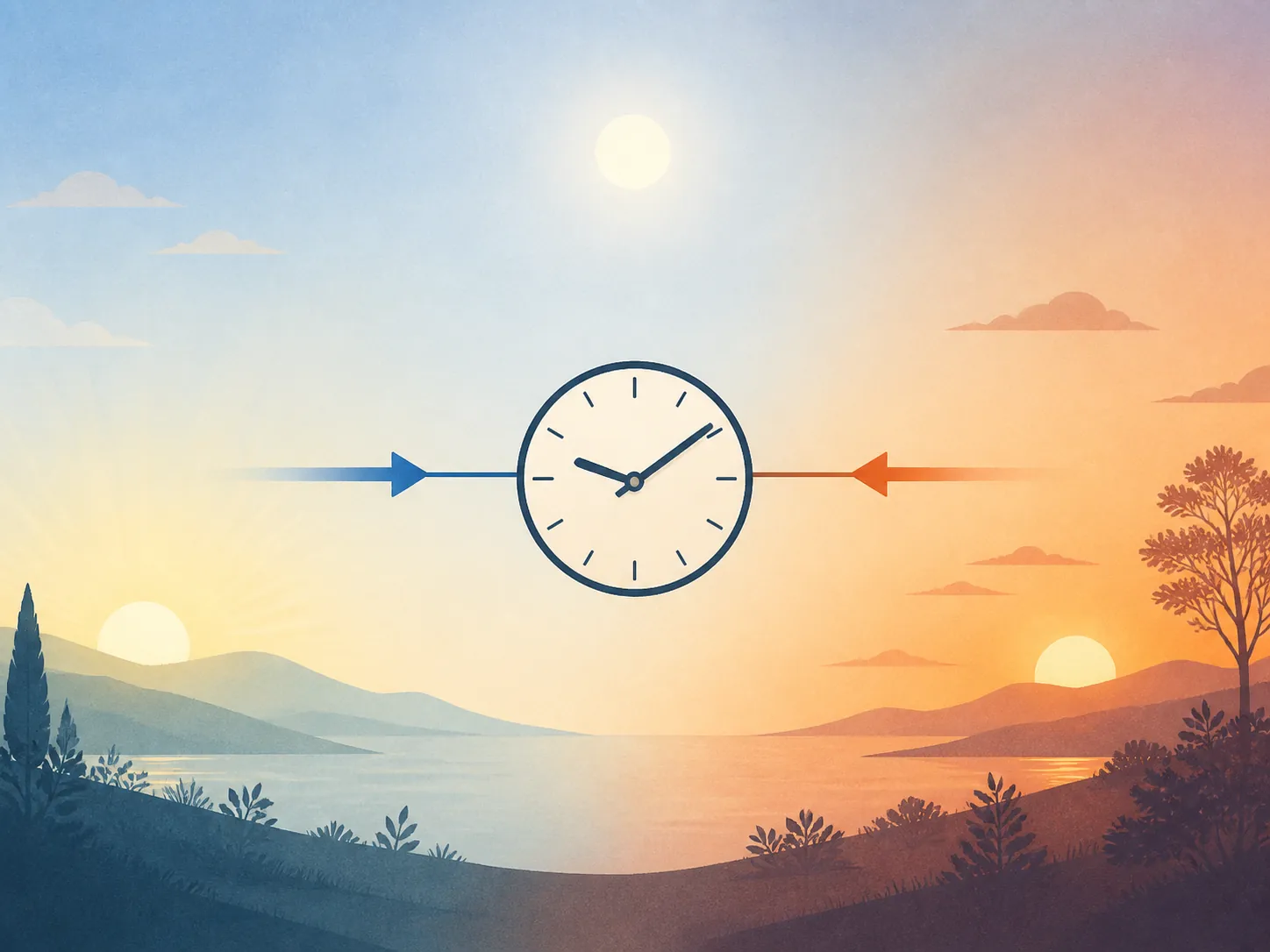
The late sunset is the selling point, and it is not imaginary. More usable evening light can make winter feel less pinched, especially for people trying to walk, exercise, run errands, or get children outside after work. But the circadian system does not score daylight by how cheerful it feels. It responds to timing. A bright evening can be pleasant and still be the wrong signal for sleep.
The common reassurance—that everyone adjusts after a few days—does not match the sleep-medicine concern. Position statements on daylight saving time describe incomplete adaptation to DST and continued misalignment when civil time is shifted later relative to solar time. [3][4]
Why perimenopause has less reserve for a later clock
Perimenopause is often discussed as if sleep disruption were a side note to hot flashes. It is more consequential than that. Harvard’s Apple Women’s Health Study update reported that 31% to 42% of perimenopausal women experience insomnia during any one-year interval, with maintenance insomnia and early-morning waking prominent in the transition; wake-after-sleep-onset also rises more steeply approaching menopause than would be expected from aging alone. [6]
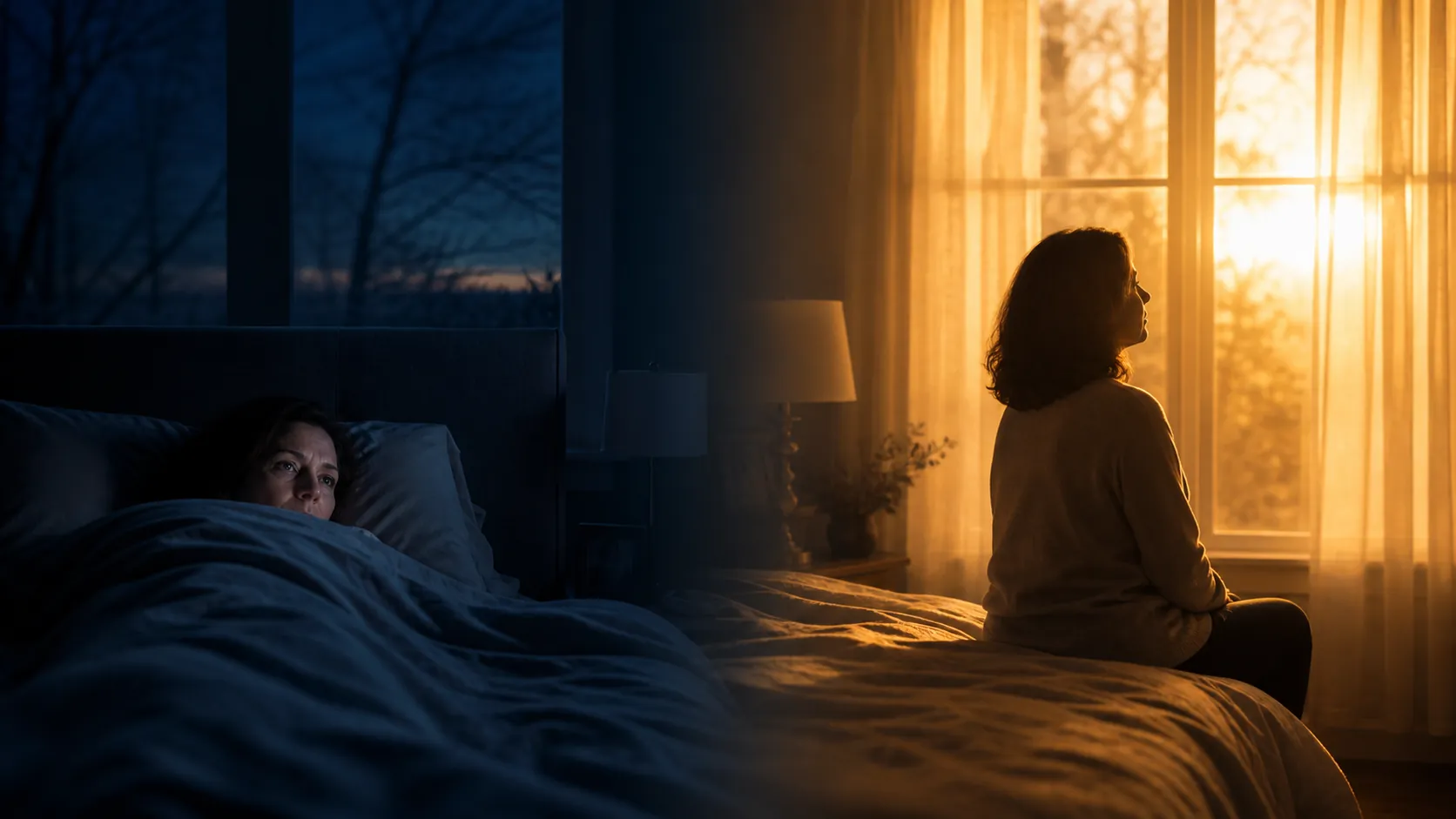
This matters because permanent DST would not be adding a sleep challenge to a neutral baseline. It would be adding it to a period when many women are already waking after sleep onset, waking too early, sweating through sleep, or trying to function after a fragmented night that no one else in the house sees.
Circadian signaling also appears to change across the menopausal transition. Reviews and newer menopause-focused work describe lower or blunted melatonin secretion, altered timing of melatonin rhythms, and links among ovarian hormone changes, circadian regulation, mood, temperature control, and sleep continuity. [7][8]
A useful bridge comes from a pilot randomized trial in peri- and postmenopausal women with depression symptoms. A phase-advancing sleep-and-morning-light intervention advanced melatonin offset by about 2 hours and 15 minutes and was associated with mood improvement of about 70%. That does not prove permanent DST would worsen perimenopausal sleep. It does show that, in this population, phase-advancing light timing can move a biological rhythm in a clinically meaningful direction. [9]
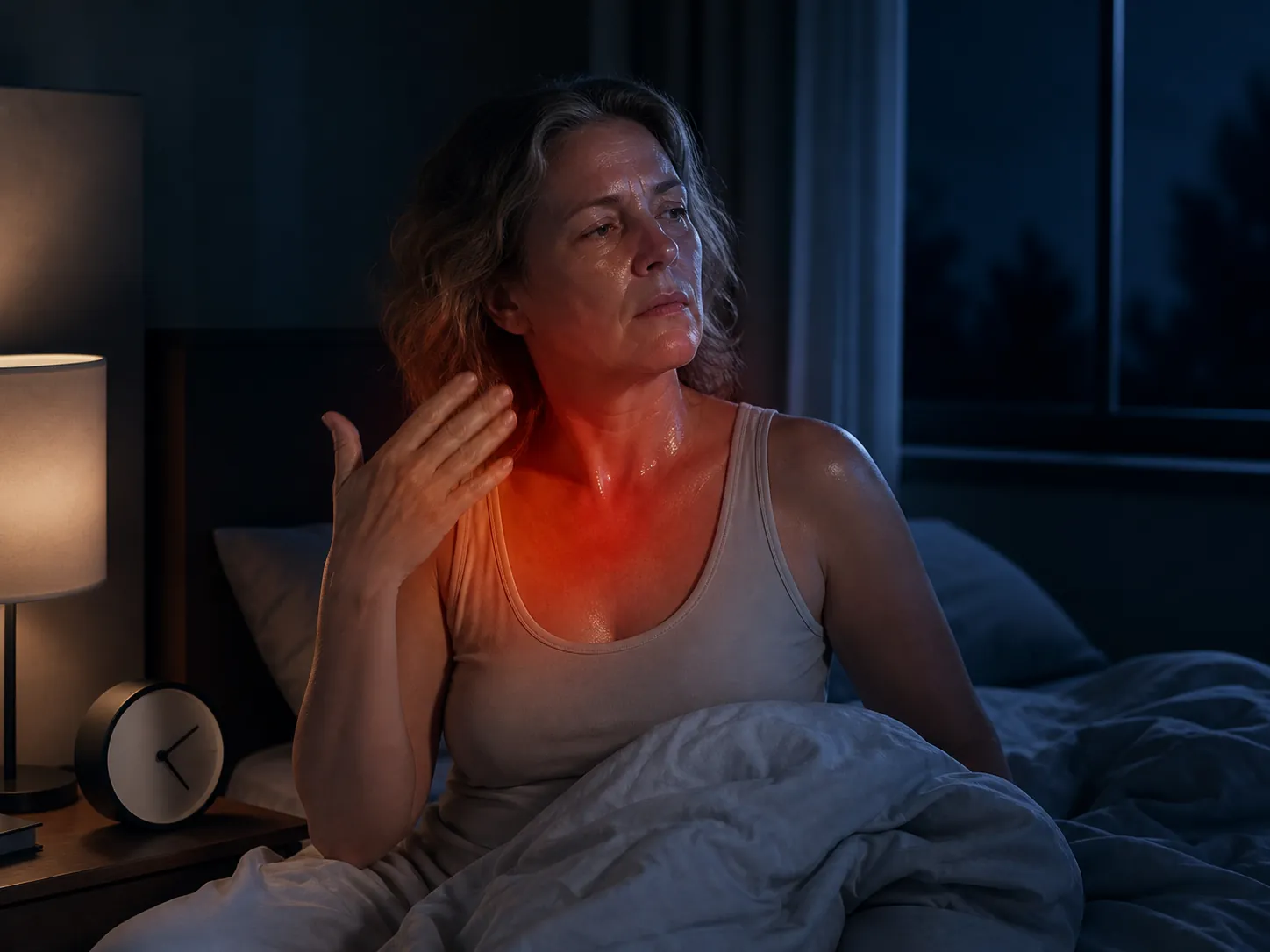
Thermoregulation adds another layer. During the menopausal transition, the body’s comfortable temperature range narrows, and vasomotor symptoms can trigger awakenings that are hard to recover from. A dark winter morning after a hot-flash wake-up is not just unpleasant; it removes one of the strongest environmental cues for pulling the clock earlier again. [7][8]
The compounding effect: later signals on an already-fragile night
A perimenopausal sleep problem often has more than one driver. A woman may fall asleep later because evening light and stress keep her alert, wake at 2:30 a.m. with heat or sweating, wake again at 4:40 a.m. with a racing mind, and then have to be functional before sunrise. Permanent DST would not create every part of that chain. It would make the environmental timing less forgiving.
The morning signal matters most after a bad night. Bright outdoor light in the early part of the day helps anchor the next sleep period. Under permanent DST, winter morning light arrives later by the clock, which means the person who has to wake at the same civil time may spend more of the biologically important morning window in darkness or weak indoor light.
The evening signal moves the other way. Later daylight can make it easier to stay active, social, and visually stimulated at the exact time when a perimenopausal circadian system may already have a weaker melatonin signal and a narrower temperature buffer. The result is not a simple “DST causes menopause insomnia” claim. It is a mismatch: the policy would remove the light cue that helps advance the clock and preserve the cue that delays it.
What the transition studies can and cannot tell us
DST transition studies are useful, but they are not the same as a permanent-DST study. The spring shift captures an acute clock change; permanent DST would be a chronic light-timing condition. Krishnan and Johnson’s review in the Journal of Clinical Sleep Medicine warns against using transition studies as a direct substitute for permanent-DST outcomes. [5]
Still, transition evidence gives a clue about unequal burden. A 2025 UK Biobank accelerometer study of 11,780 adults ages 43 to 78 found sex-specific differences after DST transitions: women slept less on weekdays after spring transitions, while men gained sleep. The authors noted that the female sample likely included many peri- and postmenopausal women, but the study did not isolate perimenopause and did not test permanent DST. [10]
That distinction is not academic hair-splitting. If a woman in perimenopause already has early waking, hot flashes, and a delayed or blunted melatonin rhythm, the question is not whether she loses a single hour on one March weekend. The question is whether the year-round clock keeps nudging her biology later while her life keeps requiring an early start.
The policy history is cautionary, not decisive
The United States has tried year-round daylight saving time before, including in 1974, and Russia used a version of permanent DST from 2011 to 2014. These are often invoked as proof that the policy is either intolerable or workable, depending on the argument being made. They are better treated as cautionary context: real-world clock changes produce public reaction, safety concerns, and adaptation problems, but those episodes do not provide a clean measurement of perimenopausal sleep. [4]
Modeling can widen the lens without answering the perimenopause question directly. Stanford Medicine’s county-level modeling estimated that permanent standard time would prevent about 300,000 strokes and 2.6 million cases of obesity, while permanent DST would capture roughly two-thirds of that modeled benefit. The model used an idealized 10 p.m. to 7 a.m. sleep schedule, assumed people spend less than 5% of the day outside, and identified a roughly 15% morning-lark exception in which permanent DST could fit some people better. [11]
That exception should be acknowledged, not inflated. Some people genuinely feel better with later light. But the sleep-health policy question is population timing, and the perimenopausal reader with fragile sleep is not well served by a clock that makes morning light harder to obtain.
A fair bottom line for perimenopause sleep
No study has measured the exact effect of permanent daylight saving time on perimenopausal sleep. There is no credible number for “how many minutes” a 49-year-old with night sweats would lose, or how much more often she would wake, under a national pDST law.
But the direction of concern is clear. Permanent DST would preserve the light pattern sleep-medicine groups object to: delayed morning light and extended evening light. Perimenopause is a life stage with high insomnia prevalence, more wake-after-sleep-onset, altered melatonin signaling, and thermoregulatory vulnerability. The honest conclusion is not that pDST has been proven to harm perimenopausal women in a direct trial. It is that the mechanism, population burden, and sleep-medicine consensus point strongly against pDST for this group.
Permanent standard time is the sleep-health-aligned policy because it puts more light where the circadian system needs it most: earlier in the day. For a perimenopausal woman already doing recovery work after broken sleep, that alignment is not a lifestyle preference. It is biological support.
What you can do while the policy question is unsettled
Individual routines cannot fully cancel a population-level clock mismatch. They can, however, protect the strongest sleep signals you still control.
- Make morning light the priority. Get outdoor light as early as your schedule and safety allow. If sunrise is still far away, keep the first part of the day bright indoors and seek stronger outdoor light once it is available. For more on the general clock-policy issue, see our overview of permanent DST and sleep-health risks.
- Treat evening light as a sleep input, not just ambiance. Dim the house earlier, reduce bright screens close to bed, and be aware that late outdoor light can delay sleep even when it feels emotionally restorative. If the clocks change, this DST sleep-adjustment guide walks through re-entrainment basics.
- Take night heat seriously. Cooling the bedroom, adjusting bedding layers, and treating vasomotor symptoms are not cosmetic fixes when hot flashes are breaking sleep. The thermoregulation problem is part of the sleep problem; this guide to August heat and perimenopause sleep goes deeper on that lever.
- Do not write off worsening sleep as “just hormones.” Persistent insomnia, early waking, or repeated wake-after-sleep-onset in midlife deserves clinical attention, especially because midlife sleep problems can connect to longer-term cardiometabolic risk. Start with our guide to midlife sleep and heart disease risk in women.
- Be cautious with melatonin. It is sold over the counter in the U.S., but timing, interactions, medical conditions, and other medications matter. If you are considering it—especially if you take anticoagulants, antidepressants, anti-inflammatory medications, or other regular prescriptions—discuss it with a clinician rather than treating it as a clock-policy workaround.
If permanent DST becomes law, the burden will not be distributed evenly. The people who most need a strong morning anchor—shift workers, teens, people with insomnia, and many women in perimenopause—will be asked to compensate hardest. For the broader unequal-burden question, see our permanent daylight saving time FAQ.
References
- H.R. 139, 119th Congress, Congress.gov.
- Darker Mornings, Brighter Evenings: What Permanent Daylight Saving Time Would Look Like Across the U.S., Time, July 15, 2026.
- Permanent standard time is the optimal choice for health and safety, American Academy of Sleep Medicine.
- Daylight saving time: an American Academy of Sleep Medicine position statement, Journal of Clinical Sleep Medicine, 2020.
- Debunking myths about daylight saving time: ten things sleep medicine practitioners should know, Journal of Clinical Sleep Medicine, 2023.
- Sleep Patterns and Changes in Perimenopause, Apple Women’s Health Study, Harvard T.H. Chan School of Public Health, May 2026.
- Sleep, Melatonin, and the Menopausal Transition: What Are the Links?, 2017.
- Malhan et al., npj Women’s Health, 2025, npj Women’s Health, 2025.
- Phase-advancing sleep and morning light treatment in perimenopausal and postmenopausal women, Menopause, 2023.
- Sleep duration and timing changes after daylight saving time transitions: a UK Biobank accelerometer study, Journal of Sleep Research, 2025.
- Daylight saving time year-round would improve health, but standard time year-round would be even better, Stanford Medicine, September 2025.
Safety & eligibility read
Cross-check against other interventionsExplore the mechanism
Next step
Spot an error or have clinical feedback?
Because this article covers clinical, medication, or safety information, we use a moderated correction channel instead of open public comments. Let us know if something about “What permanent daylight saving time means for perimenopause sleep” needs a closer look.
Send feedback on this article