
Why Insomnia and Depression Spike in Perimenopause
Perimenopause creates a biological vulnerability where declining hormones disrupt sleep and mood through shared pathways. Learn why treating both conditions together—with approaches like CBT-I—works better than addressing each separately.
The unnerving part is not only that sleep gets worse. It is that the bad nights often arrive with a new emotional weather: waking at 3 a.m., crying more easily, feeling wired but exhausted, snapping at people you love, then wondering whether this is depression, stress, perimenopause, or some personal failure of resilience.
For many women, those complaints are not separate stories. Depression and insomnia in women become especially intertwined during the menopausal transition, when sleep disturbance, anxiety, irritability, and low mood can rise together. A 2025 report on a systematic review and meta-analysis of 102 studies involving 1.14 million women described depression, anxiety, and insomnia as affecting nearly 1 in 3 women across the perimenopausal and postmenopausal transition worldwide; it reported insomnia prevalence of 27% in perimenopause and 42% in postmenopause, and depressive symptom prevalence of 32% in perimenopause and 30% in postmenopause.[1] Those figures are useful for scale, though the original General Hospital Psychiatry paper should be checked directly before treating the reported percentages as final clinical reference points.

The more clinically useful point is narrower than “menopause is hard.” Perimenopause is a vulnerability window. The Study of Women’s Health Across the Nation, often referred to as SWAN, found that the adjusted odds of sleep disturbance were 29% higher in perimenopausal women than in premenopausal women, and that follicle-stimulating hormone and progesterone metabolite levels were independently associated with difficulty sleeping.[2] That matters because it moves the conversation away from age alone, or stress alone, and toward a body whose sleep-regulating and mood-regulating systems are being pushed at the same time.
Why the symptoms travel together
Hot flashes and night sweats are the most visible bridge. A woman may not describe herself as having “insomnia” at first. She may say she wakes drenched, throws off the covers, waits for her heart to settle, gets chilled, then starts calculating how little sleep is left before the alarm. Menopause-related vasomotor symptoms are widely recognized as a cause of sleep disruption, and they can turn sleep into a series of recoveries rather than a single restorative stretch.[4]
That repeated fragmentation is not emotionally neutral. A few bad nights may produce ordinary tiredness; persistent fragmented sleep changes the conditions under which emotion is regulated. The brain has less room for flexible thinking. The body carries more physiological arousal into the next evening. Bed becomes a place where the nervous system rehearses threat: Will I wake sweating again? Will I fall apart tomorrow? Will this ever stop?
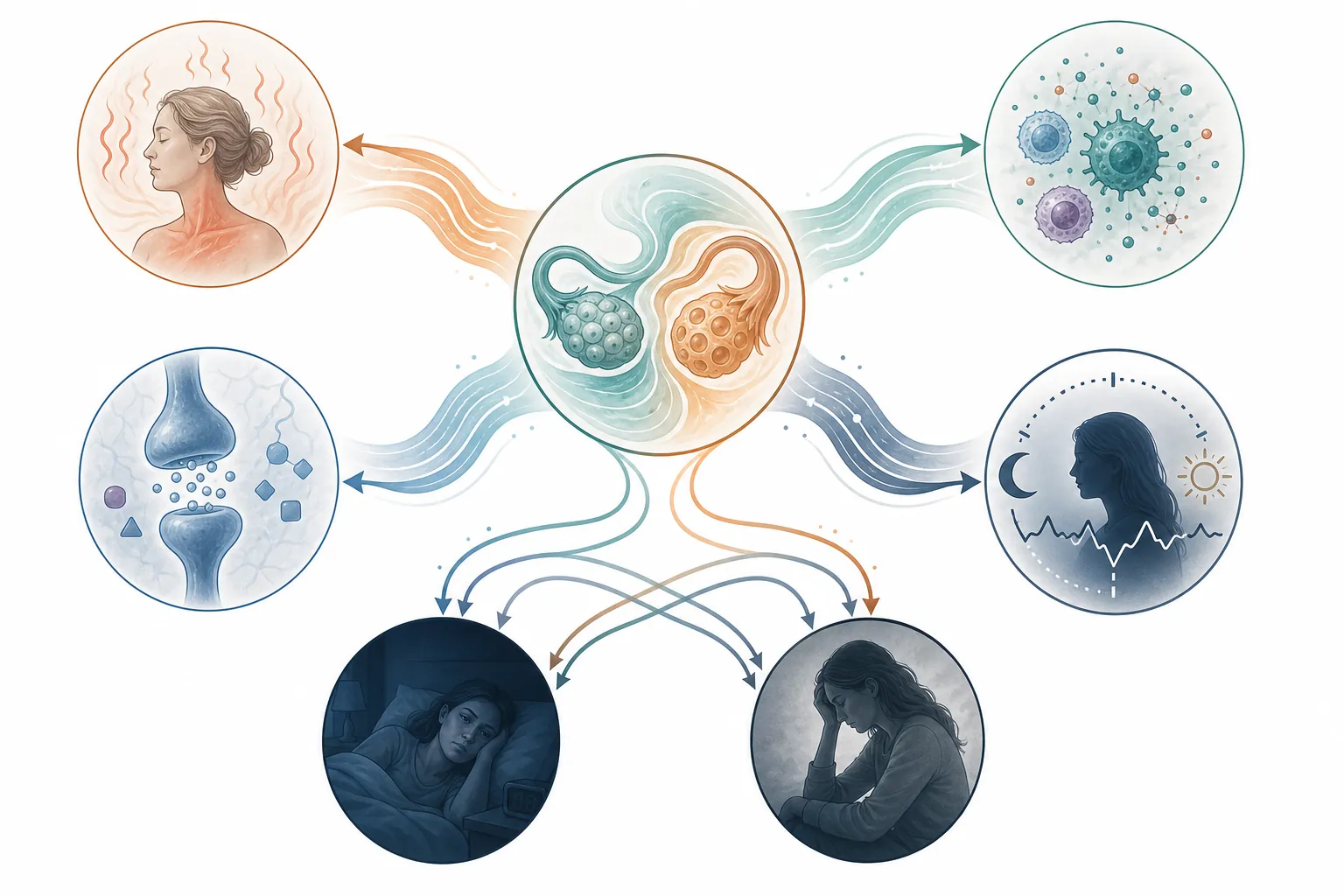
Estrogen and progesterone fluctuations help explain why the same woman may feel both physically overheated and emotionally less buffered. These hormones interact with thermoregulation, sleep architecture, neurotransmitter systems, and circadian timing. Follicle-stimulating hormone rises as ovarian function changes, while progesterone metabolites that may influence sleep shift across the transition. None of this means every mood change is “just hormones.” It means hormones are part of the operating environment in which stress, grief, work pressure, pain, caregiving, diet, alcohol, medications, and medical conditions are all being processed.
The shared pathways are not imaginary
The sleep-mood cluster becomes easier to understand when the pathways are kept concrete.
| Pathway | What changes during the transition | How it can show up |
|---|---|---|
| Thermoregulation | Vasomotor symptoms interrupt sleep with heat, sweating, and rebound chills. | Frequent awakenings, dread of bedtime, lighter sleep. |
| Inflammation | Sleep loss can activate inflammatory signaling, with some evidence of stronger cellular inflammatory responses in women. | Fatigue that feels bodily, low mood, poorer stress tolerance. |
| Monoamine signaling | Hormone fluctuation interacts with serotonin, norepinephrine, and dopamine systems involved in mood and arousal. | Irritability, anxiety, low motivation, emotional reactivity. |
| Circadian timing | Irregular wake times, night awakenings, light exposure, and shifting body signals weaken rhythm stability. | Early-morning waking, “tired but wired” evenings, mood dips. |
Inflammation is one reason persistent insomnia can feel so different from simple sleep deprivation. A review of depression and sleep disturbance describes inflammatory pathways, including interleukin-6 and C-reactive protein, as part of the biological link between disrupted sleep and depression.[5] The same review also describes sleep disturbance and depression as bidirectional rather than one-way: insomnia can be a symptom of depression, but it can also predict, generate, or maintain depressive illness.[5]
That distinction changes the clinical posture. If a woman is newly depressed and sleeping badly in perimenopause, it is not always enough to say, “Treat the depression and sleep will follow.” Sometimes the insomnia has become one of the mechanisms keeping the mood problem alive. The night after night experience of being awake, hot, alert, and self-monitoring can train the brain into conditioned arousal. By the time she gets to a clinician, the original trigger may matter less than the loop that now maintains itself.
Why sleep hygiene is too small for this problem
A cooler room, less evening alcohol, morning light, and steadier wake times can help. They are also not a full treatment plan for a woman who is waking with night sweats, panicking about the next day, and losing confidence in her own body’s predictability. Generic sleep hygiene often assumes the sleeper has a stable biological night and merely needs better habits around it. Perimenopause can make the biological night unstable.
This is where cognitive behavioral therapy for insomnia, or CBT-I, deserves more than a polite mention. CBT-I is not “try harder to relax.” It targets the sleep-mood loop directly: conditioned arousal, time awake in bed, irregular sleep timing, catastrophic thinking about sleep, and behaviors that make short-term sense but keep insomnia going. Reviews of insomnia across women’s life stages describe CBT-I as effective for insomnia in midlife and menopause-related contexts, while the broader depression-sleep literature describes insomnia treatment as capable of improving depressive symptoms and maladaptive thinking.[3][5]
For a perimenopausal woman, that may mean the treatment target is not only “get more sleep.” It may be: reduce the amount of time spent awake and alarmed in bed, rebuild a stronger circadian anchor, stop extending the sleep window in ways that dilute sleep drive, and make nighttime awakenings less likely to become emotional events. For a deeper walk-through of how CBT-I can be adapted when heat is part of the problem, see Heat Dome Night Sweats? Why CBT-I Helps Perimenopause Sleep.
Hormones may be part of care, but they are not the whole map
Hormone therapy can be appropriate for some women, especially when vasomotor symptoms are prominent and the individual risk-benefit profile supports it. But it should not be sold as a uniformly reliable insomnia-depression treatment. Sleep can improve when night sweats improve, yet insomnia may persist if conditioned arousal, anxiety, circadian disruption, pain, alcohol timing, or depression itself has become part of the pattern. The National Council on Aging notes that menopause-related sleep problems can involve hot flashes, mood changes, sleep apnea, and other overlapping contributors rather than a single cause.[4]
The same caution applies in the other direction. Antidepressants, anti-anxiety medications, hormone therapy, and nonhormonal medications for vasomotor symptoms may all have a role in the right patient. The mistake is not using medication. The mistake is treating the mood complaint, the sleep complaint, and the hormone conversation as if they belong in separate rooms with no shared chart.
What should be ruled out before everything is blamed on perimenopause
A hormone-sensitive explanation should still leave room for differential diagnosis. Thyroid problems can mimic or worsen sleep disruption, palpitations, temperature sensitivity, anxiety, fatigue, and mood change. If symptoms feel disproportionate, unusually abrupt, or accompanied by other thyroid clues, it is reasonable to ask about evaluation rather than assuming perimenopause explains the whole picture. For that overlap, How to Tell If Subpotent Thyroid or Perimenopause Is Ruining Your Sleep goes deeper.
Obstructive sleep apnea also deserves a firm place on the boundary. Risk rises after menopause, and women may not present with the classic picture of loud snoring plus obvious daytime sleepiness. Some present with insomnia, awakenings, fatigue, mood symptoms, morning headaches, or a sense that sleep is never restorative. Menopause-related sleep guidance increasingly includes sleep apnea among the conditions that can complicate midlife sleep, and missing it can keep both insomnia and mood symptoms from improving.[4]
Life context still matters. Grief, caregiving, job strain, inflammation-related metabolic changes, alcohol, meal timing, and irregular schedules can all intensify the same loop. That does not make the problem “only stress.” It means the care plan should be honest about both biology and context. Readers looking at adjacent contributors may find it useful to explore grief and insomnia during perimenopause, food choices for sleep and memory in menopause, or time-restricted eating and menopause brain function without turning every dinner, bedtime, and mood dip into a self-blame assignment.
Treat the loop, not just the loudest symptom
The most useful next step is often an integrated one: assess the insomnia pattern and the mood pattern together. That means asking when the sleep change began, whether awakenings are linked to heat or panic, how much time is spent awake in bed, whether wake times have drifted, whether depressive symptoms are persistent or episodic, and whether anxiety or irritability is concentrated after bad nights or present even after better ones.
A clinician-guided plan might combine CBT-I, treatment for hot flashes or night sweats, mood-focused therapy, medication when appropriate, circadian stabilization, and screening for apnea or thyroid disease. It does not have to choose between “it’s hormones” and “it’s mental health.” In perimenopause, that split is often the least accurate part of the story.
A woman in perimenopause who develops insomnia plus low mood, anxiety, or irritability is not dealing with two random failures. She is dealing with a loop that can be evaluated, named, and treated with more precision than “try to sleep more” or “maybe you’re just stressed.” The care should match the cluster: sleep, mood, hormones, and red flags reviewed together, not handed back to her as separate projects.
References
- High Prevalence for Depression, Anxiety, and Insomnia in Women With Menopause — Systematic Review and Meta-Analysis — Psychiatry Advisor.
- Depression and Menopause — SWAN Study of Women’s Health Across the Nation — SWAN.
- Sleep health challenges among women: insomnia across the lifespan — Frontiers in Sleep, 2024.
- Menopause and Sleep: What Every Woman Should Know — NCOA.
- Depression in sleep disturbance: A review on a bidirectional relationship, mechanisms and treatment — PMC J Cell Mol Med, 2019.
Explore the mechanism
Next step
Spot an error or have clinical feedback?
Because this article covers clinical, medication, or safety information, we use a moderated correction channel instead of open public comments. Let us know if something about “Why Insomnia and Depression Spike in Perimenopause” needs a closer look.
Send feedback on this article