
The hardest dementia sleep problems at end of life are often the ones that seem to contradict each other. A person may sleep through breakfast, lunch, and most of the afternoon, then become frightened or impossible to settle after dark. To the caregiver standing in the hallway at 3 a.m., it can look like one problem: sleep is broken.
It may be two different patterns happening close together. One is progressive, peaceful sleep as the body withdraws. The other is nighttime agitation that can signal distress. They ask for opposite responses.
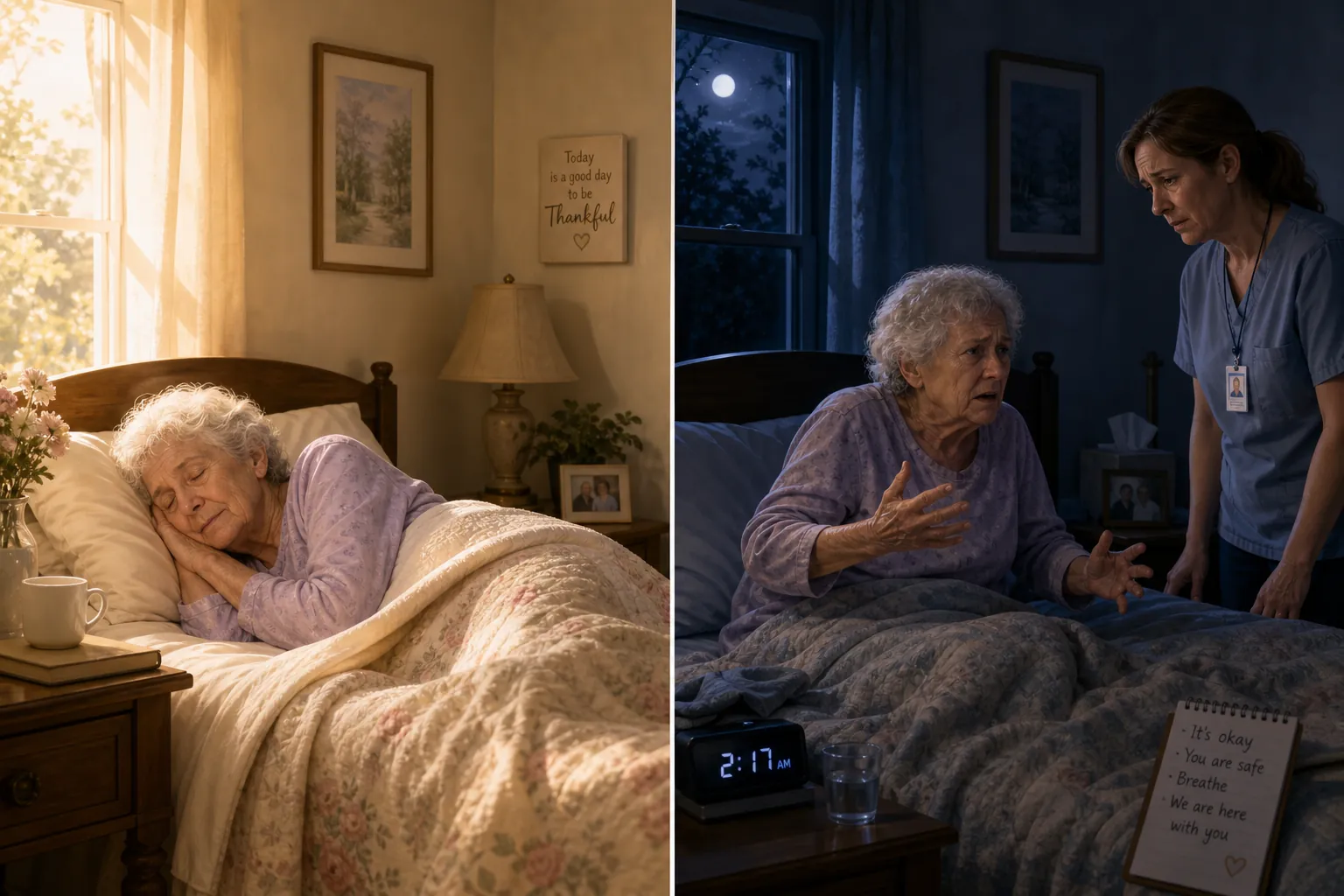
For clarity, this article uses two descriptive terms: terminal hypersomnia and terminal restlessness. They are not formal diagnostic labels. They are bedside patterns that help families decide whether to let sleep continue, look for pain or fear, or call hospice for help tonight.
First, Separate Peaceful Sleep From Distressed Wakefulness
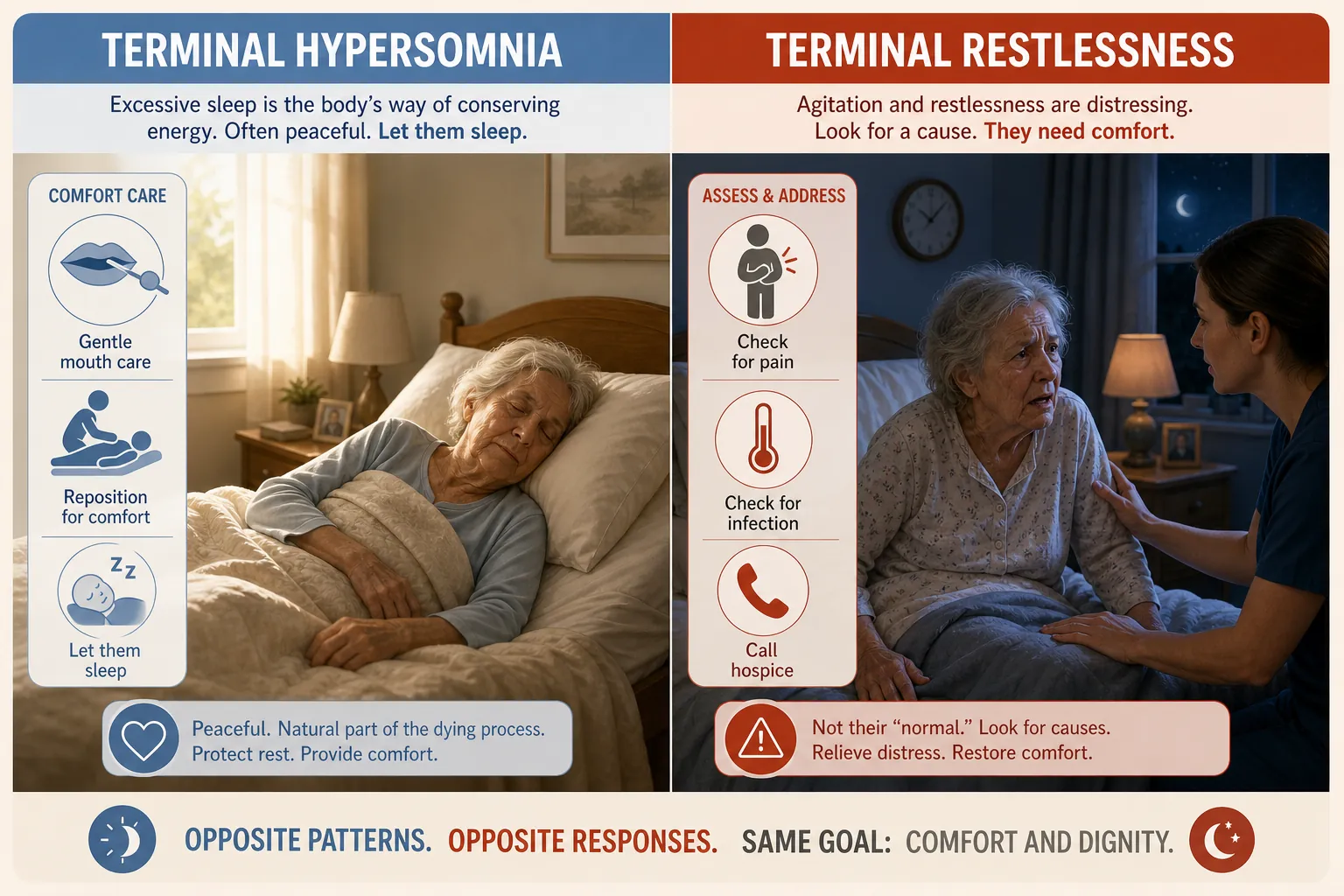
Terminal hypersomnia looks like a gradual increase in sleep. The person dozes more, wakes less fully, eats and drinks less, and may seem comfortable when left undisturbed. The caregiver’s task is not to restore a normal schedule. It is to protect comfort.
Terminal restlessness looks different. The person may call out, pull at clothing or bedding, resist lying down, appear afraid, become more confused as evening comes, or cycle through brief unsettled periods without seeming rested. The Alzheimer’s Association describes sundowning as increased confusion, restlessness, and agitation from dusk through night, with possible contributors including exhaustion, low lighting, and disruption of the internal body clock.[1]
The distinction matters because waking a peacefully dying person can add burden, while explaining away agitation as “just dementia” can miss treatable distress.
| What you are seeing | Likely pattern | First response |
|---|---|---|
| More daytime sleep over days or weeks, calm face, relaxed body, harder to wake but not distressed | Terminal hypersomnia | Let them sleep; focus on mouth care, gentle repositioning, skin comfort, and a quiet room |
| Calling out, fear, resistance to lying down, trembling, grimacing, sudden night waking, or agitation after dusk | Terminal restlessness or sundowning | Look for pain, fear, infection, medication effects, or other distress; call hospice if symptoms persist or escalate |
| A sudden change from the person’s recent baseline | Possible reversible problem on top of advanced dementia | Ask hospice or a clinician what should be checked, especially if there are urinary, fever, pain, or delirium signs |
When More Sleep Is Part of the Dying Process
Hospice educator Barbara Karnes describes a common dying pattern in which, about two to four months before death from disease, a person begins taking an afternoon nap, then gradually sleeps more until sleep occupies most or all of the day.[2] That timeline should be treated as experienced hospice observation, not as a controlled-study rule. Some people move faster, some slower, and dementia often makes exact timing harder to read.
Still, the pattern is familiar at the bedside: the person is not simply “sleeping in.” They may be losing the energy to remain awake, to process stimulation, and to participate in the small tasks that once anchored the day. Families often respond by trying to keep them up: opening curtains, turning on television, encouraging visitors, offering food, asking questions, trying to make the day feel normal.
There is love in that impulse. There can also be harm. A late-stage dementia patient who is peacefully sleeping may not benefit from being repeatedly pulled back into noise, swallowing demands, or conversation they can no longer organize. If the face is relaxed, breathing is not labored, the body is not tense, and the sleepiness has been gradual within an overall decline, comfort care is usually the more protective response.
Comfort care can be very active without being stimulating. It may mean moistening the mouth, applying lip balm, turning the person gently on a schedule recommended by hospice, smoothing bedding away from fragile skin, checking briefs, reducing background noise, and allowing familiar voices without expecting answers. The goal is not to make the person alert. The goal is to make sleep safe and easy.
This is the part that can feel emotionally wrong to families. Letting someone sleep may feel like giving up. In hospice dementia care, it can be the opposite: a decision not to fight the body’s withdrawal when the sleep is peaceful.
Why Nighttime Agitation Deserves a Different Level of Attention
Restlessness at night should not be filed away as a sleep schedule problem too quickly. In late-stage dementia, the person may no longer be able to say, “My hip hurts,” “I’m scared,” “I need to urinate,” or “I feel burning.” The distress comes out through movement, sound, resistance, facial tension, or a night that suddenly no one can get through.
The Alzheimer’s Association notes that signs of pain in late-stage dementia can include anxiety, agitation, trembling, shouting, and sleeping problems.[3] That does not mean every restless night is pain. It means agitation has to be given the respect of an assessment, especially when the person cannot explain it.
Sundowning can add another layer. As evening comes, low lighting may make shadows confusing, fatigue may lower the person’s ability to cope, and a disrupted body clock may leave them awake when the house is trying to sleep.[1] A caregiver may see pacing, calling out, repeated attempts to get up, suspicion, crying, or a refusal to stay in bed. The room may be quiet, but the person’s body is not.
Broad dementia sleep data can reassure families that they are not imagining how common this is, but it should not flatten the end-of-life decision. Mayo Clinic reports that sleep troubles affect up to 25% of people with mild to moderate Alzheimer’s disease and about 50% of those with moderate to severe Alzheimer’s disease.[4] A 2024 ScienceDirect report notes sleep disturbances in 46% to 64% of dementia patients and says that, in end-stage dementia, patients spend about 40% of nighttime awake and a significant part of daytime sleeping.[5] Those figures describe populations; they do not tell you whether the person in front of you is comfortable tonight.
What to Notice Before You Call
You do not need to diagnose the cause of restlessness before asking for help. You do need to notice enough that hospice or a clinician can respond well.
- What changed: more calling out, new fear, more attempts to get up, less sleep, grimacing, guarding, breathing changes, or refusal of care.
- When it changed: gradually over many nights, abruptly tonight, mostly after dusk, after a medication change, after a fall, or after a long day of visitors.
- What the body shows: clenched jaw, tight hands, moaning with movement, pulling away during care, sweating, trembling, feverish warmth, new odor, or pain with repositioning.
- What helped or worsened it: soft light versus deep shadows, a calm voice, toileting, repositioning, pain medicine already ordered by hospice, touch, music, or removing stimulation.
A sudden deterioration in sleep or behavior deserves special caution. Three Oaks Hospice describes urinary tract infections as a common reversible cause of sudden sleep deterioration in end-stage dementia.[6] Not every restless night is a UTI, but abrupt change should not be dismissed without asking what might be treatable.
What To Do Tonight
If the person is sleeping most of the day and appears peaceful, keep the room calm. Do not force wakefulness for the sake of a normal schedule. Offer care in small, gentle pieces: mouth care, repositioning, brief hygiene, skin checks, and quiet presence. If they wake enough to take sips or accept comfort, follow the plan hospice has given you. If they do not, do not turn every sleep period into a struggle.
If the person is restless, frightened, calling out, or repeatedly trying to get up, lower the room’s demands before adding more stimulation. Use soft, even lighting rather than darkness with sharp shadows. Reduce television noise and overlapping voices. Approach from the front. Say who you are. Use fewer words. Offer toileting, repositioning, warmth, or a familiar object. Watch the face and body while you move them; pain often announces itself during care.
Then call hospice if the restlessness is new, escalating, unsafe, or not settling with ordinary comfort measures. Call sooner if there are signs of pain, fever, urinary symptoms, breathing distress, repeated attempts to climb out of bed, or agitation after a medication change. Hospice can help decide whether the plan needs pain treatment, anxiety medication, medication adjustment, infection evaluation, or another symptom-management step.
This is also where over-the-counter sleep thinking can mislead families. General dementia sleep resources discuss approaches such as routine changes, light exposure, and in some cases medications or supplements, but end-of-life agitation is not the same problem as ordinary insomnia.[7] Before adding melatonin, sedating antihistamines, or any sleep aid, ask the hospice team or prescribing clinician. The question is not only, “Will this make them sleep?” It is, “What distress are we treating, and what could this medication worsen?”
The Caregiver’s Exhaustion Is Real, But It Should Not Blur the Assessment
A caregiver who has been woken for the fourth time in one night is not failing because they feel desperate. Penn LDI reported in 2022 that family home hospice caregivers struggle with sleep, a burden that affects their own health and ability to provide care.[8] If that is happening, it deserves attention too; long-term sleep loss changes mood, judgment, reaction time, and the body’s stress load. For a deeper look at that toll, see what caregiver sleep deprivation does to your body and mind.
But in the moment of decision, the person with dementia is the one least able to explain what is wrong. That is why the first question is not whether the night is inconvenient, even though it is. The first question is whether the person appears peacefully withdrawn or distressed.
The Decision To Hold Onto
When sleep increases gradually, the body is declining, and the person looks comfortable, let the sleep continue and shift your energy toward comfort care. When wakefulness comes with agitation, fear, calling out, sudden change, or possible pain, treat it as distress until hospice or a clinician helps you sort it out.
The same person can show both patterns in the same week. That is why dementia sleep problems at end of life cannot be answered with one rule. Peaceful sleep may need protection. Restlessness needs attention.
References
- What is Sundowning? Causes & Coping Strategies. Alzheimer’s Association.
- Sleep Is a Sign of the Dying Process. BK Books.
- Late-Stage Caregiving. Alzheimer’s Association.
- Alzheimer's: Managing sleep problems. Mayo Clinic, Oct 2024.
- Sleep disturbance prevalence in dementia. ScienceDirect, 2024.
- 10 Signs Death is Near Dementia. Three Oaks Hospice, 2025.
- Treatments for Sleep Changes. Alzheimer’s Association.
- Family Home Hospice Caregivers Struggle with Sleep. Penn LDI, 2022.




Comments
Join the discussion with an anonymous comment.