Does the Full Moon Affect Sleep and Meteor Visibility?
Short answer: yes, the full moon can affect sleep, but the signal is modest for most people — think minutes, not a ruined week. And no, the moon should not ruin the 2026 Perseid meteor shower. The Perseids peak overnight Aug. 12–13, 2026, right on a new moon, with the American Meteor Society listing 0% moon illumination and “optimum” conditions for that peak window.[1] The real sleep cost is not moonlight. It is choosing to be outside after midnight.
Last reviewed: Aug. 1, 2026. The 2026 sky-calendar details in this article should be refreshed annually, because meteor-shower peaks and moon timing are date-specific.
The August 2026 calendar answers most of the question
The useful thing about August 2026 is that the sleep question and the meteor question separate cleanly on the calendar. The full moon that might matter for sleep is not sitting on top of the Perseid peak.
| Date | Sky event | Why it matters for sleep and visibility |
|---|---|---|
| July 29, 2026 | Buck Moon | The full moon before the main August meteor planning window.[2][3] |
| Aug. 12, 2026, 17:37 UTC | New moon | The sky is moon-dark for the Perseid peak night, not full-moon bright.[2] |
| Overnight Aug. 12–13, 2026 | Perseid peak | The shower is active July 17–Aug. 24 and peaks with 0% moon illumination, which AMS describes as optimum.[1] |
| Aug. 28, 2026 | Sturgeon Moon | The August full moon arrives about two weeks after the Perseid peak.[2][3] |
That gap matters because the lunar-sleep pattern reported in field research is strongest before the full moon, especially in the 3–5 nights leading into it, rather than necessarily on the full-moon night itself.[4] For August 2026, that puts the more plausible Sturgeon Moon sleep-sensitive window in the days before Aug. 28, not on the Perseid peak night.
How much does the full moon affect sleep?
The fairest read is: there is a real lunar sleep signal, but it is small and uneven. In the 2021 field study that tends to anchor this discussion, sleep started later and ran shorter in the nights before the full moon across three Toba/Qom Indigenous communities in Argentina and a comparison group of 464 Seattle-area college students.[4] The authors reported individual variation in sleep duration changes from about 20 minutes to more than 90 minutes, and changes in sleep onset from 30 to 80 minutes.[4]
For ordinary planning, I would not treat “more than 90 minutes” as the expected outcome. A more useful working range is roughly 15–30 minutes less sleep for many people, with the caveat that fragile sleepers can feel a small shift much more sharply than a good sleeper does. Harvard Health’s discussion of the same 2021 research described the pattern as shorter sleep and later bedtimes in the nights before a full moon, with the pre-full-moon timing again being the point to notice.[5]
The older Basel lab finding is intriguing because it did not depend on people sleeping under actual moonlight. In a retrospective analysis of 33 healthy adults sleeping in a windowless lab, researchers reported that around the full moon participants took about 5 minutes longer to fall asleep, slept about 20 minutes less, and had about 30% less deep-sleep delta activity on EEG.[6] That is concrete, but it is also a small sample and a re-analysis, so it should not be stretched into a universal rule for every bad night near a full moon.
Evidence tier: observational and emerging. This is not the kind of evidence that lets anyone diagnose “moon insomnia,” and it is not a randomized clinical rule. It is enough to justify planning gently around the full moon if you already know your sleep is breakable.
The likely mechanism is light, not tides
The most plausible explanation is evening moonlight. Light exposure at the wrong biological time can suppress melatonin and shift circadian timing; that pathway is well-established in sleep science, and lunar studies tend to interpret the pre-full-moon effect through that lens.[4][7][8] That also explains why the timing is interesting: in the nights before the full moon, the moon is already bright in the evening, when many people are still awake and able to receive that light exposure.
Gravity and tides make for dramatic copy, but they are not the explanation to build a bedtime around. The moon’s pull moves oceans; that does not mean it is tugging a person into lighter sleep in a clinically useful way. If you are trying to protect sleep, the actionable variable is light exposure and bedtime timing, not lunar gravity.
Will the moon block the 2026 Perseids?
No. This is the rare August when the calendar is genuinely kind. The American Meteor Society lists the 2026 Perseids as active from July 17 to Aug. 24, with the peak overnight Aug. 12–13 and 0% moon illumination.[1] EarthSky gives the predicted 2026 peak as 14:53 UTC on Aug. 13 and says observers under ideal dark skies may see 90-plus meteors per hour.[9] The Planetary Society gives a more conservative dark-site estimate of 50–75 meteors per hour.[10] Those are attributed ranges, not a guarantee from the sky.
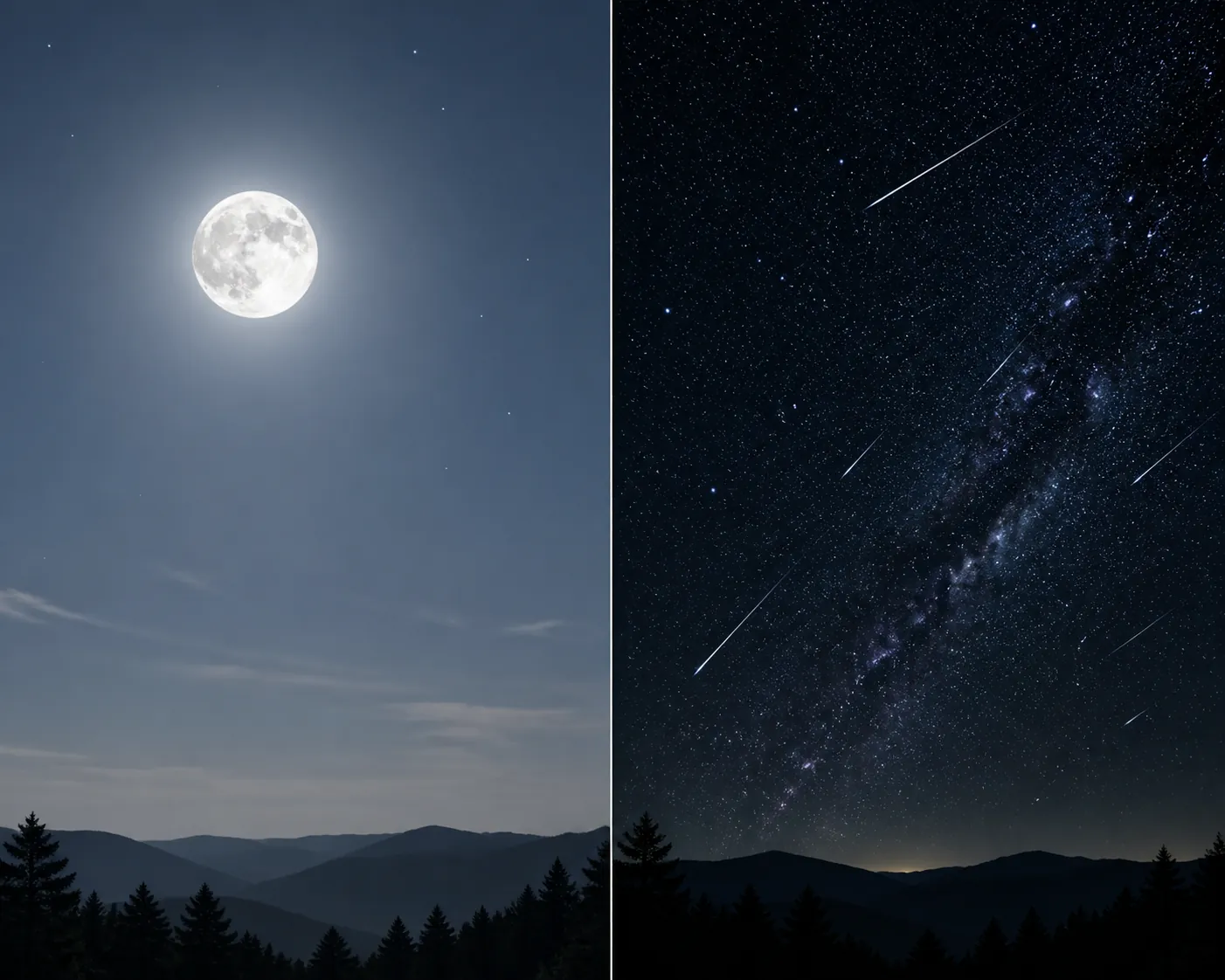
Moonlight usually matters because it brightens the sky background and erases faint meteors. Sky & Telescope has noted that a bright moon can cut visible meteor counts by half or more, although bright Perseid fireballs can still punch through moonlight.[11] That is why the 2026 new moon is not a decorative detail. It removes one of the biggest visibility problems.
There is still no way to make the Perseids a sleep-neutral event. The better viewing window is late night into the pre-dawn hours, which is exactly when many people would otherwise be protecting consolidated sleep. If you are pregnant, perimenopausal with night sweats, managing ADHD, recovering from poor sleep, or just not twenty-two anymore, the new moon is helpful for visibility but it is not a permission slip for an all-nighter.
A bounded plan for Aug. 12–13
For 2026, I would plan around the Perseids as a dark-sky opportunity with a sleep cost, not as a full-moon problem. Pick one window before you leave home. Keep the trip boringly practical: a dark site if you can manage it, phone in pocket, warm layers, and no “we’ll see how late we feel like staying” plan. If you are going to be out well past your usual bedtime, a nap earlier in the day is more useful than pretending tomorrow morning will not notice.
The usual meteor-viewing advice still applies: avoid bright lights, preserve night vision, and use shade or a moon shadow when moonlight is present.[12] In 2026, the moon-shadow part is mostly irrelevant for the Perseid peak because the moon is new; the phone restraint is not. A bright screen can undo the dark adaptation you drove out to get.
- If your main question is whether to stay up, set an alarm, or skip it by chronotype, use the Perseid-specific sleep guide.
- If tonight is near a full moon and your sleep already feels touchy, use the full-moon sleep protocol instead of trying to reason with yourself at 1 a.m.
- If you are comparing sky events and deciding which ones are worth the sleep debt, start with which meteor showers are worth wrecking sleep and how to watch a meteor shower without ruining sleep.
- If the problem is recovery after a late sky event, see the guides to watching a blood moon without ruining sleep and sleep after an eclipse or meteor shower.
- If night sweats are already making sleep unstable, the perimenopause full-moon sleep piece is the more relevant route.
So the August 2026 judgment is simple: do not skip the Perseids because of moonlight. Do not turn the new moon into an all-nighter, either.
References
- Meteor Shower Calendar. American Meteor Society.
- Full Moon Calendar. The Old Farmer’s Almanac.
- Full moon calendar 2026. Royal Museums Greenwich.
- Moonstruck sleep: Synchronization of human sleep with the moon cycle under field conditions. Science Advances. 2021.
- Moonlight may affect sleep cycles. Harvard Health Publishing. 2021.
- Evidence that the Lunar Cycle Influences Human Sleep. Current Biology. 2013.
- Do Moon Phases Affect Sleep?. Sleep Foundation.
- Does the full moon make us sleepless? A neurologist explains the science behind sleep, mood and lunar myths. The Conversation. 2025.
- Everything you need to know: Perseid meteor shower. EarthSky.
- Your guide to meteor showers. The Planetary Society.
- Moon or Not, the Perseid Meteor Shower is On. Sky & Telescope.
- Meteors in moonlight: 6 tips for watching. EarthSky.
Read the full guide: Does the full moon affect sleep during perimenopause?