
The most effective OTC sleep aid is not the one that sounds strongest on the box. It is the one that matches the part of sleep that is actually failing tonight. A person who cannot fall asleep at 11 p.m., a person waking at 3 a.m., and a person trying to sleep after crossing time zones are not shopping for the same problem.
That matters because over-the-counter ingredients work in different ways. Melatonin is a timing signal, not a knockout sedative. Doxylamine and diphenhydramine are sedating antihistamines, which can make you sleepy but can also leave you foggy. Magnesium glycinate and L-theanine are better thought of as low-grogginess wind-down options, not proven insomnia treatments.
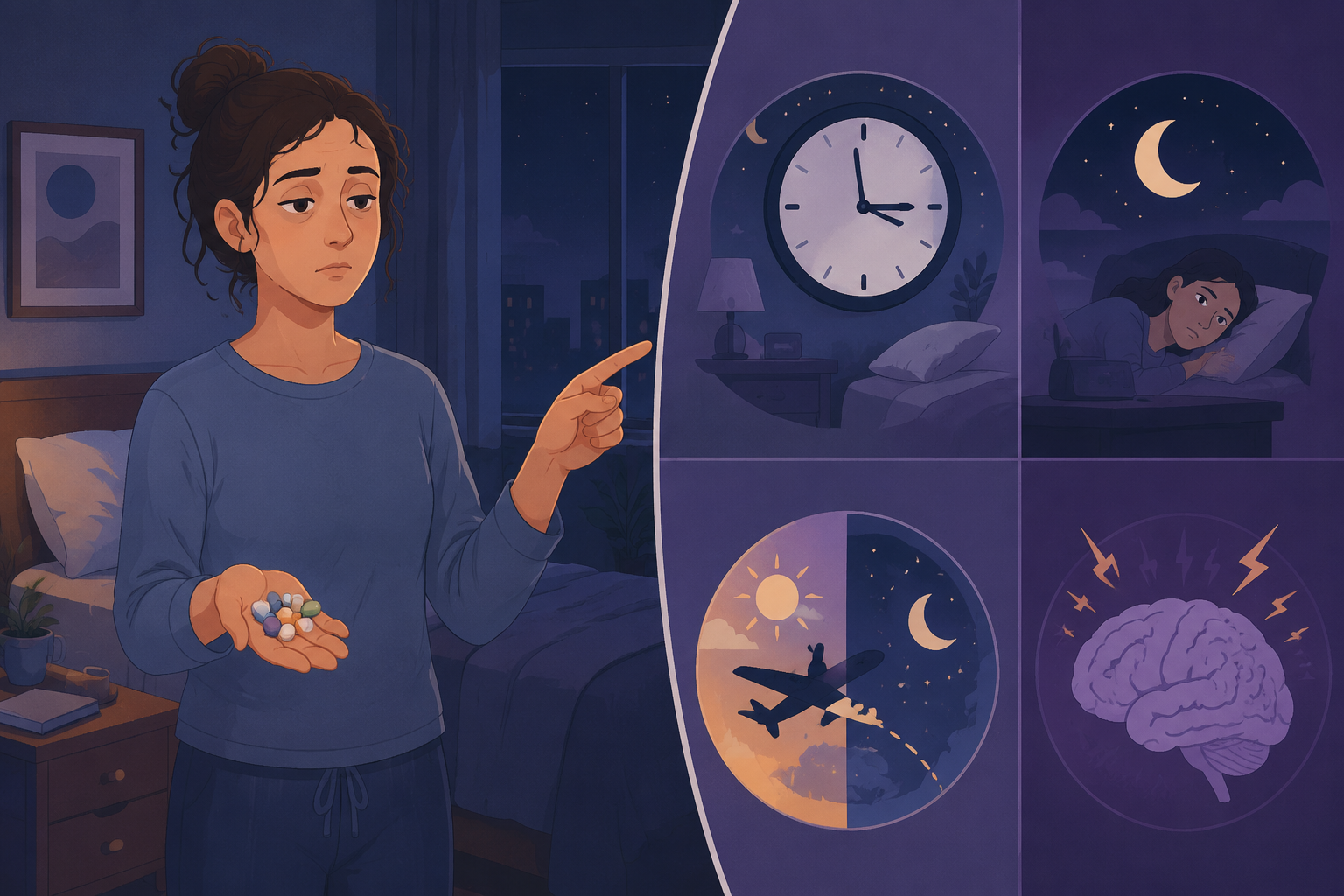
Start With the Sleep Problem, Not the Brand
If you are comparing bottles in a pharmacy aisle, use the complaint as the filter. The evidence is uneven, and different studies measure different outcomes: minutes to fall asleep, total sleep time, sleep quality, or next-day functioning. Those are not interchangeable.
| What is going wrong tonight? | Best-fit OTC ingredient | Why it fits | Evidence strength | Main downside or caution |
|---|---|---|---|---|
| You are lying awake at the start of the night | Melatonin | Best matched to sleep onset and circadian timing; meta-analytic summaries report about 7 minutes faster sleep onset on average | Moderate for sleep onset; effect is modest | Supplement labels may be inaccurate; timing matters more than taking more |
| You wake during the night and need a longer-lasting sedating option | Doxylamine | Longer half-life may cover more of the night | Limited direct insomnia evidence; pharmacology explains the longer duration | Higher next-day grogginess risk, especially in older adults |
| You want a familiar drugstore sedative for occasional use | Diphenhydramine | Sedating antihistamine effect can make some people sleepy | Sparse randomized trial evidence; tolerance can develop after 3 to 4 nights | Next-day impairment, anticholinergic effects, and poor fit for repeated use |
| You are shifted by travel or schedule change | Melatonin | Acts more like a body-clock cue than a general sedative | Useful when the problem is timing rather than anxiety or pain | Wrong timing can be unhelpful; product quality varies |
| You feel keyed up and want a gentle wind-down option | L-theanine or magnesium glycinate | Low-grogginess options that may support relaxation | Limited evidence for sleep disorders | Reasonable expectations matter; not a substitute for treating insomnia, anxiety, or depression |
For a broader decision tree that includes age, medical conditions, and medication conflicts, see How to Choose the Best Adult Sleep Aid. The shorter version is this: choose the ingredient only after you can name the sleep problem in one sentence.
If You Cannot Fall Asleep: Melatonin Is Usually the Cleanest Match
Melatonin is often sold as if more milligrams mean more sleep. That is the wrong frame. Melatonin is a hormone signal involved in circadian timing, so it is most useful when the problem is sleep onset or a disrupted body clock, not when the real issue is pain, alcohol rebound, untreated sleep apnea, or waking to use the bathroom.
The best practical argument for melatonin is also the reason not to oversell it: the average gain is small. Sleep Foundation summarizes meta-analysis data showing that melatonin reduces time to fall asleep by about 7 minutes on average.[1] Seven minutes may matter if your sleep is slightly delayed or your schedule is drifting. It is not the same thing as reliably turning a two-hour insomnia episode into normal sleep.
Timing is where melatonin earns its keep. For a person whose body clock is simply too late, taking it at the right time can support a shift toward earlier sleep. For jet lag or a sudden schedule change, it may help nudge the sleep-wake rhythm. Taking it randomly at bedtime because the label says “sleep” is less precise.
There is also a product-quality problem that shoppers cannot see from the front label. Sleep Foundation cites research finding that more than 70% of melatonin supplements were inaccurately labeled.[1] A 2023 JAMA study of 25 melatonin gummy products found that 22 were inaccurately labeled, a small sample but a useful warning for a category many people treat as automatically predictable.[2]
That does not make melatonin a bad option. It makes it a specific option. It is the best-supported OTC choice when the complaint is “I cannot fall asleep at the right time,” especially when the goal is to avoid the hangover risk of sedating antihistamines. For a deeper look at dose timing, formulations, and safety, see melatonin sleep aid for adults.
If You Wake During the Night: Doxylamine Lasts Longer, Which Is Both the Point and the Problem
Doxylamine is a sedating antihistamine. Compared with a body-clock cue like melatonin, it is a more direct “make me sleepy” ingredient. That can make it tempting for someone who falls asleep but keeps waking. The reason it may feel more useful for sleep maintenance is also the reason to be careful: it stays in the body longer.
GoodRx summarizes doxylamine’s half-life at about 10 hours, and notes that it can be up to 15 hours in older adults.[3] A longer half-life may help explain why some people reach for it when they need coverage across the night. It also explains the morning-after complaint: the medication may still be active when the alarm rings.
That next-day cost is not a small side note. In a 2018 Consumer Reports survey of 1,767 people, 40% of OTC sleep aid users reported next-day drowsiness.[4] The survey is self-reported, not a clinical trial, so it should not be read as a precise risk estimate for every ingredient. It is still a useful reality check: the problem many shoppers are trying to solve at night can be traded for a driving, work, or fall-risk problem the next morning.
Doxylamine deserves extra caution in older adults. The 2023 Beers Criteria flags first-generation antihistamines, including doxylamine and diphenhydramine, as potentially inappropriate for adults 65 and older because of anticholinergic effects and safety concerns.[5] For older readers, the safer question is not “Which one is strongest?” but “Which options avoid confusion, urinary retention, falls, and lingering sedation?” More detail is available in safe sleep aids for older adults.
For a healthy adult using an OTC aid rarely, doxylamine may be a reasonable occasional fit when the main complaint is waking through the night. It is a poor fit when tomorrow requires early driving, sharp attention, balance, or caregiving, and it is not a good default for repeated use.
Diphenhydramine Is Familiar, Not Especially Convincing for Repeated Sleeplessness
Diphenhydramine is the ingredient many people recognize from nighttime pain relievers and “PM” products. Familiarity helps sales; it does not settle the evidence question.
The randomized trial base is thin. Culpepper and Wingertzahn’s 2015 systematic review identified only three placebo-controlled randomized controlled trials of diphenhydramine since 2002, and they did not show consistent improvement on polysomnography measures.[6] That review is useful because it gathers sparse antihistamine evidence in one place, but it is dated, covers literature only through 2014, and was partially funded by Pfizer, so it should not be treated as the final word.
The other problem is speed of tolerance. Mayo Clinic notes that tolerance to antihistamine sleep aids can develop quickly, meaning the sedating effect may wear off after only a few nights.[7] In practical terms, that can mean 3 to 4 consecutive nights. That is a very short runway for a product many people buy because they assume they can keep it on the nightstand for recurring insomnia.
Diphenhydramine can also leave people impaired the next day, and the same Beers Criteria concerns apply to older adults.[5] It is especially worth avoiding casual stacking: a person may take a nighttime pain reliever, an allergy medicine, and a sleep product without realizing that more than one contains the same sedating antihistamine.
If diphenhydramine is used at all, the most defensible use is short, occasional, and cautious. It should not be treated as a nightly plan for insomnia. For a fuller comparison of these two antihistamines, see doxylamine vs. diphenhydramine safety.
If Travel or a Shifted Schedule Is the Issue
Jet lag and schedule disruption are not just “not sleepy enough” problems. They are timing problems. That is why melatonin usually makes more sense here than an antihistamine. The goal is not to sedate your way through the wrong circadian signal; it is to help the sleep-wake rhythm move.
This is also where the phrase “strongest OTC sleep aid” becomes actively unhelpful. A stronger sedating effect can still leave you groggy at the destination, and it may not fix the timing mismatch. Melatonin’s modest average effect on sleep onset is a better match for this kind of problem than its reputation as a general sleeping pill suggests.[1]
If You Feel Keyed Up: Consider Lower-Grogginess Options, but Keep Expectations Honest
Some nights are not classic insomnia. They are tension nights: the body is tired, the brain is loud, and the person mostly wants help settling without feeling medicated tomorrow. This is where magnesium glycinate or L-theanine may look appealing.
Sleep Foundation describes L-theanine as a natural sleep aid option and commonly discusses it in the 100 to 200 mg range.[8] These options are generally more relevant to relaxation and wind-down than to a clearly measured insomnia endpoint. Ubie Health also distinguishes non-sedating relaxation-oriented choices from antihistamines that can cause a “hangover” effect.[9]
The advantage is low next-day grogginess. The limitation is evidence. Magnesium glycinate and L-theanine should not be described as the most effective OTC sleep aids for insomnia. They are more reasonable when the user accepts that the target is relaxation, not a guaranteed reduction in sleep latency or nighttime awakenings. For a tiered look at these and other options, see natural sleep aids clinical evidence.
Who Should Be More Careful Before Using Any OTC Sleep Aid
“OTC” means available without a prescription. It does not mean low-risk for every person. The people who need the least casual approach are often the people most likely to be handed a bottle by someone well-meaning.
- Adults 65 and older should be especially cautious with diphenhydramine and doxylamine because first-generation antihistamines are flagged as potentially inappropriate in the 2023 Beers Criteria.[5]
- Pregnant or breastfeeding readers should ask a clinician before using OTC sleep aids, including supplements, because “natural” does not settle safety for pregnancy.
- People taking antidepressants, anxiety medications, opioids, alcohol, or other sedating products should check for additive sedation and interactions.
- People with depression, worsening anxiety, breathing problems during sleep, restless legs symptoms, or frequent middle-of-the-night awakenings should not keep escalating OTC products instead of getting evaluated.
- Anyone who needs to drive early, operate equipment, care for another person, or prevent falls should treat next-day drowsiness as a deciding factor, not an afterthought.
Cleveland Clinic’s consumer guidance on OTC sleep aids makes the same broad point: short-term availability does not turn these products into a long-term insomnia plan.[10] If sleep trouble is frequent, persistent, or tied to mood symptoms, the better next step is diagnosis, not a stronger aisle choice. For broader non-prescription and behavioral context, see alternative medicine for insomnia.
A Practical Buying Rule
Before buying anything, finish this sentence: “Tonight, my main problem is…” Then choose only from the ingredients that plausibly match that answer.
- “I cannot fall asleep at the right time” points first to melatonin, with modest expectations and attention to timing.
- “I wake during the night” may point to doxylamine for occasional use, but the longer duration raises the risk of morning grogginess.
- “I want something familiar and sedating” is not enough of a reason to use diphenhydramine repeatedly, especially once tolerance and next-day impairment are part of the calculation.
- “I am keyed up and want a gentle wind-down” may point to L-theanine or magnesium glycinate, as long as limited evidence is acceptable.
So, if the question is the most effective OTC sleep aid overall, the honest answer is that there is no single winner. Melatonin is the best-supported match for sleep onset and body-clock problems. Doxylamine may fit occasional sleep maintenance but carries more next-day risk. Diphenhydramine is familiar but weakly supported for repeated sleeplessness and limited by quick tolerance. Low-grogginess supplements can be reasonable when relaxation is the goal, not when a person needs proven insomnia treatment.
References
- Compare Sleep Aids, Sleep Foundation, sleepfoundation.org
- Quantity of Melatonin and CBD in Melatonin Gummies Sold in the US, JAMA, 2023, jamanetwork.com
- Doxylamine vs. Diphenhydramine: Which Sleep Aid Is Better?, GoodRx, goodrx.com
- The Problem With Sleeping Pills, Consumer Reports, consumerreports.org
- Are drugstore sleep aids safe?, Harvard Health, health.harvard.edu
- Over-the-Counter Agents for the Treatment of Occasional Disturbed Sleep or Transient Insomnia: A Systematic Review of Efficacy and Safety, Primary Care Companion for CNS Disorders, 2015, psychiatrist.com
- Sleep aids: Understand options sold without a prescription, Mayo Clinic, mayoclinic.org
- Natural Sleep Aids, Sleep Foundation, sleepfoundation.org
- Stop the Benadryl Hangover, Ubie Health, ubiehealth.com
- What to Know About Over-the-Counter Sleep Aids, Cleveland Clinic, health.clevelandclinic.org


Comments
Join the discussion with an anonymous comment.