
The most useful question about melatonin for insomnia is not whether it can make someone sleepy. It is whether the sleep problem in front of you is a timing problem. If your body seems ready for sleep at 2 a.m. or 3 a.m. but not at 10:30 p.m., melatonin may fit the biology. If you are exhausted, in bed at a reasonable hour, and still spending the night alert, worried, or repeatedly awake, melatonin is much less likely to be the right lead treatment.
That distinction is not a small technicality. The American Academy of Sleep Medicine recommends melatonin for some circadian rhythm sleep-wake disorders, including delayed sleep-wake phase disorder, but recommends against using melatonin to treat chronic insomnia in adults. The same organization strongly recommends cognitive behavioral therapy for insomnia, or CBT-I, as the first-line treatment for chronic insomnia.[1]
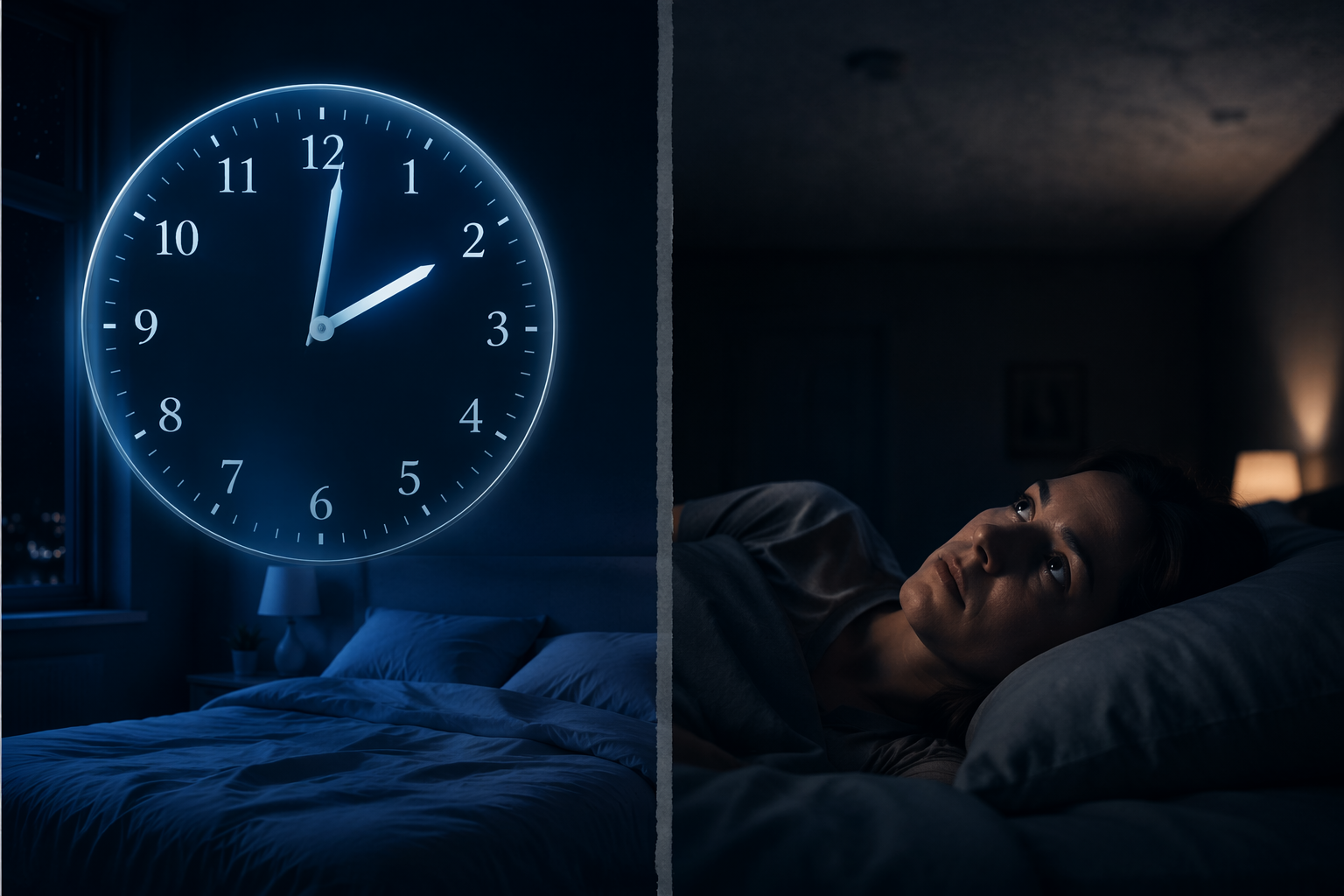
Start by naming the sleep problem
A pharmacy shelf cannot tell whether your insomnia is a body-clock mismatch, a learned pattern of wakefulness, medication-related sleep disruption, pain, depression, anxiety, sleep apnea, restless legs, or a work schedule problem. Melatonin is often sold as if all of those complaints sit in the same bucket. They do not.
| Sleep complaint | What melatonin is most likely doing | Better next question |
|---|---|---|
| You naturally get sleepy very late and struggle to wake for morning obligations | May help shift circadian timing when used at the right time | Is this delayed sleep-wake phase disorder or another circadian rhythm pattern? |
| You crossed time zones and cannot sleep on the new schedule | May help signal the new night to the body clock | What timing matches the destination schedule? |
| You are in bed at a normal hour but stay awake for long stretches | May slightly shorten sleep onset for some people, but evidence is weak for chronic insomnia | Would CBT-I or an insomnia evaluation address the pattern better? |
| You fall asleep but wake repeatedly or too early | Usually a poor match unless a circadian issue is also present | Is this sleep maintenance insomnia, mood-related awakening, sleep apnea, pain, alcohol, or medication effect? |
| You keep increasing the dose because the first gummy did little | Higher dose does not clearly mean better insomnia relief | Is the target wrong rather than the dose too low? |
For readers trying to sort onset, maintenance, and early-morning patterns, a broader pattern map such as why you can't sleep depends on your insomnia pattern is often a better starting point than comparing supplement labels.
Where melatonin fits best: a late body clock
Melatonin is a hormone involved in circadian signaling. In practical terms, it helps tell the brain that biological night is approaching. That is why it makes the most sense when the problem is not simply “I need stronger sedation,” but “my internal night is arriving too late for the life I have to live.”
Delayed sleep-wake phase disorder is the cleanest example for many adults. The person may sleep reasonably well if allowed to sleep from very late night into late morning, yet cannot reliably fall asleep on a conventional schedule. In that situation, melatonin is not being asked to overpower insomnia. It is being used as a timing cue, often alongside morning light exposure, evening light management, and a consistent wake time.
That is also why timing matters as much as the tablet. Taking melatonin at bedtime because the bottle says “sleep” may be too late for a circadian shift. Taking it at the wrong time can be unhelpful or even push the rhythm in the wrong direction. If your pattern sounds like a delayed body clock, start with guidance on delayed sleep phase syndrome in adults before treating the problem as ordinary insomnia.
Jet lag is another reasonable use case because the problem is explicitly circadian: your body is still keeping time for one place while your obligations have moved somewhere else. Melatonin may help cue the new schedule, but again the point is alignment, not a universal knockout effect.
Chronic insomnia is a different treatment target
Chronic insomnia is not defined by one rough night or a short stressful stretch. It is a persistent pattern in which sleep difficulty continues despite adequate opportunity for sleep and causes daytime impairment. By the time many people meet that description, the issue is often maintained by conditioned arousal, schedule drift, time-in-bed extension, worry about sleep, or behaviors that made sense during a crisis but now keep the insomnia loop going.
That is the territory where CBT-I has its strongest role. CBT-I does not work by pretending sleeplessness is imaginary. It changes the sleep-wake behaviors and mental patterns that keep the bed paired with wakefulness. A good CBT-I plan may include sleep restriction, stimulus control, cognitive work, relaxation strategies, and relapse planning. The AASM recommendation reflects that chronic insomnia usually needs retraining and pattern repair, not just a nighttime signal.[1]
The practical difference is easy to miss when the only symptom you are tracking is “I cannot fall asleep.” A person with a delayed body clock may not be biologically ready for sleep at the desired bedtime. A person with chronic insomnia may be sleepy, frustrated, and primed for sleep in theory, but their bed has become a place of monitoring, effort, and threat. Those two people can write the same complaint in a search bar. They should not automatically get the same treatment.
If the pattern sounds chronic rather than circadian, resources on how to choose a CBT-I app for chronic insomnia are more relevant than moving from one melatonin brand to another.
The evidence can look bigger than the benefit
One reason melatonin remains confusing is that the evidence base is large enough to sound reassuring. A 2025 Oxford scoping review mapped 57 reviews and 227 meta-analyses; 80.9% of the included meta-analyses favored melatonin.[2] Read quickly, that sounds like a broad endorsement.
The closer reading is less sweeping. In that same review, only 8.8% of reviews met all assessed quality criteria.[2] The authors also disclosed that the work was funded by Cooper Consumer Health, a melatonin manufacturer, and that the funder formulated the research question, while stating that the funder had no further role in execution or analysis.[2] That disclosure does not erase the review, but it does argue against treating its most favorable headline as the whole story.
The size of the effect matters even more. A 2025 Psychiatric Times synthesis of the evidence described melatonin’s sleep-onset benefit for insomnia as roughly 5 to 7 minutes.[3] For someone desperate at 2 a.m., any improvement can sound welcome. But a few minutes off sleep onset is not the same as restoring sleep, reducing nightly distress, or fixing a chronic insomnia pattern. This is why “statistically favorable” and “clinically persuasive” should not be treated as synonyms.
There are cases where 5 minutes matters. Catching a train matters. A medication side effect that consistently shortens a dangerous delay might matter. But for chronic insomnia, the complaint is usually not “I fall asleep 7 minutes too late.” It is nights shaped by vigilance, frustration, long awakenings, early waking, or fear of the next day. Melatonin’s modest average effect does not match that burden well.
More milligrams are not a better diagnosis
The common aisle logic is understandable: if one gummy did nothing, maybe the higher-dose bottle will. The Oxford review does not give much support to that move. Across reviewed dose bands of 0.1 to 3 mg, 3 to 5 mg, and more than 5 mg, the authors found no statistically significant difference in melatonin efficacy.[2]
That finding is especially important in the United States, where melatonin is widely available as a dietary supplement rather than a prescription drug. Mayo Clinic describes melatonin as generally safe for short-term use, while noting that it can cause side effects such as headache, dizziness, nausea, and daytime drowsiness and can interact with certain medications.[4] “Available without a prescription” is not the same as “dose does not matter.”
For a carefully chosen trial, the better question is usually not “How high can I go?” It is “What am I trying to shift, and when should the signal be taken?” A responsible trialing plan belongs closer to a timing protocol than a sedative escalation plan. Readers considering that route can use a melatonin dosage guide matched to sleep problem rather than treating dose as a contest.
Safety is not the main argument, but it still matters
The strongest reason not to use melatonin as a default chronic insomnia treatment is not that it is known to be dangerous for everyone. It is that the match is often poor and the expected benefit is small. Safety still matters because a low-benefit habit is easier to normalize, especially when the product is framed as natural.
Regulation also shapes the practical risk. In the U.S., melatonin is sold as a dietary supplement, which means it does not go through the same premarket approval process as prescription sleep medications. For readers who want the regulatory context, what the FDA doesn't check in natural sleep aids is the more relevant rabbit hole than a brand-by-brand label comparison.
The supplement industry has recognized at least some of the concern. In 2024, the Council for Responsible Nutrition adopted voluntary guidelines for melatonin supplements, including child-deterrent packaging and labeling that frames use as intermittent.[5] Voluntary guidance is not the same as universal enforcement, but it signals that casual, open-ended use is not the responsible default.
Older adults deserve extra caution because sleep aids of all kinds can intersect with fall risk, cognitive effects, medication interactions, and underlying medical conditions. Melatonin may still be discussed in some cases, but the decision should sit inside a broader safety review. A guide to sleep aids that are safer for people over 65 is a better frame than assuming the gentlest-sounding supplement is automatically the safest.
The long-term heart signal is a caution flag, not a verdict
A 2025 American Heart Association presentation drew attention because it linked long-term melatonin use with worse heart outcomes in an observational analysis. The study used TriNetX data on 130,828 adults and reported that people categorized as long-term melatonin users, defined as at least 12 months of use, had a 90% higher incidence of heart failure, 3.5 times the rate of heart-failure hospitalization, and about twice the all-cause mortality compared with matched nonusers.[6]
That should not be read as proof that melatonin causes heart failure. The finding came from an observational abstract, not a peer-reviewed full manuscript, and it may be affected by differences in insomnia severity, depression, anxiety, other medical conditions, or medication use. The American College of Cardiology also summarized the work as an association presented at AHA 2025, not as a causal conclusion.[7]
Still, the signal belongs in the conversation because it challenges a common habit: taking melatonin night after night for months or years because it feels too mild to count as a real intervention. When the expected chronic-insomnia benefit is only modest, the threshold for indefinite unsupervised use should be higher, not lower.
A practical decision map
If your sleep problem looks circadian, melatonin may be worth discussing or trialing carefully. The clues are a stable late sleep window, better sleep when allowed to follow that late schedule, major difficulty waking for required morning times, or a recent time-zone shift. In that setting, the intervention should be paired with timing discipline: consistent wake time, morning light when appropriate, reduced evening light exposure, and a dose-timing plan that aims to shift the clock rather than simply sedate.
If your sleep problem looks like chronic insomnia without a clear circadian mismatch, melatonin should not be the treatment anchor. CBT-I is the better-supported first-line path, and medical evaluation matters when insomnia is severe, persistent, new, or paired with loud snoring, breathing pauses, restless legs, depression, anxiety, pain, medication changes, substance use, or major daytime impairment.
If you are still comparing OTC options, keep the hierarchy honest. Melatonin is one tool with a fairly specific job. Broader guides to natural sleep aids ranked by clinical evidence or how to choose the best adult sleep aid can help separate a short-term aid from treatment for a sleep disorder.
The decision is not “melatonin works” or “melatonin is useless.” It is narrower and more useful: if insomnia is really a body-clock mismatch, melatonin may fit the mechanism. If insomnia is chronic wakefulness without circadian disruption, it should not replace CBT-I or other evidence-based care. The question to take to the shelf, the clinician, or the sleep diary is not “Is this natural?” It is “Is my sleep problem the kind melatonin is designed to solve?”
References
- Missing the mark with melatonin: Finding the best treatment for insomnia, American Academy of Sleep Medicine
- Melatonin and health: a scoping review of systematic reviews and meta-analyses, PMC
- The Truth About Insomnia and Melatonin: Natural Does Not Always Mean Harmless, Psychiatric Times, August 2025
- Melatonin, Mayo Clinic
- CRN Adopts New Guidelines for Melatonin Supplements to Promote Responsible Usage, Council for Responsible Nutrition, 2024
- Long-term use of melatonin supplements to support sleep may have negative health effects, American Heart Association, 2025
- Melatonin Supplements and Heart Failure: What Clinicians Should Know, American College of Cardiology, 2025


Comments
Join the discussion with an anonymous comment.