
Most sleep hygiene advice starts to wobble the moment someone has to stay alert at 3 a.m. and sleep at 9 a.m. “No naps,” “avoid caffeine,” “keep a regular bedtime,” and “get morning light” may be reasonable for a day worker with a cooperative schedule. For a nurse leaving a night shift at sunrise, a plant operator rotating from evenings to nights, or a dispatcher trying to stay safe through the dead zone before dawn, the same rules can sound less like health advice and more like a scolding.
That is the problem at the heart of sleep hygiene for shift workers: the work schedule is not merely inconvenient. It changes the timing problem. A 2020 systematic review in Sleep Medicine Reviews found that sleep hygiene guidelines had not been validated for shift workers and that several common shift-worker strategies, including napping before shifts and using caffeine strategically during shifts, can align with fatigue management while contradicting generic sleep hygiene advice.[1]
So the better question is not whether shift workers have enough discipline to follow standard sleep rules. The better question is what changes when sleep advice is built around circadian disruption instead of nighttime sleep.

The scale is large, even if the exact numbers need caution
Shift-work sleep problems are not a niche inconvenience. In a 2023 Frontiers in Psychiatry study of 37,662 adults, night workers had a two-fold higher prevalence of short sleep than day workers, with short sleep reported by 50% of night workers compared with 26% of day workers. The same study found higher rates of insomnia, circadian rhythm sleep-wake disorders, and sleep-related movement disorders among shift workers, especially those working nights.[2]
Those figures should not be treated as a perfect population estimate. The sample came from Belgian newspaper readers, was more highly educated than the general population, and may have attracted people already concerned about sleep. Still, even with that caveat, the direction is hard to dismiss: night work is consistently associated with more disordered sleep, and standard advice written for day-oriented lives does not meet the shape of the problem.[2]
Start with light, because light tells the body what time it is
Light is not just a bedroom comfort issue for shift workers. It is the main environmental signal the circadian system uses to decide whether the body should be alert or winding down. Shift work disturbs the circadian system because the work-rest schedule, meals, activity, darkness, and light no longer arrive in the pattern the body expects.[3]
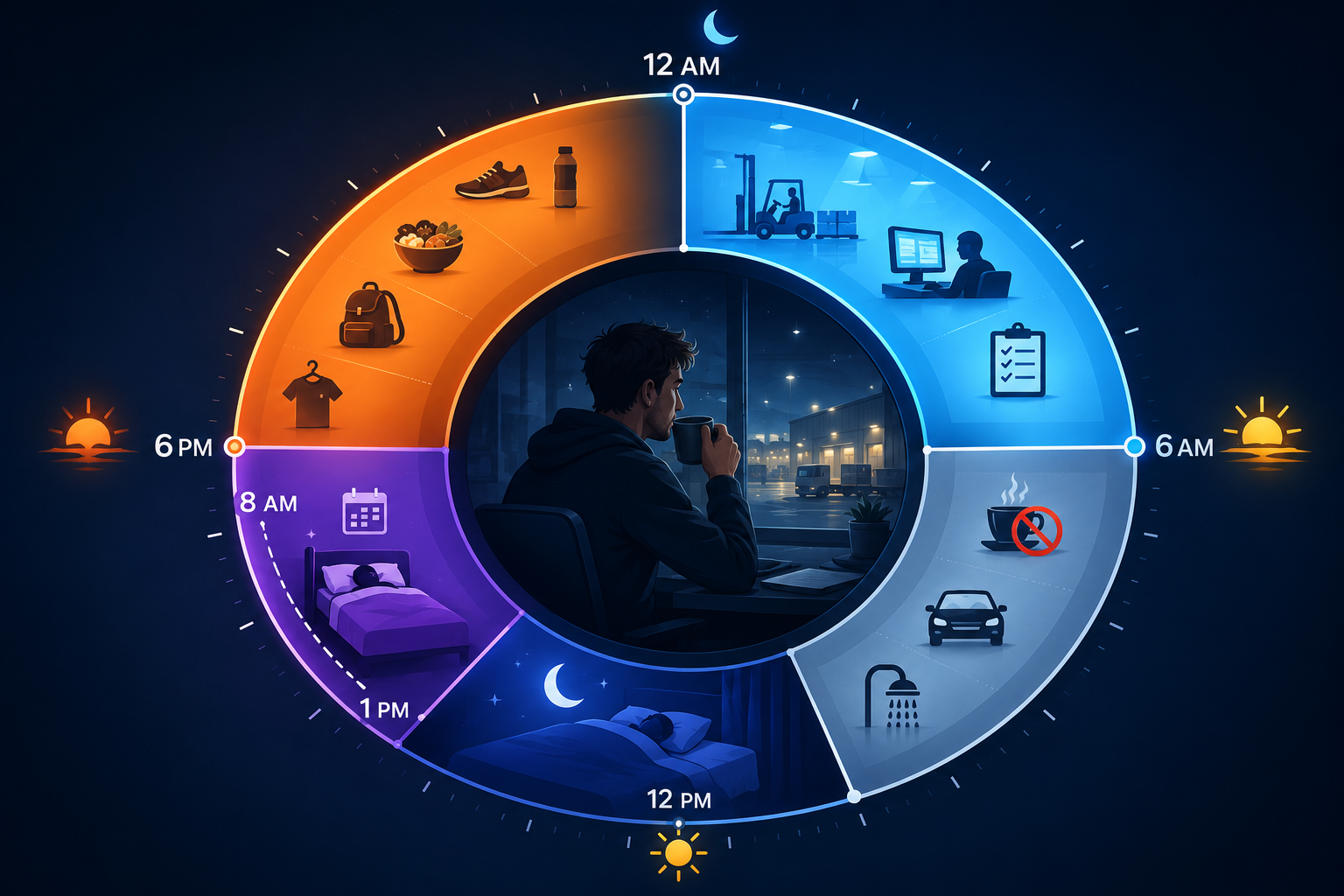
That means light management has to work as a system. Bright light early in the shift can support alertness when the worker needs to function. Light avoidance on the commute home helps prevent sunrise from acting like a wake-up signal. A genuinely dark bedroom protects the daytime sleep period that follows. Treated separately, these sound like small tips. Treated together, they are a circadian boundary around the shift.

For night workers, the practical version is usually this: use brighter light during the first 2–3 hours of the shift when alertness needs support, then reduce bright light exposure as the shift ends. On the way home, sunglasses or blue-blocking glasses can make sense, especially after sunrise. Once home, blackout curtains, an eye mask, and reducing household light matter more than a perfect “wind-down aesthetic.” Sleep Foundation guidance for shift workers also emphasizes bright light during work, limiting morning light after night shifts, and making the sleep space dark and quiet.[4]
The hardest part is often not knowing what to do. It is getting permission from real life. A shared bedroom, children, a noisy apartment building, or a long commute can make “sleep in a cool, dark, quiet room” feel laughably incomplete. But the priority is still clear: protect darkness during the sleep opportunity you actually have. If the bedroom cannot be perfect, reduce the biggest light leaks first. If the commute happens in full sun, cover the eyes before worrying about whether the phone screen is set to the ideal color temperature.
Naps are not a failure of sleep hygiene
Generic sleep hygiene often treats naps as a threat to nighttime sleep. For shift workers, that framing can be backward. A nap before a night shift may be the thing that reduces the most dangerous stretch of sleepiness later. The Shriane review matters here because it names the contradiction directly: behaviors discouraged in standard sleep hygiene may be appropriate fatigue-management tools for shift workers.[1]
The nap choice depends on the job, the commute, and how the person wakes from sleep:
- A 90-minute pre-shift nap can give enough time for a fuller sleep cycle before a night shift.
- A 10–20 minute power nap can help when there is not enough time for a longer nap or when waking groggy would be a problem.
- A nap before the first night shift can be especially useful when moving from a day-oriented schedule into overnight work.
- A workplace nap, where permitted and safely managed, should be treated as a fatigue-control measure, not a character flaw.
Sleep Foundation guidance describes both longer naps before work and shorter naps during breaks as options for shift workers, while noting that timing matters.[4] The point is not to nap randomly whenever exhaustion appears. It is to place sleep where it reduces risk without stealing too much from the main sleep period.
The “coffee nap” belongs in a more cautious category. The idea is simple: drink caffeine, immediately take a 15–20 minute nap, and wake as the caffeine begins to take effect. Some workers find it useful. But high-quality trial evidence specific to shift workers is limited, so it is better treated as a practical experiment than a proven protocol. It also fails if the nap becomes long enough to cause grogginess or if the caffeine lands too close to the planned sleep period.
Caffeine needs a clock, not a moral lecture
Caffeine is another place where standard advice can become unhelpfully tidy. “Avoid caffeine” is easy to say when work ends before dinner. It is less useful when someone is responsible for patients, machinery, guests, vehicles, or emergency calls at 4 a.m.
For shift workers, the more useful question is when caffeine helps alertness and when it starts sabotaging the next sleep attempt. CDC/NIOSH training for nurses describes using moderate caffeine early in the shift, potentially in smaller repeated amounts every 1–2 hours, while avoiding caffeine within 3–4 hours of planned sleep.[5] Sleep Foundation guidance also recommends caffeine early in the shift and avoiding it too close to bedtime.[4]
| Situation | More useful caffeine strategy |
|---|---|
| Starting a night shift | Use caffeine early enough to support alertness during the first part of the shift. |
| Long shift with a predictable low point | Consider smaller, moderate amounts spaced across the earlier shift rather than one large late dose. |
| Within 3–4 hours of planned daytime sleep | Stop caffeine, even if the shift is not over, unless safety demands override the sleep plan. |
| After the shift on the commute home | Avoid caffeine if the goal is to sleep soon after arriving home. |
This is caffeine chronometry: timing the stimulant around both alertness and the next sleep window. It is not proof that caffeine is harmless, and it is not permission to keep escalating dose. It is simply more honest than pretending that a night worker and a day worker face the same tradeoff.
For rotating schedules, anchor part of sleep instead of chasing perfect regularity
“Go to bed and wake up at the same time every day” is one of the most common sleep hygiene rules. It is also one of the quickest ways to make rotating shift workers feel as if the advice was written in another universe.
The useful compromise is not perfect regularity. It is anchoring. CDC/NIOSH describes a compromise sleep schedule in which workers keep a consistent 4-hour sleep period across different shift types, then add a second sleep block that changes as needed.[5] For example, a worker might protect 8 a.m. to noon after night shifts and keep that same protected block when possible during other parts of the rota, adding an evening or afternoon sleep period depending on the next shift.

Anchoring works because it gives the body at least one recurring sleep signal when the rest of the schedule keeps moving. It also gives the household something concrete to protect. The instruction becomes less vague: this four-hour block is not an optional nap, a chore window, or a convenient time for appointments. It is the non-negotiable core of sleep.
Forward rotation, moving from day to evening to night, is generally easier on circadian timing than backward rotation, moving from night to evening to day. Many workers cannot choose their rotation direction, but they may be able to recognize which rotations are hitting harder, request forward rotation when schedules are negotiated, or avoid adding extra obligations during backward transitions. CDC/NIOSH also discusses clockwise rotation as easier for many workers than counterclockwise rotation.[5]
This is where broader sleep regularity advice still has value, but only after being translated for the rota. If you want the general evidence behind regularity, sleep regularity matters. For shift workers, the humane version is not “be regular everywhere.” It is “make one sleep block as regular as the schedule allows.”
Protect daytime sleep like a recovery period, not spare time
Daytime sleep is vulnerable because the rest of the world is awake. Deliveries arrive, phones ring, lawns get cut, children need care, and people who would never call at 2 a.m. may think 10 a.m. is fair game. Shift-worker sleep hygiene has to treat the sleep period after work as recovery time, not an empty slot in the calendar.
The basics still matter, but they matter because they defend the daytime sleep opportunity: blackout curtains or an eye mask, earplugs or white noise if the environment is loud, a cool room when possible, and a phone setting that blocks nonessential interruptions. A short post-shift routine can help if it reliably lowers arousal. It does not need to be elaborate. The worker who has 35 minutes between walking in the door and collapsing into bed does not need a lifestyle performance; they need light blocked, caffeine stopped, and other people warned that sleep is happening.
For a phase-by-phase routine, a practical night-shift sleep routine can be useful. The principle here is simpler: do not let daylight, noise, social expectations, or late caffeine consume the sleep window before sleep even has a chance.
When fatigue becomes more than ordinary shift-work strain
Some tiredness after night work is expected. That does not mean every level of sleepiness should be normalized. If insomnia, excessive sleepiness, near-misses while driving, repeated inability to sleep after shifts, or serious impairment continues despite schedule-specific strategies, the issue may be moving beyond ordinary fatigue.
Shift Work Disorder is a circadian rhythm sleep-wake disorder, not a personal weakness. Workers who are unsure where they fall can use a diagnostic-oriented guide such as this Shift Work Disorder versus shift-work fatigue FAQ and should consider clinical evaluation when symptoms are persistent, unsafe, or affecting daily functioning.
The health stakes are not limited to feeling tired. In a BMJ Open study of 1,006 Malaysian manufacturing workers, sleep quality partially mediated the association between night-shift work and reduced health-related quality of life. Subjective sleep quality and disturbances were linked with physical well-being, while sleep latency and daytime dysfunction were linked with mental well-being. The sample was specific, so the findings should not be stretched to every workforce, but they do show why “just push through” is a poor long-term sleep plan.[6]
What actually changes
Standard sleep hygiene assumes the worker is trying to sleep at night and stay awake in the day. Shift-worker sleep hygiene starts from a different reality: the worker may need to be alert when the circadian system expects sleep, then sleep when light, noise, family life, and biology all push the other way.
That changes the advice. Light becomes a timed signal. Naps become fatigue management. Caffeine becomes a clock-based tool with a hard stop before planned sleep. Regularity becomes an anchored sleep window rather than a fantasy of identical bedtimes. None of this guarantees full adaptation to night work, and it should not be sold that way. It is a more precise strategy for reducing circadian confusion, preserving alertness, and protecting the sleep opportunity that shift workers actually have.
References
- Sleep hygiene in shift workers: A systematic literature review — Sleep Medicine Reviews, 2020
- Shift work is associated with extensively disordered sleep, especially when working nights — Frontiers in Psychiatry, 2023
- Disturbance of the Circadian System in Shift Work and Its Health Impact — Journal of Biological Rhythms, 2022
- Tips for Shift Workers — Sleep Foundation
- Module 9: Coping with the Night and Evening Shifts — CDC/NIOSH
- Association between night-shift work, sleep quality and health-related quality of life — BMJ Open, 2020



Comments
Join the discussion with an anonymous comment.