
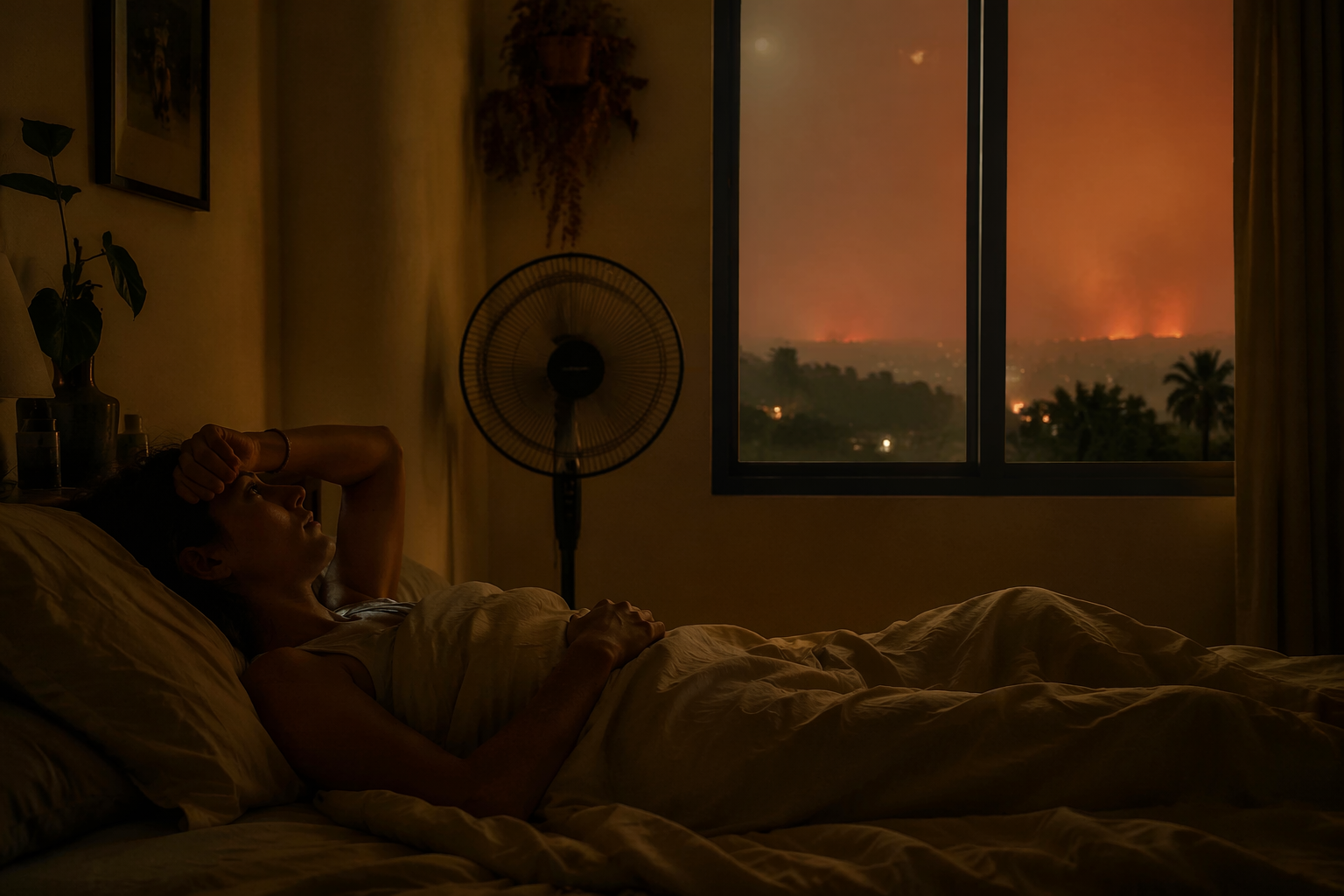
The hard part of sleeping through a smoky heat wave is that the usual advice starts fighting itself. Open the window and the room may cool, but the air can get worse. Close the window and the smoke stays out more effectively, but the room keeps its heat and the air gets stale. Run a fan and it may help sweat evaporate, but it does not remove fine particles from wildfire smoke.
That bind is not abstract in summer 2026. July reporting has already described widespread sleep difficulty during the UK heat wave, with 2 in 3 people reporting trouble sleeping on hot nights, while Detroit recorded its highest AQI on record during Canadian wildfire smoke plumes. Those are different places and different air masses, but they point to the same bedroom problem: the safest air choice may make the heat and ventilation problem harder.
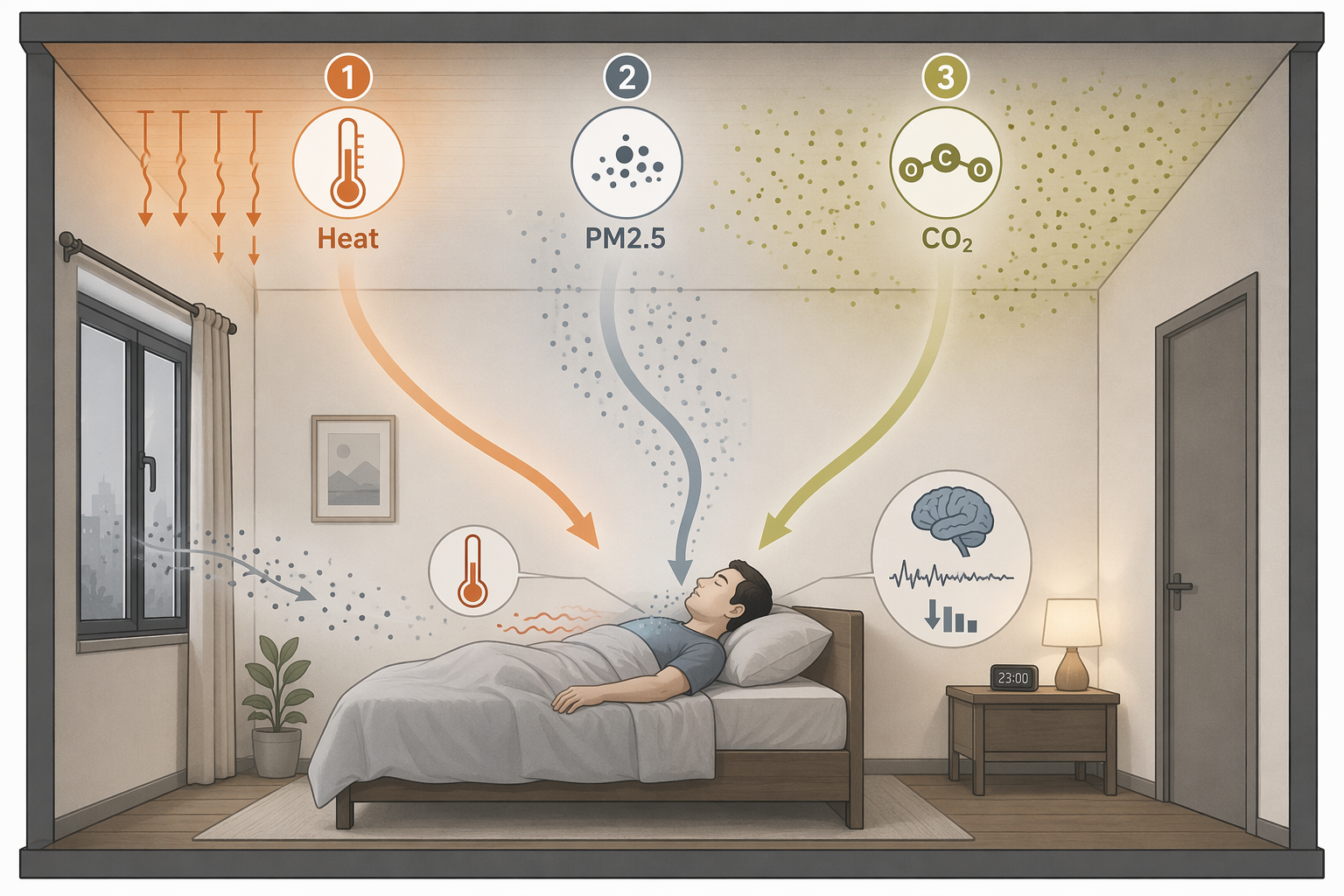
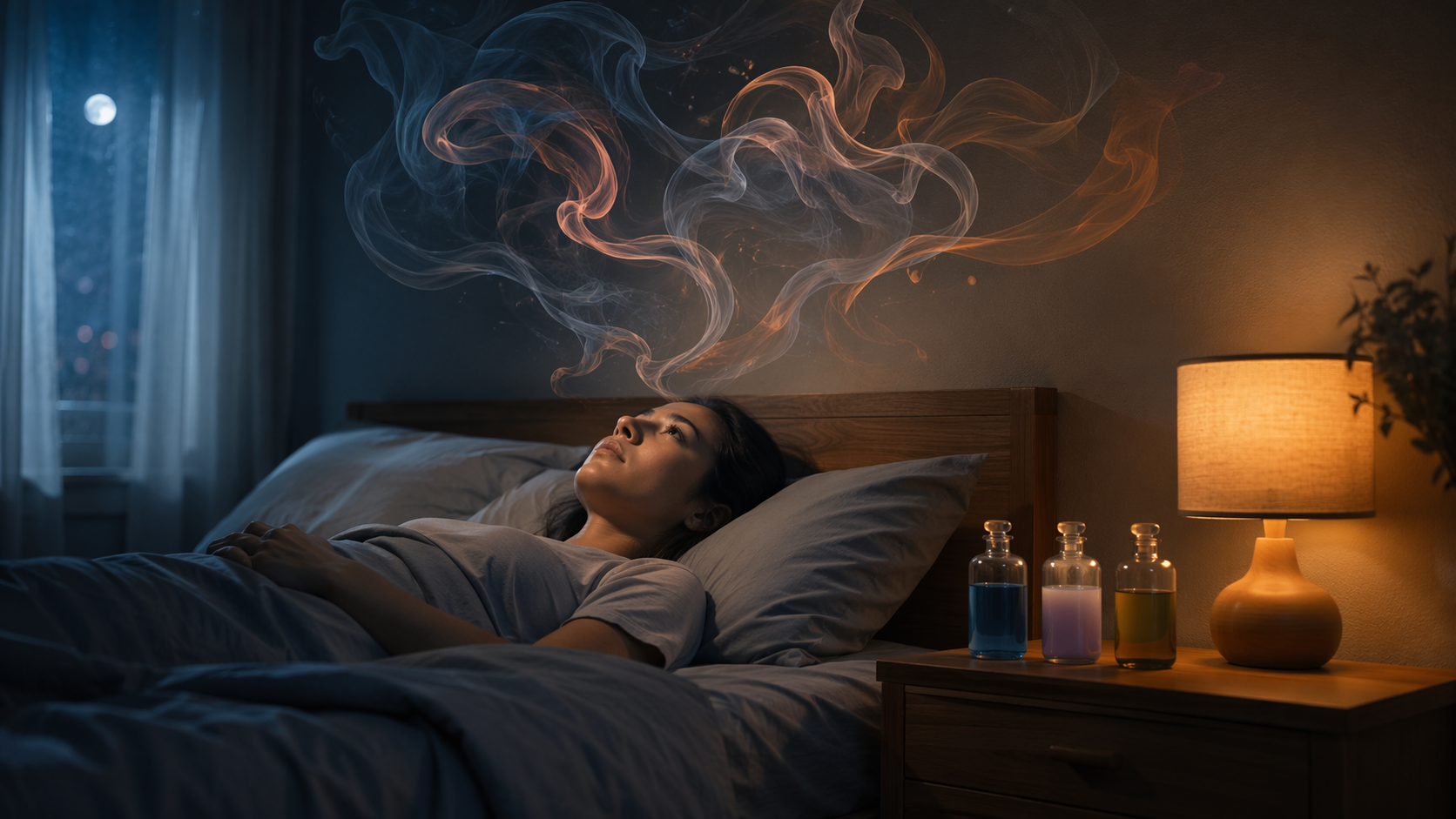
The air quality impact on sleep is easiest to misunderstand when it is treated as one variable. In a sealed summer bedroom, three pressures can arrive together: heat pushes the body away from the temperature drop that supports sleep, PM2.5 from smoke can degrade sleep quality, and reduced ventilation can allow CO₂ to build up overnight. None of these requires panic. They do require a different standard than “shut the window and hope.”
Why a Hot, Smoky Bedroom Hits Sleep From Three Directions
Sleep is not just a decision to lie still. The body has to shed heat, breathing has to stay easy enough that arousals do not keep breaking sleep, and the room has to remain breathable for several hours without constant adjustment. Heat, smoke, and stale air disturb different parts of that arrangement.
Heat makes the body work when it should be downshifting
A warm room does not merely feel annoying. It can interfere with the body’s normal nighttime cooling. One large U.S. analysis published in 2017 estimated that a 1°C increase in nighttime temperature was associated with 3 additional nights of insufficient sleep per 100 people per month.[1] That number is not a personal sleep forecast; it is a population-level signal. But it explains why a room that is only “a little too warm” can still leave people short on sleep by morning.
The practical consequence is familiar: more tossing, lighter sleep, earlier waking, and the strange fatigue of having spent the night doing nothing yet still feeling physically overworked. In a heat wave, the problem often continues after sunset because walls, roofs, pavement, and upper-floor apartments release stored heat slowly. A renter without central air may be sleeping inside yesterday’s accumulated heat, not just tonight’s outdoor temperature.
PM2.5 can make “the air is bad” show up inside sleep architecture
Wildfire smoke is not just a smell at the window. The fine particles most often discussed in smoke events, PM2.5, are small enough to penetrate indoors and be inhaled deeply. For sleep, the concern is not only coughing or throat irritation, although those can matter. A 2026 Shanghai field study linked PM2.5 exposure with a reduced proportion of deep sleep.[2]
That study should be read carefully. It does not prove that every smoky night will remove the same amount of deep sleep from every person, and Shanghai field-study conditions are not interchangeable with every North American bedroom during a Canadian smoke plume. Its usefulness is more specific: it supports the idea that particulate exposure can reach beyond “my nose feels irritated” and show up in measured sleep quality.
Closed windows solve one problem and create another
When the AQI is unsafe because of smoke, closing windows is often the right move. The mistake is pretending that this ends the bedroom problem. A closed room with one or two sleeping adults is also a room with less air exchange. Overnight, exhaled CO₂ can accumulate, especially in small bedrooms, rooms with poor mechanical ventilation, and apartments where windows are the main source of fresh air.
CO₂ is not the same issue as PM2.5. A filter that helps capture particles does not automatically bring in fresh outdoor air. A fan that moves air across skin does not clean smoke or remove exhaled CO₂ from a sealed room. This is where single-fix advice starts to fail: each tool may help one pathway while leaving another untouched.
| Pressure in the room | What it can do to sleep | Why the usual quick fix is incomplete |
|---|---|---|
| Nighttime heat | Makes it harder for the body to cool and maintain stable sleep | Opening a window may cool the room but can admit smoke when outdoor air is unsafe |
| PM2.5 from smoke | Can irritate breathing and has been associated with reduced deep sleep proportion | A fan moves smoky air around; it is not an air cleaner |
| CO₂ buildup | Can make a sealed bedroom feel stale and may add to morning grogginess | Closing windows protects against smoke but reduces ventilation |
The Order of Operations Matters Tonight
The first decision is not whether you care more about comfort or clean air. It is which exposure is most dangerous to worsen on purpose. If outdoor smoke is high, opening a window for relief can be the wrong trade, even when the bedroom is hot. If outdoor air improves after a front passes or smoke thins, ventilation may become useful again. The point is to decide deliberately, not to follow the same bedtime routine regardless of AQI.
- Check outdoor AQI before bed and again if you wake up hot. Do not assume nighttime air is safe because it feels cooler.
- If smoke is unsafe, keep windows closed and reduce indoor particle sources such as candles, incense, frying, and smoking.
- Cool the body directly: lighter bedding, a cool shower before bed, damp washcloths, and airflow across skin can lower heat strain without bringing smoke inside.
- Use filtration if you have it, but treat it as particle control, not ventilation. It helps with PM2.5; it does not replace fresh air.
- Ventilate during cleaner-air windows when conditions allow, then close back up before smoke returns or heat rises.
People often want a single threshold that settles the night: one AQI number, one bedroom temperature, one device setting. Real rooms are messier. A top-floor bedroom may stay hot long after outdoor air cools. A street-facing apartment may get more particle infiltration than an interior room. A small bedroom with the door closed may feel stale faster than a larger room connected to a hallway. The better question is what you can reduce without increasing another exposure.
If the room is too hot but the AQI is unsafe
Keep smoke out first. Then shift from cooling the room to cooling the sleeper. Use the least bedding you can tolerate. Move heat-producing electronics away from the bed. Place a fan so it moves air across your body, not from a smoky window into the room. If you have access to a cooler interior space, sleeping there for one night is not a failure of sleep hygiene; it is environmental triage.
This is also the night to make the bedroom smaller in terms of workload. Do not add indoor combustion or fragrance. Do not cook a late meal that fills the apartment with particles and heat if you can avoid it. If you have a portable air cleaner, run it in the sleep space with doors and windows closed, following the device’s instructions. The goal is not a perfect bedroom. It is fewer burdens at the same time.
If the AQI improves but the room is stale
Cleaner outdoor air changes the calculation. A short ventilation period may help flush CO₂ and indoor pollutants, especially before sleep or after waking. Cross-ventilation can be more effective than cracking one window, but only when outdoor air is actually acceptable. If smoke returns, close the windows again; ventilation is a timed tactic, not a moral commitment to fresh air at any cost.
For a more detailed AQI-based bedtime sequence, the site’s AQI > 100 bedtime protocol is a useful continuation. If smoke is the dominant issue where you live, the wildfire smoke sleep guide goes deeper on smoke-specific disruption.
If you have some cooling but no clear ventilation plan
Air conditioning can reduce heat strain, but it does not automatically solve smoke or ventilation. Some systems recirculate indoor air. Some bring in outdoor air. Some filters are inadequate for fine particles. The important thing is to know what your setup actually does. If you cannot change the system, you can still reduce leakage, run appropriate filtration if available, and air out the space only during cleaner periods.
The same caution applies to fans. A fan can be genuinely helpful for heat, especially when it increases evaporative cooling from skin. It becomes risky when it pulls smoky outdoor air through a window or gives the false impression that air movement equals air cleaning. Moving dirty air is still dirty air.
What Not to Blame on Willpower
A bad night in these conditions can look like ordinary insomnia from the inside. You go to bed on time, put the phone away, and still wake repeatedly. By morning, it is easy to decide you failed at relaxing. But a hot, sealed, smoky-adjacent room is not a neutral sleep setting. It is asking the body to regulate temperature, filter irritation, and tolerate stale air for hours.
That does not mean every symptom is caused by the room. Stress, alcohol, medications, sleep apnea, pain, hormones, and irregular schedules can all worsen sleep. The environmental piece matters because it is often the part people are told to handle with one blunt instruction: close the windows, use a fan, buy a purifier, tough it out. In a compound event, the useful move is to separate the pressures and reduce them in the safest order.
For readers trying to tune the room beyond an acute smoke event, the guides on bedroom air quality and sleep and sleep environment optimization can help turn the same logic into a more stable setup. During active wildfire smoke, layered indoor air protection is the more relevant next step.
A Realistic Standard for a Bad-Air Heat Night
A realistic target is not eight flawless hours in a perfectly cooled, perfectly filtered, perfectly ventilated room. Many people do not have that room. The practical target is to avoid making one pathway worse while trying to fix another: do not invite smoke in just to cool down; do not assume closed windows have solved the whole problem; do not treat airflow as filtration.
For tonight, reduce heat load where you can, keep smoke out when AQI is unsafe, manage indoor air and ventilation deliberately, and pay attention to symptoms that are bigger than a rough night. Chest pain, severe shortness of breath, confusion, signs of heat illness, or persistent insomnia deserve medical attention. Summer 2026 sleep disruption is not just “stress” or “hot weather.” In many bedrooms, it is a compound indoor-environment problem, and it needs layered mitigation.
References
- Nighttime temperature and human sleep loss in a changing climate, Science Advances, 2017, https://pmc.ncbi.nlm.nih.gov/articles/PMC5446217/
- Association between PM2.5 exposure and reduced deep sleep proportion, Scientific Reports, 2026, https://www.nature.com/articles/s41598-026-37949-2


Comments
Join the discussion with an anonymous comment.