
The useful answer to “how does exercise affect sleep” is not that movement simply makes the body tired. Exercise changes several sleep-relevant signals at once: melatonin timing, body temperature, cortisol and sympathetic arousal, and the circadian clock’s read on what time it is. A 2025 review in npj Biological Timing and Sleep treats these as overlapping pathways rather than separate perks, which is the right way to read the evidence: the same walk, ride, swim, or strength session can cool the body later, quiet stress physiology over time, and add a timing cue to the brain’s clock system.[1]
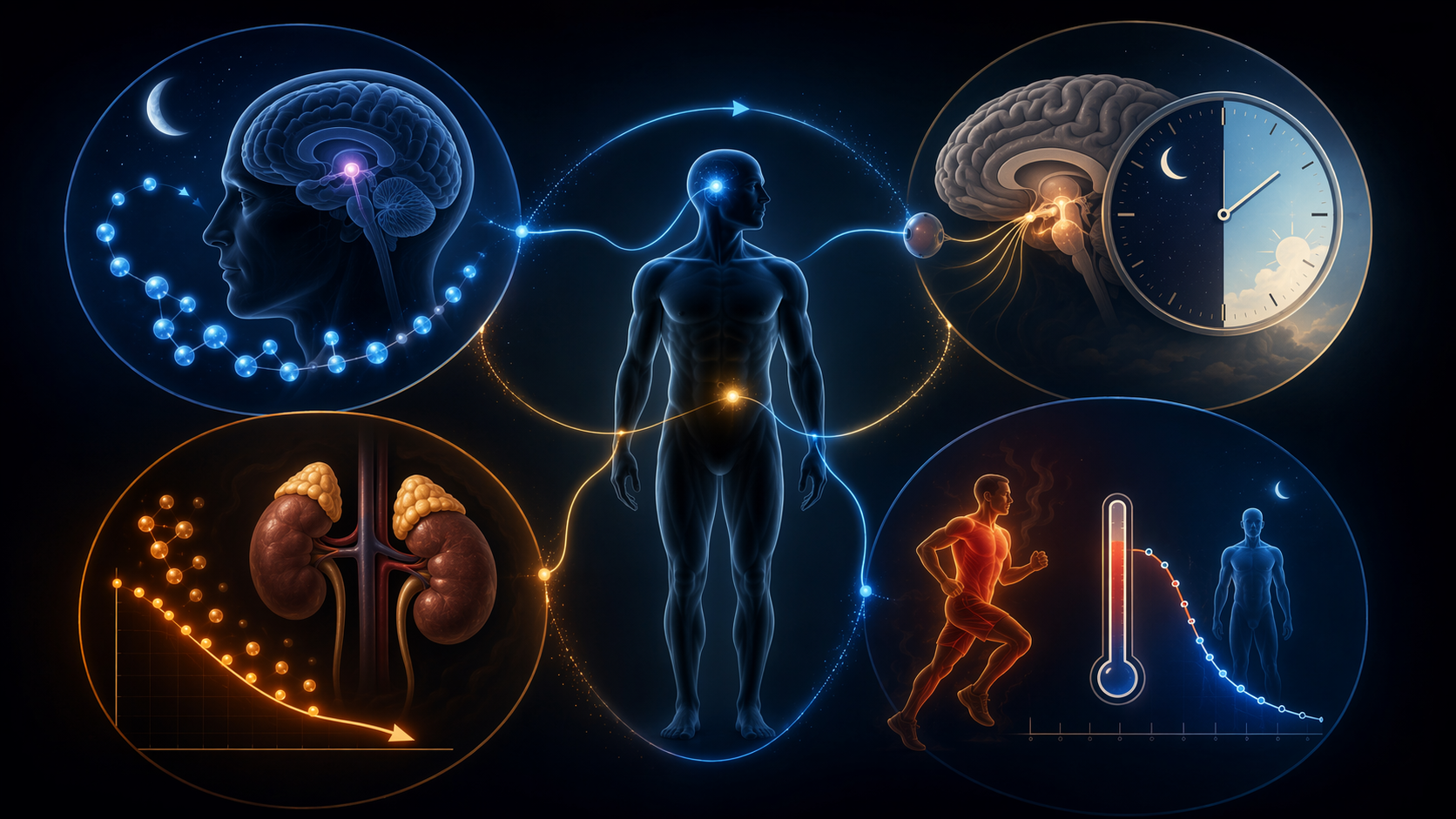
Those pathways do not all respond equally to every workout. Moderate aerobic exercise is the cleanest fit for much of the human evidence. Late, very intense exercise is less predictable. Morning movement may matter partly because it often comes with daylight. A sleep tracker may show “better sleep” after a training block, but the plausible biology depends on what changed: bedtime body temperature, arousal level, circadian timing, or some combination of them.
The four pathways are separated on paper, not in the body
It helps to name the pathways separately because each one answers a different version of the same question. Melatonin is about biological night. Temperature is about the physical transition into sleep. Cortisol is about whether the body remains mobilized when it should be downshifting. Circadian entrainment is about how exercise helps the brain’s clock place sleep in the 24-hour day.
| Pathway | What exercise may change | Why it matters for sleep |
|---|---|---|
| Melatonin regulation | Timing and possibly production of melatonin, depending on exercise timing | Helps mark biological night, but human evidence is still more limited than animal evidence |
| Body temperature dynamics | Core temperature rises during exertion, then falls afterward | The post-exercise decline can resemble the body’s natural sleep-onset temperature signal |
| Cortisol and arousal | Resting stress physiology may decrease with regular moderate exercise | Lower physiological arousal makes sleep maintenance more stable |
| Circadian entrainment | Exercise acts as a non-light timing cue, especially when paired with daylight | Helps align activity, alertness, and sleep timing with the 24-hour clock |
That table is a simplification. In real life, a morning run outside is not only “exercise.” It is exercise plus light exposure, a rise in body temperature, a change in feeding and activity timing, and often a different stress trajectory for the rest of the day. This is why single-rule advice about the “best” workout time usually outruns the evidence.
Temperature: the body warms first, then the sleep signal comes from cooling
The temperature pathway is the easiest to feel. During exercise, core temperature rises. After exercise ends, the body sheds heat through the skin and core temperature falls. Johns Hopkins Medicine explains this post-exercise temperature decline as one reason moderate aerobic activity can help the brain and body move toward sleep; it also notes that moderate aerobic exercise increases slow-wave sleep, the deeper stage associated with physical restoration.[2]
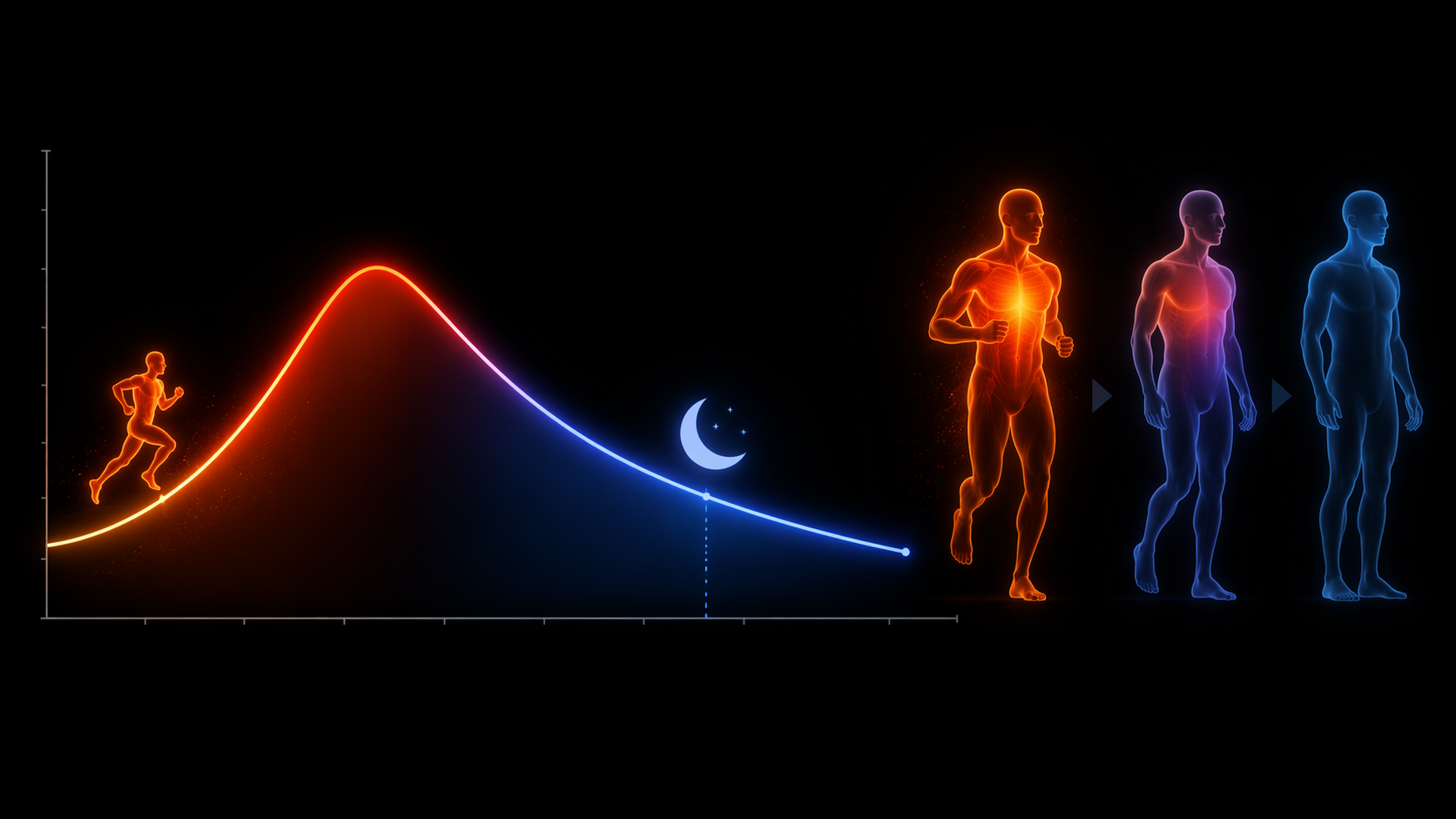
The mechanism is a rise in core temperature during exercise followed by a roughly 0.5–1°C decline during the 30–90 minutes after activity ends, a pattern that can resemble the natural temperature drop that accompanies sleep onset.[1][2]
This does not mean every evening workout is bad. It means the interval between exertion and bed has to leave room for the cooling phase. A moderate session that ends early enough for the body to come down may fit the sleep-onset pathway well. A late session that keeps the body hot, alert, and sympathetically activated close to bedtime may point in the other direction, especially if it is intense.
This is also where “I feel sleepy after exercise” needs a more precise interpretation. The useful signal is not exhaustion by itself. It is the transition: heat production during movement, heat loss afterward, and a nervous system that permits that drop rather than fighting it.
Melatonin: exercise may shift the night signal, but timing is the hard part
Melatonin is often described too loosely in exercise advice. It is not a sedative switch that exercise automatically flips. It is a darkness-linked timing signal, and the question is whether physical activity changes when that signal rises, how strongly it rises, or how the body responds to it.
A 2023 systematic review by Alnawwar and colleagues discusses the connection between physical activity, melatonin, and sleep, including evidence that exercise timing relative to the dim-light melatonin onset window can affect sleep outcomes.[3] That is the right level of specificity: timing relative to biological evening is more meaningful than the clock time printed on a gym schedule.
The evidence is still uneven. The broader 2025 review notes that melatonin-related effects of exercise are well established in animal models, while human data are more limited.[1] So the careful claim is not “exercise boosts melatonin” as a universal rule. It is that exercise can interact with melatonin regulation, and that the direction and usefulness of that interaction depend on when the activity occurs relative to a person’s circadian phase.
That distinction matters for people using melatonin supplements too. If the problem is timing rather than total sleep need, exercise timing, light exposure, and supplement timing can push on the same clock system. For a deeper discussion of that timing problem, see when melatonin works for insomnia.
Cortisol: the stronger evidence is adaptation, not a one-night trick
Cortisol belongs in the exercise-sleep story because insomnia is often a state of unwanted physiological readiness: higher arousal, more sympathetic activation, and a body that behaves as if something still needs to be handled. Regular moderate exercise can train the stress system toward a quieter baseline over time, reducing resting cortisol and blunting hyperarousal in ways that support sleep continuity.[1]
The important word is “regular.” A hard workout is itself a stressor. For many people it is a useful one, but the cortisol pathway is not best understood as a guaranteed same-night drop after any single session. The evidence summarized in the 2025 review is strongest for moderate-intensity exercise and weaker for acute high-intensity bouts.[1]
That helps explain a common split experience. A few weeks of repeatable moderate training may make sleep feel steadier, while one late, competitive, high-intensity session may leave someone wired. Both experiences can be biologically plausible. They are just not activating the same part of the evidence with the same reliability.
Circadian entrainment: exercise is a timing cue, but light still matters
The circadian system is most sensitive to light, but it also listens to non-light signals. Exercise is one of those signals. It can act as a non-photic zeitgeber, giving the suprachiasmatic nucleus and related clock networks information about when the body is active, when energy is being used, and how the day is structured.[1]
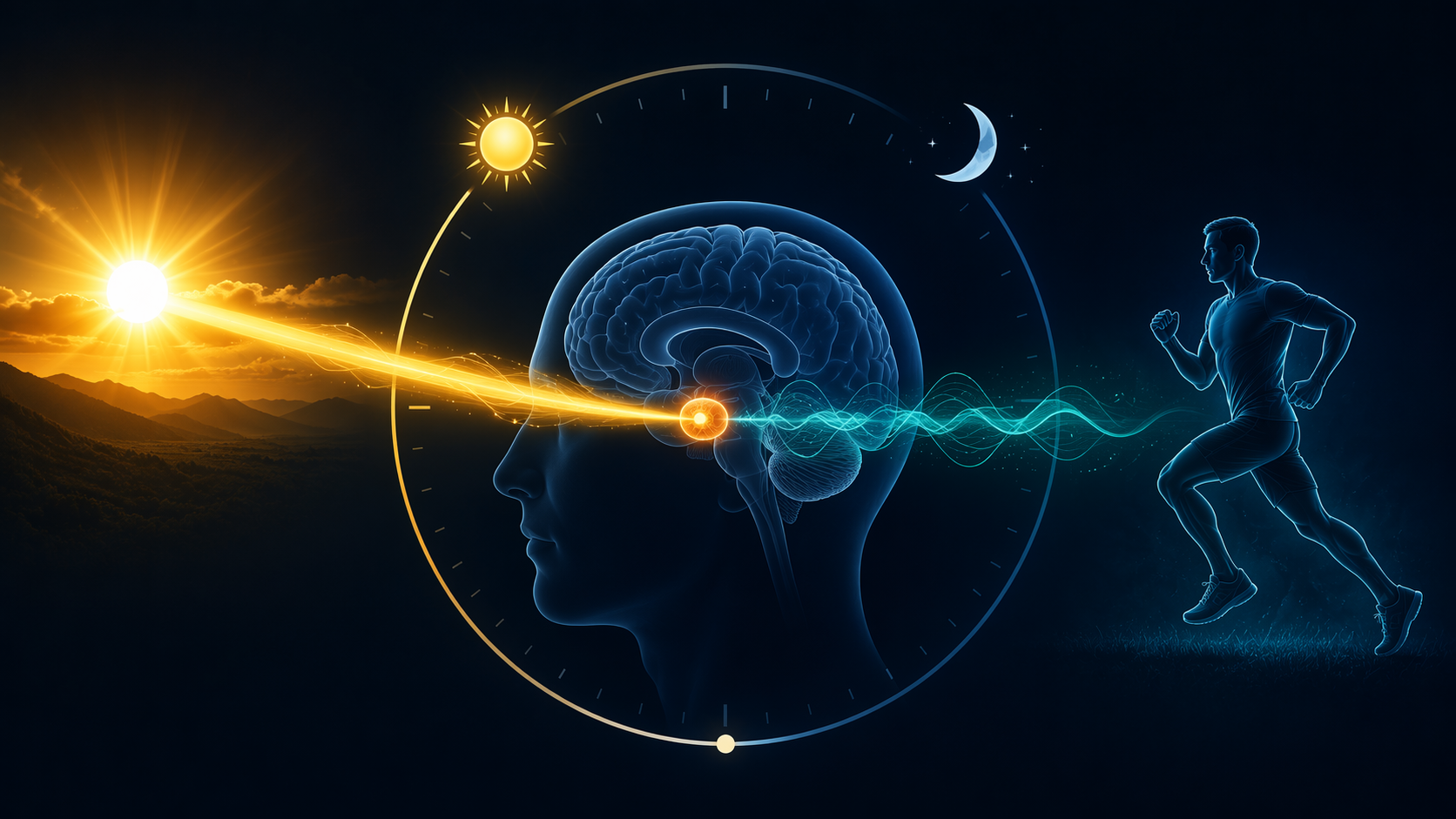
This is where morning exercise can be more than a willpower ritual. If it happens outdoors, movement and daylight arrive together. Sleep Foundation describes exercise as a factor that can support circadian alignment, while also emphasizing the role of chronotype and light exposure in how exercise timing affects sleep.[4] The mechanism is not that morning workouts are morally superior. It is that activity plus light can make a stronger “day has started” signal than activity alone.
A 2023 systematic review by Kim and colleagues focused on exercise timing, intensity, circadian rhythm, and sleep quality, and it supports the practical nuance that timing and intensity can change the sleep response.[5] This is one reason two people can react differently to the same 7 p.m. class: one may still have enough biological evening left to cool down and relax, while another may be nudged later or kept too activated.
Chronotype sharpens that difference. A late chronotype using morning outdoor activity may be adding a phase-advancing cue, especially if the session includes bright light exposure. An early chronotype doing intense activity late at night may be adding heat, arousal, and activity timing in the wrong part of their biological day. People with pronounced delayed sleep timing may need a broader clock strategy than exercise alone; see delayed sleep phase syndrome in adults for that larger pattern.
Shift work complicates the picture further because “morning” may not mean the same thing socially and biologically. In that setting, exercise timing has to be read alongside light avoidance, light exposure, commuting, meals, and recovery sleep. The same principle applies, but the clock map is different; see sleep hygiene for shift workers.
What deep sleep findings do, and do not, prove
Deep sleep is often where exercise benefits become easiest to imagine: the body repairs tissue, the brain becomes less responsive to the outside world, and a hard day of movement seems as if it should be paid back in slow waves. Johns Hopkins specifically reports that moderate aerobic exercise increases slow-wave sleep.[2] Cleveland Clinic similarly describes exercise as beneficial for sleep quality and notes practical targets such as 30 minutes a day, 5 days a week, while also discussing same-night improvements.[6]
Those observations fit the temperature and arousal pathways well, but they should not be stretched into a precise promise about every workout type. A tracker may estimate more deep sleep after a week of consistent training; that estimate is more credible when the surrounding conditions also make sense: earlier or moderate exercise, enough time to cool down, lower evening arousal, and stable wake timing.
Resistance training, high-intensity intervals, stretching, and light walking may all help some people sleep, but the mechanistic evidence is not equally developed for every modality. Much of the clearer pathway evidence comes from moderate aerobic exercise. That does not make other movement useless; it means the confidence level changes when the workout changes.
How to read timing decisions through the pathways
The practical question is usually not “Should I exercise for sleep?” but “What is this session likely to signal to my body?” The same workout can be helpful, neutral, or disruptive depending on when it lands and how intensely it presses the stress and heat systems.
- Morning outdoor exercise leans toward circadian alignment because movement and daylight reinforce the start-of-day signal.
- Moderate aerobic exercise is the most reliable fit for the temperature and cortisol pathways because it raises heat load without necessarily leaving the nervous system overactivated.
- Evening exercise is more likely to work when there is enough time afterward for core temperature, heart rate, and alertness to fall.
- Late high-intensity exercise is more individual: some people tolerate it well, while others experience heat, arousal, or circadian delay close to bedtime.
- Chronotype changes the interpretation; the same clock time can be early biological evening for one person and near-bedtime for another.
A person trying to fall asleep earlier may get more from a morning walk in daylight than from adding another late workout. A person who falls asleep easily but wakes often may benefit more from the long-term arousal-lowering effects of a repeatable moderate routine. A person who sleeps worse after evening training does not need to conclude that exercise is bad for sleep; they may simply have found the edge where the temperature and arousal pathways are being activated too late.
Regular exercise can deepen and stabilize sleep because it pushes on several biological systems at once. The pathway that matters most depends on timing, intensity, consistency, light exposure, and chronotype. Morning movement with daylight leans toward clock alignment. Moderate aerobic exercise most cleanly supports cooling and stress-system adaptation. Late or intense exercise can still help some sleepers, but it is the least useful place to look for a universal rule.
References
- The Nature npj Biological Timing and Sleep review, Nature, 2025.
- Exercising for Better Sleep, Johns Hopkins Medicine.
- The Alnawwar et al. systematic review, PMC, 2023.
- Exercise and Sleep, Sleep Foundation.
- The Kim et al. systematic review, PMC, 2023.
- How Exercise Affects Your Sleep, Cleveland Clinic.
Comments
Join the discussion with an anonymous comment.