
You wake up before the ride, check the clock, and start doing the worst kind of math: hours slept, watts lost, caffeine needed, excuses prepared. For most cyclists, that is the real question behind sleep strategies for cyclists: not whether sleep matters, but whether one awful night has already wrecked the day.
The best direct evidence is calmer than the panic. In a 2026 randomized controlled trial of 26 male amateur cyclists, one full night without sleep made a 40-minute moderate-intensity cycling test feel harder and reduced performance, but one recovery night restored that moderate-intensity performance to baseline. In the same study, a 20-minute high-intensity time trial was not significantly impaired by the sleep-deprivation condition in the first place.[1]
That does not make sleep optional. It means the time scale matters. One bad night is a different problem from two weeks of under-sleeping while trying to train, work, travel, and pretend the body is not keeping score.
What the new cycling study actually tested
The useful thing about the Gattoni et al. study is that it does not ask a vague athletic-performance question. It used amateur male cyclists, cycling-specific tests, total sleep deprivation, and a recovery-night follow-up. That is unusually close to the rider who lies awake before an event and wants to know what tomorrow will cost.[1]
The participants completed two kinds of work. One was a 40-minute constant-workload ride at moderate intensity. That kind of effort resembles the steady, uncomfortable part of cycling: holding pressure on the pedals, staying smooth, not yet racing all-out but definitely paying attention. After 25 hours of total sleep deprivation, this test was impaired, and the key signal was higher perceived exertion. The work felt harder.[1]
That detail matters. A sleep-deprived rider may not be dealing with a simple mechanical failure of the legs. The same power can feel more costly, pacing can become more irritating, and the mental negotiation with discomfort can start earlier. Restful Ground’s guide to how sleep deprivation affects cognition is relevant here because perceived exertion is not just a leg sensation; it is partly the brain’s interpretation of effort, fatigue, and threat.
Then came the cleaner practical finding: after one recovery night, moderate-intensity performance returned to baseline.[1] Not improved. Not magically supercompensated. Returned. For the rider who slept terribly on Friday and still has to function on Saturday or Sunday, that is the difference between respecting the problem and catastrophizing it.
The surprising part: the 20-minute time trial held up
The second test was a 20-minute high-intensity time trial. This is the part of the study that will make racers sit up, because 20 minutes is long enough to hurt and short enough to tempt overconfidence. In this trial, total sleep deprivation did not significantly impair performance.[1]
That does not mean a sleepless rider should expect a personal best. The study was small, used only male participants, and tested one controlled sleep-deprivation event rather than the messier reality of travel, nerves, alcohol, heat, family stress, and back-to-back training days.[1] It does mean the common fear — “I slept badly, so the hard effort is ruined before I start” — is too blunt.
High-intensity performance may be more resilient in the short term than many cyclists expect. Moderate work may suffer more through how hard it feels. A recovery night may be enough to restore that moderate-intensity baseline. Those are narrow conclusions, but narrow is useful when the alternative is guessing.
One bad night is not the same as sleep debt
Cyclists often talk about sleep as if every lost hour goes into one big account. That is partly right, but it misses an important distinction. Acute sleep loss can affect some abilities more than others, and recovery can also be domain-specific. A single night may be followed by a fairly quick rebound in one cycling task while mood, appetite, decision-making, or immune resilience lag behind.
That is why the “one recovery night” finding should not be stretched into a universal rule. It applies to the moderate-intensity cycling performance measured in this study. For the broader question of how many nights it can take to recover from accumulated sleep loss, see Restful Ground’s explainer on how many nights it takes to recover sleep debt. For the wider science of why catching up is not one simple transaction, the related guide to sleep debt and recovery science is the better frame.
For a cyclist, the practical reading is simple enough: if the problem is one miserable night, do not treat it like a season-ending event. If the problem is repeated short sleep, the risk profile changes.
When poor sleep becomes a real training problem
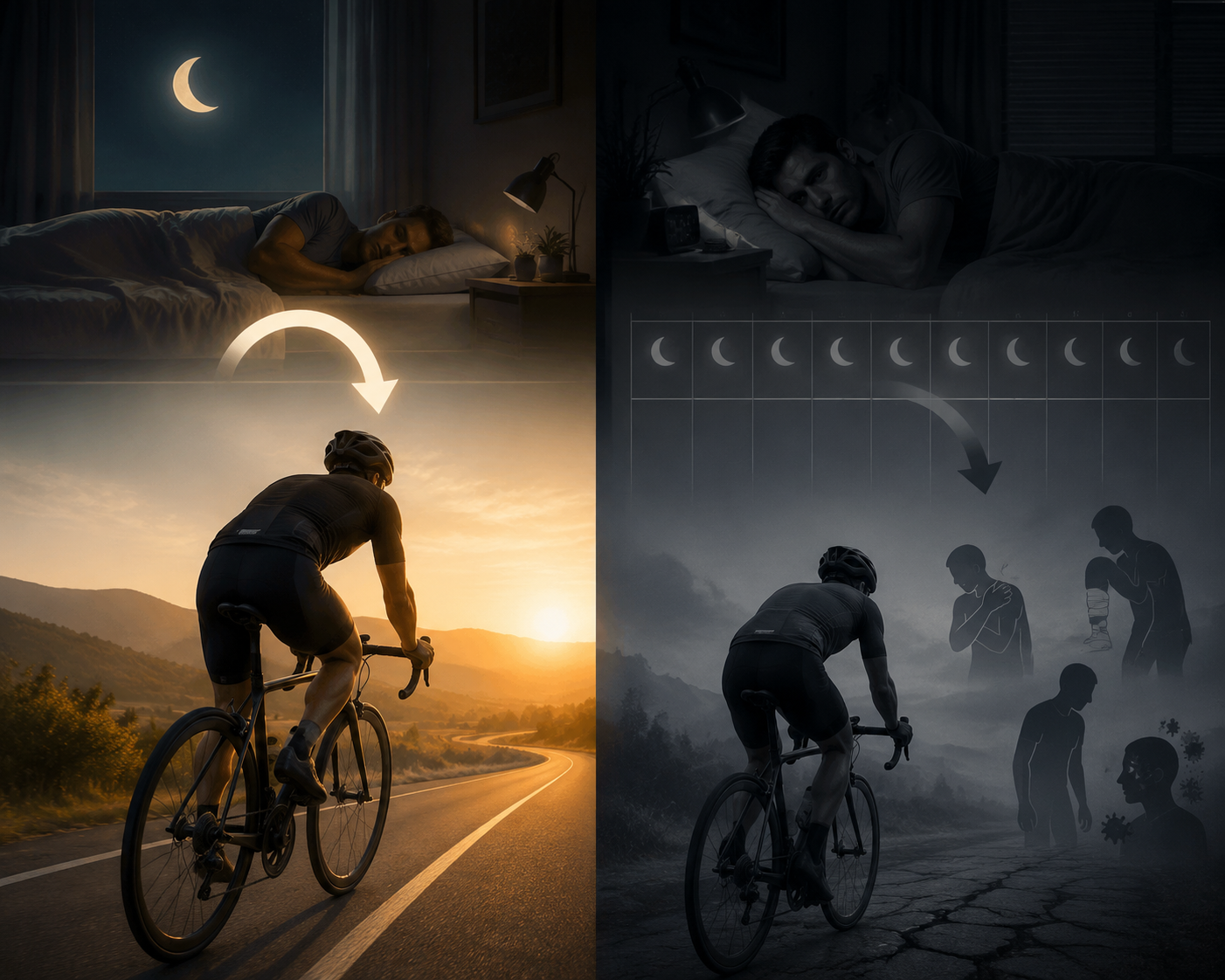
The warning becomes stronger when sleep restriction repeats. A 2019 review by Vitale and colleagues reported that restricting sleep to 2–4 hours per night across three nights can reduce submaximal performance metrics. The same review noted that even Olympic athletes often sleep only 6.5–6.8 hours despite high recovery demands.[2]
That should feel familiar to amateur cyclists, not comforting. A lot of riders are not choosing between perfect sleep and disaster. They are choosing between a consistent seven-plus-hour routine and the slow leak of late work, early alarms, hard sessions, and weekend events. The adult baseline is still best understood as a range, not a single magic number; Restful Ground’s guide to how many hours of sleep adults need explains the usual 7–9 hour recommendation and why individual variation does not erase the pattern.
The chronic-health evidence is sharper. In Cohen et al.’s controlled viral-challenge study of 153 adults, sleeping less than seven hours was associated with about a threefold greater likelihood of developing a cold compared with sleeping eight hours or more.[3] In Prather et al.’s later study, sleeping less than five hours was associated with a 4.5-fold higher risk of developing a cold compared with sleeping more than seven hours.[4]
For cyclists, illness risk is not an abstract wellness concern. It means missed training, poor adaptation, disrupted event blocks, and the familiar bad bargain of trying to ride through symptoms because the plan says intervals. Chronic sleep below seven hours is also linked with 1.7-fold higher injury risk and threefold infection risk over time. Those are not claims about one bad night before a fondo; they are about repeated under-recovery becoming part of the training environment.
| Sleep situation | What the evidence supports | How a cyclist should treat it |
|---|---|---|
| One night of very poor sleep | Moderate-intensity cycling may feel harder; one recovery night restored baseline in the Gattoni study | Adjust expectations, ride if appropriate, and protect the next night |
| One acute total sleep-deprivation event | A 20-minute high-intensity time trial was not significantly impaired in 26 male amateur cyclists | Do not assume the hard effort is doomed, but do not turn the finding into bravado |
| Several nights of 2–4 hours sleep | Submaximal performance metrics can decline | Reduce load and prioritize recovery before adding intensity |
| Weeks of routinely sleeping below seven hours | Injury and infection risk become the larger concern | Treat it as a training-health issue, not a minor inconvenience |
What to do the day after a bad night
The morning-after plan should be boring. That is a compliment. The goal is not to rescue the day with heroic hacks; it is to avoid turning one bad night into two or three.
- Keep the ride light if the session is optional. Easy endurance, skills work, or a shorter spin usually beats forcing a demanding workout when perceived effort is already inflated.
- If it is race day, warm up normally and judge the body by the first real efforts, not by how anxious you felt at breakfast.
- Prioritize the next night of sleep. The Gattoni study’s useful finding was not that deprivation is harmless; it was that a recovery night restored the measured moderate-intensity performance to baseline.
- Avoid compounding the problem with caffeine after noon. Morning caffeine may be part of your normal routine, but late caffeine is a good way to make the recovery night worse.
- Reset bedtime instead of chasing perfection. A long panic nap late in the day can make the next night harder; a short early nap may help some riders, but the main target is the normal sleep window.
The mistake is treating every bad night as a problem that needs a complicated intervention. Most of the time, the better move is to reduce the next training decision by one notch and make the next sleep opportunity easier to take.
The routine that gives cyclists the most resilience
If there is one sleep habit worth defending, it is a consistent schedule within about a 30-minute window. Not because it sounds impressive, but because it is the routine-builder that survives real life better than most sleep advice. Riders can argue forever about screens, room temperature, supplements, mouth tape, magnesium, and the perfect pillow. A stable sleep-wake schedule quietly does more of the basic work.
Vitale et al. emphasize sleep hygiene as part of athlete recovery, and the practical center of that advice is regularity: giving the body a predictable window for sleep rather than asking it to improvise around training, work, and late scrolling.[2] For cyclists, that means the weekday bedtime matters as much as the night before the big ride.
This is also where inflated performance claims need a filter. A 5–15% improvement figure sometimes attributed to sleep coaching in cycling media should be read as practitioner testimony unless it is tied to a controlled finding. Better sleep may help performance, especially when it replaces chronic restriction, but a precise percentage should not be treated like a guaranteed wattage upgrade.
The same caution applies to cycling-blog interpretations of sleep research. If a claim sounds like it turns a small study into a universal rule, follow it back to the original source. The Gattoni paper supports a useful, bounded conclusion. It does not prove that every cyclist, in every event, under every kind of stress, can ignore a sleepless night.
When to stop calling it “just a bad night”
A single rough night before a ride calls for adjustment. A pattern calls for attention. If poor sleep has lasted two weeks or more, especially with mood changes, frequent illness, or plateauing performance, treat it as a training-health issue. That may mean reducing load, moving intensity, talking with a clinician, or looking honestly at work stress and recovery time.
The calmer conclusion is also the more useful one. One terrible night does not mean the race is ruined. A single recovery night can restore moderate-intensity cycling performance to baseline in the best direct study we have, and short high-intensity performance may be more resilient than expected.[1] The real debt accumulates when sleep restriction becomes routine, especially below seven hours, and starts changing the odds of illness, injury, and stalled adaptation.
References
- Effects of total sleep deprivation and recovery sleep on cycling performance in amateur cyclists, European Journal of Applied Physiology, 2026.
- Sleep Hygiene for Optimizing Recovery in Athletes: Review and Recommendations, PMC, 2019.
- Sleep Habits and Susceptibility to the Common Cold, Archives of Internal Medicine, 2009.
- Behaviorally Assessed Sleep and Susceptibility to the Common Cold, Sleep, 2015.
Comments
Join the discussion with an anonymous comment.