
The sleep effect of gaming before bed depends less on the word gaming than on what the game asks your body and brain to do at 11:30 p.m. A few slow puzzle rounds in bed are not the same experiment as queueing into a ranked shooter, starting a horror chapter, joining a raid, or logging into an MMORPG where other people are waiting.
That distinction matters because many adults are not gaming at night to be reckless. In a study of adult media use as a sleep aid, 10.3% of adults reported using video games to help them sleep.[1] That does not prove games improve sleep. It does prove the habit is already serving as a wind-down tool for some people, which is a better starting point than pretending every player is simply ignoring bedtime.
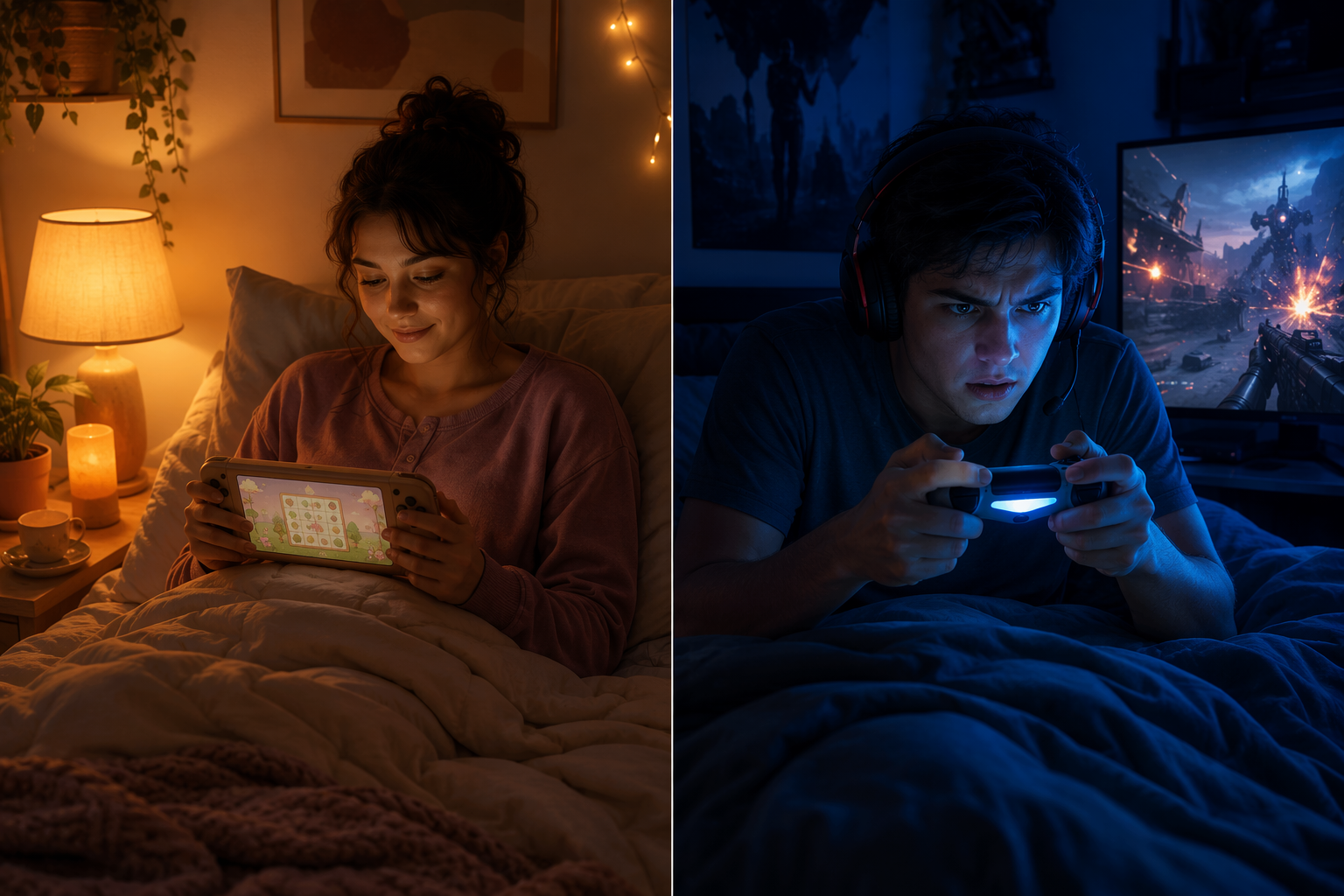
The best-supported answer is cautious but useful: before-bed gaming is not uniformly bad for sleep, but high-arousal genres are the ones most likely to cause trouble. A 2024 systematic review in Sleep Medicine concluded that non-arousing, cognitively stimulating games such as word games and puzzles may enhance sleep quality, while horror, shooter, and MMORPG genres can interfere with sleep.[2] The caveat is important: the full text was not directly verifiable without authentication, so the genre-specific conclusions here are attributed through the published abstract record, author summary, and secondary reporting rather than treated as independently checked line by line.
Why Genre Changes the Sleep Effect
Arousing games do not delay sleep because pixels have a special anti-sleep property. They delay sleep because they keep systems active that bedtime is supposed to quiet: attention, threat monitoring, social obligation, emotional reaction, and the urge to finish one more attempt.
A horror game keeps you scanning for danger. A competitive shooter keeps score, punishes mistakes, and invites immediate re-entry after a loss. A ranked match adds status pressure. A raid or MMORPG session adds a social contract: stopping is no longer only your decision. These are different sleep inputs than a word puzzle that ends cleanly after a round.
This is also why “blue light” is too small an explanation. Screen light can matter, but when gaming before bed affects sleep, cognitive arousal and bedtime displacement often explain more of the real-life problem: the game makes you alert, then it makes the session longer than planned. For a broader breakdown of those mechanisms, see how technology affects sleep.
The useful question is not whether a game looks cute or violent on the surface. It is what the game does to your stopping ability. Does it create a natural endpoint, or does it roll you into the next match? Does losing make you want revenge? Does success unlock a timed event? Is another person depending on you to stay? The body reads those design choices as activation.
What Counts as a Safer Bedtime Game
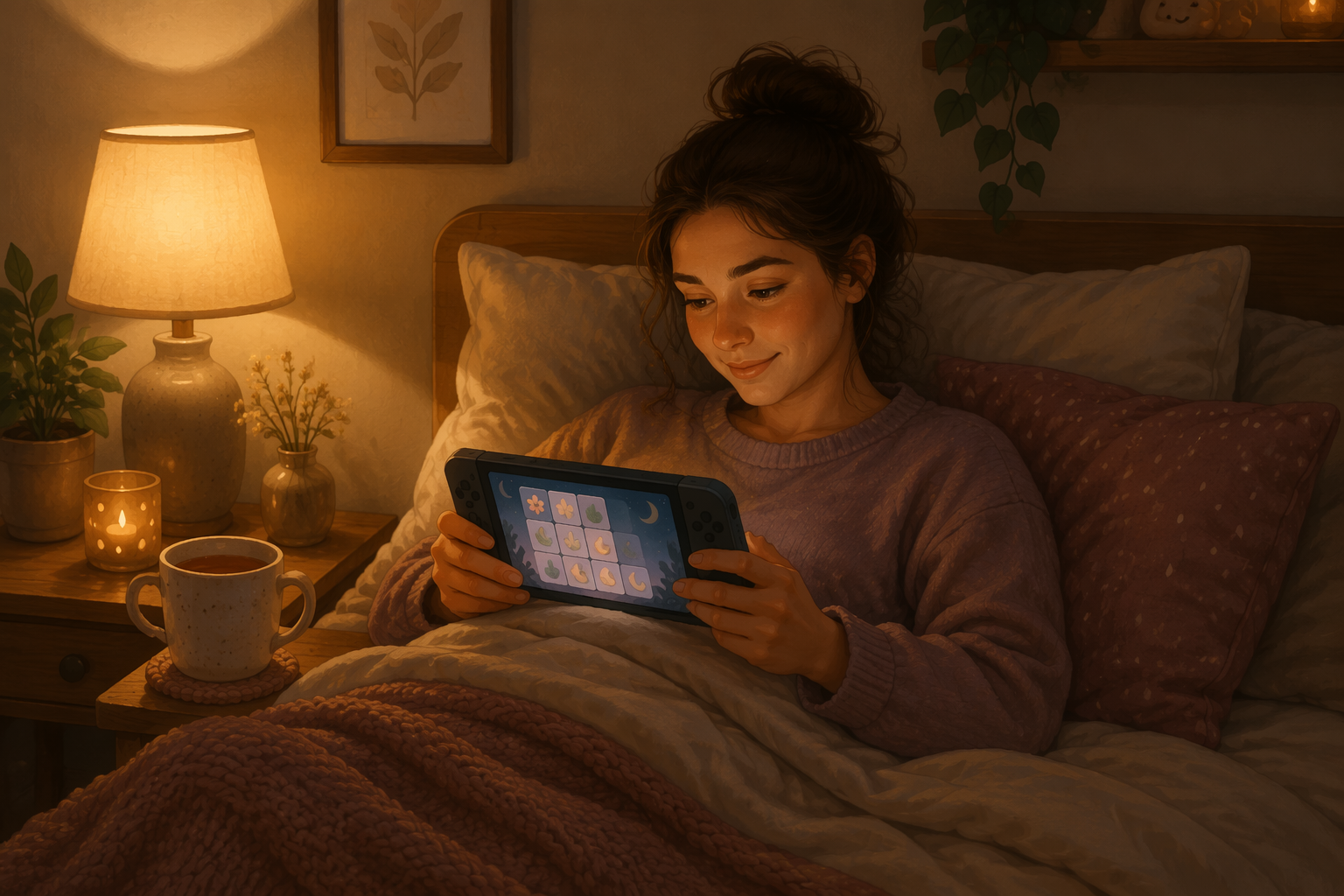
“Cozy” is useful only if it means something observable. A safer bedtime game is usually short, predictable, emotionally low-stakes, and easy to stop. It has low time pressure, low threat, no competitive punishment, and no social obligation to keep playing.
| Better fit close to bed | Riskier close to bed |
|---|---|
| Word games with short rounds | Ranked competitive matches |
| Simple puzzles with clear stopping points | Shooters that encourage immediate rematches |
| Cozy games with optional tasks and no urgent penalty | Horror sequences designed around threat and suspense |
| Low-stakes solo play that can be paused or saved | MMORPG sessions, raids, or timed group events |
That is why a farming sim, decorating game, gentle puzzle, or word game can be compatible with sleep for some players. Rebecca Robbins, a Harvard sleep scientist quoted by Verywell Health, specifically pointed to cozy games such as Stardew Valley and Animal Crossing as games that can help players wind down when the activity is meaningfully different from their daily work.[3]
The last clause matters. If your job is project management, a game that turns bedtime into resource optimization, timed chores, and inbox-style task clearing may not feel restful even if the art is adorable. If your day is full of social performance, a “cozy” multiplayer space may still keep you socially switched on. The game’s genre label is a clue, not a guarantee.
The 60-Minute Line Is a Useful Guardrail
Even a gentle game can become sleep-negative if it expands into the time you meant to sleep. In a survey of 844 adults, Exelmans and Van den Bulck found that gaming’s sleep effects became detrimental when daily play exceeded 60 minutes.[4] That threshold should not be treated as a magic biological cutoff, but it is a practical boundary: once the session passes an hour, the problem may be duration as much as genre.
This is where many regular players get into trouble. The first 20 minutes may genuinely decompress the day. The next 40 minutes may still feel harmless. Then a save point, daily quest, ranked ladder, or group chat turns the session into bedtime displacement. Nothing dramatic has to happen. Sleep just loses the negotiation by small increments.
A workable rule is to decide the stop condition before opening the game. “One puzzle set,” “one in-game day,” or “one short route” works better than “I’ll stop when I feel tired,” because many games are built to make tired people keep interacting. If the game has no natural endpoint, it is a poor bedtime game even if you enjoy it.
Exposure and Fitness Games Complicate the Picture
The evidence does not support a clean rule that every intense-looking game affects every player the same way. In one study, violent game exposure reduced sleep quality in low-exposure gamers, while high-exposure gamers did not show the same effect, possibly because of desensitization.[5] That is a caution against universal claims, not a license to assume experienced players are immune.
Active gaming also resists easy sorting. In a study of undergraduates, a sport-racing fitness game played for 30 minutes, three times per week, improved sleep quality under controlled conditions.[6] That finding is useful because it shows “active” or “video game” does not automatically mean bad for sleep. It does not mean a sweaty, late-night, competitive session is a good idea right before bed.
The pattern is narrower and more believable: game context changes the outcome. Timing, exposure history, session length, emotional intensity, and whether the game is solo or socially binding all shape the result.
How Strong Is the Evidence?
The genre distinction is useful, but the evidence is not as tidy as a bedtime rule printed on a controller. Several important gaming-and-sleep studies have used small, adolescent, all-male samples, which limits how confidently they can be generalized to adult women, older players, or people with different sleep schedules.[2][5]
Self-reported sleep also appears often in this literature. That does not make the findings worthless; people’s perceived sleep quality matters, especially when the question is whether a habit leaves them feeling rested. But self-report is not the same as polysomnography or other objective sleep measurement.
So the honest conclusion is not “gaming improves sleep.” It is that low-arousal games appear more compatible with sleep than high-arousal games, and that some gentle, bounded games may help certain players transition out of the day. That is enough to guide tonight’s choice without pretending the science is finished.
A Bedtime Game Selection Rule
If gaming is part of your wind-down routine, choose the game by its sleep behavior, not by whether it is technically a “screen.” A good pre-bed game should lower stakes, offer a natural stopping point, avoid threat and competition, and stay inside a reasonable time boundary.
- Green light: short word games, simple puzzles, solo cozy games, low-pressure building or tending tasks, and games you can stop without penalty.
- Yellow light: cozy games with daily tasks, collection loops, social features, or optimization pressure; keep these on a clear timer.
- Red light near bed: horror, ranked competition, shooters, raids, MMORPG commitments, timed events, and anything that makes you chase revenge or completion.
- Move earlier: any game that leaves your body alert, stretches past the planned stop, or keeps your mind replaying decisions after the screen is off.
This is also a behavior-design problem. If you know what helps but keep losing the evening to one more round, the issue may be the familiar gap between sleep knowledge and nightly action. For broader routine help, Good Night Sleep: Why Knowing Isn’t Doing — and How to Fix It is a better next read than another lecture about willpower.
The point is not to become a person who never plays at night. It is to stop treating every game as the same bedtime choice. If the game is quiet, bounded, low-stakes, and easy to leave, it may fit your wind-down. If it makes you tense, socially obligated, competitive, or unable to stop, it belongs earlier in the evening.
References
- Media use as a sleep aid in adults, Behavioral Sleep Medicine, 2014.
- The impact of videogames on sleep: A systematic review, Sleep Medicine, 2024.
- Can Playing Video Games Before Bedtime Impact Your Sleep?, Verywell Health, 2024.
- Sleep quality is negatively related to video gaming volume in adults, Journal of Sleep Research, 2015.
- The effect of violent and nonviolent video games on heart rate variability, sleep, and emotions in adolescents with different violent gaming habits, Psychosomatic Medicine, 2013.
- The effects of active video games on sleep quality among university students, International Journal of Environmental Research and Public Health, 2020.
Comments
Join the discussion with an anonymous comment.