
You can make the room dark, quiet, and nominally cool and still wake as if the night never quite consolidated. That is where “sleep hygiene” advice often becomes strangely accusatory: if the checklist is complete, the problem must be you. Bedroom air complicates that story. In one bedroom-level study, people kept rating the air as “just right” while instruments showed carbon dioxide and temperature moving enough to predict sleep efficiency. The same study measured PM2.5, CO2, temperature, and noise at the same time in real bedrooms, and each one independently predicted sleep efficiency; the highest PM2.5 quintile corresponded to a 3.2% drop, and the highest CO2 quintile to a 4.0% drop.[1]
That is the useful question behind the sleep effects of air quality: not whether “fresh air” is virtuous, but which invisible exposures can reduce the amount of the night you actually spend asleep, even when the room feels acceptable.

The bedroom can feel fine while measuring poorly
The Basner study is small enough to treat carefully: 62 adults in Louisville, Kentucky, not a national sample. Its strength is not scale. Its strength is the bedroom setup. Rather than estimating exposure from a distant monitor, the researchers measured the environment where sleep was happening and paired it with actigraphy. That makes the finding harder to dismiss as another vague warning about “bad air.”[1]
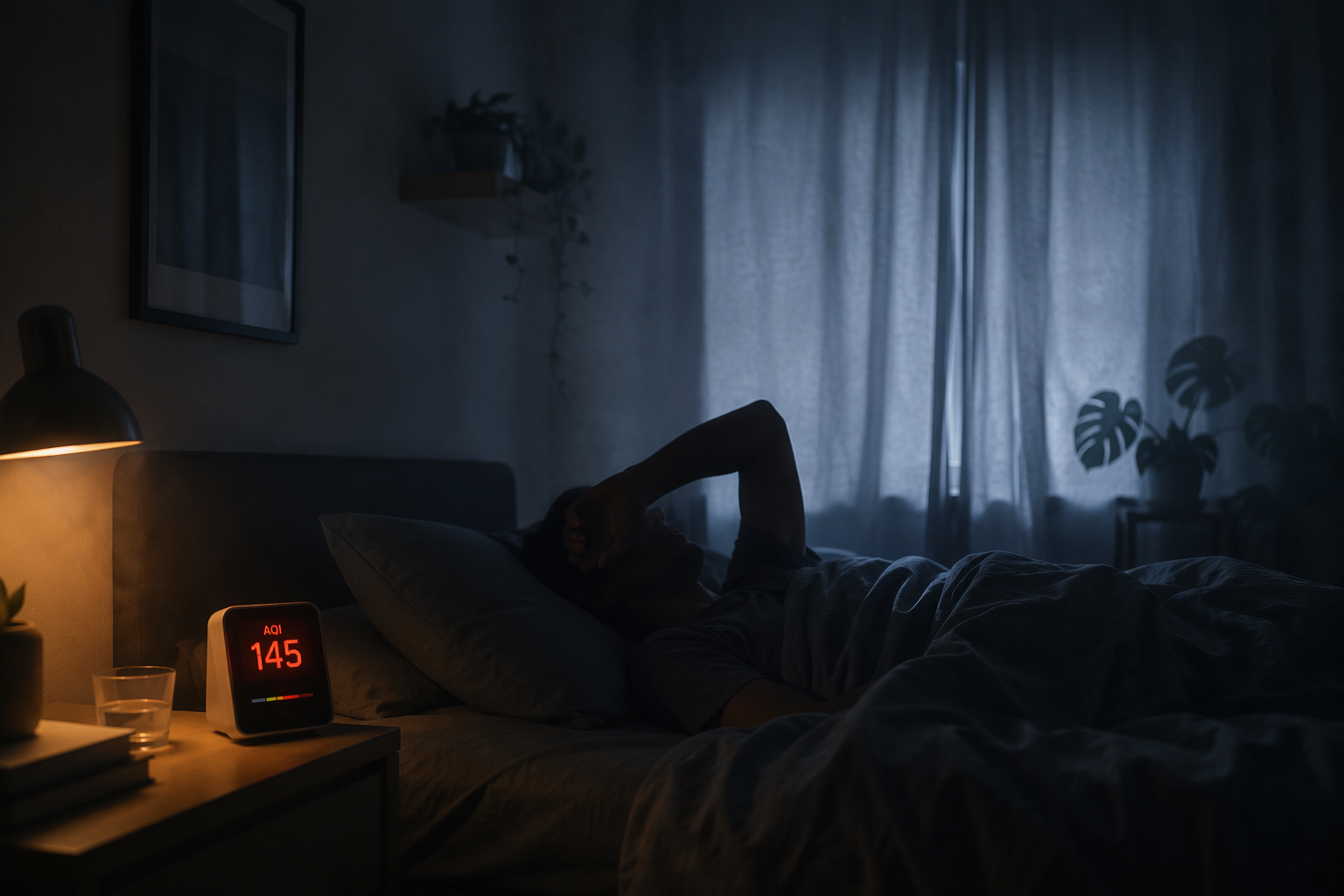
The perception result matters almost as much as the sleep-efficiency result. Participants did not reliably feel the CO2 or temperature differences that showed up in the data. A room can be stuffy in the measurable sense before it feels stuffy in the human sense. By the time you notice it, the night may already have spent hours in a different exposure range.
That is why broad advice like “keep the room cool and well ventilated” can be both correct and unhelpful. It skips the part where a closed bedroom may protect you from traffic noise, wildfire smoke, pollen, security risk, or a heat wave. It also skips the part where opening a window can lower CO2 while raising PM2.5 or NO2. The useful unit is not a virtue signal. It is the measured room over several nights.
Four exposures, not one vague problem called “bad air”
PM2.5, CO2, NO2, and temperature do not behave the same way in a bedroom. They come from different sources, respond to different fixes, and probably affect sleep through different routes. Treating them as one blended “air quality” issue is how people end up with advice that works in one apartment and backfires in the next.
| Variable | What it often reflects at night | Why it can affect sleep |
|---|---|---|
| PM2.5 | Fine particles from outdoor pollution, wildfire smoke, cooking residue, combustion, or infiltration | Airway irritation and inflammation; possible central nervous system effects |
| CO2 | Exhaled breath accumulating in a closed or poorly ventilated room | Ventilation adequacy; elevated levels are linked with poorer sleep quality and next-day performance |
| NO2 | Traffic pollution and combustion sources, especially near roads or with gas appliances | Respiratory irritation and inflammation; associated with lower sleep efficiency in cohort studies |
| Temperature | Outdoor heat, building insulation, HVAC limits, bedding, body heat, and ventilation choices | Thermoregulation strain and sleep disruption, especially in vulnerable groups |
VOCs belong in the wider indoor-air picture, but the strongest sleep-specific material here is not about scented candles or furniture off-gassing. The better-supported sleep discussion starts with particles, combustion gases, CO2 accumulation, and heat.
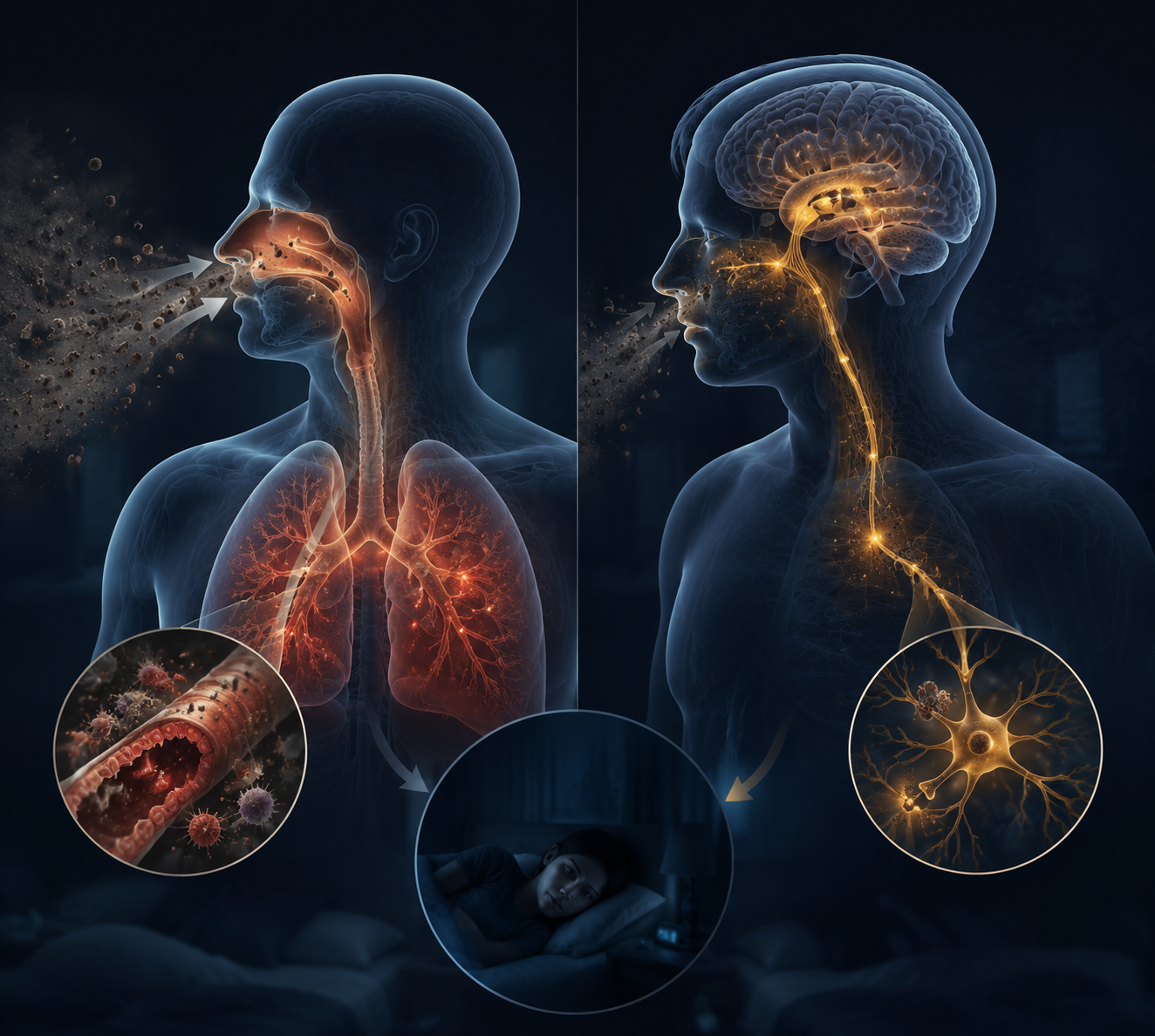
PM2.5 and NO2 first act like airway problems
The most grounded mechanism for PM2.5 and NO2 is respiratory. A systematic review of 22 studies across the life course described air pollution as a sleep disruptor through inflammation and irritation in the respiratory tract: edema, airway narrowing, snoring, and possible worsening of obstructive sleep apnea are the practical sleep-relevant consequences.[2]
This is not an exotic pathway. If the nose, throat, and airway are more irritated at night, the sleeper may breathe with more resistance, snore more, fragment sleep more often, or spend less time in efficient sleep. For someone already near the edge of sleep-disordered breathing, pollution does not need to “cause insomnia” to matter. It only has to add enough respiratory load to make the night less stable.
The same review also discusses a more direct central nervous system route: pollutants may affect the brain through the olfactory nerve and alter neurotransmitter levels, including serotonin. That pathway is plausible and important, but the review authors describe it as not fully understood, and much of the support comes from animal and in vitro work rather than clean bedroom intervention trials.[2]
There is also a measurement caveat. Only 5 of the 22 studies in that review measured indoor pollution directly; many relied on ambient monitoring station data.[2] That does not make the findings useless, but it means a city-level pollution number may not tell you what your pillow-level exposure was during a closed-window night.
CO2 is the bedroom variable people most often misread
CO2 is different from PM2.5 and NO2. In an ordinary bedroom, the main source is usually the sleeper. A closed door, closed window, small room, and long sleep opportunity can turn exhaled breath into a ventilation signal. You may not smell anything. You may not feel hot. The number can still climb.
The DTU/ASHRAE bedroom work made that visible. In a 16-participant within-subject crossover design, closed-bedroom CO2 averaged 2,395 ppm, compared with 835 ppm under ventilated conditions. Better ventilation improved reported sleep quality and next-day cognitive performance.[3]
That does not prove that every person should sleep with a window open. It does show why CO2 deserves its own category. It changes quickly with occupancy and ventilation, so it can improve within days when the airflow problem is solvable. It is also exactly the kind of exposure people are bad at judging by feel, which matches the Basner finding that subjective bedroom-air ratings stayed “just right” despite meaningful measured differences.[1]
A 2024 Building & Environment comparison sharpened the point by finding that elevated CO2 reduced sleep quality more than changes in temperature or relative humidity in that study context.[4] That is not a license to ignore heat or humidity. It is a reminder that the silent accumulation of exhaled air can be more consequential than the comfort variable you notice first.
For a fuller treatment of the ventilation mechanics, the site’s deeper guide to CO2 buildup and sleep quality is the more focused read. The short version here is mechanical: if CO2 rises through the night, the room is not exchanging enough air for the number of people, room volume, and closure level.
Temperature is not just a comfort preference
Temperature is the bedroom exposure most likely to be treated as personal preference: one person likes a cold room, another needs socks. But population data suggest nighttime heat changes sleep at a scale too large to reduce to taste. Obradovich and colleagues analyzed responses from 765,000 people and found that a 1°C rise in nighttime temperature was associated with about 3 additional nights of insufficient sleep per 100 people per month, with stronger effects in summer, older adults, and lower-income groups.[5]
The vulnerable-group pattern is important because heat is not evenly distributed as a sleep problem. A person with weak air conditioning, a top-floor apartment, poor insulation, medication-related heat sensitivity, or limited ability to pay for cooling does not experience “keep it cool” as a simple behavioral instruction. Heat can also conflict with ventilation: opening a window may lower CO2 while raising room temperature, or it may help only after the outdoor temperature drops.
Temperature also interacts with the body’s normal overnight thermoregulation. Sleep onset and continuity are easier when the body can shed heat appropriately. When the room stays warm, the sleeper may not fully wake for long periods, but micro-arousals, restlessness, or reduced sleep efficiency can still show up by morning.
What the larger cohorts add
Once the pathways are separated, the large cohort findings become easier to interpret. They do not tell you exactly what happened inside one bedroom last night, and most are observational rather than causal. They do show that the same pollutants implicated by airway mechanisms are associated with sleep outcomes at population scale.
In the UK Biobank analysis, high NO2 exposure was associated with roughly 60% higher odds of low sleep efficiency, and high PM2.5 exposure with roughly 50% higher odds.[6] The MESA Sleep study likewise links air pollution exposure with sleep-disordered patterns, adding plausibility across a different cohort.[7]
The limitation is the usual one: ambient exposure estimates do not always equal bedroom exposure. A person in a tight building with filtration may have lower particle exposure than the neighborhood monitor suggests. Someone beside a leaky window or near a combustion source may have higher exposure. For urban context, the Chicago-focused discussion of how local air quality disrupts sleep is useful precisely because outdoor averages and indoor nights do not always line up neatly.
Why “just open a window” is sometimes right and sometimes wrong
If the problem is CO2 accumulation and the outdoor air is clean, quiet, safe, and not too hot or cold, ventilation is the obvious lever. Opening a door, cracking a window, using a fan to improve mixing, or adjusting HVAC operation can move the room from a closed-box night toward a better-exchanged one.
But bedrooms are not laboratory chambers. During wildfire smoke, a window can trade high CO2 for high PM2.5. Near traffic, it may bring in NO2 and noise. During a heat wave, it may make sleep temperature worse. In a ground-floor bedroom, security may be the deciding constraint. With seasonal allergies, the first “fresh air” experiment may be a nasal-irritation experiment.
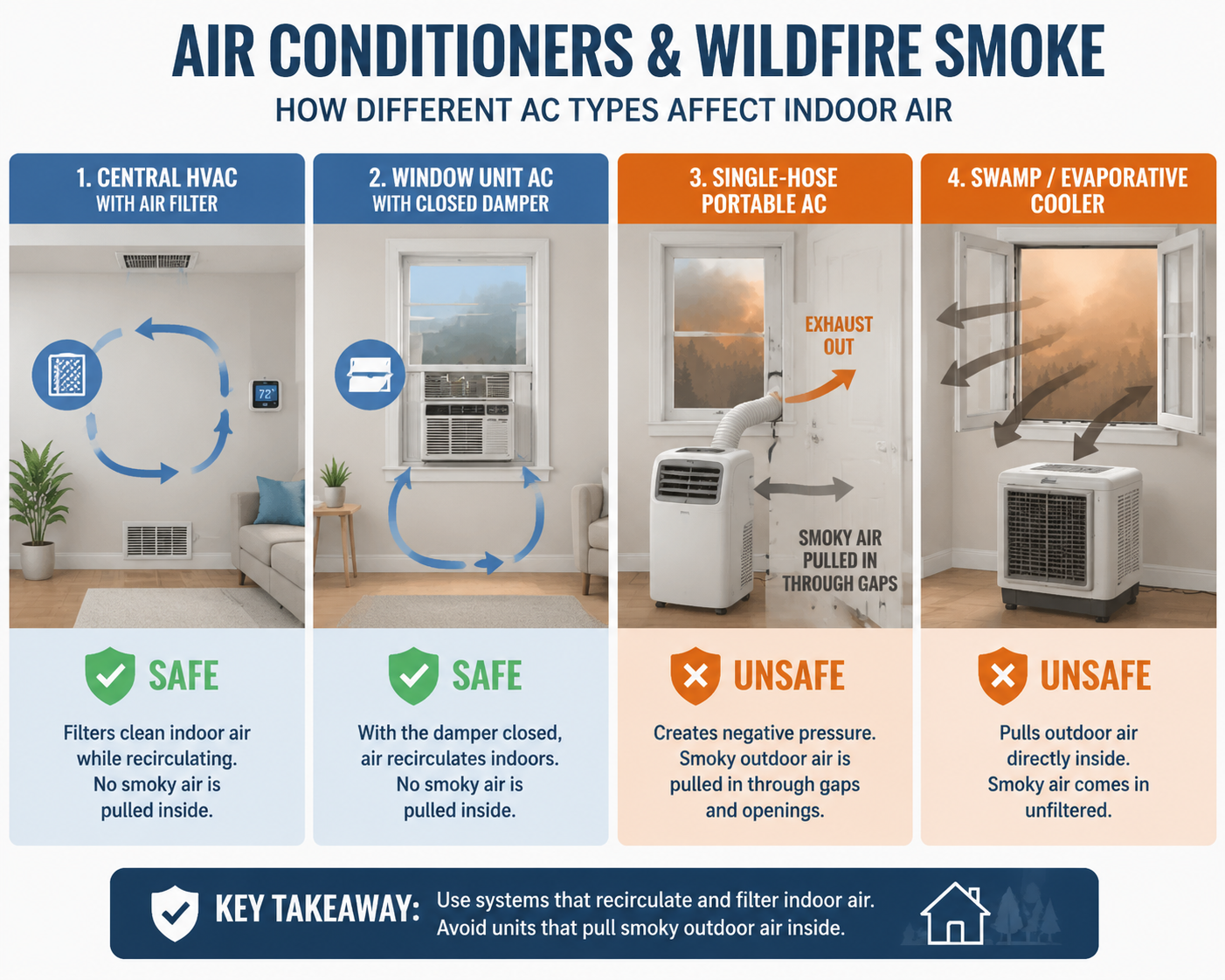
That is where sealed-room tradeoffs matter. During smoke or pollution episodes, the better move may be to keep the envelope tighter, filter recirculated air, reduce indoor particle sources, and accept that CO2 needs a different solution later. The guides to wildfire smoke and sleep and air quality alerts at night cover those conflict days more directly.
A measured several-night loop beats another bedtime ritual
If the basics are already in place, there is no need to re-moralize the evening. Keep the broader behavioral checklist where it belongs; if you need that foundation, use an evidence-based sleep hygiene checklist. For the bedroom-air question, the more rational experiment is short, boring, and instrument-based.
- Measure CO2, PM2.5, and bedroom temperature across several ordinary nights instead of relying on how the room feels at bedtime.
- Compare nights with different door, window, HVAC, or filtration conditions, changing one main variable at a time when possible.
- Treat CO2 below 800 ppm as a practical ventilation reference point, not as a sleep-specific medical threshold.
- Treat PM2.5 below 15 μg/m³ as a practical clean-air reference point, again drawn from general indoor-air guidance plus sleep evidence rather than a single sleep standard.
- Watch the tradeoffs: a change that lowers CO2 but raises PM2.5, NO2, noise, or heat may not improve the night.
The promise is not that a sensor fixes sleep. The promise is that it can stop you from guessing about exposures humans are not built to perceive accurately. Bedroom air affects sleep through independently measurable variables; the next useful step is to measure the room you actually sleep in, adjust the constraint that is actually present, and see whether the night changes within days.
References
- Effects of bedroom environmental conditions on sleep quality, Sleep Health, 2023.
- The effect of air pollution on sleep: A systematic review, 2020.
- The effects of bedroom air quality on sleep and next-day performance, ASHRAE Journal, 2017.
- Effects of elevated carbon dioxide, temperature, and relative humidity on sleep quality, Building & Environment, 2024.
- Nighttime temperature and human sleep loss in a changing climate, Science Advances, 2017.
- Air pollution and sleep: evidence from the UK Biobank, 2020.
- The association of ambient air pollution with sleep apnea: the Multi-Ethnic Study of Atherosclerosis, 2019.


Comments
Join the discussion with an anonymous comment.