
Most tips for preventing jet lag from long flights sound reasonable until they meet a real itinerary. Morning light helps after one trip and makes the next one worse. Melatonin feels useful on a flight to Europe, then oddly mistimed on the way home. The missing question is usually not whether the tip is good. It is which way you are trying to move your body clock.
Eastbound travel and westbound travel ask the circadian system to do opposite things. Flying west usually requires a phase delay: stay awake later, sleep later, and let the clock drift backward. Flying east usually requires a phase advance: get sleepy earlier, wake earlier, and pull the clock forward. The CDC Yellow Book puts numbers on the asymmetry: after time-zone travel, people tend to adapt at about 1.5 hours per day when traveling westward, compared with about 1 hour per day when traveling eastward.[1]

That is why a direction-blind checklist can fail a careful traveler. A westbound itinerary often works with the body's natural tendency to run slightly longer than 24 hours. An eastbound itinerary asks the body to do the harder thing: advance. If you want a broader baseline before getting into direction-specific timing, start with this general jet lag prevention framework. The rest of this guide is for the part that baseline advice often skips.
First, Decide Whether To Adapt At All
Full adaptation is not always worth the effort. If you are crossing fewer than 3 time zones, or if the trip lasts only 2 to 3 days, the CDC and Huberman Lab both note that staying closer to your home schedule may be more practical than forcing a full circadian shift.[1][2]
| Your trip | Main clock move | Practical strategy |
|---|---|---|
| Eastbound across several time zones | Phase advance | Move sleep earlier before departure; use carefully timed morning light after the body is ready; consider low-dose melatonin before destination bedtime. |
| Westbound across several time zones | Phase delay | Move sleep later before departure; use evening light after arrival; avoid accidentally advancing the clock too early. |
| Fewer than 3 time zones or a 2- to 3-day trip | Often not worth full adaptation | Keep meals, sleep, and obligations partly anchored to home time when possible. |
The annoying but useful truth is that the best plan may be no aggressive plan. If you land in New York from Chicago for a two-day meeting, shifting your whole sleep schedule may create more disruption than the flight itself. If you fly from Los Angeles to London for a week, the math changes.
Eastbound Flights: Pull The Clock Earlier
Eastbound jet lag is where generic advice does the most damage. You are trying to become sleepy earlier than your body expects. That means the plan starts before the airport, not after the first bad night in the hotel.
Before departure: start the phase advance
For 3 to 4 days before an eastbound trip, move bedtime and wake time earlier by about 30 to 60 minutes per day. This gradual shifting approach is supported by CDC, Mayo Clinic, and Harvard Health guidance on reducing jet lag by adjusting the circadian clock before travel.[1][3][4]
The target is not to become perfectly adapted before the plane takes off. It is to reduce the size of the jump waiting for you after arrival. A traveler who shifts 2 hours earlier before a 6-hour eastward time change has not solved jet lag, but they have made the first hotel night less hostile.
- Move bedtime earlier first; do not simply set an earlier alarm and hope exhaustion fixes the rest.
- Dim bright indoor light in the late evening at home, especially in the last hour before the earlier bedtime.
- Get outdoor light soon after the new, earlier wake time if it fits the direction you are shifting.
- Protect the final pre-flight night; starting a long-haul eastbound trip already sleep-deprived makes the timing plan harder to execute.
Melatonin before destination bedtime
For eastward travel, melatonin is usually used as a phase-advance signal rather than as a heavy sedative. The CDC describes 0.5 to 1 mg of fast-release melatonin taken about 90 minutes before destination bedtime as a common timing strategy; Mayo Clinic also describes melatonin as an option for reducing jet lag symptoms.[1][3]
That timing matters more than many travelers realize. Taking melatonin when it is still late afternoon at your destination, or taking a large dose because the hotel bed feels uninviting, can blur the signal you are trying to send. For a deeper treatment of this specific scenario, use the eastward melatonin timing guide rather than treating melatonin as an anytime sleep button.
There is also a product-quality caveat. In the United States, melatonin is sold as a dietary supplement rather than regulated as an FDA-approved drug for jet lag, and the CDC notes that actual melatonin content can vary substantially from label claims.[1] If you use gummies or combination sleep products, read the melatonin gummy quality guide and match the product to the actual sleep problem instead of defaulting to the highest dose.
After arrival: morning light is useful only when it is the right morning light
The most common eastbound mistake is landing, seeing daylight, and forcing bright outdoor light because every article said to get morning sun. Sometimes that is right. Sometimes it is exactly the wrong move.
The useful concept is the body's temperature minimum: the low point in core body temperature that usually occurs about 2 hours before habitual wake time. Huberman Lab describes a practical timing rule based on circadian physiology: bright light before the temperature minimum tends to phase-delay the clock, while bright light after the temperature minimum tends to phase-advance it.[2]
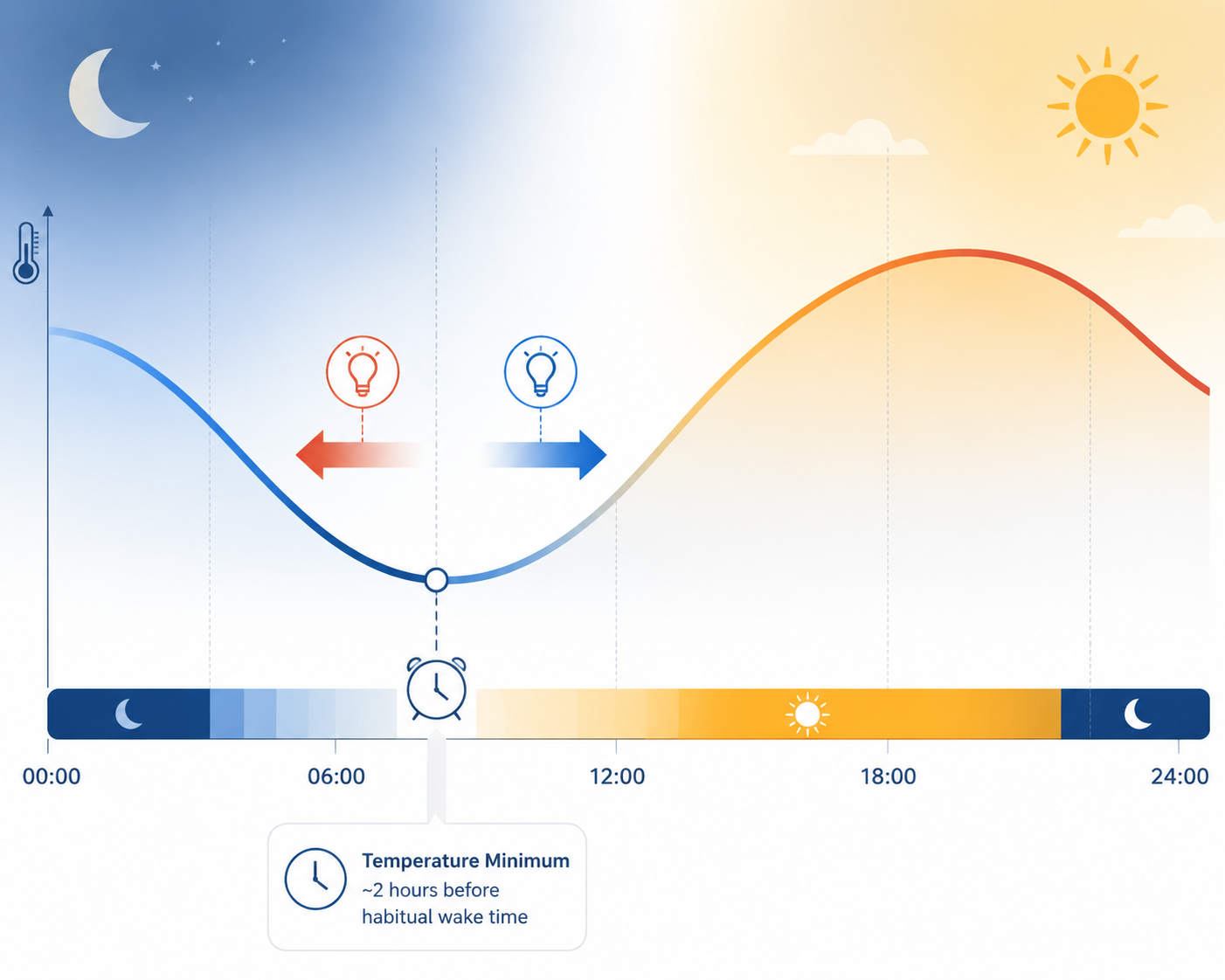
For an eastbound trip, you want a phase advance. That means bright light after your temperature minimum can help. Bright light before that minimum can push you the other way. This is not a large clinical-trial protocol for every traveler; it is a physiology-based timing tool. But it explains a very real failure pattern: the traveler who lands early, stands under bright airport light when their body still thinks it is the middle of the night, and accidentally delays the clock they are trying to advance.
A practical way to estimate the minimum is to start with your usual home wake time and count back about 2 hours. Then translate that biological time into the destination day. If your body still thinks it is before that low point, keep light dim or wear sunglasses if you must move through bright spaces. Once you are past it, seek outdoor light, ideally while walking rather than sitting half-awake beside a hotel window.
This is also where route-specific planning helps. A traveler looking at a concrete overnight eastward route, such as a Manila to Los Angeles flight plan, needs clock math more than another generic reminder to hydrate.
Westbound Flights: Let The Clock Run Later
Westbound travel usually feels easier because it asks the clock to delay. You stay awake later, sleep later, and stretch the day. That fits the body's tendency to run a little long rather than a little short. Easier does not mean effortless; it means the timing strategy is different.
Before departure: shift later
For 3 to 4 days before a westbound trip, move bedtime and wake time later by about 30 to 60 minutes per day when your schedule allows. The same gradual-shift principle appears in CDC, Mayo Clinic, and Harvard Health guidance; the difference is the direction of the shift.[1][3][4]
- Use brighter evening light in the days before departure to support the later bedtime.
- Avoid very early morning bright light if it pulls you back toward an earlier schedule.
- Keep the shift modest if work, driving, or caregiving would make late nights unsafe.
After arrival: use evening light, not an early crash
After a westbound arrival, evening light is often your ally. Stay outside or in bright indoor light during the destination evening, eat dinner on local time if your stomach can tolerate it, and avoid collapsing into a long early-evening nap. The goal is to keep the clock moving later until local bedtime is believable.
Melatonin is handled differently westbound. The CDC describes morning melatonin as a possible phase-delay tool for westward travel, not the usual bedtime strategy used for eastward phase advance.[1] That does not mean every westbound traveler needs it. If you can stay awake until a reasonable local bedtime with light, meals, and movement, the simpler plan is often cleaner.
Exercise can help anchor the new day when it is timed sensibly, especially if it gets you outdoors. Keep hard workouts away from the hour when you are trying to wind down, and use lighter movement after arrival if you are already sleep-deprived. For more on the sleep and circadian effects of activity, see the guide to exercise and sleep pathways.
In Flight, Behave According To Destination Time
The flight itself is not a separate wellness universe. It is a controlled, uncomfortable bridge between two time zones. Once you board, set your watch or phone to destination time and make sleep, caffeine, and meals answer to that clock as much as the cabin schedule allows.
- Sleep when it is night at your destination, especially on eastbound overnight flights.
- Stay awake when it is daytime or early evening at your destination, using light, movement, and low-stimulation activities.
- Use caffeine early in the destination day, not close to destination bedtime.
- Avoid alcohol and excess caffeine; the CDC specifically advises avoiding both during jet lag prevention planning.[1]
- Drink water steadily rather than trying to compensate all at once. The CDC gives a practical range of 200 to 250 ml of water per hour in flight.[1]
Naps are allowed, but they need boundaries. CDC and Sleep Foundation guidance supports keeping naps short, about 20 to 30 minutes, and avoiding naps within 8 hours of destination bedtime.[1][5] That rule matters most when you are tempted to take a 90-minute hotel nap at 5 p.m. and then wonder why 1 a.m. feels wide awake.
A Direction-Specific Plan You Can Actually Use
| Timing | Eastbound: phase advance | Westbound: phase delay |
|---|---|---|
| 3 to 4 days before travel | Move bedtime and wake time earlier by 30 to 60 minutes per day. | Move bedtime and wake time later by 30 to 60 minutes per day. |
| Light before departure | Dim late-evening light; use earlier morning light when it supports the advance. | Use evening light; avoid very early bright light if it pulls the clock earlier. |
| On the plane | Sleep during destination night; avoid caffeine late in the destination day. | Stay awake into the destination evening when possible; sleep when destination night begins. |
| After arrival light | Seek bright light after your estimated temperature minimum; avoid bright light before it. | Use evening light to stay up until local bedtime. |
| Melatonin | Consider 0.5 to 1 mg fast-release about 90 minutes before destination bedtime. | Consider morning use only when a phase delay is needed and appropriate. |
| Naps | 20 to 30 minutes maximum; not within 8 hours of destination bedtime. | Same rule; be especially careful with early-evening crash naps. |
This plan is deliberately less glamorous than most travel advice. It asks you to choose a direction, protect a few timing signals, and avoid the one or two exposures that would push your clock the wrong way. For many long flights, that is the difference between being tired in a predictable way and being tired because your own prevention plan fought the itinerary.
When To Be More Cautious
Melatonin, caffeine, light exposure, and sleep restriction are not equally benign for everyone. If you are pregnant, managing a seizure disorder, taking sedatives or anticoagulants, treating a mood disorder, or planning travel for a child, get medical guidance before using melatonin or aggressive sleep shifting. If you are a pilot, driver, clinician on call, or anyone whose first-day alertness affects other people's safety, prioritize sleep opportunity over a perfect circadian experiment.
Jet lag is common enough that it gets normalized; the CDC cites survey data in which 68% of international business travelers reported regular negative jet lag symptoms.[1] Common does not mean trivial. The point of direction-specific planning is not to hack your way into pretending a long-haul flight was restful. It is to stop giving your body contradictory instructions.
References
- Jet Lag Disorder, CDC Yellow Book 2026
- Defeat Jet Lag, Huberman Lab
- Jet Lag Diagnosis & Treatment, Mayo Clinic
- Resetting Your Circadian Clock to Minimize Jet Lag, Harvard Health, 2016
- How to Get Over Jet Lag, Sleep Foundation




Comments
Join the discussion with an anonymous comment.