
A new flight route is where vague jet lag advice becomes least useful. You may know how you felt after a familiar red-eye or a regular cross-country trip, but a first flight to a different continent gives you no body memory to work from. The direction may be unfamiliar, the time-zone count may be larger than usual, and the schedule printed on the ticket can make the wrong thing look sensible.
Jet lag is most likely once travel crosses three or more time zones, because the sleep-wake system, light exposure, meals, and local clock time stop agreeing with one another.[1] Jet lag prevention tips for new flight routes should therefore start with a plan for shifting the clock, not with a hope that sleep on the plane will solve the problem.

| Planning variable | What to write down | Why it matters |
|---|---|---|
| Habitual wake time | The time you normally wake up at home, not the time you wish you woke up | It estimates your temperature minimum, the anchor for light timing |
| Direction of travel | Eastward or westward, based on time zones crossed | Eastward travel usually requires advancing the clock; westward travel usually requires delaying it |
| Time-zone count | The difference between home time and destination time | It sets how aggressive the pre-flight shift and arrival plan should be |
| Chronotype | Whether you naturally run early, average, or late | It affects how realistic early bedtime, early wake time, and morning light will be |
| Trip length | Whether you have fewer than three days or enough time to adapt | Short trips may be better managed by partial adaptation rather than full local-time conversion |
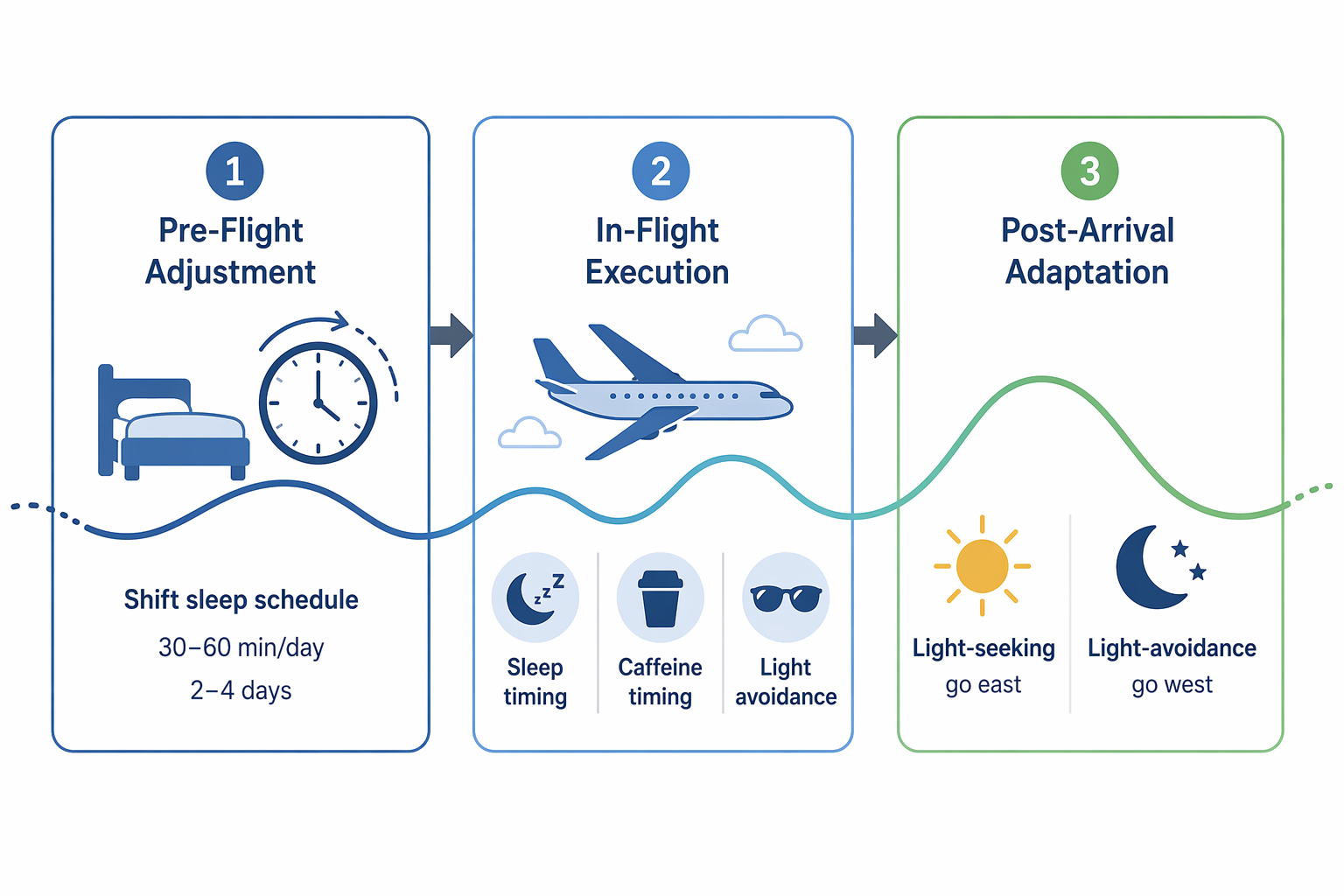
The usable framework has three phases: shift a little before departure, execute the same plan during the flight, and use light after arrival to continue the shift. The plane matters, but mostly because it can protect or damage the schedule you have already built.
Start With Your Temperature Minimum
The most useful number in a jet lag plan is not the departure time or even the destination bedtime. It is your estimated temperature minimum: the low point in your circadian cycle, often roughly two hours before your habitual wake time. If you normally wake at 7 a.m., a working estimate for your temperature minimum is about 5 a.m.
That estimate is imperfect, especially for very early or very late chronotypes, but it gives the plan a hinge. Light exposure after the temperature minimum tends to advance the circadian clock, which is usually what eastward travel requires. Light exposure before the temperature minimum tends to delay the clock, which is usually what westward travel requires.[2]
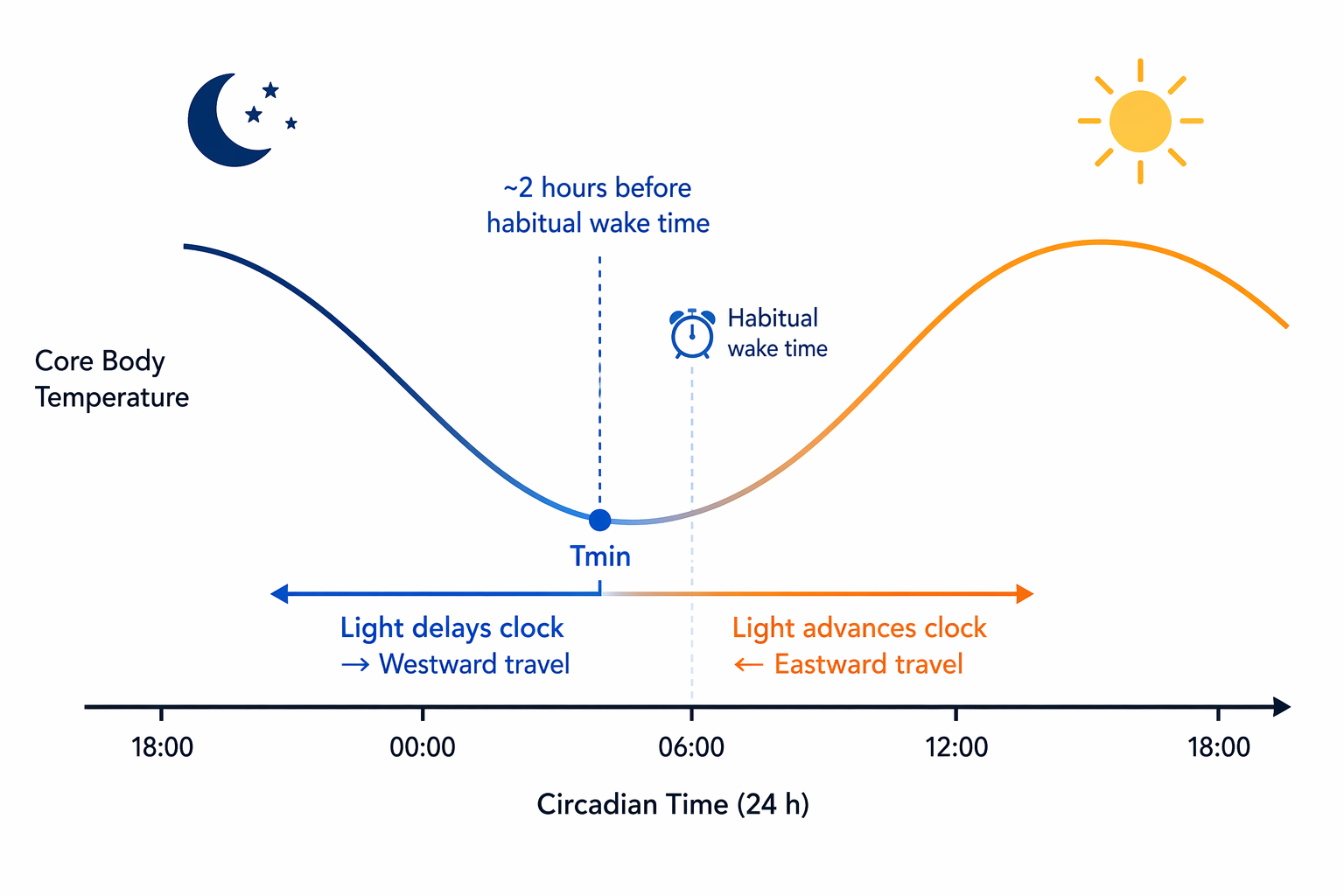
This is where the familiar “get morning sun” advice can misfire. After an eastward overnight flight, local morning may arrive while your body is still near biological midnight. If bright light hits before your temperature minimum, it can push the clock later instead of earlier. The advice sounds healthy; the timing can be wrong.
Eastward routes are harder for many travelers because the circadian system generally advances more slowly than it delays. Sleep Foundation, citing NIH material, reports that eastward travel is harder for about 75% of people.[3] In the classic estimates cited by Eastman and Burgess, the circadian clock advanced by about 57 minutes per day after eastward travel and delayed by about 92 minutes per day after westward travel.[4]
Build The Route Plan Before You Pack
For most new routes, the best first move is a modest pre-flight schedule shift. Move sleep and wake time by 30 to 60 minutes per day for two to four days before departure when your calendar allows it. Harvard Health, Huberman Lab, and the Eastman and Burgess review all describe pre-adjustment as a way to reduce post-arrival jet lag rather than waiting for the destination to do all the work.[2][4][5]
| Route direction | Pre-flight sleep shift | Light priority before departure | Main mistake to avoid |
|---|---|---|---|
| Eastward | Move bedtime and wake time earlier by 30–60 minutes per day | Seek light earlier in your biological morning; dim light earlier in the evening | Taking bright local morning light after arrival before your body has crossed its temperature minimum |
| Westward | Move bedtime and wake time later by 30–60 minutes per day | Seek light later in the day or evening when appropriate; avoid too-early morning light if it pulls you back | Going to bed too early at the destination and locking in an unwanted early wake-up |
For eastward travel, the pre-flight shift is often the most valuable work you can do. If bedtime at home is 11 p.m. and wake time is 7 a.m., moving to 10:30 p.m./6:30 a.m., then 10 p.m./6 a.m., and perhaps 9:30 p.m./5:30 a.m. narrows the gap before you fly. This does not make a nine-hour shift disappear. It reduces the amount of circadian debt you ask the first two destination mornings to pay.
For westward travel, the plan usually runs the other way. Bedtime and wake time move later, and evening light becomes more useful. This is why the same tip can be right for one itinerary and wrong for another. A traveler flying New York to Paris is usually trying to advance; a traveler flying Paris to New York is usually trying to delay. The airport may look the same. The clock arithmetic is not.
Chronotype changes the friction. A late chronotype may struggle more with an eastward pre-shift because the plan asks for earlier sleep before the body is ready. An early chronotype may find westward delay harder because evening alertness fades. The answer is not to abandon the shift; it is to make the step smaller, protect the light timing, and avoid turning the pre-flight week into a second sleep-loss problem.
Use Light As The Main Clock-Setting Tool
Light is the strongest practical cue most travelers can control. The decision is not simply “more light” or “less light.” It is whether light is landing on the advance side or the delay side of your circadian cycle.
- For eastward travel, seek bright light after your estimated temperature minimum and avoid bright light before it.
- For westward travel, seek light before your usual sleep window when it helps delay the clock, and avoid light that would pull you earlier.
- If you are unsure which side of the temperature minimum you are on after arrival, use sunglasses, dim indoor light, or a short delay before seeking full outdoor light.
- Do not let hotel lighting, airport lounges, and phone use accidentally become your light therapy.
A practical eastward example: if your home wake time is 7 a.m., your estimated temperature minimum is about 5 a.m. home time. On arrival, translate that point into destination time. Bright light after that translated point supports an advance; bright light before it risks delay. The exact calculation gets messier with long-haul flights and missed sleep, but this one step prevents the common error of treating every destination morning as automatically helpful.
A practical westward example: if you land in late afternoon and need to stay awake until a reasonable local bedtime, outdoor light can help delay your clock and stabilize alertness. The risk is not usually a too-late clock on the first evening; it is collapsing into bed early, waking at 3 or 4 a.m., and then reinforcing that schedule with early bright light.
Pre-Flight Adjustment: The Part Most People Skip
A new route is easier to manage if the first destination morning is not doing all the circadian work. Two to four days of 30- to 60-minute shifts will not perfectly adapt you to a large time-zone change, but it can move the hardest edge of the trip away from the first meeting, first drive, or first full day outside.
| Days before departure | Eastward route | Westward route |
|---|---|---|
| 4 days out, if possible | Move sleep and wake 30–60 minutes earlier; get earlier morning light | Move sleep and wake 30–60 minutes later; use later-day light |
| 3 days out | Repeat the earlier shift if sleep quality holds | Repeat the later shift if wake time can move safely |
| 2 days out | Protect the new bedtime from evening bright light | Avoid early bedtime; keep evening light consistent |
| 1 day out | Prioritize sleep duration over squeezing in one more aggressive shift | Prioritize sleep duration over forcing a late night |
The last line matters. Pre-adjustment is useful only if it does not create sleep deprivation before the trip begins. A 30-minute shift that preserves sleep is better than a heroic 90-minute shift that leaves you wired, short-slept, and dependent on caffeine before boarding.
If your route involves an unfamiliar connection, plan from the final destination, not the layover. The connecting airport may decide when you can eat or nap, but it should not decide the circadian target unless the stopover is long enough to function as a real destination.
Melatonin Helps Only If The Timing Fits The Direction
Melatonin is often discussed as if it were a mild sleeping pill. For jet lag, that framing is too blunt. It can shift circadian timing, but the effect depends heavily on when it is taken. Mayo Clinic describes melatonin as a possible jet lag treatment, and research summarized by Roach and Sargent notes that low doses in the 0.5 to 3.0 mg range, when timed correctly, can shift the clock by about 1 to 1.5 hours per day.[6][7]
For eastward travel, the useful window is near destination bedtime, commonly around 10 p.m. to midnight at the destination, not the time that would have been bedtime at home. That distinction is the difference between using melatonin as a timing cue and simply adding a sedating variable to an already confusing night. For a deeper route-specific discussion, see The Right Melatonin Timing for Eastward Travel.
Dose should stay restrained unless a clinician has advised otherwise. More is not automatically better for circadian shifting, and next-day grogginess can become its own travel hazard. Product choice is also less reliable than many U.S. shoppers assume; if you are comparing forms or labels, the caveats in The Best Melatonin Sleep Aid for Adults Depends on Your Sleep Problem and Why Melatonin Sleep Aid Labels Can't Be Trusted are more relevant than brand enthusiasm.
Legal status matters, too. Melatonin is available over the counter in the U.S., but it is prescription-only in many countries outside the U.S., including the UK, EU countries, Japan, and Australia. Do not build a route plan around buying it after arrival unless you have checked local rules before the trip.
Sedating sleep aids are a separate category. Antihistamines and prescription hypnotics may make a flight feel shorter for some people, but they do not accelerate circadian re-entrainment. CDC and Mayo Clinic both caution against relying on sleep medicines as a jet lag solution rather than addressing timing.[1][6]
The Flight Is For Protecting The Plan
On the plane, your job is not to win sleep. It is to avoid sabotaging the phase shift you are trying to create. Set your watch or phone to destination time once the plan begins, but keep the temperature-minimum logic in mind. Destination time alone does not tell you whether light is helping or hurting.
- Sleep attempts: Aim them toward the destination night or the pre-shifted schedule, especially on eastward overnight flights.
- Cabin light and screens: Use an eye mask or dim settings when your plan calls for darkness; do not let in-flight entertainment become accidental bright-light exposure.
- Caffeine: Use it only when it supports the destination day; avoid it late enough that it blocks the first local night.
- Meals: Treat meal timing as a supporting cue, not the main clock setter; eat when it helps you follow the sleep-light plan.
- Alcohol: Be cautious; it may make sleep feel easier while worsening sleep quality and next-day alertness.
A route case study can help if your itinerary resembles a long overnight westward trip; the principles in How to Sleep on the Manila to Los Angeles Overnight Flight show how sleep timing, light avoidance, and arrival-day choices have to be handled together rather than as separate travel hacks.
Arrival Day: Be Careful With The First Light
Arrival day has two jobs: get enough alertness to function safely, and give the circadian clock the cue that matches the route. Those jobs can conflict. A traveler landing after an eastward red-eye may feel desperate for daylight and coffee, yet the first local morning light may arrive before the body is ready to advance.
| Arrival situation | Default move | Reason |
|---|---|---|
| Eastward arrival in early morning | Delay strong outdoor light until after your estimated temperature minimum has passed in destination time | Light too early may delay the clock |
| Eastward arrival near midday | Use bright afternoon light, then dim evening light and protect destination bedtime | The light is more likely to support advancing |
| Westward arrival in afternoon | Use daylight to stay awake until a reasonable local bedtime | Later light can help delay the clock |
| Westward arrival late evening | Keep light low, avoid a long nap, and aim for local sleep | The immediate goal is to prevent an early-morning wake trap |
Exercise can help reinforce daytime alertness and circadian timing when placed in the destination day, but it should serve the light plan rather than replace it. A hard workout at the wrong local time can be another arousing cue when the first night is already fragile. For the sleep-related mechanisms, see The four biological pathways that link exercise to better sleep.
Naps are useful only when they do not steal the first local night. If you need one for safety, keep it brief and place it early enough that it does not become a substitute sleep period. The mistake is not napping; the mistake is waking from a long late nap and then wondering why destination bedtime has no authority.
How Long Adaptation May Take
Adaptation estimates are not promises. Roach and Sargent modeled schedules using assumptions such as a fixed 11 p.m. to 7 a.m. sleep period and a 1 p.m. arrival, so the tables are best read as templates rather than forecasts for every itinerary. In their examples, a nine-hour eastward shift, such as Los Angeles to London, reached partial adaptation in about five days; a nine-hour westward shift reached partial adaptation in about three days.[7]
| Time-zone shift | Planning implication |
|---|---|
| 3 hours | A modest pre-shift and disciplined arrival light may be enough for many travelers |
| 6 hours | Begin shifting before departure if performance matters in the first two days |
| 9 hours | Expect eastward adaptation to take several days; protect arrival light timing carefully |
| 12 hours | Treat the route as a special case; local clock time may be a poor guide on day one |
The point of prevention is not to feel untouched by travel. It is to reduce the mismatch between the clock inside the body and the obligations waiting at the destination. You may still be tired from the airport, the cabin, the connection, and the sleep you missed. That fatigue is real, but it is not the same problem as circadian misalignment.
When Not To Fully Adapt
For trips shorter than three days, full adaptation may not be worth the cost. Huberman Lab recommends considering staying closer to the home schedule for short trips, using light management strategically rather than forcing the body into a destination schedule it will barely have time to use.[2]
That rule is especially relevant for business trips with one or two fixed obligations. If the key event occurs during what is still a tolerable home-time window, partial adaptation may preserve performance better than chasing local bedtime on the first night. If the key event occurs at what would be the middle of the night at home, the route needs a more aggressive pre-shift and arrival-light plan.
The Long Eastward Trap
Very long eastward routes deserve extra caution because the clock may not behave the way the simple version of the plan suggests. In one study cited by Eastman and Burgess, seven of eight subjects crossing eight or more time zones eastward paradoxically re-entrained by phase delaying rather than advancing.[4] This is called antidromic re-entrainment, and it is one reason a long eastward trip can feel strangely stubborn even when the traveler is trying to do the right things.
For these routes, the safest practical posture is humility: avoid aggressive early bright light until you have mapped your temperature-minimum estimate into the destination day, use pre-flight shifting if possible, and consider a structured planning tool if the itinerary involves high-stakes work soon after arrival.
Apps And Devices Can Help, But They Should Not Be A Black Box
A good jet lag app can save arithmetic, especially on multi-city itineraries. Timeshifter reports 1.7 million users and says that, in company self-reported post-travel surveys of 129,852 users, 96.4% of users who followed its advice crossed time zones without feeling jet-lagged; it also reports that non-followers were 14.1 times more likely to report very severe jet lag.[8] The CDC Yellow Book 2026 features the Timeshifter jet lag app, which is a meaningful adoption signal, but the user outcome figures remain company-reported rather than independently peer-reviewed.[9]
Entrain, from the University of Michigan, is a free open-source alternative for calculating light schedules. It is less polished than a consumer travel app, but the basic value is the same: it forces the plan to respect timing rather than relying on destination-clock intuition.
Light-pulse devices are a more speculative category for travelers. National Geographic reported in 2025 that the Lumos Smart Sleep Mask, based on Stanford researcher Jamie Zeitzer’s light-pulse work, reportedly shifts the clock by three to four hours per night.[10] That is an emerging-technology claim, not a reason to discard the basics. If a device works for a traveler, it still works through timing.
There is also a psychological benefit to structure. National Geographic’s 2025 update noted a 2021 German study finding that worrying about jet lag made symptoms worse.[10] That does not mean jet lag is imagined. It means a plan can remove one avoidable burden: standing in an airport after a sleepless flight, guessing whether the sun is friend or enemy.
A Route-Specific Plan You Can Rebuild
Before an unfamiliar flight, write down your normal wake time and estimate your temperature minimum at about two hours earlier. Mark whether the destination requires an advance or a delay. Count the time zones. Then decide whether the trip is long enough to adapt.
If the route is eastward, move sleep earlier before departure, protect the early destination night, use melatonin only if the timing is tied to destination bedtime, and be careful with first-morning light. If the route is westward, move sleep later before departure, use later light to stay awake, avoid collapsing into early local sleep, and keep the first morning from dragging you back toward home time.
That is the difference between a route-specific plan and a travel tip list. The plan does not need to predict exactly how you will feel. It only needs to make the next light exposure, sleep attempt, caffeine dose, and melatonin decision less random.
References
- Jet Lag, CDC Travelers' Health
- Defeat Jet Lag newsletter, Huberman Lab
- How to Get Over Jet Lag, Sleep Foundation
- How To Travel the World Without Jet Lag, PMC
- How to avoid jet lag: Tips for staying alert when you travel, Harvard Health
- Jet lag diagnosis and treatment, Mayo Clinic
- Jet Lag and Shift Work Sleep Disorders: How to Help Reset the Internal Clock, Frontiers, 2019
- Timeshifter app, Timeshifter
- The CDC Features the Timeshifter Jet Lag App in Its Yellow Book 2026, Timeshifter
- Jet lag tips 2025, National Geographic, 2025
Comments
Join the discussion with an anonymous comment.