
Why 'Feeling Rested' Isn't Enough to Define Good Sleep
Most people evaluate their sleep by a single, subjective question: "Do I feel rested this morning?" The answer is unreliable. A person can wake up feeling refreshed after only six hours of fragmented sleep, or feel groggy after nine hours in bed. The feeling of being rested is influenced by mood, caffeine intake, morning light exposure, and even the day of the week. It tells you very little about whether your sleep is actually supporting your long-term health.
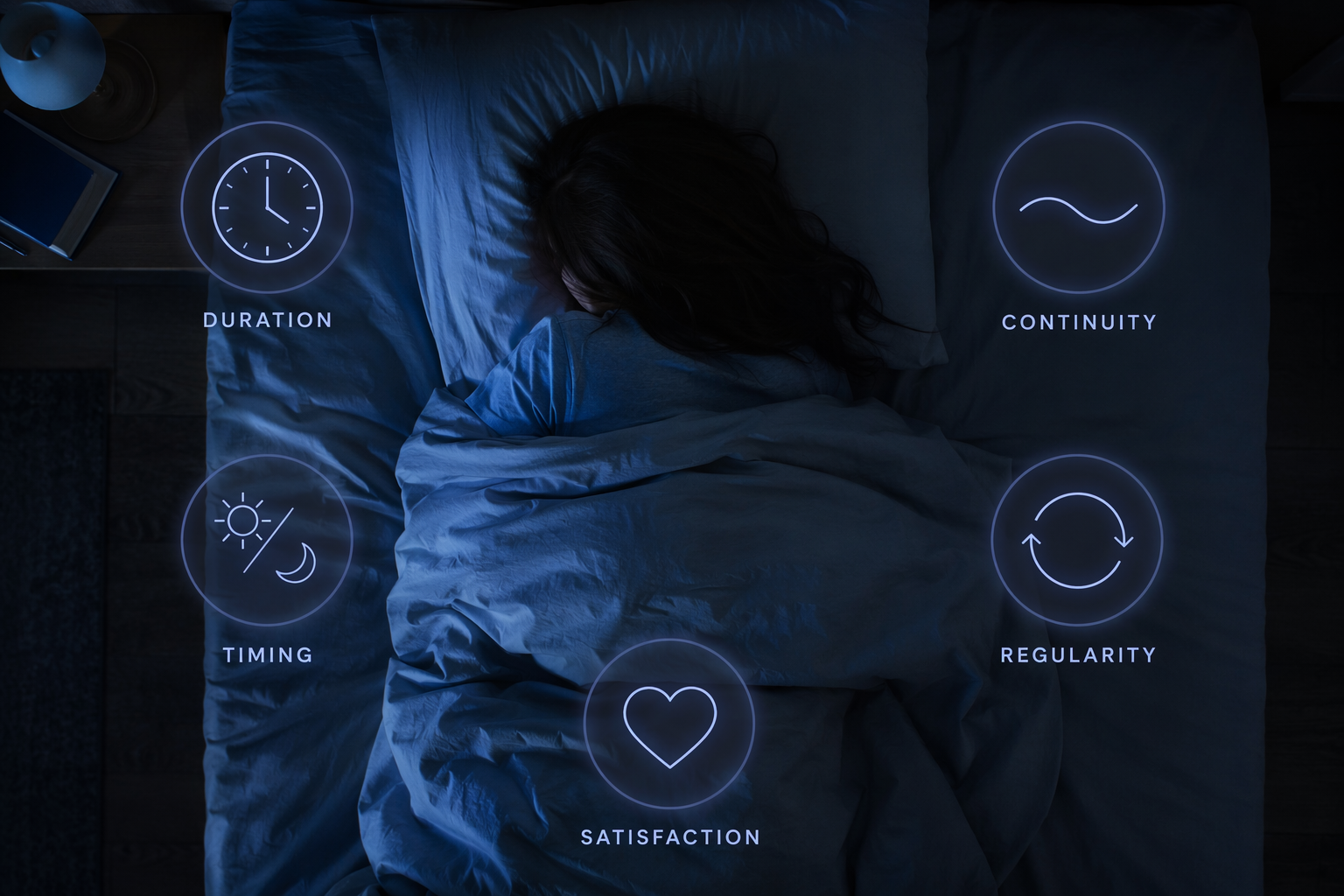
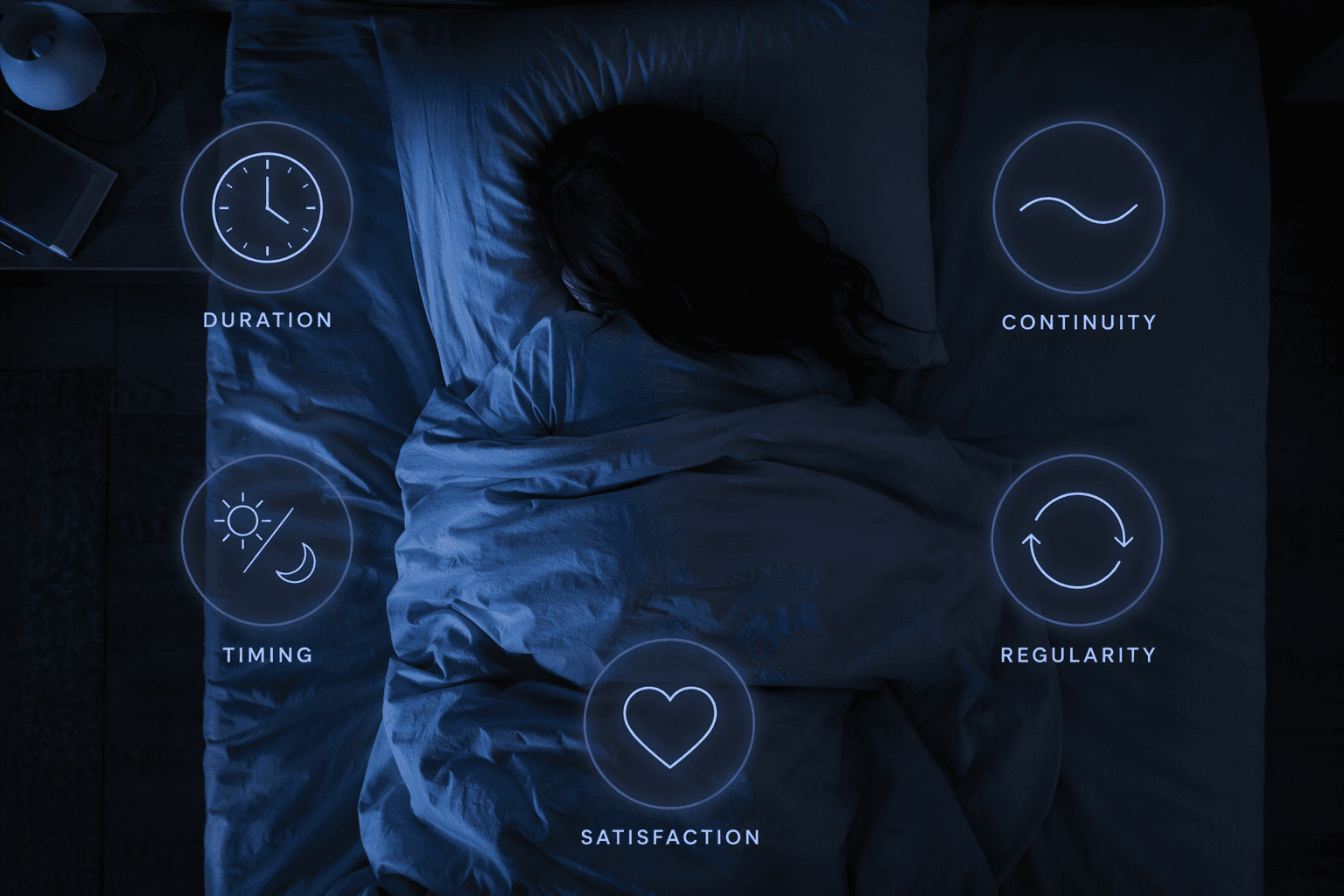
Sleep science has moved past this single-question approach. In 2025, the American Heart Association published a scientific statement identifying six distinct sleep health components—duration, continuity, timing, regularity, satisfaction, and architecture—each independently linked to cardiometabolic outcomes such as blood pressure, insulin resistance, and coronary heart disease risk. Other research from the University of Surrey has shown that specific, measurable features of sleep (number of night awakenings, REM duration) predict how people rate their own sleep quality far better than the amount of deep sleep they get.
The following five dimensions give you a concrete, evidence-backed way to assess your own sleep. Instead of asking "Did I sleep well?" you can ask "Did I get enough hours? Was my sleep uninterrupted? Was it timed correctly? Was it consistent? Did I feel restored?" Each dimension points to a different potential fix.
Dimension 1: Duration — The 7-Hour Threshold and What It Means
Duration is the most familiar dimension, but it is also the most commonly misunderstood. The joint consensus statement of the American Academy of Sleep Medicine and the Sleep Research Society recommends 7 to 9 hours of sleep per night for healthy adults, with a minimum of 7 hours as the threshold below which health risks begin to accumulate. The CDC echoes this guidance for adults aged 18–60, while noting that adults 61–64 need 7–9 hours and those 65+ need 7–8 hours.
When sleep duration drops below 7 hours consistently, the evidence shows a dose-dependent increase in risk for hypertension, obesity, type 2 diabetes, cardiovascular disease, and impaired immune function. These are not theoretical risks—they are drawn from population-level data cited in the AASM/SRS consensus and supported by decades of sleep deprivation research.
| Age Group | Recommended Sleep Duration | Source |
|---|---|---|
| Adults 18–60 | 7+ hours per night | CDC |
| Adults 61–64 | 7–9 hours per night | CDC |
| Adults 65+ | 7–8 hours per night | CDC |
| Healthy adults (general) | 7–9 hours (sweet spot 7–7.5) | AASM / SRS Joint Consensus |
For a deeper look at the research behind the 7-hour minimum, see our dedicated FAQ: Why 7 Hours Is the Recommended Minimum for Adult Sleep.
Dimension 2: Continuity — Why Uninterrupted Sleep Matters More Than Total Time in Bed
Sleep continuity refers to how smoothly you move through the night without waking. Two people can both spend eight hours in bed, but one wakes up four times and the other sleeps through. Their sleep quality will be dramatically different, even though their total time in bed is identical.
Researchers measure continuity using two key metrics: sleep efficiency (the percentage of time in bed that you are actually asleep) and wake after sleep onset (WASO—the total minutes spent awake after initially falling asleep). A sleep efficiency of 85% or higher is generally considered healthy, meaning you should be asleep for at least 85% of the time you spend in bed. WASO should ideally be under 30 minutes.
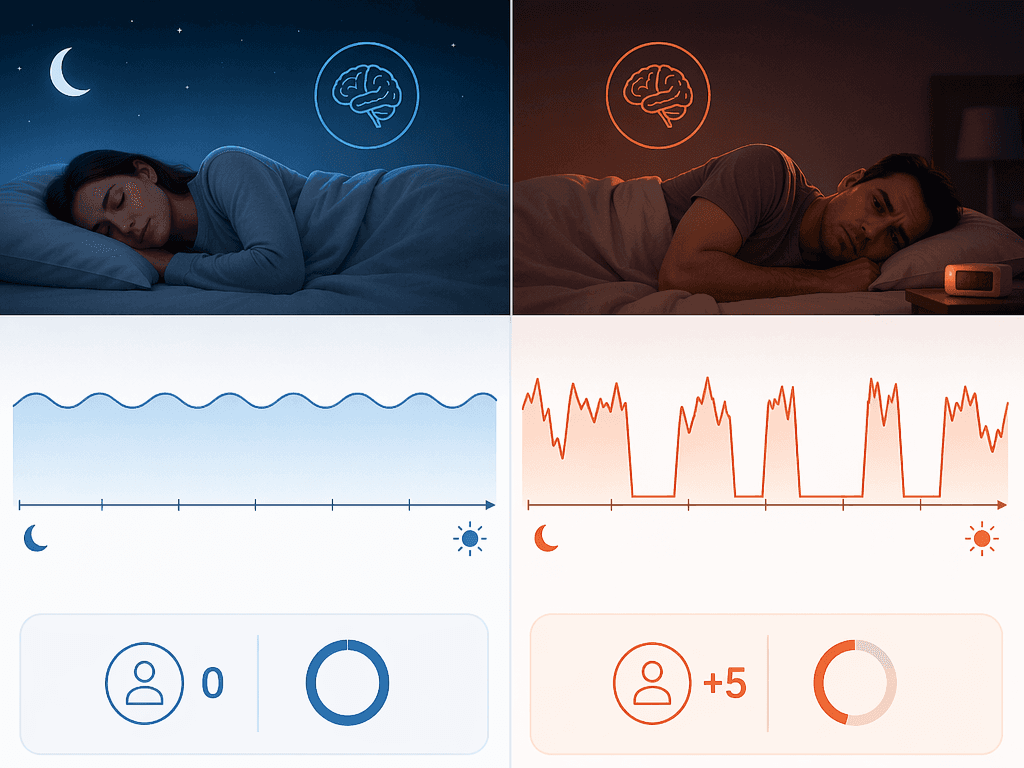
Why does continuity matter so much? A study from the University of Surrey, led by researchers Ciro della Monica and Derk-Jan Dijk, examined 206 healthy adults aged 20–84 and found that the number of night awakenings was the strongest predictor of poor subjective sleep quality. Longer REM sleep duration also correlated with feeling refreshed upon waking. Notably, the amount of slow-wave (deep) sleep could not predict how people rated their sleep quality. This suggests that an uninterrupted night with sufficient REM is more restorative than a deep-sleep-heavy night that is repeatedly broken.
The AHA's 2025 scientific statement adds a clinical layer: poor sleep continuity has been linked to higher risk for atrial fibrillation, heart attack, high blood pressure, and greater insulin resistance. Fragmented sleep disrupts the normal cycling between NREM and REM stages, reducing the restorative value of every hour spent in bed.
- Sleep efficiency ≥ 85%: You are asleep for at least 85% of your time in bed.
- WASO < 30 minutes: You spend less than half an hour awake after falling asleep.
- Fewer than 2–3 awakenings per night: More than this is associated with lower subjective sleep quality.
Dimension 3: Timing — Aligning Sleep with Your Circadian Clock
Timing is about when you sleep, not just how long. Your body's internal circadian clock, driven by the hypothalamus, programs a roughly 24-hour rhythm in sleep-wake propensity. Sleeping out of phase with this clock—going to bed at 2 a.m. when your biology expects sleep at 10 p.m.—creates a mismatch that degrades sleep quality even if you get enough hours.
The AHA's 2025 scientific statement specifically flags late sleep timing as a health risk: going to sleep at midnight or later, compared to earlier bedtimes, may raise the risk of overweight or obesity, insulin resistance, and high blood pressure. These associations hold even after controlling for sleep duration, suggesting that timing has an independent effect on metabolic health.
Optimal timing is not the same for everyone. Your chronotype—whether you are naturally a morning person, an evening person, or somewhere in between—influences when your body is biologically ready to sleep. A night owl forced into a 10 p.m. bedtime will struggle just as much as an early bird forced to stay up until 1 a.m. The goal is to align your sleep schedule with your natural circadian preference as much as your life allows.
Dimension 4: Regularity — The Power of a Consistent Sleep-Wake Schedule
Regularity means keeping your bedtime and wake time within a narrow window—ideally within 60 minutes—across all days of the week, including weekends. The human circadian system is not designed for a Monday-through-Friday schedule followed by a Saturday sleep-in. When you shift your sleep timing on weekends, you create a condition known as social jet lag: your internal clock is misaligned with your social schedule.
The metabolic consequences of irregular sleep are well documented. The AHA 2025 statement includes regularity as one of its six sleep health components, and research consistently shows that large day-to-day variability in sleep timing is associated with higher body mass index, poorer glycemic control, and increased cardiovascular risk. A person who sleeps 7.5 hours every night but shifts their bedtime by 2–3 hours between weekdays and weekends may have worse metabolic health than someone who sleeps 6.5 hours on a perfectly regular schedule.
- Set a fixed wake time: Your wake time is the strongest anchor for your circadian rhythm. Keep it within 60 minutes every day, including weekends.
- Avoid weekend catch-up sleep: Sleeping in on Saturday does not fully repay sleep debt and disrupts your rhythm for the following week.
- Use morning light exposure: Bright light within 30–60 minutes of waking helps lock in your circadian timing and reinforces regularity.
Regularity is presented here as one dimension among five, not as the single most important factor. The site has a dedicated article on this topic for readers who want to go deeper: The Hidden Cause of Poor Sleep: Why Sleep Regularity Might Matter More Than How Many Hours You Get.
Dimension 5: Satisfaction — The Subjective Experience of Restorative Sleep
Satisfaction is the subjective dimension: how rested, restored, and refreshed you feel upon waking. Unlike the other four dimensions, it cannot be measured by a wearable or a stopwatch. Yet it is independently linked to health outcomes. The AHA 2025 statement reports that lower satisfaction with one's sleep quality has been linked to higher blood pressure, stiffer arteries, coronary heart disease, and blood pressure that does not decrease normally during the night.
What drives satisfaction? The University of Surrey study found that longer REM sleep duration was associated with feeling more refreshed upon waking, while slow-wave sleep amount was not. This makes physiological sense: REM sleep is concentrated in the second half of the night, and people who wake themselves prematurely (via an alarm or a fragmented sleep pattern) may truncate their REM periods, leaving them feeling unrefreshed even if they got adequate total sleep.
If you consistently wake up feeling unrefreshed despite sleeping 7–8 hours without obvious interruptions, pay attention to that signal. It may point to a REM-specific issue, an underlying medical condition, or simply a mismatch between your sleep schedule and your chronotype.
A Practical Self-Assessment: Where Does Your Sleep Stand Across All Five Dimensions?
The five-dimensional framework is only useful if you can apply it to your own sleep. Below is a simple self-assessment checklist. For each dimension, compare your typical sleep to the target threshold. The dimension where you fall short most consistently is the one to work on first.

| Dimension | Target Threshold | How to Check It |
|---|---|---|
| Duration | 7–9 hours per night (minimum 7) | Check your average sleep time from a tracker or a sleep log over 2 weeks |
| Continuity | Sleep efficiency ≥ 85%; WASO < 30 minutes | Most wearables report sleep efficiency; otherwise, estimate time awake vs. time in bed |
| Timing | Bedtime aligned with your chronotype; not after midnight if possible | Note your natural sleepiness window; compare to your actual bedtime |
| Regularity | Bedtime and wake time within 60 minutes across all days | Track your weekend vs. weekday sleep times; look for shifts larger than 60 minutes |
| Satisfaction | Waking feeling restored most mornings | Rate your morning freshness on a 1–5 scale for 7 days; look for a pattern |
Once you identify your weakest dimension, the next step is to address it with targeted, evidence-based strategies. Our Evidence-Based Sleep Improvement Hierarchy provides a structured approach to improving sleep starting with the interventions that have the strongest research support.
When to See a Doctor About Your Sleep
The five-dimensional framework is designed for self-assessment and lifestyle-level improvement. It is not a diagnostic tool. If you have addressed all five dimensions consistently for several weeks and still experience significant sleep problems, it is time to consider professional evaluation.
- Persistent difficulty falling or staying asleep despite good sleep hygiene and consistent routines (possible insomnia disorder)
- Loud snoring, gasping, or breathing pauses during sleep (possible sleep apnea)
- Uncontrollable daytime sleepiness or falling asleep in inappropriate situations (possible hypersomnia or narcolepsy)
- Unpleasant leg sensations at night that improve with movement (possible restless legs syndrome)
- Consistently low sleep satisfaction despite meeting all five objective targets (possible underlying medical or psychiatric condition)
Despite widespread sleep dissatisfaction—the ResMed 2026 Global Sleep Survey of 30,000 adults across 13 markets found that more than half get a good night's sleep four nights a week or less—only 23% of respondents had sought professional help. The top barriers to good sleep reported in that survey were stress and anxiety (39%), work demands (22%), screen use before bed (21%), and household responsibilities (19%). Many of these are addressable through behavioral changes, but persistent symptoms warrant a clinical evaluation.
This article is for educational purposes and does not substitute for professional medical advice. If you are concerned about your sleep health, please consult a healthcare provider. See our Medical Disclaimer for more information.
Comments
Join the discussion with an anonymous comment.