
Why a Tiered Approach to Home Remedies Matters
If you have ever lain awake at 2 a.m. wondering whether to try warm milk, melatonin, or just scroll through your phone until dawn, you are not alone. According to the CDC's 2024 National Health Interview Survey, 15.4% of adults report having trouble falling asleep most days or every day. In response, 56% of adults have consumed at least one sleep aid in the past month, and 12.9% use some form of sleep aid on a daily basis — whether prescription, over-the-counter, or a supplement like melatonin.
The problem is that most advice on home remedies presents them as a flat list: try this, try that, see what sticks. But the research tells a different story. Some approaches — like cognitive behavioral therapy for insomnia (CBT-I) — are backed by decades of randomized controlled trials and are recommended as first-line treatment by the American Academy of Sleep Medicine. Others, like chamomile tea or warm milk, have only a handful of small studies in specific populations. And a few popular remedies, such as alcohol or high-dose melatonin, may actually make your sleep worse.
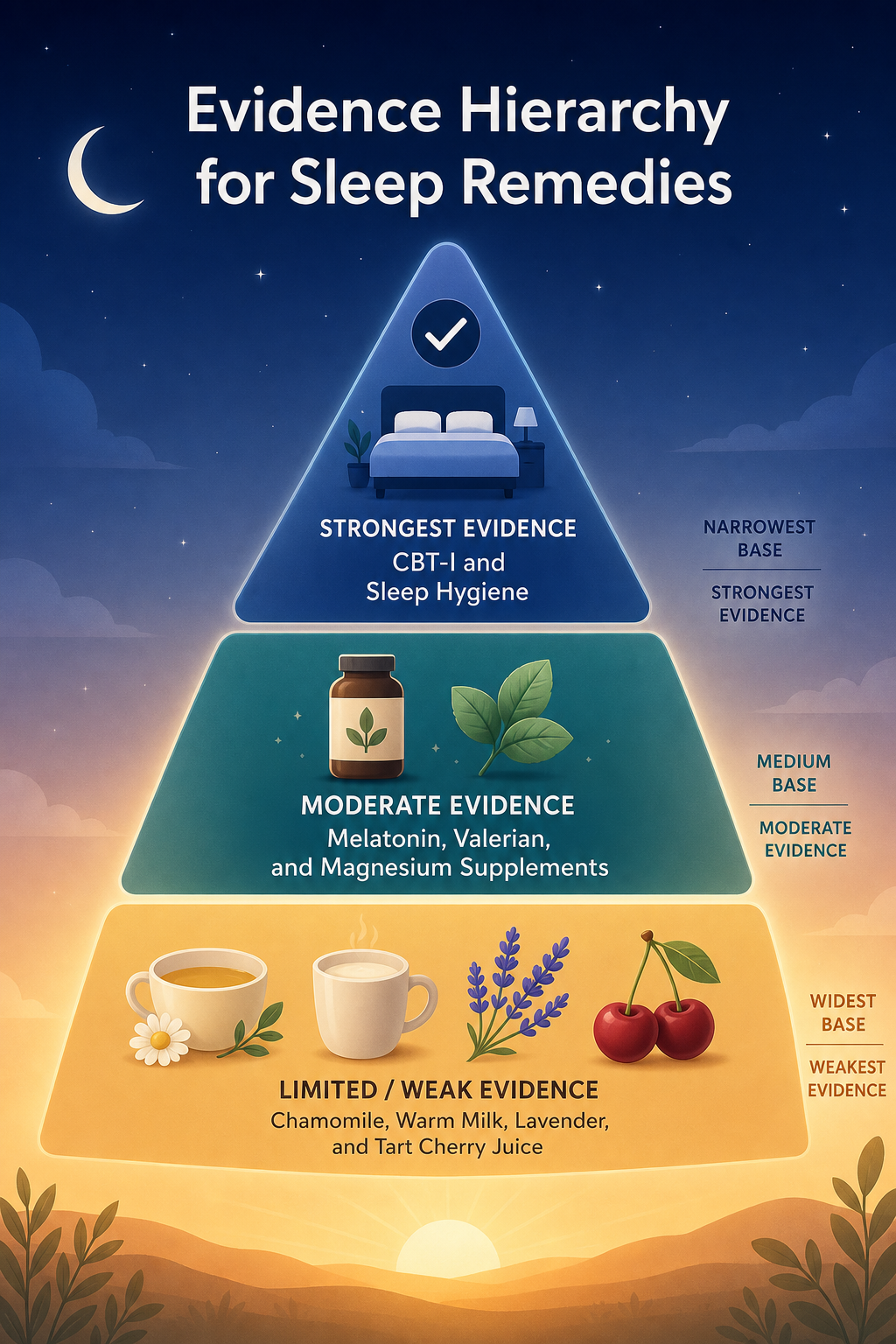
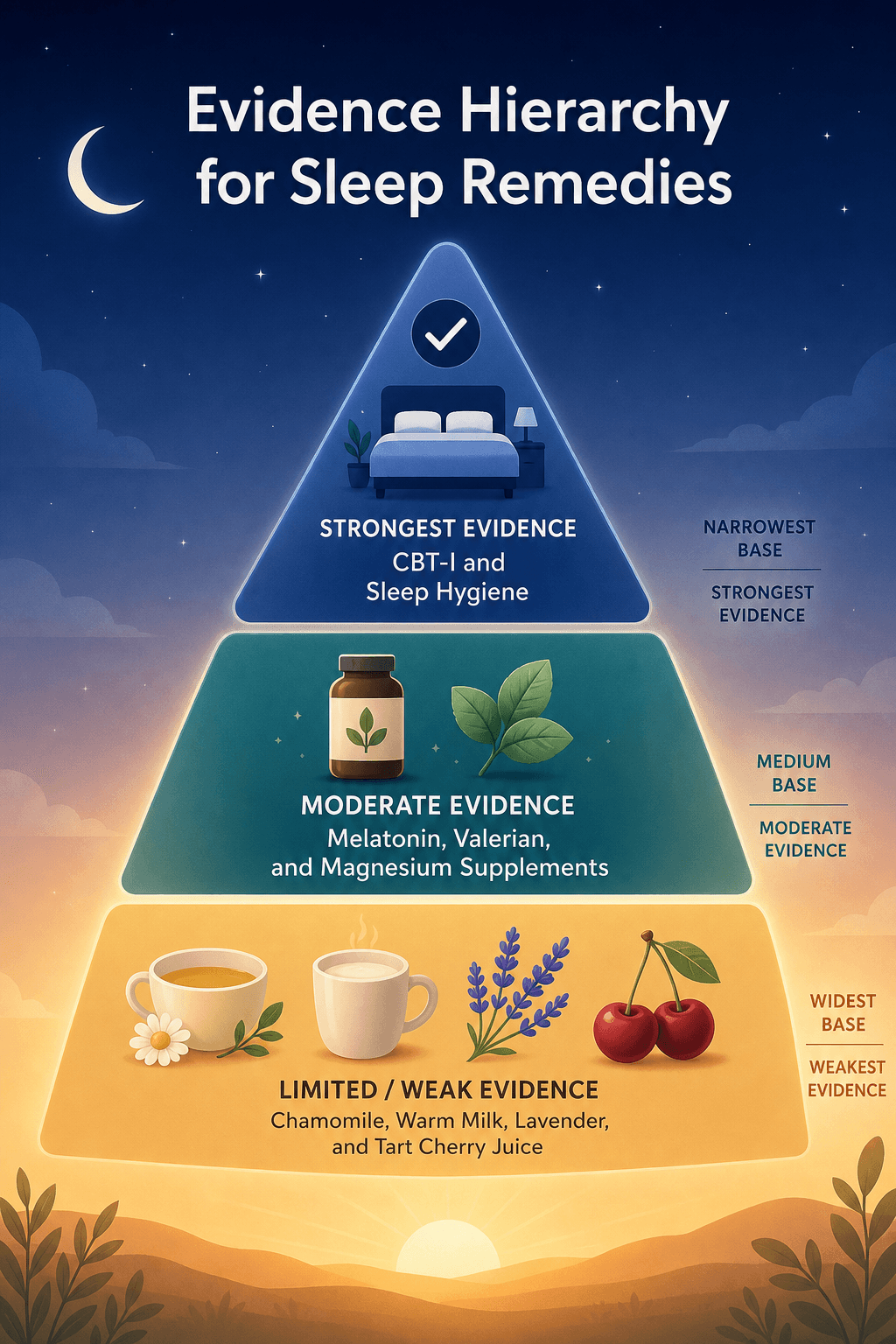
This guide organizes home remedies into four tiers based on the strength of the evidence behind them. The framework is an editorial construct — it is not a standardized clinical classification — but it gives you a practical way to prioritize your efforts. If you are new to this topic, start with the Evidence-Based Sleep Improvement Hierarchy for the broader framework, and read Why You Can't Sleep for the mechanistic background on the two-system model of sleep drive and arousal.
Tier 1: Behavioral Approaches with the Strongest Evidence
If you are looking for the single most effective non-drug intervention for sleeplessness, the answer is clear: cognitive behavioral therapy for insomnia (CBT-I). The Sleep Foundation describes CBT-I as the most rigorously studied and widely recommended treatment for insomnia that does not involve sleeping pills. It is recommended as first-line treatment by the American Academy of Sleep Medicine (AASM) and the American College of Physicians.
CBT-I is not a single technique — it is a structured, multi-component program that typically includes:
- Stimulus control: Rebuilding the association between your bed and sleep by limiting time in bed to actual sleep time only.
- Sleep restriction: Consolidating your sleep window to match your actual sleep duration, then gradually expanding it.
- Cognitive restructuring: Identifying and challenging unhelpful thoughts about sleep (e.g., "I'll never fall asleep").
- Sleep hygiene education: Optimizing your environment and daily habits to support natural sleep onset.
The evidence for CBT-I is not just strong — it is durable. Unlike sleep medications, which often lose effectiveness over time and carry risks of dependence, CBT-I produces improvements that persist long after treatment ends. For chronic insomnia, it is the gold standard.
For occasional sleeplessness that does not meet the threshold for chronic insomnia, the core components of sleep hygiene — a consistent wake time, a cool bedroom (65–72°F is the range recommended by Johns Hopkins), limited screen time before bed, and daily physical activity — are the first line of defense. These are not glamorous, but they are free, zero-risk, and supported by decades of observational and interventional research.
Tier 2: Supplements with Moderate Evidence
When behavioral changes alone are not enough, many people turn to supplements. Three ingredients — melatonin, valerian, and magnesium — have enough research to warrant a closer look, though each comes with important caveats about who should use them and how.
Melatonin
Melatonin is the most popular sleep aid in the United States — 49% of adults have used it, and 88% of those users say it helps them fall asleep faster, according to Sleep Foundation data. But its strongest track record is not for general insomnia. The research consistently shows melatonin is most effective for circadian rhythm disruptions: jet lag, delayed sleep phase disorder, and shift work. For garden-variety difficulty falling asleep, the evidence is more mixed.
A major concern is product quality. A 2017 analysis published in JAMA found that 88% of melatonin products are inaccurately labeled. Some contained up to 347% more melatonin per dose than stated on the label, while others contained none at all. Because melatonin is classified as a dietary supplement, not an FDA-regulated drug, manufacturers are responsible for their own quality control — and the data suggests that control is inconsistent.
Johns Hopkins sleep specialist Dr. Charlene Gamaldo advises sticking with one brand and avoiding unknown sources, since dosages and ingredients differ between manufacturers. Typical doses range from 1–5 mg taken 30 minutes to 2 hours before bed, but higher doses do not produce better results and may cause side effects including headaches, dizziness, and next-day drowsiness.
Valerian Root
Valerian root has been used as a sleep aid for centuries, and modern research has begun to catch up. A 2024 meta-analysis of 18 randomized controlled trials, published in the PMC literature review, reported that valerian produced a statistically significant improvement in sleep latency (SMD: -0.71, 95% CI: -1.05 to -0.37) and sleep quality (SMD: -0.46, 95% CI: -0.77 to -0.14) compared to placebo. A 2025 scoping review in Sleep Medicine, which examined 51 randomized controlled trials of over-the-counter sleep products, concluded that valerian and melatonin have substantial evidence to demonstrate their effectiveness and safety among the most studied OTC options.
That said, the same review notes that the overall evidence remains "promising but inconclusive" due to variability in study designs, dosages, and product quality. Valerian is generally well-tolerated, but some people experience mild side effects like headaches or digestive upset. For a deeper look at how valerian interacts with the GABA system, see our GABA-Targeting OTC Sleep Aids article.
Magnesium
Magnesium plays a role in regulating the nervous system and the sleep-wake cycle, and several studies suggest supplementation may help, particularly in older adults. A randomized trial of 46 older adults found that 500 mg of magnesium taken daily for 8 weeks increased total sleep time, improved sleep efficiency, and raised serum melatonin levels, while reducing insomnia severity scores, sleep onset latency, and serum cortisol. Another study in 43 older adults used a combination of 5 mg melatonin, 225 mg magnesium, and 11.25 mg zinc and found improved sleep quality over 8 weeks.
Magnesium glycinate is the form most commonly recommended for sleep due to its high bioavailability and gentle effect on the digestive system. For detailed guidance on dosing, timing, and how magnesium compares to other forms, see our Magnesium Glycinate for Sleep article.
| Supplement | Typical Dose | Best Evidence For | Key Caveat |
|---|---|---|---|
| Melatonin | 1–5 mg, 30–60 min before bed | Jet lag, delayed sleep phase, shift work | 88% of products inaccurately labeled (JAMA) |
| Valerian root | 300–600 mg, 30–60 min before bed | Sleep latency and sleep quality (modest effect) | Evidence promising but inconclusive; mild side effects possible |
| Magnesium (glycinate) | 200–500 mg, 1–2 hours before bed | Sleep efficiency in older adults | Best evidence in older adults; less studied in younger populations |
Tier 3: Popular Remedies with Limited Evidence
The remedies in this tier are widely known, generally safe, and may help some people — but the research supporting them is thinner, often limited to small studies in specific populations. They are worth trying if you are curious and have realistic expectations, but they should not be your first stop if you are dealing with persistent sleeplessness.
- Chamomile tea: Johns Hopkins sleep specialist Dr. Charlene Gamaldo notes that chamomile is "believed to have flavonoids that may interact with benzodiazepine receptors in the brain." A trial in 60 older adult nursing home residents and another in 80 postpartum women both found improved sleep quality compared to placebo. The effect is modest, but the risk is essentially zero.
- Tart cherry juice: A pilot study in older adults with chronic insomnia showed improvements in sleep time and quality. Tart cherries are a natural source of melatonin, though the amount is small. Johns Hopkins includes it on its list of recommended home remedies.
- Warm milk: The mechanism is plausible — milk contains tryptophan, a precursor to serotonin and melatonin. Dr. Gamaldo explains that warm milk is "believed to be associated with chemicals that simulate the effects of tryptophan on the brain." The effect is likely mild, but it is a comforting, low-risk ritual that may help signal to your body that it is time to wind down.
- Lavender: A 2014 study found that lavender oil capsules (20–80 mg) improved sleep patterns and reduced anxiety in people with depression. Inhaled lavender (via essential oil diffuser or pillow spray) is also commonly used, though the evidence for inhalation is less robust than for oral capsules.
- L-theanine: An amino acid found in green tea, L-theanine may reduce night wakings and promote relaxation without sedation. One study found that L-theanine combined with GABA decreased sleep latency and improved NREM sleep. The effect is subtle, and it is best suited for people whose sleeplessness is driven by a racing mind rather than physiological hyperarousal.
The common thread across Tier 3 remedies is that they are low-risk and may provide a small benefit for some people. If you enjoy a cup of chamomile tea before bed or find that warm milk helps you relax, there is no reason to stop. Just do not expect these to resolve moderate or severe insomnia on their own.
Tier 4: What to Skip — Remedies to Avoid
Some popular "remedies" are not remedies at all — they either make sleep worse, carry real health risks, or are so poorly regulated that you cannot know what you are actually taking. These belong in a category of their own: skip them.
- Alcohol: A nightcap may help you fall asleep faster, but it fragments sleep architecture, suppresses REM sleep, and increases nighttime awakenings as the alcohol is metabolized. The net effect is poorer sleep quality, not better sleep.
- High-dose melatonin: More is not better. Doses above 5 mg do not produce greater sleep benefits and increase the risk of side effects including headaches, dizziness, and next-day grogginess. Some products contain far more melatonin than their labels state, so even a "standard" dose from an unreliable brand could be high-dose in practice.
- Kava: Kava has been associated with hepatotoxicity (liver damage), and several countries have restricted or banned its use. The Sleep Foundation flags kava for "potentially serious side effects involving the liver." Given the availability of safer alternatives, there is no reason to take this risk for sleep. For more detail on kava's risks and mechanism, see our GABA-Targeting OTC Sleep Aids article.
- Unregulated products with inconsistent labeling: Beyond melatonin, many herbal sleep supplements are not subject to FDA pre-market approval. A product labeled "natural" or "herbal" may contain undisclosed ingredients, incorrect dosages, or contaminants. If you cannot find a reputable third-party testing seal (e.g., USP, NSF International), proceed with caution — or skip it entirely.
When Home Remedies Aren't Enough: The 3-Month Rule and Red Flags
Home remedies are appropriate for occasional sleeplessness — the kind that comes and goes with stress, travel, or a temporary change in routine. But if sleeplessness persists for more than three months despite consistent use of evidence-based approaches, it may have crossed the line into chronic insomnia, which requires a different treatment strategy.
The clinical definition of chronic insomnia is difficulty falling asleep, staying asleep, or waking too early at least three nights per week for at least three months, accompanied by daytime impairment (fatigue, mood changes, difficulty concentrating). If that sounds like your situation, home remedies are unlikely to resolve it on their own. The first-line treatment for chronic insomnia is CBT-I, delivered by a trained clinician or through a structured digital program.
Beyond the three-month rule, certain red flags warrant a prompt medical evaluation:
- Loud, disruptive snoring or gasping for air during sleep (possible sleep apnea)
- Uncontrollable daytime sleepiness that affects driving or work safety
- Chest pain, shortness of breath, or palpitations at night
- Unusual movements or behaviors during sleep (possible REM sleep behavior disorder or periodic limb movement disorder)
- Sleeplessness that began after a head injury or new medication
If any of these apply, stop experimenting with home remedies and see a healthcare provider or a sleep specialist. Our Sleep Conditions section has detailed guides on insomnia, sleep apnea, and other disorders that can help you understand what you might be dealing with before your appointment.
For a broader perspective on why doing less — rather than adding more remedies — may be the smartest sleep strategy of 2026, read From Sleepmaxxing to Simplicity.
Quick-Reference Decision Table
The table below summarizes every remedy covered in this guide, its evidence tier, the key research finding, typical use, and the most important safety note. Use it as a scannable reference when you are deciding what to try.
| Remedy | Tier | Key Evidence | Typical Use | Safety Note |
|---|---|---|---|---|
| CBT-I | 1 | First-line treatment for chronic insomnia (AASM) | Structured program with a therapist or app | Requires commitment; not a quick fix |
| Sleep hygiene | 1 | Decades of observational and interventional research | Consistent wake time, cool room, limited screens | Zero risk; foundational for all sleep improvement |
| Melatonin | 2 | Best for jet lag/delayed sleep phase; 88% of products inaccurately labeled (JAMA) | 1–5 mg, 30–60 min before bed | Not FDA-regulated; choose a trusted brand |
| Valerian root | 2 | Meta-analysis: SMD -0.71 sleep latency, -0.46 sleep quality (18 RCTs) | 300–600 mg before bed | Mild side effects possible; evidence promising but inconclusive |
| Magnesium | 2 | 500 mg/day for 8 weeks improved sleep efficiency in older adults (RCT) | 200–500 mg glycinate form, 1–2 hours before bed | Best evidence in older adults; less studied in younger adults |
| Chamomile | 3 | Improved sleep quality in older adults and postpartum women (small trials) | 1 cup of tea 30–60 min before bed | Very low risk; effect is modest |
| Tart cherry juice | 3 | Pilot study in older adults with chronic insomnia showed improvements | 8 oz tart cherry juice 1–2 hours before bed | Low risk; natural melatonin source |
| Warm milk | 3 | Mechanism via tryptophan/serotonin; expert recommendation (Johns Hopkins) | 1 cup warm milk before bed | Zero risk; may serve as a comforting ritual |
| Lavender | 3 | 2014 study: 20–80 mg capsules improved sleep in people with depression | Capsules or inhaled (diffuser/pillow spray) | Low risk; inhalation evidence is weaker than oral |
| L-theanine | 3 | May reduce night wakings; one study showed improved NREM sleep with GABA | 100–200 mg before bed | Subtle effect; best for racing-mind sleeplessness |
| Alcohol | 4 | Fragments sleep architecture, suppresses REM | Not recommended | Worsens sleep quality; not a remedy |
| High-dose melatonin | 4 | No added benefit above 5 mg; increased side effects | Avoid doses above 5 mg | Headaches, dizziness, next-day grogginess |
| Kava | 4 | Hepatotoxicity risk; FDA warnings issued | Not recommended | Potential liver damage; safer alternatives exist |
Comments
Join the discussion with an anonymous comment.