
If you have already done the usual sleep-hygiene work - caffeine earlier, screens dimmed, bedtime steadier - and you still wake up foggy after a full night, the missing variable may not be another habit. It may be the air trapped in the room with you.
For many people, that is the practical link between air quality and sleep quality: in a closed bedroom, carbon dioxide rises steadily because you are breathing into a small space for hours. Aggregated Airthings monitoring data reports that closed-bedroom CO2 levels are typically 3 to 5 times higher than daytime room levels, and bedroom CO2 can commonly exceed 2,500 ppm in those conditions.[1] That does not mean CO2 explains every bad night. It does mean that a sealed bedroom is a measurable, testable suspect.
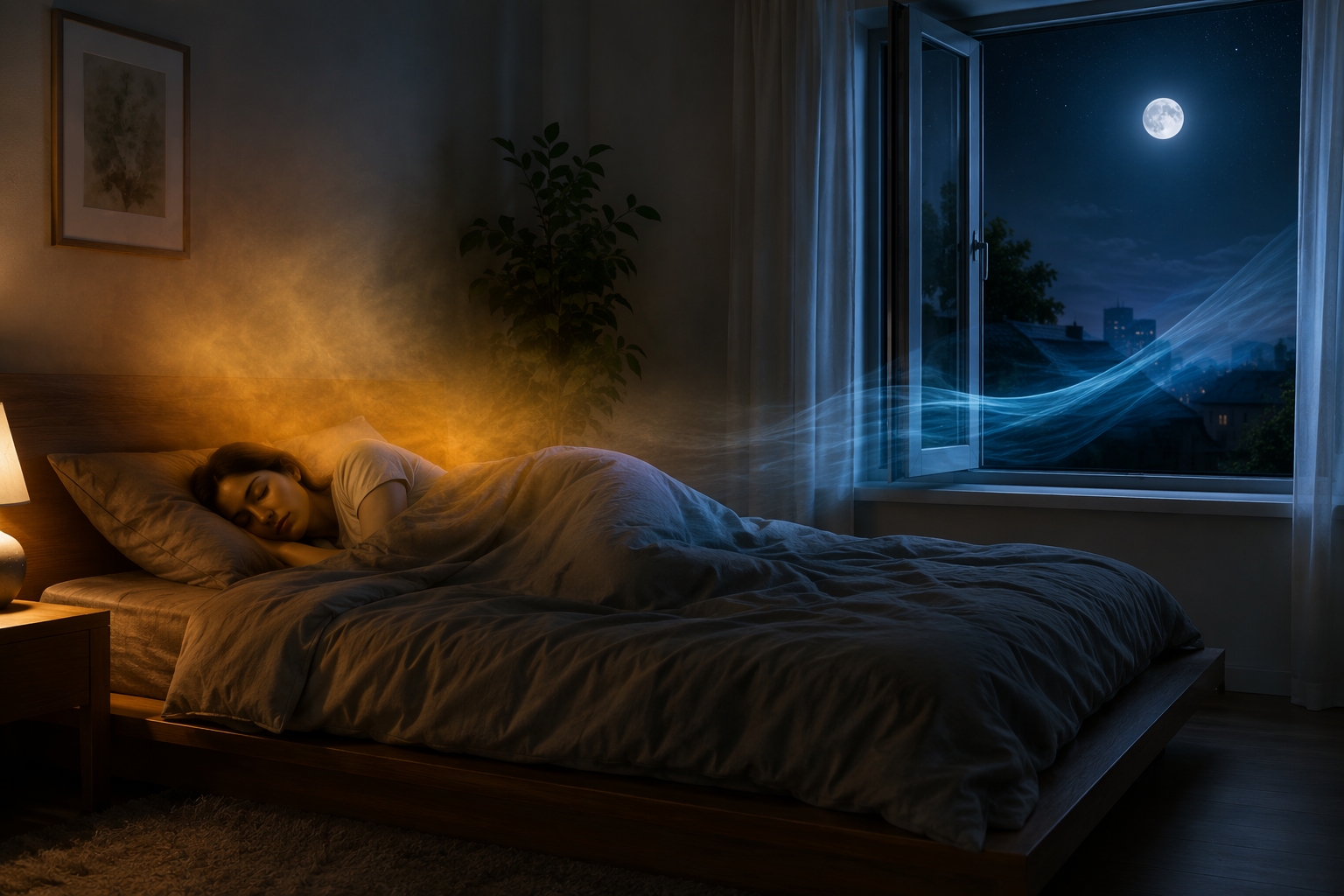
The fix is not glamorous. Better ventilation - more air exchange between the bedroom and somewhere fresher - is the most direct air-quality intervention for sleep because it dilutes CO2 while also reducing other pollutants that accumulate overnight. Before buying a new bedside device, it is worth asking a plainer question: did the room have a way to breathe?
The closed-bedroom problem is easy to miss
A bedroom can feel comfortable and still be poorly ventilated. Temperature, bedding, and darkness are obvious. CO2 is invisible, odorless at typical indoor levels, and often highest when no one is awake to notice it. A person can go to bed in a room that feels fine, shut the door for privacy or noise control, keep the window closed for weather or safety, and spend the next seven or eight hours changing the room’s chemistry one breath at a time.
This is why bedroom air is different from living-room air. During the day, people move around, doors open, HVAC cycles run, and rooms exchange air intermittently. At night, the bedroom may be the most sealed and most occupied room in the home for the longest continuous block of time. Add a partner, a pet, a small room, or a closed door, and CO2 can climb faster.
The useful part is that CO2 is measurable. A wearable may tell you sleep efficiency was poor, but it usually cannot tell you whether the bedroom crossed from normal indoor air into a stale-air range for most of the night. A CO2 monitor, even borrowed for a few nights, can turn a vague “sleep environment” problem into a curve: the room starts lower, rises after bedtime, and either plateaus with enough air exchange or keeps climbing behind a closed door.
What changed when researchers ventilated real bedrooms
The most useful study for ordinary bedrooms is not a dramatic lab exposure. It is a field experiment from the Technical University of Denmark that compared nights in actual bedrooms under two ventilation conditions. On low-ventilation nights, average bedroom CO2 was 2,395 ppm. On fan-assisted intake nights, average CO2 fell to 835 ppm.[2]
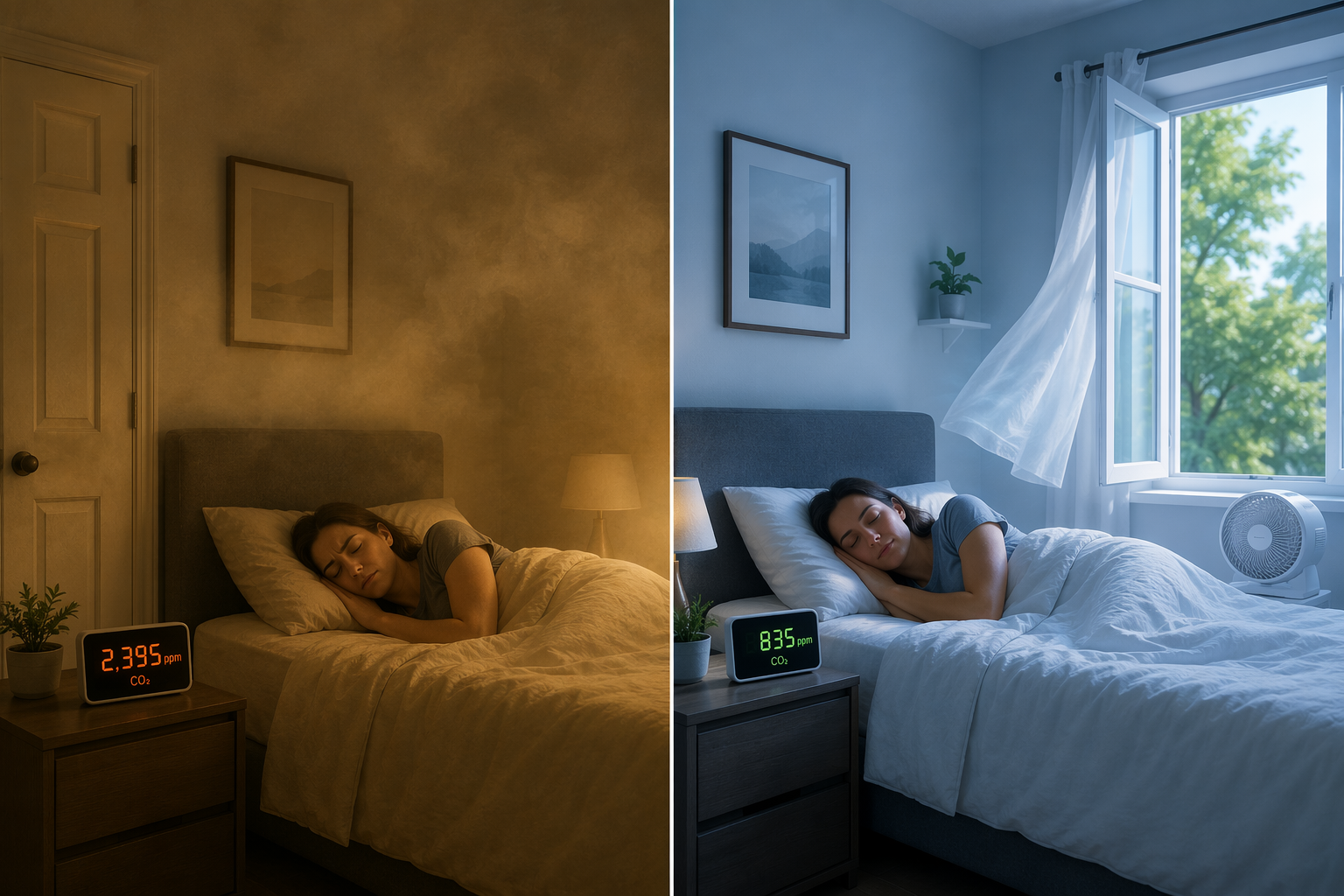
That contrast matters because it did not stop at the air reading. At the lower CO2 level, sleep quality improved significantly, and next-day logical-thinking test performance was better.[2] In other words, the bedroom condition moved, the sleep outcome moved, and the next-day functioning measure moved in the expected direction.
For someone troubleshooting “good habits, bad sleep,” that is more persuasive than a generic warning that indoor air can be unhealthy. The study connects a specific overnight condition - insufficient ventilation with elevated CO2 - to the two outcomes people actually care about: how well they slept and how well their brain worked the next day.
| Bedroom condition | Average CO2 | Observed result |
|---|---|---|
| Low ventilation | 2,395 ppm | Worse sleep quality and lower next-day logical-thinking performance |
| Fan-assisted intake | 835 ppm | Significantly better sleep quality and better next-day logical-thinking performance |
The study population and setting still matter. Much of this research has used young adults in dormitory-like or controlled residential settings, so it should not be stretched into a universal diagnosis for every sleeper. But as a practical home experiment, the result is hard to ignore: when the bedroom got more outside air, both the night and the following morning improved.
Higher CO2 also appears to affect sleep architecture
The field experiment shows what happens when ventilation changes in real rooms. A controlled chamber study by Zhang and colleagues helps sharpen the dose-response question. Participants slept under three CO2 conditions: 800 ppm, 1,900 ppm, and 3,000 ppm.[3]
At 3,000 ppm, subjective sleep quality dropped to 80.8% of the 800-ppm baseline.[3] The same study found a linear negative correlation between CO2 level and slow-wave sleep duration, meaning that as CO2 increased, deep sleep duration decreased.[3]
That deep-sleep finding is the part worth lingering on. Slow-wave sleep is not just a pleasant sleep-stage score on an app; it is one of the ways the body expresses sleep depth and recovery. If a bedroom condition reduces time in that stage, a person may spend enough hours in bed and still wake up feeling as if the night did not do its job.
The chamber study is also cleaner than a typical home experiment because it helps isolate CO2 levels. In real bedrooms, ventilation changes more than CO2. It also changes concentrations of particles, volatile organic compounds, odors, humidity, and heat. That is useful for real life but messy for interpretation. The chamber results make the CO2 signal harder to dismiss.
A newer field study, published in Scientific Reports in 2026, measured bedroom CO2 and PM2.5 at the individual level in 163 participants and found that improved bedroom ventilation was linked to better next-day cognitive performance, replicating the DTU findings in a naturalistic setting.[4] Because the study is recent, broader replication is still developing. For now, it reinforces the practical pattern rather than closing the case for every age group, housing type, or health condition.
Ventilation deserves priority over endless temperature tinkering
Bedroom temperature still matters. A room that is too hot or too cold can fragment sleep. But many people keep adjusting thermostat settings, bedding layers, and fan speed while leaving the door sealed and the air exchange unchanged.
A Sydney field study discussed in ASHRAE-related reporting found that bedroom indoor air quality, specifically CO2, had a more direct impact on sleep metrics than thermal conditions.[5] That does not make temperature irrelevant. It changes the troubleshooting order. If the room is already in a tolerable temperature range, the bigger missed lever may be whether fresh air is entering and stale air is leaving.
Air purifiers complicate this point. A purifier may reduce particles, depending on the device and filter, but it usually does not remove CO2 in a meaningful way. Houseplants are also not a realistic overnight CO2 solution for a sleeping adult in a closed bedroom. For CO2, the main intervention is air exchange.
What to try tonight
The first experiment should be as simple as the bedroom allows: create a path for air to enter and leave. That may mean opening the bedroom door, cracking a window, using a window fan to bring in outdoor air, running existing mechanical ventilation, or combining a slightly open door with a hallway or bathroom exhaust fan. The best option is the one that improves air exchange without creating a new sleep problem.
- If outdoor air is clean and quiet enough, crack a window or use a low fan setting to increase intake.
- If the window is not practical, leave the bedroom door open or partly open to increase mixing with the rest of the home.
- If privacy or noise requires a closed door, look for another air path, such as a transfer grille, under-door gap, supply vent, or mechanical ventilation setting.
- If you share the bed or room, assume CO2 will rise faster and test a stronger ventilation change.
- If you use a CO2 monitor, compare the overnight peak and the time spent elevated, not just the reading at bedtime.
A good home test does not require perfection. Try one ventilation change for several comparable nights, then compare how you wake, how often you remember waking, and whether your wearable shows changes in sleep efficiency or deep sleep. If you have a CO2 monitor, place it near the bed but not directly in your breath stream. The question is not whether the room ever rises above an outdoor-like number. The question is whether it spends much of the night in stale-air territory and whether your intervention brings that curve down.
When opening a window is the wrong answer
Ventilation advice gets lazy when it treats every bedroom as safe, quiet, temperate, and surrounded by clean air. Many are not. Pollen, wildfire smoke, traffic-related PM2.5, street noise, winter cold, summer heat, humidity, apartment security, and shared-room constraints can all make an open window a bad trade.
In those cases, keep the principle and change the tactic. The goal is better overnight air exchange, not a ritual of sleeping with a window open. Someone in a high-pollution area may need filtered mechanical ventilation rather than direct outdoor intake. Someone in a noisy apartment may get more benefit from opening the bedroom door to the rest of the home than from opening a street-facing window. Someone in winter may use a shorter pre-bed airing period plus a safer mechanical setting overnight.
This is also where measurement helps. If cracking a window drops CO2 but raises noise enough to wake you, it is not a successful sleep intervention. If opening the door lowers CO2 almost as much without the noise penalty, that is the better bedroom solution. The winning setup is the one that improves the air and survives the actual room.
What CO2 can and cannot explain
Elevated bedroom CO2 is a strong candidate when the pattern looks like this: you sleep in a closed room, especially a small one; you wake unrefreshed despite enough time in bed; your wearable shows poor sleep efficiency or reduced deep sleep without an obvious cause; and the problem improves when the room is aired out or the door is left open.
It is not a complete explanation for poor sleep. Insomnia, sleep apnea, restless legs, alcohol, medications, pain, stress, depression, anxiety, circadian mismatch, and inconsistent sleep timing can all produce unrefreshing sleep. If you snore heavily, gasp, have significant daytime sleepiness, or keep struggling despite a better bedroom setup, ventilation should not delay medical evaluation.
Still, bedroom air deserves a place much earlier in the troubleshooting sequence than it usually gets. It is measurable. It changes over the exact hours you are asleep. It has field and chamber evidence connecting it to sleep quality, deep sleep, and next-day cognition. And in many homes, the first test costs nothing: give the room a better way to exchange air, then see whether the night and the morning change.
References
- Airthings aggregated data, Airthings, https://www.airthings.com/
- The effects of bedroom air quality on sleep and next-day performance, PubMed, https://pubmed.ncbi.nlm.nih.gov/26452168/
- The effects of carbon dioxide on sleep and next-day cognitive performance, PubMed, https://pubmed.ncbi.nlm.nih.gov/32979003/
- Field study of bedroom CO2, PM2.5, ventilation and next-day cognitive performance, Scientific Reports, 2026, https://www.nature.com/articles/s41598-026-37949-2
- ASHRAE Sydney field study on bedroom indoor air quality and sleep metrics, ASHRAE, https://www.ashrae.org/



Comments
Join the discussion with an anonymous comment.